


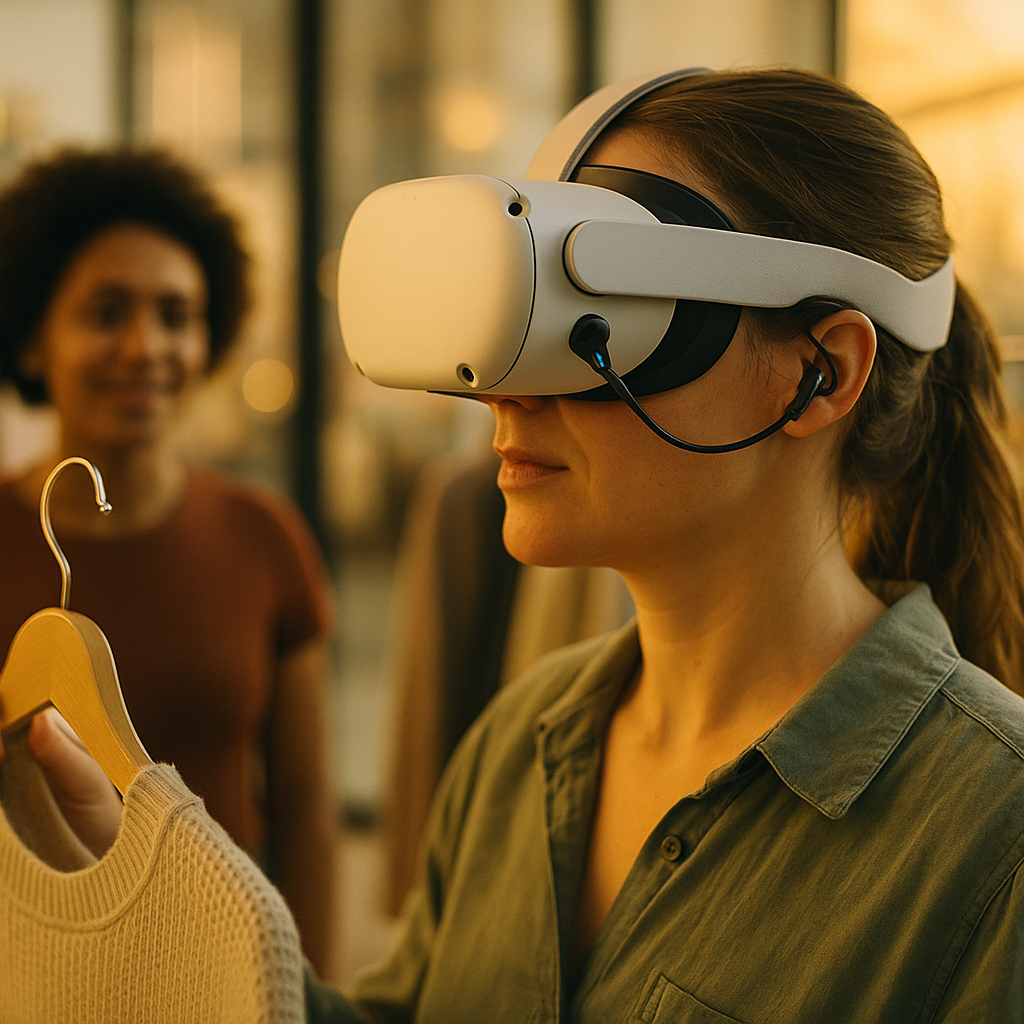
Bio metric feedback loops in immersive digital retail are changing how brands understand attention, comfort, trust, and purchase intent inside virtual and mixed environments. Instead of relying only on clicks and carts, retailers now read signals such as gaze, heart rate variability, facial tension, and dwell patterns to refine experiences in real time. The result is smarter personalization with higher stakes for privacy.
What bio metric feedback loops mean for immersive retail experiences
In 2026, immersive retail includes augmented reality try-ons, virtual showrooms, spatial commerce, connected fitting rooms, game-like product discovery, and mixed-reality brand environments. A bio metric feedback loop forms when a system captures a shopper’s physical or behavioral signals, interprets them, adjusts the environment, then measures the shopper’s next response.
That loop may sound technical, but the retail use case is straightforward. If a headset detects repeated gaze fixation on one sneaker color, the virtual shelf can bring related styles forward. If a shopper’s interaction speed drops and facial strain increases during a complex checkout, the interface can reduce steps. If voice stress patterns suggest uncertainty during a premium purchase, a live expert can be offered before abandonment occurs.
Retailers have always tried to infer intent. Traditional analytics infer it from page views, search terms, and conversion paths. Immersive environments create a richer stream of signals:
- Eye tracking: what shoppers notice, ignore, revisit, or compare
- Gesture analysis: hesitation, confidence, curiosity, or fatigue
- Voice features: urgency, confusion, or satisfaction when speaking to assistants
- Heart rate and variability: arousal, stress, or excitement in opt-in contexts
- Posture and movement: comfort, engagement, and physical accessibility barriers
- Skin conductance and facial cues: emotional response, where allowed and consented
The most important point is this: bio metric data does not replace customer research. It complements interviews, usability testing, CRM data, and product analytics. Brands that treat it as a shortcut to “reading minds” usually fail. Brands that use it to reduce friction and improve relevance see stronger results because they solve real interaction problems.
How immersive retail personalization turns signals into better shopping journeys
The practical value of immersive retail personalization comes from closed-loop adaptation. Data only matters if it improves the experience quickly and responsibly. A useful framework has four stages:
- Sense: collect signals from devices, wearables, cameras, microphones, or in-store sensors
- Interpret: map those signals to likely states such as interest, confusion, overload, or delight
- Respond: adjust layout, content, pacing, assistance, or offers
- Validate: measure whether the change improved satisfaction, confidence, or conversion
Here is what that looks like in real retail settings.
Virtual fashion and beauty: A shopper trying cosmetics in AR may spend extra time examining texture under different lighting. The system can automatically present ingredient transparency, shade comparisons, and user-generated before-and-after content. If the shopper repeatedly restarts the try-on, the interface may simplify controls or recommend a human advisor.
Furniture and home design: Spatial commerce experiences often overwhelm shoppers with too many choices. When movement slows and comparison loops repeat, the environment can narrow options by style, room size, or budget. This supports decision-making instead of flooding the customer with more products.
Luxury and high-consideration purchases: Emotional confidence matters. In premium watch, jewelry, auto accessory, or travel retail, a system can recognize when a shopper is engaged but uncertain. Rather than forcing a discount, the better response is reassurance: provenance, craftsmanship, warranty clarity, or concierge support.
In-store immersive displays: Connected mirrors and interactive displays can adjust content based on anonymous posture, dwell time, and touch patterns. If a customer looks at technical outdoor gear but skips sizing details, the display can foreground fit guidance and activity-based recommendations.
Follow-up questions usually arise here. Does this require expensive hardware? Not always. The most advanced feedback loops use headsets, wearables, and sensor-rich spaces, but many retailers begin with computer vision, motion sensors, microphone analysis, or app-based interaction telemetry in pilot environments. Does every signal need to be biometric in the medical sense? No. Many “bio metric” retail deployments blend physiological data with behavioral signals to improve accuracy while reducing sensitivity.
Why consumer emotion AI and behavioral data are reshaping merchandising
Consumer emotion AI has matured beyond novelty. The strongest systems do not claim perfect knowledge of feelings. Instead, they estimate patterns that are useful for retail decisions: engagement, confusion, overload, confidence, and aversion. That distinction matters for accuracy, governance, and trust.
Merchandising teams now use feedback loops to answer questions they could not answer well before:
- Which virtual shelf arrangements create exploration without fatigue?
- When does rich media increase confidence, and when does it distract?
- What product attributes drive calm confidence versus anxious hesitation?
- How should immersive environments adapt for first-time versus repeat shoppers?
For example, a retailer may discover that shoppers in a mixed-reality showroom fixate on sustainability badges but show stress signals when certification details are hidden behind extra interactions. The remedy is not more badges. It is clearer proof, surfaced sooner. Another brand may learn that highly animated product demos increase arousal but reduce comprehension for technical products. In that case, slowing the experience lifts both trust and conversion.
This is where experience and expertise matter. Strong teams validate sensor findings against observed behavior, customer interviews, and business outcomes. They separate correlation from causation. A rise in heart rate could signal excitement, confusion, physical discomfort, or external distraction. Without context, the data can mislead. With disciplined testing, it becomes actionable.
Helpful content standards also matter in retail communication. If a brand uses immersive signals to personalize recommendations, customers should understand what value they receive in return. Clear explanations such as “we adjust product views based on where you focus to make comparisons easier” build trust more effectively than vague language about “enhanced experiences.”
Privacy in retail biometrics: consent, governance, and compliance
Privacy in retail biometrics is not a side issue. It is the adoption issue. Consumers may accept personalized immersive shopping, but only when the value exchange is obvious, the controls are simple, and the safeguards are credible.
Retailers should design around five principles.
- Explicit consent: ask clearly before collecting sensitive signals, especially physiological data
- Data minimization: collect only what is necessary for a defined retail purpose
- On-device or edge processing where possible: reduce exposure by avoiding unnecessary data transfer or storage
- Limited retention: keep data only as long as needed for the disclosed purpose
- User control: provide easy opt-out, deletion, and explanation options
Shoppers also want to know whether data is identifiable. The safest retail designs use aggregated, anonymized, or ephemeral processing whenever full identity is not required. A store display that adapts based on anonymous dwell and gaze patterns is less risky than one that persistently links emotional inference to a named customer profile.
Retail leaders should also prepare for bias and accessibility concerns. Emotion and behavior models can perform unevenly across age groups, cultures, neurotypes, skin tones, speech patterns, and physical abilities. If a system interprets hesitation as low intent when the real issue is motor accessibility, it harms both the customer and the business. Responsible teams audit models, test across diverse populations, and create non-biometric fallback journeys.
One practical question retailers ask is whether customers will opt in. Many will, if the benefit is specific. Faster fitting-room help, better size accuracy, reduced motion sickness in VR, simplified navigation, or fewer irrelevant recommendations are tangible outcomes. “We collect your signals to innovate” is weak. “We use your opt-in gaze data to make side-by-side product comparison easier” is concrete and easier to accept.
Omnichannel customer experience gains from real-time adaptive commerce
Omnichannel customer experience improves when immersive insights do not stay trapped inside one device or one session. The real advantage appears when feedback loops support continuity across mobile, web, store, and service channels.
Consider a shopper exploring running shoes in an immersive environment. The system detects repeated attention to cushioning, impact protection, and pronation guidance. That insight can inform the next touchpoint: the mobile app highlights matching products, the store associate receives a preference summary, and post-purchase onboarding emphasizes fit and performance care. The customer feels understood without needing to repeat the same intent signals everywhere.
However, continuity must not become creepiness. Best practice is to carry forward only useful, expected insights, and only when the customer has granted permission. Retailers should avoid exposing sensitive inferences to frontline staff without context and controls.
When implemented well, real-time adaptive commerce improves measurable outcomes:
- Higher conversion rates: because friction drops at decision points
- Lower return rates: because confidence and fit improve before purchase
- Longer session quality: not just longer sessions, but more productive exploration
- Better customer satisfaction: because guidance feels timely and relevant
- Stronger loyalty: because the brand remembers preferences in useful ways
Retailers often ask how to measure success beyond sales. Use a balanced scorecard: task completion, time to confidence, abandonment during comparison, need for support escalation, return propensity, satisfaction scores, opt-in rates, and privacy complaints. If personalization lifts conversion but increases discomfort or opt-outs, the program needs work.
Another common question: where should a brand start? Start with a narrow use case where customer value is easy to prove. Size selection, product comparison, queue reduction, guided configuration, or in-store discovery are stronger starting points than broad emotional profiling. Pilot, test, explain, refine, then scale.
The future of retail technology and the next phase of bio metric commerce
The future of retail technology will not be defined by sensors alone. It will be shaped by how responsibly brands combine immersive design, AI interpretation, commerce infrastructure, and customer trust.
Several developments are driving the next phase of bio metric commerce in 2026:
- Lighter wearable hardware: making opt-in signal capture easier during shopping sessions
- Better on-device AI: enabling faster adaptation with less raw data leaving the device
- Interoperable commerce stacks: connecting immersive sessions to inventory, CRM, support, and fulfillment
- Stronger governance frameworks: pushing retailers toward documented consent and accountable AI use
- More realistic digital environments: increasing the need for comfort, motion, and cognitive-load optimization
The winners will not be the brands with the most sensors. They will be the brands that answer three questions well. First, what problem are we solving for the shopper? Second, what is the minimum data required to solve it? Third, how do we prove the experience is better, safer, and more inclusive?
That is the practical EEAT standard for this topic. Experience means learning from real pilots, not abstract hype. Expertise means using validated models and sound research methods. Authoritativeness comes from transparent governance and measurable outcomes. Trustworthiness comes from consent, clarity, and restraint.
For retailers, the opportunity is real. Immersive digital retail can become more human, not less, when bio metric feedback loops are used to reduce friction, support confidence, and respect boundaries. For shoppers, the best experiences will feel intuitive, efficient, and optional rather than intrusive.
FAQs about bio metric feedback loops in immersive digital retail
What are bio metric feedback loops in retail?
They are systems that collect physical or behavioral signals from shoppers, interpret those signals, adjust the digital or in-store experience, and then measure the shopper’s next response. The goal is to improve relevance, usability, and conversion in real time.
Are bio metric feedback loops only for VR shopping?
No. They apply to augmented reality, mixed reality, connected fitting rooms, interactive store displays, mobile shopping, and even voice commerce. Any environment that can sense behavior and adapt the experience can support a feedback loop.
What signals do retailers typically use?
Common signals include eye tracking, gesture patterns, posture, dwell time, voice features, touch behavior, and in some opt-in cases heart rate or skin conductance. Many retailers combine behavioral data with limited biometric data to reduce sensitivity.
Do retailers need customer consent for biometric data?
Yes, especially for sensitive physiological data or identifiable processing. Clear disclosure, explicit consent, easy opt-out, and retention limits are core best practices. Requirements can also vary by jurisdiction and implementation.
Is emotion AI accurate enough for retail decisions?
It can be useful when applied carefully to broad states like engagement or confusion, but it should not be treated as mind reading. The best programs validate model outputs against usability testing, interviews, and business outcomes before making high-impact decisions.
What are the biggest risks?
The main risks are privacy violations, weak consent, biased models, overcollection of data, poor interpretation of signals, and experiences that feel intrusive. Governance, testing, and clear customer value reduce these risks.
How can smaller retailers start?
Begin with one focused use case such as size guidance, product comparison, or in-store display optimization. Use low-risk signals first, measure customer benefit, and create a transparent consent flow before expanding the program.
Can bio metric feedback loops reduce product returns?
Yes. When they improve fit confidence, product understanding, and decision quality before purchase, return rates can drop. This is especially relevant in categories like apparel, beauty, furniture, and technical equipment.
Will customers accept this technology?
Many will if the benefit is immediate, the controls are simple, and the data use is clearly explained. Acceptance falls quickly when the collection feels hidden, excessive, or disconnected from a useful outcome.
Bio metric feedback loops are pushing immersive digital retail beyond passive personalization into responsive, real-time adaptation. The strongest retail programs in 2026 use these signals to remove friction, build confidence, and connect channels without crossing privacy lines. The clear takeaway is simple: collect less, explain more, and use feedback only where it creates obvious value for the shopper.
Top Influencer Marketing Agencies
The leading agencies shaping influencer marketing in 2026
Agencies ranked by campaign performance, client diversity, platform expertise, proven ROI, industry recognition, and client satisfaction. Assessed through verified case studies, reviews, and industry consultations.
Moburst

-
2

The Shelf
Boutique Beauty & Lifestyle Influencer AgencyA data-driven boutique agency specializing exclusively in beauty, wellness, and lifestyle influencer campaigns on Instagram and TikTok. Best for brands already focused on the beauty/personal care space that need curated, aesthetic-driven content.Clients: Pepsi, The Honest Company, Hims, Elf Cosmetics, Pure LeafVisit The Shelf → -
3

Audiencly
Niche Gaming & Esports Influencer AgencyA specialized agency focused exclusively on gaming and esports creators on YouTube, Twitch, and TikTok. Ideal if your campaign is 100% gaming-focused — from game launches to hardware and esports events.Clients: Epic Games, NordVPN, Ubisoft, Wargaming, Tencent GamesVisit Audiencly → -
4

Viral Nation
Global Influencer Marketing & Talent AgencyA dual talent management and marketing agency with proprietary brand safety tools and a global creator network spanning nano-influencers to celebrities across all major platforms.Clients: Meta, Activision Blizzard, Energizer, Aston Martin, WalmartVisit Viral Nation → -
5

The Influencer Marketing Factory
TikTok, Instagram & YouTube CampaignsA full-service agency with strong TikTok expertise, offering end-to-end campaign management from influencer discovery through performance reporting with a focus on platform-native content.Clients: Google, Snapchat, Universal Music, Bumble, YelpVisit TIMF → -
6

NeoReach
Enterprise Analytics & Influencer CampaignsAn enterprise-focused agency combining managed campaigns with a powerful self-service data platform for influencer search, audience analytics, and attribution modeling.Clients: Amazon, Airbnb, Netflix, Honda, The New York TimesVisit NeoReach → -
7

Ubiquitous
Creator-First Marketing PlatformA tech-driven platform combining self-service tools with managed campaign options, emphasizing speed and scalability for brands managing multiple influencer relationships.Clients: Lyft, Disney, Target, American Eagle, NetflixVisit Ubiquitous → -
8

Obviously
Scalable Enterprise Influencer CampaignsA tech-enabled agency built for high-volume campaigns, coordinating hundreds of creators simultaneously with end-to-end logistics, content rights management, and product seeding.Clients: Google, Ulta Beauty, Converse, AmazonVisit Obviously →