


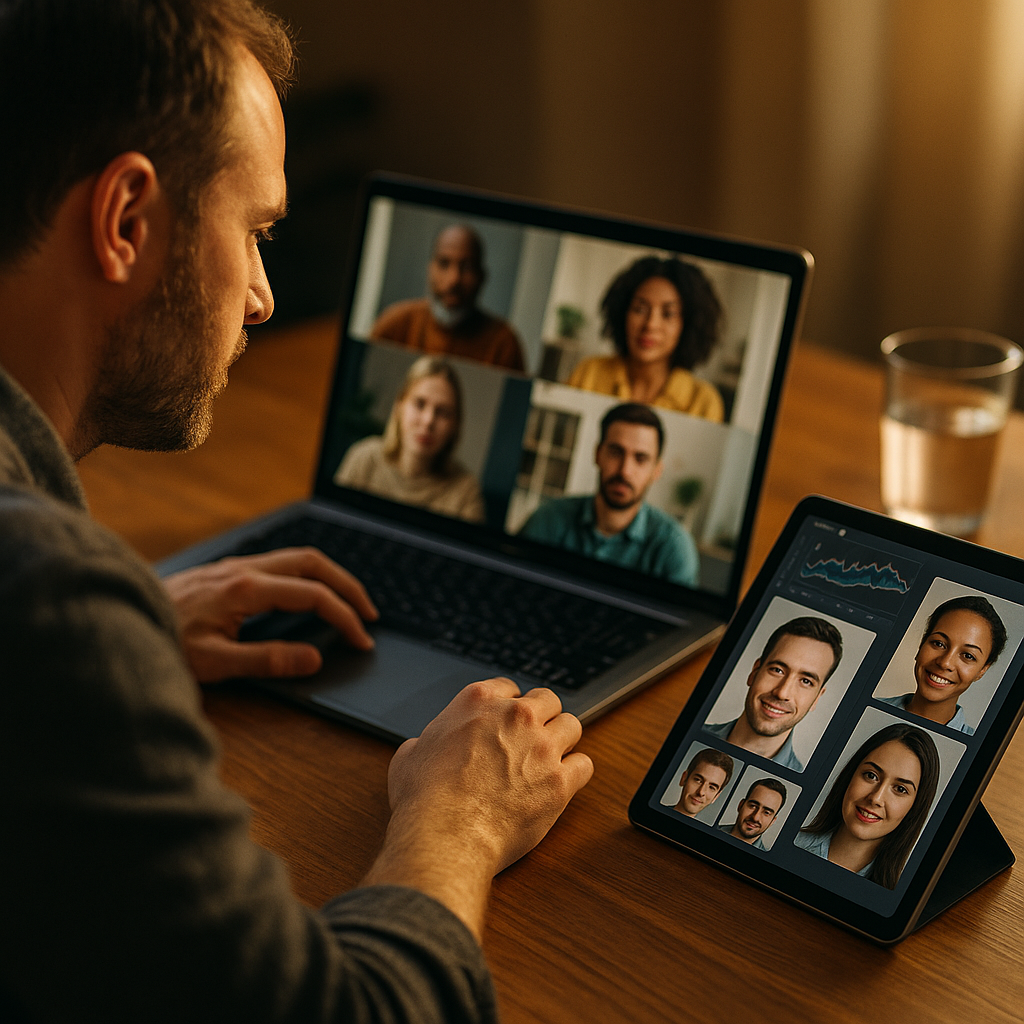
Building your first synthetic focus group can shorten research cycles, cut recruitment costs, and reveal sharper audience signals before you spend on product, messaging, or media. In 2026, augmented audiences let teams simulate responses from well-defined customer segments using AI-guided personas grounded in real inputs. Done well, this becomes a practical decision tool rather than a novelty. Here is how to design one credibly.
What Is a Synthetic Focus Group and Why Augmented Audiences Matter
A synthetic focus group is a structured research method that uses AI-generated participants, often called augmented audiences, to simulate how target users may react to concepts, messaging, features, pricing, or creative variations. Instead of recruiting eight to twelve people for a live session, you create a panel of modeled respondents based on validated customer data, market research, and behavioral inputs.
The value is speed and repeatability. A traditional focus group can take weeks to recruit, schedule, moderate, transcribe, and analyze. A synthetic setup can be fielded in hours once your inputs are ready. That makes it useful for early-stage testing, iterative creative review, and scenario planning.
Still, synthetic research is not a replacement for human research in every case. It works best when you treat it as an augmentation layer. Use it to pressure-test assumptions, identify patterns worth exploring, and narrow down options before investing in live interviews, usability studies, or full-scale surveys.
To align with strong research standards, start with a simple rule: the quality of the output depends on the quality of the source evidence. If your audience model is vague, outdated, or biased, your synthetic panel will reflect those flaws. That is why the architecture matters as much as the prompt.
How to Build Augmented Audiences from Reliable Research Inputs
The most important step in synthetic audience modeling is defining your input stack. Many first-time teams jump directly into persona generation. That is backwards. You need to establish what evidence the model is allowed to use and what assumptions it should avoid.
Useful input sources include:
- First-party customer data: CRM attributes, purchase history, support tickets, retention patterns, and product usage data.
- Voice-of-customer materials: interview transcripts, survey responses, reviews, call center logs, and community comments.
- Market context: competitor positioning, category reports, pricing norms, and channel behavior.
- Behavioral segmentation: cohorts by lifecycle stage, needs, barriers, budget sensitivity, and decision criteria.
- Research constraints: geography, language, regulatory limits, seasonality, and known uncertainties.
From those inputs, create a small set of audience archetypes. Keep them specific enough to produce meaningful differences. For example, “parents aged 30-45” is too broad. “Urban working parents with children under 10, high convenience preference, mid-to-high household income, frequent subscription buyers, skeptical of setup complexity” is much more useful.
To improve credibility, document each archetype with:
- Core need state
- Main pain points
- Decision triggers
- Objections and anxieties
- Channel and content preferences
- Confidence level of each attribute
This last point is often missed. Not every trait in a persona is equally certain. Some are strongly supported by evidence, while others are directional. Marking confidence levels helps your team interpret outputs responsibly.
Good augmented audiences are also plural, not singular. Build several variants within a segment so your synthetic focus group does not collapse into one overconfident “average customer.” Real markets are messy. Your simulation should preserve that diversity.
Designing a Synthetic Research Method That Produces Actionable Insights
Once your augmented audiences are ready, design the synthetic focus group like a real study. This means setting a clear objective, writing a discussion guide, choosing stimulus materials, and defining what a useful answer looks like before you run anything.
Start by choosing one research goal. Common first-use cases include:
- Testing value propositions
- Comparing ad concepts
- Evaluating landing page messaging
- Exploring feature prioritization
- Screening pricing and packaging reactions
- Identifying likely objections before launch
Then create a discussion structure. A reliable sequence often looks like this:
- Warm-up: Ask each synthetic participant to describe their current behavior, category attitudes, and unmet needs.
- Context probe: Explore triggers, barriers, and decision drivers.
- Stimulus review: Present the concept, message, product idea, mockup, or offer.
- Reaction capture: Ask for immediate emotional response, clarity, relevance, and credibility.
- Trade-off analysis: Compare against alternatives or competing propositions.
- Decision simulation: Assess likely action, hesitation points, and what would increase confidence.
Use prompts that require explanation, not just sentiment. For example, instead of asking, “Do you like this ad?” ask, “What specific phrase increases or decreases trust, and why?” This produces insights your team can act on.
It also helps to run the same concept across multiple audiences and then reverse the task. Ask the model to explain why one segment is reacting differently from another. This often surfaces positioning gaps, language mismatches, or hidden friction in your offer.
For better rigor, define your output format in advance. You may want:
- A per-persona transcript
- A summary by theme
- A ranked list of objections
- A confidence score tied to evidence quality
- Recommendations for what to validate with live users next
This step prevents the common failure mode of generating interesting text that never turns into a decision.
Prompt Engineering for Synthetic Focus Group Accuracy and Depth
Prompting matters, but not in the simplistic sense of writing one clever instruction. Good prompt engineering is really about establishing boundaries, context, and evaluation criteria so the synthetic focus group behaves like a disciplined research exercise.
Your system instructions should tell the model to:
- Stay within the evidence provided
- Flag uncertainty rather than inventing unsupported details
- Respond distinctly for each audience member
- Avoid collapsing nuanced opinions into generic consensus
- Separate direct reaction from interpretation
A practical prompt framework includes four elements:
- Role definition: Specify the synthetic participant’s segment, context, motivations, and constraints.
- Evidence base: List the approved data sources and assumptions.
- Task: Explain the concept being evaluated and the questions to answer.
- Output rules: Require structured responses, rationale, and confidence indicators.
For example, if you are testing subscription messaging, ask each synthetic participant to rate clarity, perceived value, trust, and purchase likelihood, then explain the top two reasons for hesitation. That output can be compared directly across audience types.
You should also include adversarial prompts. Ask the panel to challenge your concept, identify missing information, and point out what feels implausible. Teams often use synthetic audiences to confirm a preferred idea. A better use is to expose weaknesses before customers do.
Another best practice is triangulation. Run multiple prompt variants and compare outputs. If the same themes appear consistently across structures, your findings are more dependable. If the output swings wildly based on wording, that is a signal to lower confidence and validate with human research.
Bias, Validation, and EEAT in AI Audience Simulation
Helpful content in 2026 must show experience, expertise, authoritativeness, and trustworthiness. For synthetic research, that means being honest about what the method can and cannot do. A synthetic focus group is strongest when it is documented, validated, and used with safeguards.
Here are the main risks to manage:
- Input bias: If your source data overrepresents one audience or channel, your synthetic panel may amplify that skew.
- Model bias: The AI may rely on patterns that do not reflect your market, especially in niche or regulated categories.
- False precision: Rich language can create the illusion of certainty where only probability exists.
- Consensus bias: Summaries may overstate agreement and hide important minority views.
To strengthen trustworthiness, use a validation loop:
- Run the synthetic focus group and extract hypotheses.
- Test those hypotheses with real customers through interviews, surveys, or behavioral experiments.
- Compare alignment and mismatch patterns.
- Update audience models based on what was confirmed or disproved.
This process turns synthetic outputs into a living research asset instead of a one-off AI exercise.
If you work in healthcare, finance, children’s products, or other sensitive sectors, apply stricter review. Limit synthetic research to exploratory use, maintain human oversight, and avoid making high-stakes claims without direct validation. Privacy also matters. Use anonymized or aggregated inputs where possible, and keep governance clear.
One sign of mature practice is transparent reporting. When sharing findings internally, include the study objective, source inputs, segment definitions, prompt logic, known limitations, and what still requires live validation. Decision-makers are more likely to trust synthetic research when they can see how it was constructed.
Turning Synthetic Consumer Insights into Product and Marketing Decisions
The point of a synthetic focus group is not to produce impressive transcripts. The point is to improve decisions. Once you have outputs, convert them into prioritized actions across product, brand, and growth teams.
Common action pathways include:
- Messaging refinement: Replace unclear claims with language audiences found credible and relevant.
- Creative optimization: Cut visuals or headlines that triggered confusion or distrust.
- Landing page updates: Reorder content based on decision drivers and objection patterns.
- Feature roadmap input: Prioritize capabilities linked to purchase intent or retention concerns.
- Experiment design: Build A/B tests around the strongest synthetic hypotheses.
A simple prioritization model helps. Score each insight on three dimensions: likely business impact, evidence strength, and ease of validation. This keeps your team from overreacting to one provocative quote while ignoring more important patterns.
You should also define success metrics before implementation. If synthetic feedback suggests a new pricing explanation will reduce hesitation, decide how you will measure that change. For example, you might track trial starts, checkout completion, demo requests, or qualified lead rate.
For first-time teams, it is smart to start small. Choose one audience, one use case, and one decision window. A focused pilot is easier to validate and teach across the organization. As confidence grows, you can expand into multi-segment simulations, multilingual panels, or concept screening at scale.
The strongest teams treat augmented audiences as part of a broader insight system. They combine synthetic testing with analytics, customer interviews, market intelligence, and experimentation. That blended model is where the real advantage appears: faster learning with better discipline.
FAQs About Synthetic Focus Group Research and Augmented Audiences
What is the difference between a synthetic focus group and a traditional focus group?
A traditional focus group uses real recruited participants in a moderated session. A synthetic focus group uses AI-generated participants modeled on audience data. The synthetic method is faster and cheaper for early exploration, while traditional groups remain essential for direct human validation.
Are augmented audiences accurate enough for business decisions?
They can be useful for directional decisions if built from high-quality inputs and paired with validation. They are best for hypothesis generation, concept screening, and identifying likely objections. They are not a substitute for real-user evidence in high-risk or high-stakes decisions.
What data do I need to create augmented audiences?
You need first-party customer data, voice-of-customer research, behavioral segmentation, and category context. Even a modest dataset can be useful if it is current, relevant, and clearly documented. Quality matters more than volume.
How many personas should be in a synthetic focus group?
For a first project, start with three to five distinct audience archetypes and several variants within each if needed. Too few can oversimplify the market. Too many can create noise before your process is mature.
Can synthetic focus groups help with ad testing?
Yes. They are especially useful for testing hooks, claims, tone, trust cues, calls to action, and likely objections across different segments. They can help narrow creative options before live testing in market.
How do I validate synthetic focus group findings?
Validate by comparing synthetic outputs against customer interviews, surveys, usability tests, and real behavioral data such as click-through rates or conversion metrics. Look for themes that consistently appear across methods.
What is the biggest mistake teams make?
The biggest mistake is treating synthetic outputs as facts instead of modeled responses. The second biggest is building personas from weak or outdated assumptions. Strong inputs, clear limits, and a validation plan are what make the method useful.
Synthetic focus groups work best when they are architected like real research, grounded in trustworthy audience inputs, and validated against human evidence. Augmented audiences can accelerate learning, sharpen concepts, and improve decision quality, but only when used with discipline. Start with one focused use case, document your assumptions, and treat every output as a hypothesis to test. That is how this method becomes genuinely valuable.
Top Influencer Marketing Agencies
The leading agencies shaping influencer marketing in 2026
Agencies ranked by campaign performance, client diversity, platform expertise, proven ROI, industry recognition, and client satisfaction. Assessed through verified case studies, reviews, and industry consultations.
Moburst

-
2

The Shelf
Boutique Beauty & Lifestyle Influencer AgencyA data-driven boutique agency specializing exclusively in beauty, wellness, and lifestyle influencer campaigns on Instagram and TikTok. Best for brands already focused on the beauty/personal care space that need curated, aesthetic-driven content.Clients: Pepsi, The Honest Company, Hims, Elf Cosmetics, Pure LeafVisit The Shelf → -
3

Audiencly
Niche Gaming & Esports Influencer AgencyA specialized agency focused exclusively on gaming and esports creators on YouTube, Twitch, and TikTok. Ideal if your campaign is 100% gaming-focused — from game launches to hardware and esports events.Clients: Epic Games, NordVPN, Ubisoft, Wargaming, Tencent GamesVisit Audiencly → -
4

Viral Nation
Global Influencer Marketing & Talent AgencyA dual talent management and marketing agency with proprietary brand safety tools and a global creator network spanning nano-influencers to celebrities across all major platforms.Clients: Meta, Activision Blizzard, Energizer, Aston Martin, WalmartVisit Viral Nation → -
5

The Influencer Marketing Factory
TikTok, Instagram & YouTube CampaignsA full-service agency with strong TikTok expertise, offering end-to-end campaign management from influencer discovery through performance reporting with a focus on platform-native content.Clients: Google, Snapchat, Universal Music, Bumble, YelpVisit TIMF → -
6

NeoReach
Enterprise Analytics & Influencer CampaignsAn enterprise-focused agency combining managed campaigns with a powerful self-service data platform for influencer search, audience analytics, and attribution modeling.Clients: Amazon, Airbnb, Netflix, Honda, The New York TimesVisit NeoReach → -
7

Ubiquitous
Creator-First Marketing PlatformA tech-driven platform combining self-service tools with managed campaign options, emphasizing speed and scalability for brands managing multiple influencer relationships.Clients: Lyft, Disney, Target, American Eagle, NetflixVisit Ubiquitous → -
8

Obviously
Scalable Enterprise Influencer CampaignsA tech-enabled agency built for high-volume campaigns, coordinating hundreds of creators simultaneously with end-to-end logistics, content rights management, and product seeding.Clients: Google, Ulta Beauty, Converse, AmazonVisit Obviously →