


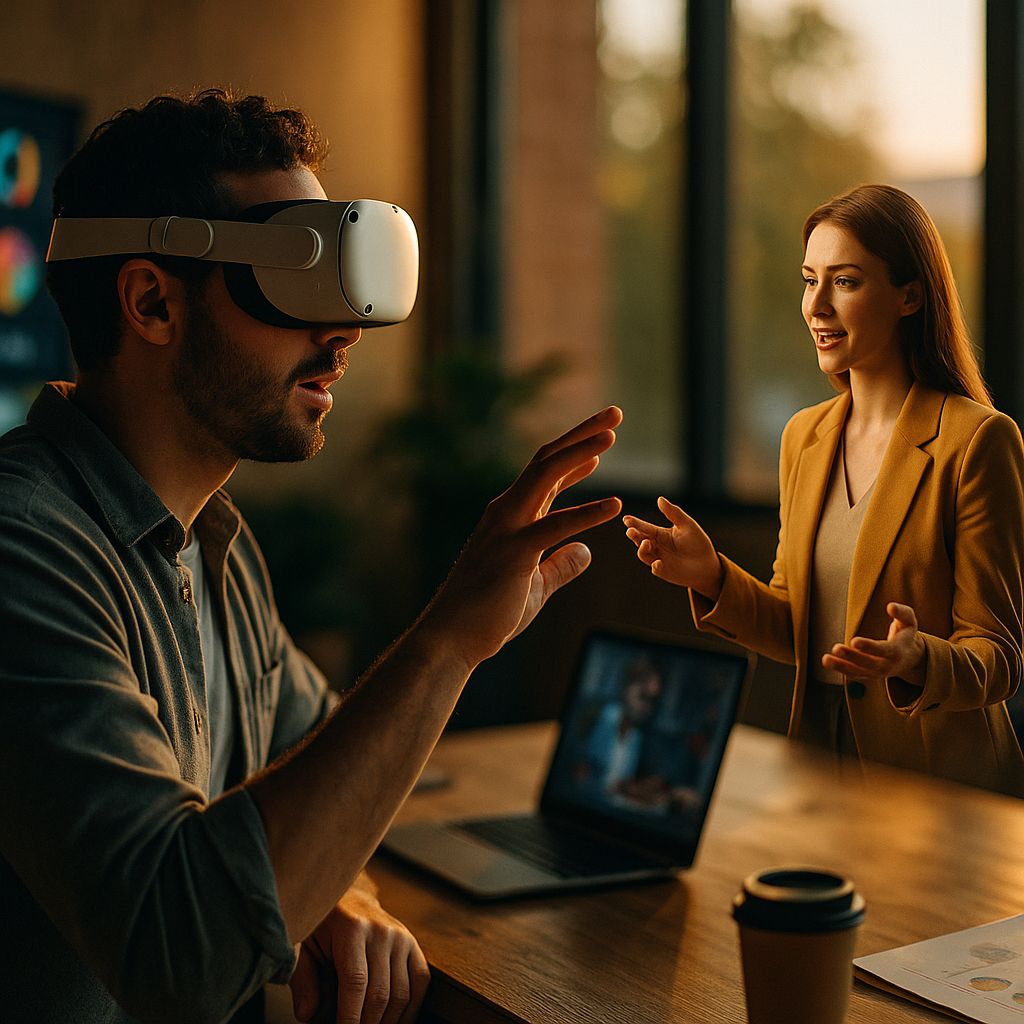
Spatial computing is reshaping how brands create, deliver, and measure immersive narratives across digital and physical environments. As headsets, smart glasses, AI, and 3D interfaces mature in 2026, marketers can move beyond flat screens into experiences people explore, influence, and remember. The result is a new storytelling grammar built on presence, context, and interaction. What does that mean for brands next?
Spatial computing in marketing: a new canvas for brand narratives
Spatial computing in marketing refers to digital experiences that understand physical space and layer content into it through devices such as mixed reality headsets, smart glasses, mobile AR, connected displays, and sensor-based environments. For brand storytelling, this matters because the audience is no longer just viewing a message. They are standing inside it, manipulating it, and moving through it.
This shift changes the format of storytelling itself. Traditional ads and branded content rely on sequence: a brand introduces a problem, presents a product, then closes with a call to action. Spatial formats are different. They are often non-linear, responsive, and personalized. A customer can approach a virtual object from any angle, trigger information in their own order, or reveal content by exploring a real-world location.
That creates several strategic advantages:
- Presence: Users feel immersed rather than interrupted.
- Agency: They choose what to engage with and how deeply to explore.
- Context: The story adapts to location, environment, and behavior.
- Memory: Interactive experiences tend to be more memorable than passive impressions.
For marketers, the opportunity is not simply to repurpose a video ad into 3D. It is to rethink what a brand story can be when space becomes part of the medium. A sports brand can turn a retail store into a performance narrative. A beauty company can build guided try-on rituals around identity and self-expression. An automotive brand can let buyers compare vehicle features at life size in a driveway, showroom, or event space.
To meet Google’s helpful content expectations, it is important to be precise here: spatial storytelling is not automatically effective because it is immersive. It works when the format supports a clear audience need, reduces friction, and expresses the brand in a way that flat media cannot. Otherwise, it becomes novelty without business value.
Immersive brand experiences and the rise of participatory storytelling
Immersive brand experiences are pushing storytelling from broadcast into participation. Instead of asking audiences to watch a narrative unfold, brands can invite them to co-create meaning through movement, voice, gesture, gaze, and real-time decision-making.
This is one of the most important format changes coming from spatial computing. In a conventional campaign, everyone receives roughly the same story. In a spatial environment, each person may follow a different path. That does not weaken brand control. It changes the role of the brand from narrator to world-builder.
Consider how this affects core storytelling elements:
- Setting: Physical space becomes a live storytelling layer, whether in-store, at home, or at an event.
- Character: The user becomes a participant, not just an observer.
- Plot: Stories branch based on user behavior, location, time, or product interest.
- Conflict and resolution: Interactions can frame problems and reveal solutions through exploration.
For example, a travel brand can turn destination discovery into an explorable mixed reality journey. Rather than showing a beach, city, or hotel in a standard video, it can invite users to walk through itinerary options, unlock cultural stories, and compare packages in context. The story becomes useful, emotional, and memorable at once.
This also answers a frequent concern from marketing teams: will audiences invest time in these experiences? They will if there is clear value. Good spatial storytelling delivers one or more of the following:
- It helps users make a decision faster.
- It increases confidence in a purchase.
- It offers entertainment that aligns with the brand.
- It creates social currency worth sharing.
That means participatory storytelling should not be built around complexity. It should be built around utility and emotional clarity. The strongest experiences guide users naturally, reward curiosity, and make the brand’s role unmistakable without overwhelming the user interface.
Augmented reality storytelling as a bridge between digital and physical touchpoints
Augmented reality storytelling is likely to remain the most scalable spatial format for many brands because it works across smartphones, retail environments, packaging, events, and increasingly wearable devices. While full mixed reality experiences can deliver deep immersion, AR often provides the best balance of reach, cost control, and measurable business outcomes.
Its biggest strength is continuity. AR can connect touchpoints that were previously separate. A product package can unlock a how-to experience. A store shelf can reveal origin stories, sustainability information, or live personalization options. A street-level activation can drive to ecommerce. A post-purchase tutorial can reduce returns and improve product satisfaction.
That continuity supports a stronger story arc across the full customer journey:
- Awareness: Interactive outdoor, social, or event-based overlays attract attention.
- Consideration: Try-ons, visualizations, and product explainers answer practical questions.
- Conversion: AR demos reduce uncertainty and support confident buying decisions.
- Loyalty: Post-purchase onboarding and exclusive experiences deepen brand connection.
In 2026, successful AR storytelling is becoming less about spectacle and more about precision. Consumers expect fast loading, realistic rendering, intuitive controls, and useful content. A furniture brand, for instance, cannot stop at placing a sofa in a room. It needs to show fabric options, dimensions, lighting effects, care guidance, and perhaps how the piece fits with the customer’s existing style. The story is not the object alone. The story is the customer’s life with the object.
Brand teams should also prepare for AR content to become more adaptive. AI can help tailor overlays based on customer preferences, prior interactions, geography, weather, inventory, or loyalty status. That allows one creative system to tell many relevant micro-stories instead of forcing every user through the same sequence.
The practical takeaway: if a brand is starting with spatial formats, AR is often the best entry point because it can prove storytelling value quickly while building internal skills, audience familiarity, and performance benchmarks.
Mixed reality commerce and how story formats are changing the path to purchase
Mixed reality commerce is turning transactional moments into narrative experiences. This matters because many brand stories break down near conversion. Awareness content may be emotionally strong, but product pages and checkout flows often flatten the story into features, prices, and buttons. Spatial computing gives brands a way to keep narrative momentum alive closer to purchase.
In mixed reality commerce, the product is no longer a static listing. It can become an interactive character in the buying journey. Users can inspect scale, materials, functionality, and comparisons in their own environment. They can trigger stories about craftsmanship, use cases, maintenance, compatibility, and community validation without leaving the experience.
That changes several familiar marketing assumptions:
- Product education becomes spatial: Users learn by manipulating rather than reading.
- Conversion friction drops: Visualization answers objections before they become drop-off points.
- Upsell opportunities become contextual: Related products appear in relevant moments, not as generic recommendations.
- Trust improves: The gap between expectation and reality narrows.
Think about categories where touch and scale matter: home goods, apparel, beauty, automotive, consumer electronics, fitness equipment, and luxury products. In these areas, mixed reality can communicate fit, function, and feeling better than many conventional assets can.
But there is a critical caution for marketers: do not confuse richer interaction with guaranteed conversion. Spatial commerce works best when it supports buying intent, not when it distracts from it. If every interaction is optional, users may explore without progressing. Strong experiences therefore include subtle narrative architecture: guided prompts, anchored product benefits, easy access to proof points, and frictionless transitions to cart, booking, or lead capture.
Another likely question is measurement. Brand teams should assess mixed reality storytelling with a blend of metrics:
- Engagement depth: dwell time, object interactions, completion rates
- Behavior quality: feature views, comparison actions, save/share activity
- Commercial impact: add-to-cart rate, conversion lift, return reduction, average order value
- Brand outcomes: recall, preference, consideration, and sentiment
When those signals are tied together, marketers can evaluate not just whether users liked an experience, but whether the format moved them forward.
3D content strategy: what brands need to build trustworthy spatial stories
3D content strategy is now a core requirement for any brand serious about spatial storytelling. This is where execution quality determines whether an immersive experience feels credible or confusing. Google’s EEAT framework is especially relevant here because spatial formats amplify both strengths and weaknesses. If a brand lacks expertise, accuracy, or user-first design, audiences notice quickly.
To build trustworthy spatial stories, brands need five foundations.
1. Accurate digital assets
Products, environments, and demonstrations must reflect reality. In regulated or high-consideration sectors such as health, finance, automotive, or home safety, inaccurate visualization can damage trust and create compliance risk.
2. Clear editorial intent
Every experience should answer a specific customer need. Is the goal to educate, entertain, compare, configure, train, or inspire? Without that clarity, 3D assets become expensive decoration.
3. Accessibility and usability
Interfaces must be intuitive. Motion, text placement, interaction cues, and audio should support a wide range of users and environments. Not every person will have the same comfort level with immersive technology.
4. Privacy-aware personalization
Spatial experiences may collect sensitive behavioral or environmental data. Brands should be explicit about what they gather, why they gather it, and how users can control their data. Trust is part of the story.
5. Cross-functional governance
Spatial storytelling sits at the intersection of brand, product, creative, engineering, legal, analytics, and customer experience teams. Strong governance prevents fragmented experiences and inconsistent messaging.
For many organizations, an effective starting model is to create a reusable 3D content system rather than building each activation from scratch. Product models, animations, interaction logic, and brand rules can be designed once and adapted across ecommerce, retail, events, training, and support content. This improves consistency while lowering long-term production costs.
Experience also matters. Teams should test prototypes with real users early. Watch where people hesitate. Identify which interactions feel natural and which feel forced. Validate whether users understand the story without explanation. Helpful content is not what the brand intends to communicate. It is what the user can easily grasp and act on.
Future of customer engagement in spatial computing: formats brands should watch
The future of customer engagement in spatial computing will not be defined by a single device or platform. It will emerge from a network of formats that work together across moments, places, and levels of immersion. Brands planning for 2026 and beyond should watch several storytelling patterns.
- Persistent brand layers: always-available content tied to locations, stores, products, or owned spaces
- AI-guided immersive journeys: adaptive narratives that respond to user questions and goals in real time
- Spatial social storytelling: shared experiences where communities explore, react, and create together
- Digital twin storytelling: detailed virtual replicas of products, venues, or supply chains that reveal brand value transparently
- Ambient branded interfaces: lightweight, glanceable interactions on wearables or connected environments
These formats point to a larger strategic shift. Brand storytelling is moving from campaign-based media objects to dynamic experience systems. Instead of launching one hero film and supporting assets, companies may build spatial story worlds that evolve over time with customer data, seasonal content, product changes, and community participation.
That creates a new competitive question: which brands are best positioned to win? Usually, not the ones with the most experimental visuals alone. The winners are likely to be brands that can connect immersive creativity with operational discipline. They know their customer problems. They maintain high-quality content pipelines. They respect privacy. They measure outcomes. And they keep the story useful at every touchpoint.
For leaders deciding when to invest, the answer is increasingly simple: start before the market fully standardizes. Spatial storytelling capabilities take time to develop. Brands that begin now can test formats, establish design principles, and build audience familiarity while the ecosystem is still forming. Waiting may reduce risk, but it also narrows the chance to define how people experience the category.
FAQs about spatial computing and brand storytelling
What is spatial computing in simple terms?
Spatial computing is technology that blends digital content with physical space, allowing users to interact with information and objects around them through AR, mixed reality, sensors, AI, and connected devices.
Why does spatial computing matter for brand storytelling?
It allows brands to create stories that people can explore instead of just watch. That makes storytelling more interactive, contextual, and memorable, especially when customers need to understand products or experiences in real-world settings.
How is spatial storytelling different from traditional digital marketing?
Traditional digital marketing is usually screen-based and linear. Spatial storytelling is immersive and non-linear. Users can move through content, trigger experiences in different orders, and interact with products or messages in physical environments.
Is augmented reality enough, or do brands need full mixed reality?
For many brands, augmented reality is the best starting point because it offers broader reach and lower friction. Mixed reality becomes valuable when deeper immersion, life-size product interaction, or multi-step guided experiences are important.
Which industries benefit most from spatial brand storytelling?
Retail, beauty, fashion, automotive, home goods, travel, entertainment, education, and consumer electronics are especially strong use cases. Any category that relies on visualization, fit, product education, or emotional engagement can benefit.
How can brands measure ROI from spatial experiences?
Measure both engagement and business impact. Useful metrics include dwell time, interaction rate, feature exploration, add-to-cart lift, conversion rate, return reduction, average order value, and brand recall or preference.
What are the biggest mistakes brands make with spatial computing?
Common mistakes include prioritizing novelty over usefulness, building confusing interfaces, using inaccurate 3D assets, failing to connect experiences to clear conversion paths, and ignoring privacy or accessibility concerns.
Do spatial experiences need a large budget to be effective?
No. Brands can start with focused AR use cases such as product visualization, packaging experiences, in-store overlays, or post-purchase tutorials. The key is solving a real customer problem and measuring results carefully.
Will spatial computing replace video and other content formats?
No. It will expand the storytelling mix. Video, social content, product pages, and email will still matter. Spatial experiences work best when they complement existing channels and enhance moments where immersion adds clear value.
What should a brand do first in 2026?
Start with one customer journey problem that spatial content can solve better than current formats. Build a pilot, test it with real users, measure both experience and business outcomes, then scale what works.
Spatial computing is changing brand storytelling from static messaging into responsive, immersive experience design. In 2026, the strongest brands will use it not as a gimmick, but as a practical way to build clarity, trust, and emotional connection across the customer journey. The clear takeaway is simple: start with useful stories, design for real behavior, and let space become part of the message.
Top Influencer Marketing Agencies
The leading agencies shaping influencer marketing in 2026
Agencies ranked by campaign performance, client diversity, platform expertise, proven ROI, industry recognition, and client satisfaction. Assessed through verified case studies, reviews, and industry consultations.
Moburst

-
2

The Shelf
Boutique Beauty & Lifestyle Influencer AgencyA data-driven boutique agency specializing exclusively in beauty, wellness, and lifestyle influencer campaigns on Instagram and TikTok. Best for brands already focused on the beauty/personal care space that need curated, aesthetic-driven content.Clients: Pepsi, The Honest Company, Hims, Elf Cosmetics, Pure LeafVisit The Shelf → -
3

Audiencly
Niche Gaming & Esports Influencer AgencyA specialized agency focused exclusively on gaming and esports creators on YouTube, Twitch, and TikTok. Ideal if your campaign is 100% gaming-focused — from game launches to hardware and esports events.Clients: Epic Games, NordVPN, Ubisoft, Wargaming, Tencent GamesVisit Audiencly → -
4

Viral Nation
Global Influencer Marketing & Talent AgencyA dual talent management and marketing agency with proprietary brand safety tools and a global creator network spanning nano-influencers to celebrities across all major platforms.Clients: Meta, Activision Blizzard, Energizer, Aston Martin, WalmartVisit Viral Nation → -
5

The Influencer Marketing Factory
TikTok, Instagram & YouTube CampaignsA full-service agency with strong TikTok expertise, offering end-to-end campaign management from influencer discovery through performance reporting with a focus on platform-native content.Clients: Google, Snapchat, Universal Music, Bumble, YelpVisit TIMF → -
6

NeoReach
Enterprise Analytics & Influencer CampaignsAn enterprise-focused agency combining managed campaigns with a powerful self-service data platform for influencer search, audience analytics, and attribution modeling.Clients: Amazon, Airbnb, Netflix, Honda, The New York TimesVisit NeoReach → -
7

Ubiquitous
Creator-First Marketing PlatformA tech-driven platform combining self-service tools with managed campaign options, emphasizing speed and scalability for brands managing multiple influencer relationships.Clients: Lyft, Disney, Target, American Eagle, NetflixVisit Ubiquitous → -
8

Obviously
Scalable Enterprise Influencer CampaignsA tech-enabled agency built for high-volume campaigns, coordinating hundreds of creators simultaneously with end-to-end logistics, content rights management, and product seeding.Clients: Google, Ulta Beauty, Converse, AmazonVisit Obviously →