


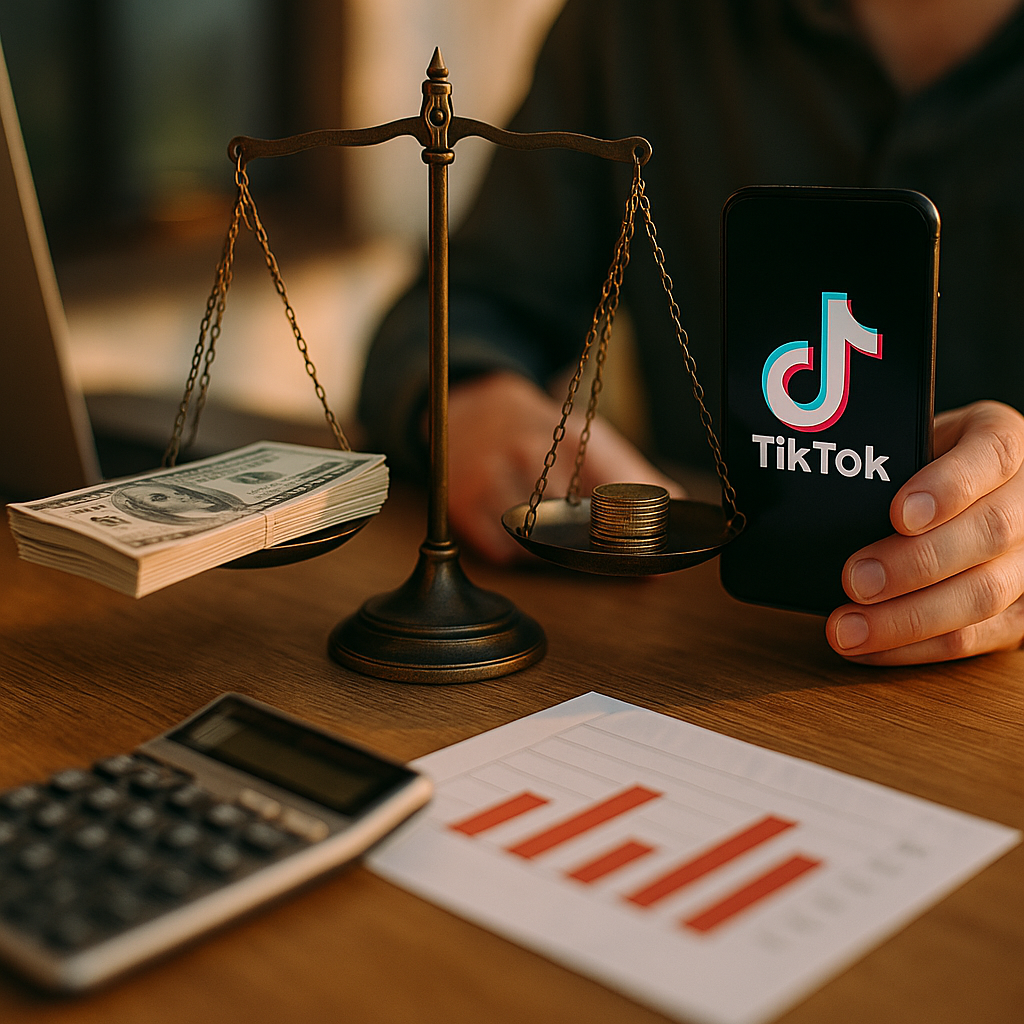
The Tipping Point: When TikTok Ad Spend Eclipses Creator Payouts
Forty-three percent of brand marketers now allocate more budget to TikTok’s paid ad products than to creator fees on the platform, according to a Kantar media spend survey from Q1. That’s up from just 18% two years ago. The TikTok ad budget line item is swelling — and it’s eating into what used to be untouchable influencer spend. If you’re a brand manager still operating on last year’s allocation model, you’re likely overpaying somewhere. Here’s a framework to fix that.
Why the Shift Is Happening — and Why It’s Not Going Back
Three structural forces are converging. First, TikTok’s ad platform has matured rapidly. Smart Performance Campaigns, Search Ads, and Shopping Ads now offer granular targeting that rivals Meta’s Advantage+ suite. Second, creator CPMs have risen steadily as the creator economy scales toward $480 billion. Third — and this is the one most brand teams underestimate — TikTok’s algorithm increasingly rewards paid distribution of creator-style content over organic creator posts.
That last point matters enormously. The platform wants your ad dollars. Its recommendation engine now gives measurably higher completion rates to Spark Ads and In-Feed Ads that use creator-filmed assets versus purely organic creator posts with the same content. The implication: you may get better reach by licensing a creator’s content and running it as paid than by paying that creator to post organically.
The strategic question has shifted from “Which creator should we hire?” to “Which content format — paid placement or organic creator post — delivers a lower customer acquisition cost for this specific campaign objective?”
A Decision Framework for CAC Comparison
Most brand managers lack a clean apples-to-apples comparison between paid TikTok placement and creator fee investment. Here’s a five-step decision rule set we’ve seen operationalized at DTC brands spending $500K+ monthly on TikTok:
- Isolate the content variable. Run the same creator asset as both an organic post (paid via creator fee) and a Spark Ad (paid via ad budget). Measure CAC independently for each over a 14-day window. If your Spark Ad CAC is 30%+ lower, you have your signal.
- Benchmark creator organic reach decay. Pull the last six months of organic post performance for your top 10 creators. If average view counts have declined more than 20%, organic distribution alone is no longer carrying its weight. AI-curated feeds are compressing organic visibility across every major platform.
- Calculate the “content + distribution” blended cost. A creator charging $8,000 per post delivers both content creation and distribution. A Spark Ad using whitelisted creator content might cost $2,000 in content licensing plus $6,000 in ad spend — same total, but with targeting control and measurable attribution. Compare the blended CAC, not just the line items.
- Apply the frequency threshold test. For awareness campaigns needing 3+ impressions per user, paid always wins. Creator organic posts rarely achieve controlled frequency against a defined audience segment.
- Flag exceptions for trust-dependent categories. If you sell supplements, financial products, or anything requiring high consumer trust, creator organic posts still outperform paid placements on conversion rate. The authenticity premium is real — just harder to scale. Our analysis of micro-creator trust dynamics confirms this pattern repeatedly.
The output of this framework isn’t binary. It’s a ratio. Most brands we advise land somewhere between 55/45 and 70/30 in favor of paid placement for direct-response objectives, flipping closer to 40/60 toward creator-organic for brand equity campaigns.
Restructuring Creator Contracts for the New Economics
Here’s where it gets uncomfortable. Your existing creator contracts probably weren’t written for a world where you’d rather license their content than pay for their distribution.
Standard influencer agreements from even 18 months ago typically bundle creation and posting as a single deliverable. The creator shoots, edits, and publishes. You pay a flat fee. Usage rights — if addressed at all — cover repurposing on your owned channels for 30-90 days.
That model is broken. Here’s what needs to change:
- Separate content creation fees from distribution rights. Pay creators for the asset. Pay separately for the right to run that asset as paid media on TikTok, Meta, and YouTube. This gives you flexibility to test paid vs. organic without renegotiating mid-campaign.
- Add Spark Ad whitelisting as a standard clause. TikTok’s Spark Ads require the creator to authorize your ad account to boost their content. Many creators still resist this or charge a premium. Build it into the base agreement with clear duration terms (90-180 days is now standard).
- Include performance escalators instead of flat fees. Replace a portion of the fixed creator payment with a performance bonus tied to ROAS or CAC thresholds. This aligns creator incentives with your actual business outcomes and offsets the risk of overpaying for underperforming organic reach.
- Negotiate content volume over post frequency. Instead of four posts per month, contract for 12 raw content assets per month with posting rights for four. You now have eight additional assets to test in paid. The ongoing compression in creator rates gives brand managers more leverage in these negotiations than they’ve had in years.
One critical note: don’t gut creator compensation in the process. Creators who feel exploited by licensing-heavy deals will produce worse content or walk. The goal is restructuring, not cost-cutting.
When to Keep Betting on Creator-Organic
Not every dollar should flow to paid. Some scenarios still demand organic creator investment:
Product launches in niche communities. A paid TikTok ad for a new climbing shoe won’t penetrate the bouldering community the way a trusted creator’s genuine endorsement will. Niche audiences are algorithm-resistant. They follow specific creators and trust their recommendations implicitly.
Regulatory-sensitive categories. FTC scrutiny of paid social ads in health, finance, and alcohol is intensifying. Creator-disclosed partnerships — properly tagged per FTC guidelines — can actually carry lower compliance risk than some paid ad formats where disclosure requirements vary by placement type.
Long-term brand building. If your KPI is brand favorability or purchase intent lift (not direct-response CAC), creator organic still outperforms. Statista’s global survey data shows that 62% of Gen Z consumers trust product recommendations from creators they follow over any form of paid advertising.
The brands winning on TikTok aren’t choosing between paid and creator-organic. They’re building a content supply chain that feeds both channels from the same creator relationships — then letting CAC data determine the distribution mix in real time.
The Operational Playbook: Making This Work Internally
Budget reallocation fails when org charts fight it. In most companies, influencer budgets sit with brand or social teams, while paid media budgets sit with performance marketing. Two different P&Ls. Two different dashboards. Two different incentive structures.
You need a unified content-to-commerce budget owner. One person or team that controls both creator fees and paid amplification spend, measured against a single CAC or ROAS target. Without this, you’ll optimize in silos and miss the arbitrage between channels.
Tooling matters too. Platforms like Aspire and CreatorIQ now offer integrated workflows for creator content licensing, Spark Ad authorization, and performance tracking in a single view. If you’re still managing creator relationships in spreadsheets and running ads through a separate agency, the friction alone is destroying value. Our guide on scaling creator operations covers the tech stack in detail.
Run a 90-day pilot. Take 20% of your current creator budget, reallocate it to paid amplification of creator content, and measure the delta. Most brand managers who run this test never go back to the old model.
Your Next Move
Pull your last quarter’s TikTok creator spend and your TikTok ad spend. Calculate CAC for each independently. If the gap is wider than 25%, you have a reallocation opportunity that’s costing you real money every week you delay. Start restructuring contracts this month — not next quarter.
Frequently Asked Questions
Should brands stop paying for organic TikTok creator posts entirely?
No. Organic creator posts remain valuable for brand equity, niche community penetration, and trust-dependent product categories. The shift is about rebalancing — not eliminating — organic creator investment. Most brands should move toward a blended model where creator content is licensed for both organic posting and paid amplification, with CAC data determining the optimal split.
How do you calculate TikTok ad CAC versus creator fee CAC accurately?
Run the same creator asset simultaneously as an organic post and a Spark Ad over a 14-day window. Track conversions independently using TikTok’s attribution tools and your own UTM parameters. For creator organic, divide the total creator fee by attributed conversions. For paid, divide total ad spend (including any content licensing cost) by attributed conversions. Compare the two to identify which channel delivers lower acquisition cost for that specific campaign.
What contract terms should brand managers change when restructuring creator agreements?
Separate content creation fees from distribution rights, add Spark Ad whitelisting as a standard clause with 90-180 day terms, include performance escalators tied to ROAS or CAC thresholds, and negotiate for higher content volume rather than higher post frequency. This gives brands flexibility to test paid versus organic distribution without renegotiating mid-campaign.
What percentage of TikTok budget should go to paid ads versus creator fees?
There is no universal ratio. For direct-response campaigns, most successful brands allocate 55-70% toward paid placement and 30-45% toward creator-organic. For brand equity and awareness campaigns, the ratio often flips to 40% paid and 60% creator-organic. Use the five-step decision framework — isolating content variables, benchmarking reach decay, and applying frequency thresholds — to find the right ratio for your category and objectives.
Does licensing creator content for Spark Ads hurt the creator relationship?
It can if handled poorly. Creators who feel their content is being exploited without fair compensation will produce lower-quality work or leave the partnership. The key is transparent contract terms that compensate creators fairly for both creation and licensing rights, include clear duration limits, and offer performance bonuses that let creators benefit from the paid amplification of their content.
Top Influencer Marketing Agencies
The leading agencies shaping influencer marketing in 2026
Agencies ranked by campaign performance, client diversity, platform expertise, proven ROI, industry recognition, and client satisfaction. Assessed through verified case studies, reviews, and industry consultations.
Moburst

-
2

The Shelf
Boutique Beauty & Lifestyle Influencer AgencyA data-driven boutique agency specializing exclusively in beauty, wellness, and lifestyle influencer campaigns on Instagram and TikTok. Best for brands already focused on the beauty/personal care space that need curated, aesthetic-driven content.Clients: Pepsi, The Honest Company, Hims, Elf Cosmetics, Pure LeafVisit The Shelf → -
3

Audiencly
Niche Gaming & Esports Influencer AgencyA specialized agency focused exclusively on gaming and esports creators on YouTube, Twitch, and TikTok. Ideal if your campaign is 100% gaming-focused — from game launches to hardware and esports events.Clients: Epic Games, NordVPN, Ubisoft, Wargaming, Tencent GamesVisit Audiencly → -
4

Viral Nation
Global Influencer Marketing & Talent AgencyA dual talent management and marketing agency with proprietary brand safety tools and a global creator network spanning nano-influencers to celebrities across all major platforms.Clients: Meta, Activision Blizzard, Energizer, Aston Martin, WalmartVisit Viral Nation → -
5

The Influencer Marketing Factory
TikTok, Instagram & YouTube CampaignsA full-service agency with strong TikTok expertise, offering end-to-end campaign management from influencer discovery through performance reporting with a focus on platform-native content.Clients: Google, Snapchat, Universal Music, Bumble, YelpVisit TIMF → -
6

NeoReach
Enterprise Analytics & Influencer CampaignsAn enterprise-focused agency combining managed campaigns with a powerful self-service data platform for influencer search, audience analytics, and attribution modeling.Clients: Amazon, Airbnb, Netflix, Honda, The New York TimesVisit NeoReach → -
7

Ubiquitous
Creator-First Marketing PlatformA tech-driven platform combining self-service tools with managed campaign options, emphasizing speed and scalability for brands managing multiple influencer relationships.Clients: Lyft, Disney, Target, American Eagle, NetflixVisit Ubiquitous → -
8

Obviously
Scalable Enterprise Influencer CampaignsA tech-enabled agency built for high-volume campaigns, coordinating hundreds of creators simultaneously with end-to-end logistics, content rights management, and product seeding.Clients: Google, Ulta Beauty, Converse, AmazonVisit Obviously →