


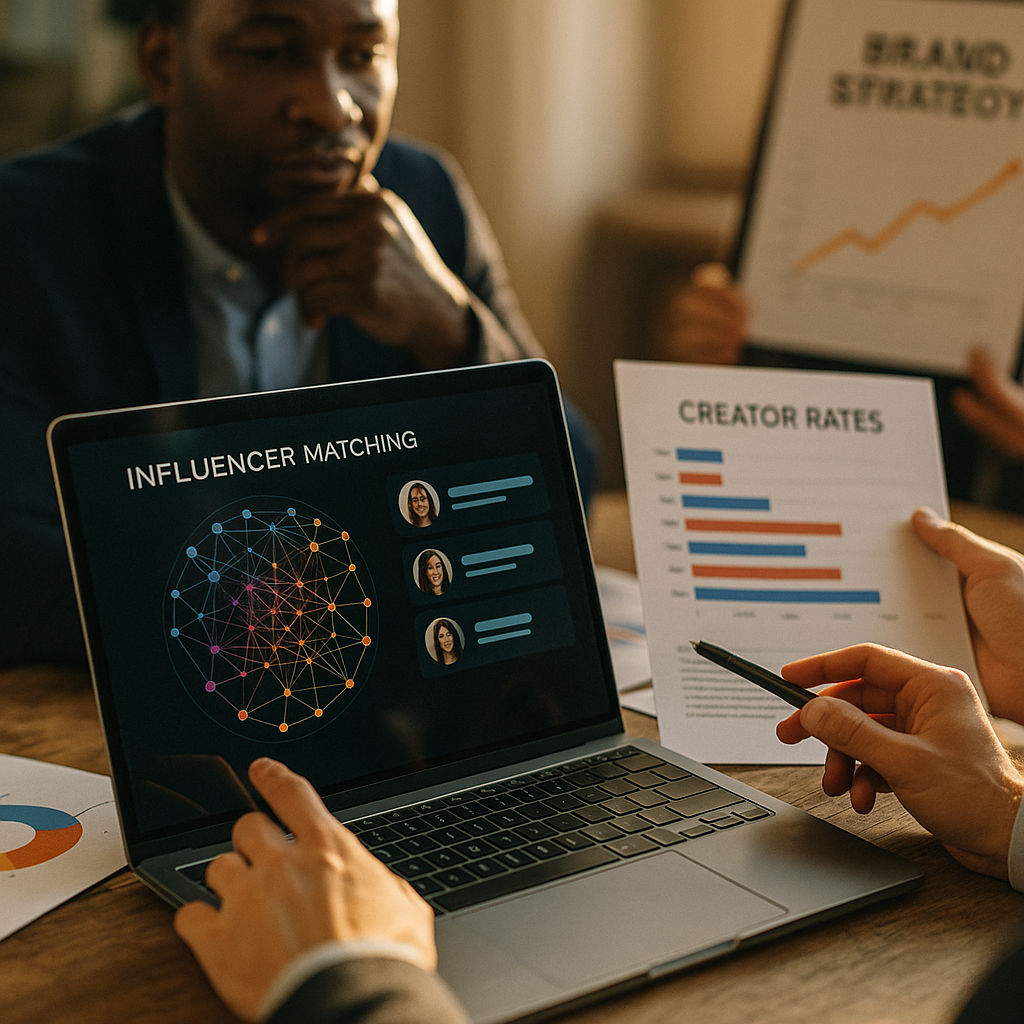
Automated Matching Is Repricing the Middle of the Market
Nearly 60% of brands now use AI-powered creator discovery platforms as their primary sourcing tool — and mid-tier creators are paying the price in rate compression, reduced negotiating leverage, and thinner margins. This is the algorithmic placement phase of the creator economy, and it’s restructuring every layer of the ecosystem.
The mechanism is straightforward, even if the consequences aren’t. Platforms like TikTok’s Creator Marketplace, Meta’s Creator Marketplace on Instagram, and third-party tools like Grin, Creator.co, and Aspire now surface performance benchmarks, estimated CPMs, and engagement rate histories at scale. Brands can compare 200 mid-tier creators in the time it once took to evaluate 10. When supply becomes visible and comparable, price discovery becomes ruthless.
When AI makes creator performance fully transparent and comparable, rate compression isn’t a side effect — it’s the logical outcome of commoditized supply meeting informed demand.
For brand marketers, this looks like efficiency. For creators earning between 50,000 and 500,000 followers — the segment that built the influencer economy’s operational backbone — it looks like a slow squeeze. And understanding that squeeze matters, because the creators feeling it most are often the ones delivering the most durable conversion signals for brands.
Where Agencies Are Losing Ground
Talent agencies and influencer management firms built their value on exclusive access and relationship capital. They knew which creators were available, what they charged, and how to negotiate favorable terms. Automated matching platforms have systematically dismantled that moat.
This isn’t hypothetical. When a brand can query an AI tool for “female fitness creators, 18-34 demo, US-based, 2%+ engagement, $3,000–$5,000 per post” and receive 300 vetted options in seconds, the agency’s sourcing function becomes redundant. What’s left is contract management, creative direction, and compliance oversight — functions that still require human judgment, but which command lower margins than exclusive talent brokerage.
Platform-direct creator programs are accelerating this shift. TikTok’s affiliate and Series programs, YouTube’s BrandConnect, and Instagram’s Partnership Ads infrastructure all enable brands to transact directly with creators at scale, often within the platform’s own performance optimization loop. The platform consolidation dynamic isn’t just a MarTech story — it’s a fundamental renegotiation of who controls creator access.
Agencies that survive this phase will do so by competing on what AI can’t easily replicate: deep category expertise, first-party audience insight, creative strategy, and long-term talent development. The ones that don’t adapt will find themselves disintermediated from the sourcing process entirely.
The Mid-Tier Creator’s Leverage Problem
Here’s the uncomfortable truth for a creator with 150,000 Instagram followers and a solid engagement rate: you are now a data point in someone else’s algorithm. Your profile, your rates, your historical performance — all of it feeds into comparison engines that rank you against dozens of near-identical substitutes.
This is precisely the dynamic detailed in recent analysis of mid-tier creator rate compression. When differentiation collapses to a set of standardized metrics, uniqueness disappears from the pricing equation. The algorithmic marketplace doesn’t know how to value the creator who has built genuine trust with a hyper-specific community over three years. It sees engagement rate. Full stop.
So what actually gives a creator pricing power in this environment?
- Owned email lists and SMS communities — audiences that exist outside any platform’s reach and can’t be algorithmically suppressed
- Paid community platforms — Substack, Patreon, Discord servers, and Geneva groups that demonstrate audience commitment beyond passive follows
- Direct attribution data — creators who can show brands a conversion history with affiliate links, promo codes, or first-party UTM tracking
- Exclusive audience demographics — serving a niche that AI tools genuinely can’t replicate at scale, whether that’s B2B SaaS buyers, professional athletes, or narrow geographic communities
The creators building these assets aren’t doing it for vanity. They’re doing it because platform-independent community ownership is now a negotiating tool. A creator with 40,000 email subscribers can legitimately argue that their brand placement reaches an audience no algorithmic feed can guarantee — a powerful counterpoint in a rate negotiation.
What This Means for Brand Procurement Strategy
Rate compression creates a false economy for brands that treat it purely as a cost reduction opportunity. Yes, you can now source mid-tier creators at lower CPMs than you could three years ago. But you are almost certainly sourcing creators who are burned out, under-invested in content quality, and cycling through brand deals to compensate for margin erosion. That risk is real — and it shows up in creative quality and audience trust signals.
There’s a strategic counterargument to the lowest-bid AI match: the long-term partner model. Brands that lock in preferred creator relationships before the algorithmic market fully commoditizes a given niche will pay today’s compressed rates and retain creators who feel genuinely invested in the partnership. This is the procurement equivalent of buying futures. The trust currency framework matters here — relationships built on stability and creative respect outperform transactional placements across virtually every long-term metric.
Brands also need to think carefully about what they’re optimizing for. An AI matching platform optimizes for the metrics it can measure: engagement rate, estimated reach, cost per post. It doesn’t optimize for brand safety nuance, creative alignment, or the kind of slow-burn audience influence that actually shifts purchase behavior over a six-month window. The authenticity cost of full automation deserves a line item in every campaign brief.
Brands racing to extract maximum efficiency from AI matching tools risk building influencer programs that are cheap to operate and expensive to recover from when creator quality degrades.
Platform Power Accumulation — and Its Limits
The algorithmic placement phase is, at its structural core, a power transfer from talent intermediaries to platforms. TikTok, Meta, YouTube, and Pinterest are not passive technology providers in this story. They’re active participants in creator economics who benefit directly from disintermediating agencies, commoditizing creator rates, and keeping brand budgets inside their own managed environments.
This concentration of power has compliance and risk implications that procurement teams are only beginning to map. When a platform simultaneously sets the algorithmic rules that determine a creator’s organic reach, operates the marketplace where brands find creators, and runs the ad infrastructure that amplifies sponsored content, they hold leverage at every step of the value chain. That’s a structural conflict of interest worth tracking — especially as FTC disclosure requirements and platform monetization terms continue to evolve in ways that affect both brands and creators.
The counterweight is creator-owned infrastructure. Platforms know this, which is why the race to build native monetization tools — subscriptions, tipping, paid communities — is partly about keeping creators financially tethered to the platform ecosystem even when they’re building “independent” audiences. As you evaluate the shifting market map of creator economy infrastructure, the question isn’t just which platforms are winning. It’s which creators are managing to win despite the platforms.
Practical Signals to Watch in Creator Negotiations
For brand marketers actively managing creator rosters, the algorithmic placement phase changes what due diligence looks like. A few specific shifts worth embedding in your evaluation process:
- Ask for off-platform audience data — email list size, newsletter open rates, community membership numbers. Creators who can provide this are demonstrating platform-independent leverage. Those who can’t are algorithmically dependent.
- Evaluate rate consistency over time — creators whose rates have held steady or grown despite market compression are either delivering exceptional performance or have successfully diversified their revenue base. Both are positive signals.
- Weight conversion history heavier than reach — in a rate-compressed market, the creator with a proven $8 CPA on affiliate links is worth considerably more than a creator with double the followers and no attribution history. See the CAC decision framework for how to structure this trade-off.
- Scrutinize contract terms around exclusivity — creators under financial pressure from rate compression may be accepting more exclusivity clauses just to secure deals. That’s a short-term risk for both parties.
The relationship between measurable creator performance metrics and genuine audience influence is imperfect, and AI matching tools tend to optimize for the former. Building an internal framework that captures both is the operational advantage brands can develop right now, before their competitors do.
One final point: the creators who are most aggressively building platform-independent communities today are signaling something important about where they expect this market to go. Smart brand partners should read that signal and align with them accordingly — because the creators who survive this phase with intact audiences and independent leverage will be the most valuable partners in the next one.
Next step: Audit your current creator roster against platform dependency risk. Any creator whose entire audience lives on a single platform deserves a direct conversation about their community-building strategy — and what you might do together to support it.
Frequently Asked Questions
What is algorithmic placement in the creator economy?
Algorithmic placement refers to the use of AI-powered tools and platform-native marketplaces to automatically match brands with creators based on performance data — engagement rate, estimated reach, historical CPMs, and audience demographics. Instead of relying on agency relationships or manual outreach, brands use tools like Aspire, Grin, TikTok Creator Marketplace, or Meta’s Partnership tools to surface and compare creators at scale. This process makes creator selection faster and more data-driven, but it also commoditizes creator profiles and contributes to rate compression, particularly for mid-tier creators.
Why are mid-tier creators specifically being affected by rate compression?
Mid-tier creators — roughly those with 50,000 to 500,000 followers — are uniquely vulnerable because they lack the brand equity and cultural cachet of mega-influencers, but are now being compared side-by-side in AI discovery platforms with dozens of near-identical alternatives. When brands can easily see that 15 creators offer similar engagement rates at different price points, negotiating leverage erodes quickly. Nano-creators often work for product-only or very low fees, and celebrity creators have established premium positioning. The middle tier bears the brunt of algorithmic price discovery.
How are platforms benefiting from AI creator matching?
Platforms benefit in multiple ways. By operating both the algorithmic feed that determines creator reach and the marketplace where brands source creators, they position themselves as unavoidable intermediaries. They collect transaction data from brand-creator deals, reduce brands’ dependence on external agencies, and keep budget allocation decisions within their managed environments. This vertical integration gives platforms pricing and policy leverage that neither creators nor brands can easily counter without building audience assets that exist outside platform control.
What can creators do to maintain negotiating leverage with brands?
The most effective strategies involve building platform-independent community assets: email newsletters, paid Substack or Patreon communities, Discord or Geneva groups, and direct SMS subscriber lists. These demonstrate audience commitment that no algorithmic feed can suppress or replicate. Creators can also strengthen their negotiating position by maintaining clean conversion attribution data — affiliate link performance, promo code redemption histories — that proves direct commercial impact independent of vanity metrics. Niche specificity also helps: creators serving hyper-specific professional or interest communities are harder to substitute algorithmically.
Should brands be concerned about the quality risk of AI-matched creators?
Yes. Rate compression drives a race to the bottom in content investment. Creators who are cycling through large volumes of low-fee brand deals to compensate for margin erosion often produce lower-quality, less authentic content. Brands optimizing purely for cost efficiency via AI matching may find they’re accumulating placements that perform poorly on brand safety, creative alignment, and long-term audience trust. A hybrid model — using AI for initial discovery and filtering, then applying human judgment for final selection and relationship management — tends to deliver better outcomes than fully automated sourcing.
How should agencies adapt to the algorithmic placement phase?
Agencies need to compete on what AI tools genuinely cannot replicate: deep category expertise, creative strategy, compliance management, and long-term talent development. Sourcing as a standalone value proposition is increasingly hard to defend when platforms offer direct access. The agencies that will survive and grow are those repositioning themselves as creative and strategic partners rather than talent brokers — with proprietary data, owned creator relationships built on genuine investment, and measurable frameworks for campaign performance that go beyond algorithmic benchmarks.
Top Influencer Marketing Agencies
The leading agencies shaping influencer marketing in 2026
Agencies ranked by campaign performance, client diversity, platform expertise, proven ROI, industry recognition, and client satisfaction. Assessed through verified case studies, reviews, and industry consultations.
Moburst

-
2

The Shelf
Boutique Beauty & Lifestyle Influencer AgencyA data-driven boutique agency specializing exclusively in beauty, wellness, and lifestyle influencer campaigns on Instagram and TikTok. Best for brands already focused on the beauty/personal care space that need curated, aesthetic-driven content.Clients: Pepsi, The Honest Company, Hims, Elf Cosmetics, Pure LeafVisit The Shelf → -
3

Audiencly
Niche Gaming & Esports Influencer AgencyA specialized agency focused exclusively on gaming and esports creators on YouTube, Twitch, and TikTok. Ideal if your campaign is 100% gaming-focused — from game launches to hardware and esports events.Clients: Epic Games, NordVPN, Ubisoft, Wargaming, Tencent GamesVisit Audiencly → -
4

Viral Nation
Global Influencer Marketing & Talent AgencyA dual talent management and marketing agency with proprietary brand safety tools and a global creator network spanning nano-influencers to celebrities across all major platforms.Clients: Meta, Activision Blizzard, Energizer, Aston Martin, WalmartVisit Viral Nation → -
5

The Influencer Marketing Factory
TikTok, Instagram & YouTube CampaignsA full-service agency with strong TikTok expertise, offering end-to-end campaign management from influencer discovery through performance reporting with a focus on platform-native content.Clients: Google, Snapchat, Universal Music, Bumble, YelpVisit TIMF → -
6

NeoReach
Enterprise Analytics & Influencer CampaignsAn enterprise-focused agency combining managed campaigns with a powerful self-service data platform for influencer search, audience analytics, and attribution modeling.Clients: Amazon, Airbnb, Netflix, Honda, The New York TimesVisit NeoReach → -
7

Ubiquitous
Creator-First Marketing PlatformA tech-driven platform combining self-service tools with managed campaign options, emphasizing speed and scalability for brands managing multiple influencer relationships.Clients: Lyft, Disney, Target, American Eagle, NetflixVisit Ubiquitous → -
8

Obviously
Scalable Enterprise Influencer CampaignsA tech-enabled agency built for high-volume campaigns, coordinating hundreds of creators simultaneously with end-to-end logistics, content rights management, and product seeding.Clients: Google, Ulta Beauty, Converse, AmazonVisit Obviously →