


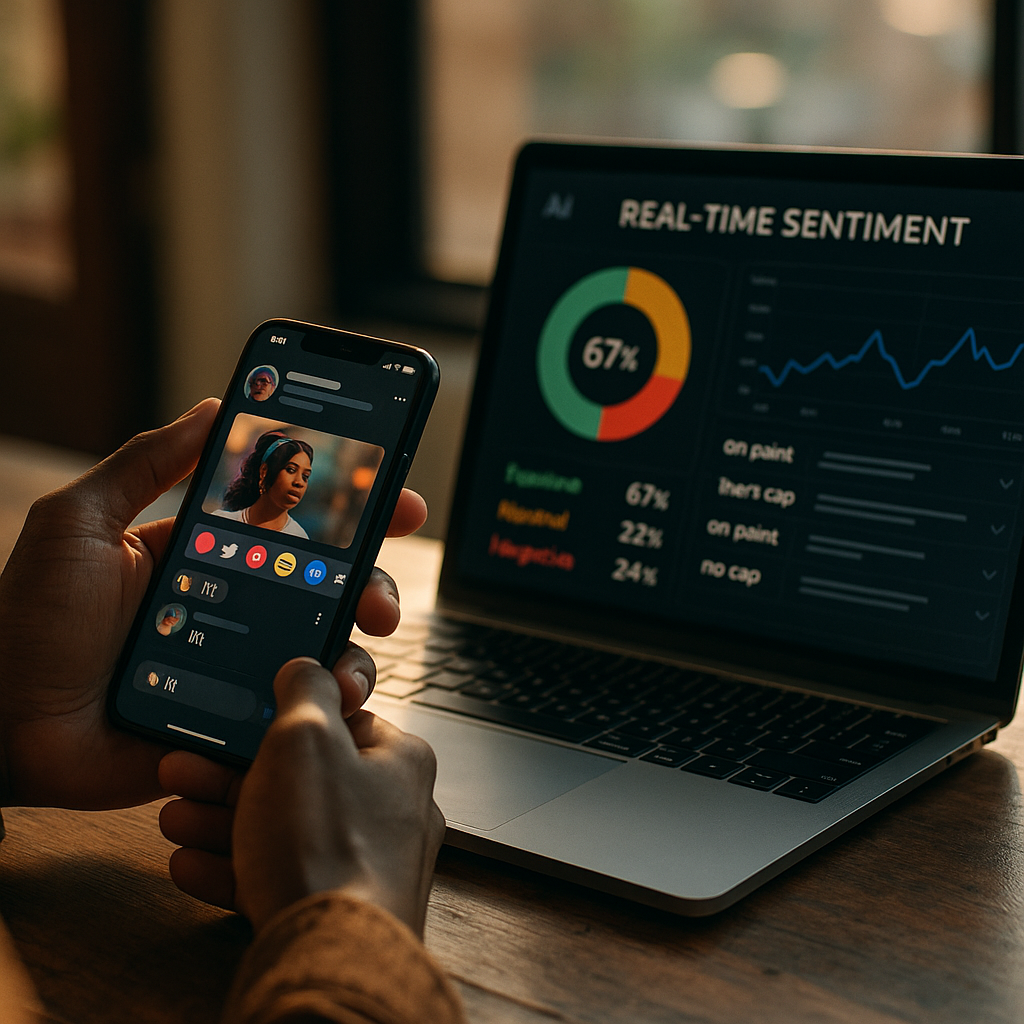
AI For Contextual Sentiment and Understanding Real Time Cultural Slang is reshaping how brands, platforms, and researchers interpret human language in 2026. Traditional sentiment models often miss irony, local references, and fast-moving slang, creating costly blind spots. The next generation of AI closes that gap by reading context, intent, and culture together. So how does it actually work in practice?
Contextual sentiment analysis: why older models fail
Basic sentiment analysis once relied on simple word matching. If a post included words like great, it was marked positive. If it used words like terrible, it was marked negative. That approach breaks quickly in real online conversation. A phrase such as that movie was sick may express praise, while great, just what I needed may signal frustration. Without context, systems misread intent.
Contextual sentiment analysis solves this by evaluating meaning at several levels at once. It looks at sentence structure, speaker intent, platform norms, current events, conversational history, and community-specific language patterns. Modern large language models and multimodal systems can process not only text, but also emojis, images, hashtags, audio tone, and posting sequences to infer the real emotional signal.
For businesses, this matters because poor sentiment detection leads to poor decisions. Customer care teams may escalate the wrong issues. Brand managers may misread campaign reception. Product teams may miss emerging complaints because users express dissatisfaction through humor or coded slang rather than direct criticism.
Helpful, high-quality AI systems now combine:
- Linguistic context such as syntax, semantic relationships, and negation
- Conversation context including earlier messages and replies
- Cultural context shaped by region, age group, identity, and platform behavior
- Temporal context that captures how meaning changes in real time
- Behavioral signals like engagement patterns and reaction formats
This shift reflects a broader lesson in trustworthy AI: language cannot be separated from the people and communities who use it. Systems that respect this complexity produce more reliable insights and fewer harmful errors.
Real-time cultural slang detection: the new language challenge
Real-time cultural slang detection has become essential because slang now evolves at internet speed. A phrase can move from a niche online community to mainstream advertising in weeks. Its meaning can also reverse depending on the audience. Words that appear negative in a dictionary may signal admiration among younger users. Terms that seem harmless in one market may be offensive in another.
AI trained only on static datasets struggles with this pace. By the time a conventional model is updated, the slang may already be outdated. In 2026, effective systems use continuous learning pipelines, human review loops, and retrieval-based methods that reference fresh language examples without retraining an entire model every time a phrase shifts.
To understand slang in real time, AI must ask practical questions:
- Who is speaking, and to whom?
- On which platform or channel?
- Is the phrase being used sincerely, ironically, or performatively?
- Has a recent cultural event changed the meaning?
- Does the term carry different signals across regions or communities?
For example, the same slang term can indicate approval on short-form video platforms, sarcasm on X-style micro-posts, and insider humor in gaming chats. If the model treats all uses as identical, sentiment scores become noisy and misleading.
This is why advanced systems increasingly rely on domain adaptation. A model for consumer beauty conversations should not interpret language exactly like one trained on financial forums or esports communities. Specialized tuning improves precision and reduces the risk of flattening diverse cultural expression into generic labels.
There is also a governance issue. Real-time slang detection should not become a tool for over-policing communities or misclassifying marginalized speech. Teams need clear standards for fairness, transparency, and human escalation, especially when outputs affect moderation, safety, or reputation.
Natural language understanding for social listening and customer insight
Natural language understanding for social listening has moved beyond simple mention tracking. In 2026, organizations want to know not just what people are saying, but what they mean, why they mean it, and whether that meaning is changing. This is where contextual AI delivers measurable value.
Social listening platforms that integrate contextual sentiment and slang interpretation can identify weak signals earlier. A sudden increase in playful mockery, coded complaints, or ironic praise may point to product friction before formal support tickets rise. That gives teams time to investigate and respond.
Use cases include:
- Brand health monitoring to distinguish genuine praise from sarcastic backlash
- Customer experience analysis to detect hidden frustration in casual language
- Trend forecasting to spot emerging phrases tied to products, creators, or movements
- Crisis detection to identify shifts in tone before a reputational issue escalates
- Audience research to understand how different communities describe the same experience
A useful implementation does not rely on sentiment scores alone. Strong teams pair quantitative dashboards with qualitative review. They audit sample conversations, compare outputs across audience segments, and test whether the model explains its reasoning well enough for decision-makers to trust it.
This aligns with Google’s helpful content and EEAT principles. Readers and users benefit when content and tools are built from demonstrated expertise, real-world experience, and transparent methods. If an organization claims its AI understands audience sentiment, it should be able to explain how the system was trained, where it performs well, and where human judgment still matters.
That balance is critical. AI can process volume and speed far beyond any manual team, but humans remain better at interpreting nuance in sensitive or ambiguous cases. The most effective workflows treat AI as an intelligent triage and analysis layer, not a final authority on culture.
Multilingual AI sentiment models and cross-cultural nuance
Multilingual AI sentiment models face an even harder challenge: language meaning does not transfer cleanly across borders. Direct translation often strips away tone, humor, and social context. A phrase that reads neutral in English may carry strong emotional force in Arabic, Spanish, Hindi, or Japanese. Slang can be hyperlocal, and bilingual communities often blend languages in the same sentence.
That means organizations operating internationally need models designed for cross-cultural nuance, not just machine translation plus sentiment scoring. High-performing multilingual systems account for:
- Code-switching when speakers alternate between languages
- Regional dialects that shift vocabulary and emotional intensity
- Local references tied to media, politics, sports, or neighborhood identity
- Platform conventions that vary by country and app ecosystem
- Emoji and meme usage which often changes meaning across cultures
For a global brand, this is not an academic detail. Misreading emotional tone in one market can distort campaign analysis, customer support prioritization, and public relations strategy. A launch that appears successful in translated dashboards may actually be receiving skeptical or mocking responses locally.
Experience matters here. Teams that work closely with native-language reviewers, local market specialists, and ongoing annotation programs consistently produce better outcomes than teams that depend on one universal model. Human-in-the-loop review is especially important for low-resource languages and communities underrepresented in public training data.
There is also a trust dimension. People notice when AI misunderstands them. If a system repeatedly misclassifies community language, users lose confidence quickly. Accurate multilingual understanding supports not only analytics but also credibility.
AI model training for slang: data quality, safety, and trust
AI model training for slang depends on data quality more than most teams expect. Slang is messy, contextual, and often short-lived. If the training data is stale, overly formal, or biased toward a narrow user base, the model will underperform in the exact situations where nuance matters most.
Robust training pipelines in 2026 typically include several layers:
- Fresh data collection from relevant public and permissioned sources
- Community-aware annotation by reviewers who understand the culture and platform
- Temporal labeling to track how meaning changes over time
- Bias and fairness testing to reduce harmful misclassification
- Red-team evaluation for sarcasm, coded speech, ambiguity, and edge cases
- Human escalation rules for sensitive topics such as harassment, self-harm, or identity language
Data governance should be explicit. Organizations need to document source quality, consent boundaries, model limitations, and intended use. This is part of building trustworthy systems under EEAT-aligned standards. Expertise is not just technical ability; it includes responsible handling of data, clear disclosure, and operational accountability.
Another best practice is explainability. Stakeholders should be able to understand why the system labeled a message as positive, negative, sarcastic, or uncertain. Explainable outputs make it easier to catch errors, improve training, and avoid blind trust in scores that may hide uncertainty.
Teams should also monitor model drift continuously. A phrase that signaled excitement last quarter may now be used dismissively. Drift alerts, benchmark refreshes, and recurring human audits help keep performance aligned with current language rather than frozen snapshots of the past.
In short, the strongest AI systems for cultural language understanding are not just bigger models. They are better-maintained systems with higher-quality data, sharper oversight, and clearer boundaries.
Real-time sentiment AI implementation: what businesses should do next
Real-time sentiment AI implementation works best when tied to a clear business objective. Companies often start too broadly, trying to understand all language across all channels at once. A better approach is to begin with a focused use case where contextual understanding creates immediate value.
Strong starting points include customer support deflection analysis, campaign response tracking, creator partnership monitoring, and community moderation support. From there, teams can define success metrics such as improved classification accuracy, faster issue detection, lower false positives, or stronger customer satisfaction outcomes.
To implement effectively:
- Choose a narrow pilot with measurable impact
- Benchmark against human review before deployment
- Segment by audience and platform rather than using one universal logic
- Build human oversight into sensitive workflows
- Track drift and retrain regularly as slang evolves
- Document limitations so teams know when not to rely on the model
Leaders should also ask whether the model supports decisions or automates them. Supporting decisions is lower risk and often more effective early on. For example, surfacing likely sarcastic complaints for agent review is safer than auto-replying to them with full confidence.
The long-term opportunity is significant. Organizations that can read emotion and cultural language accurately gain a sharper view of customers, trends, and brand perception. But the advantage comes from disciplined execution, not hype. Useful AI is specific, tested, supervised, and updated in line with how people actually speak.
As digital communication becomes more fluid and culturally layered, the companies that invest in contextual understanding will make better decisions faster. They will not just hear audiences. They will understand them.
FAQs about contextual sentiment AI and cultural slang
What is contextual sentiment analysis?
Contextual sentiment analysis is the process of identifying emotional tone by considering surrounding meaning, speaker intent, conversation history, platform norms, and cultural signals instead of relying only on individual words.
Why is slang hard for AI to understand?
Slang changes quickly, varies across communities, and often depends on irony, identity, and current events. The same phrase can mean different things on different platforms or in different regions.
Can AI detect sarcasm accurately?
AI can detect sarcasm better than older keyword-based tools, especially when it has access to conversational and cultural context. However, sarcasm remains difficult, so human review is still important in high-stakes use cases.
How do businesses use real-time cultural slang detection?
Businesses use it for social listening, customer experience analysis, moderation support, campaign tracking, crisis detection, and audience research. It helps teams understand what users really mean in fast-moving online conversations.
Does multilingual sentiment analysis require more than translation?
Yes. Translation alone often misses emotion, humor, and local context. Effective multilingual sentiment analysis needs native-language data, regional tuning, and human reviewers who understand cultural nuance.
What are the risks of using AI for slang and sentiment?
Risks include bias, cultural misclassification, overconfidence, privacy issues, and harmful moderation decisions. These risks can be reduced through better data governance, fairness testing, explainability, and human oversight.
How often should sentiment AI models be updated?
They should be monitored continuously and refreshed regularly. In fast-changing environments such as social media, language drift can happen quickly, so benchmarks, annotations, and review cycles should be ongoing.
What should companies look for in a sentiment AI solution?
Look for contextual understanding, multilingual support, explainability, drift monitoring, human-in-the-loop workflows, strong privacy standards, and evidence that the model performs well on your specific audience and channels.
AI for contextual sentiment and real-time cultural slang understanding gives organizations a more accurate view of what people mean, not just what they say. The key takeaway is simple: success depends on context, current data, and human oversight. Businesses that combine these elements can improve customer insight, reduce misreads, and build more trustworthy AI systems in 2026.
Top Influencer Marketing Agencies
The leading agencies shaping influencer marketing in 2026
Agencies ranked by campaign performance, client diversity, platform expertise, proven ROI, industry recognition, and client satisfaction. Assessed through verified case studies, reviews, and industry consultations.
Moburst

-
2

The Shelf
Boutique Beauty & Lifestyle Influencer AgencyA data-driven boutique agency specializing exclusively in beauty, wellness, and lifestyle influencer campaigns on Instagram and TikTok. Best for brands already focused on the beauty/personal care space that need curated, aesthetic-driven content.Clients: Pepsi, The Honest Company, Hims, Elf Cosmetics, Pure LeafVisit The Shelf → -
3

Audiencly
Niche Gaming & Esports Influencer AgencyA specialized agency focused exclusively on gaming and esports creators on YouTube, Twitch, and TikTok. Ideal if your campaign is 100% gaming-focused — from game launches to hardware and esports events.Clients: Epic Games, NordVPN, Ubisoft, Wargaming, Tencent GamesVisit Audiencly → -
4

Viral Nation
Global Influencer Marketing & Talent AgencyA dual talent management and marketing agency with proprietary brand safety tools and a global creator network spanning nano-influencers to celebrities across all major platforms.Clients: Meta, Activision Blizzard, Energizer, Aston Martin, WalmartVisit Viral Nation → -
5

The Influencer Marketing Factory
TikTok, Instagram & YouTube CampaignsA full-service agency with strong TikTok expertise, offering end-to-end campaign management from influencer discovery through performance reporting with a focus on platform-native content.Clients: Google, Snapchat, Universal Music, Bumble, YelpVisit TIMF → -
6

NeoReach
Enterprise Analytics & Influencer CampaignsAn enterprise-focused agency combining managed campaigns with a powerful self-service data platform for influencer search, audience analytics, and attribution modeling.Clients: Amazon, Airbnb, Netflix, Honda, The New York TimesVisit NeoReach → -
7

Ubiquitous
Creator-First Marketing PlatformA tech-driven platform combining self-service tools with managed campaign options, emphasizing speed and scalability for brands managing multiple influencer relationships.Clients: Lyft, Disney, Target, American Eagle, NetflixVisit Ubiquitous → -
8

Obviously
Scalable Enterprise Influencer CampaignsA tech-enabled agency built for high-volume campaigns, coordinating hundreds of creators simultaneously with end-to-end logistics, content rights management, and product seeding.Clients: Google, Ulta Beauty, Converse, AmazonVisit Obviously →