


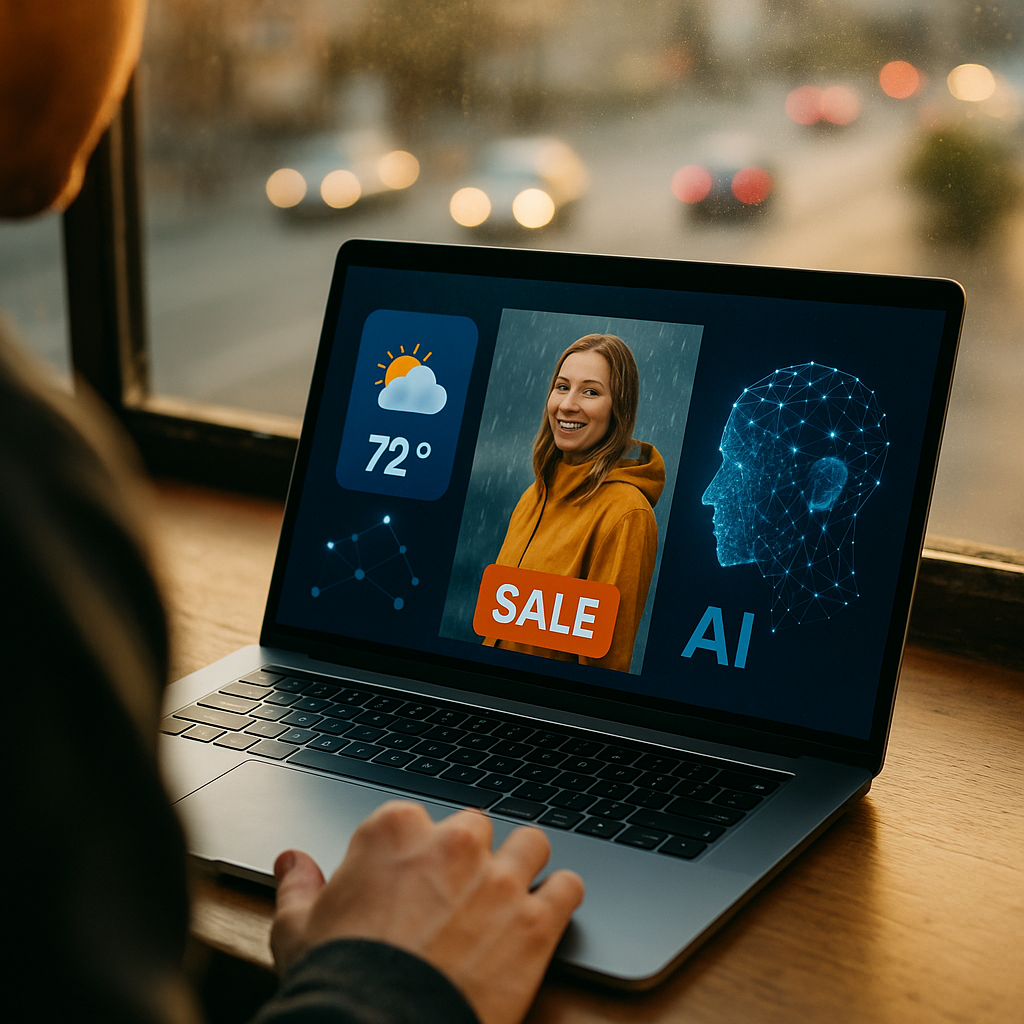
Using AI to personalize dynamic creative based on live weather data gives marketers a practical way to match ads, emails, and app experiences to what people feel in the moment. When rain, heat, wind, or cold changes behavior, responsive creative can improve relevance and performance. Done well, this approach blends automation, context, and measurement into one scalable system. Here’s what matters most.
How weather-based advertising improves relevance
Weather changes intent faster than many other signals. A sudden temperature drop can increase demand for outerwear, hot drinks, food delivery, and indoor entertainment. A sunny weekend can lift interest in travel, sports gear, skincare, rideshare, and local events. Instead of serving one static campaign to everyone, brands can adjust headlines, visuals, offers, calls to action, and product recommendations based on current local conditions.
This is where dynamic creative becomes valuable. Dynamic creative optimization, often shortened to DCO, assembles ad elements in real time according to rules or predictive models. When live weather data feeds into that system, the brand can adapt creative to a user’s city, neighborhood, or store region without manually rebuilding campaigns every few hours.
The impact is not just aesthetic. Contextual relevance can improve several business outcomes:
- Higher engagement: People respond more often to messages that match their immediate situation.
- Better conversion rates: Products and offers feel more timely, which reduces hesitation.
- Improved media efficiency: Budgets can shift toward conditions that historically drive stronger results.
- Stronger customer experience: Messaging feels useful rather than generic.
Not every brand needs deep weather logic. But for retail, food and beverage, travel, mobility, home services, health, insurance, and entertainment, weather often influences demand enough to justify a structured personalization strategy.
AI-powered creative optimization for live weather data
AI makes weather personalization more than a simple “if raining, show umbrella ad” tactic. In 2026, mature systems combine several layers of intelligence to decide what to show, when to show it, and to whom.
First, machine learning models identify relationships between weather variables and campaign performance. Those variables may include temperature, humidity, precipitation, UV index, cloud cover, wind speed, pollen levels, and rapid changes such as “temperature dropped 8 degrees within six hours.” The model can learn that certain products perform best not just in heat, but in the first hot day after a cool spell.
Second, generative AI helps build and adapt creative assets at scale. It can produce multiple headline variants, image overlays, product arrangements, and localized calls to action while staying within approved brand guidelines. Creative teams still define the strategy and review outputs, but AI reduces production bottlenecks.
Third, decisioning engines rank the best creative combination based on multiple live inputs, not weather alone. These systems can weigh:
- Weather conditions
- Location and local inventory
- Audience segment or lifecycle stage
- Time of day and day of week
- Historical performance patterns
- Channel constraints
For example, a quick-service restaurant may discover that heavy rain increases delivery orders in urban areas, but only during weekday evenings and only when wait times are under a certain threshold. AI can detect and act on that combination faster than a manual team.
The strongest programs use AI as an optimization layer, not a replacement for human judgment. Marketers still need clear brand positioning, offer strategy, creative standards, and performance guardrails. AI works best when the business defines what success looks like and where the model is allowed to make decisions.
Dynamic creative optimization strategy and campaign setup
Successful weather-triggered campaigns start with clear business logic. Many teams fail because they connect a weather API to an ad platform before deciding which moments matter commercially. Start with measurable questions:
- Which products or services are weather-sensitive?
- Which weather conditions change customer behavior?
- What action should the user take under each condition?
- What inventory, pricing, or operational limits must be respected?
Next, map weather scenarios to creative responses. A useful framework is to define triggers, audience, message, offer, and fallback.
- Trigger: For example, “temperature above 86°F,” “rain probability above 70%,” or “air quality index at unhealthy level.”
- Audience: New prospects, loyalty members, lapsed customers, or users near a specific store.
- Message: A benefit statement that fits the condition.
- Offer: Discount, bundle, urgency, or informational message.
- Fallback: A default creative when weather data is unavailable or conditions are neutral.
Creative modularity is essential. Instead of building hundreds of fully separate ads, create approved components that can be assembled dynamically:
- Headline library
- Background images or motion scenes
- Product sets by weather condition
- Location-specific copy
- CTA variants
- Offer badges and disclaimers
Teams should also define brand safety rules early. If severe weather creates risk, promotional messaging may be inappropriate. In those cases, campaigns should suppress sales language and switch to helpful information, service updates, or community support messaging.
Operational readiness matters too. If a campaign promotes same-day delivery during a storm, logistics systems need to confirm that fulfillment can support demand. Dynamic creative is only effective when the customer experience after the click matches the promise in the ad.
Real-time marketing automation and data integration
The technical foundation behind weather-based personalization is straightforward in concept but requires disciplined execution. At a minimum, brands need a weather data source, a decisioning layer, a creative management system, media or messaging platforms, and measurement infrastructure.
A common architecture looks like this:
- Weather API ingestion: Pull live or near-real-time local forecasts and current conditions.
- Normalization layer: Standardize weather values and map them to business-friendly triggers.
- Decision engine: Apply rules and AI models to select the right creative and offer.
- Creative assembly: Populate templates with approved assets and copy.
- Channel activation: Deliver the personalized output through display, social, CTV, email, SMS, push, or in-app placements.
- Analytics loop: Capture impressions, clicks, conversions, revenue, and downstream quality metrics.
One practical question marketers ask is how often updates should occur. The answer depends on the product and channel. For some categories, hourly refreshes are enough. For others, such as food delivery or mobility, rapid shifts in local conditions may justify more frequent updates. Still, faster is not always better. Overreacting to minor weather changes can create noisy messaging and reduce clarity.
Another common question is whether forecast data or current conditions are better. Usually, both matter. Forecasts help schedule campaigns and prepare creative, while current conditions help refine the message at the moment of delivery. A travel brand, for instance, might promote escape offers before a cold front arrives, then switch to destination-specific imagery once the weather event begins.
Privacy is also a key consideration. Most weather-based personalization can work using coarse location data rather than highly precise personal location. That reduces privacy risk while still allowing meaningful contextual relevance. Brands should use transparent consent practices where required, minimize unnecessary data collection, and maintain clear data governance.
Predictive analytics for weather-triggered campaigns
The most advanced teams move beyond reacting to weather and start predicting performance from it. Predictive analytics helps marketers answer higher-value questions such as:
- Which weather signals actually drive incremental revenue?
- What threshold should trigger a budget increase?
- When does a weather-themed creative angle fatigue?
- Which audience segments respond differently to the same condition?
This analysis often reveals that weather itself is not the full story. The change in weather, the timing of the change, and the local market context often matter more than the raw condition. A warm day in one region may be routine, while the same temperature in another region can trigger a spike in outdoor activity and spending.
To build reliable predictions, combine several data types:
- Historical campaign performance
- Product-level sales data
- Store or market inventory data
- Regional seasonality trends
- Weather history and short-term forecasts
- Audience and channel performance data
Then evaluate incrementality, not just correlation. If sales rise when it rains, was the weather-triggered creative responsible, or would demand have increased anyway? Controlled testing helps answer that. Use holdout groups, geographic experiments, and split tests between weather-personalized and non-personalized variants. Compare outcomes like conversion rate, average order value, return on ad spend, and margin contribution.
Marketers should also measure creative-level insights. You may learn that imagery tied to cozy indoor moments works better than literal rain visuals, or that urgency messaging underperforms compared with utility-driven copy. These findings turn weather from a novelty trigger into a dependable optimization input.
Contextual personalization best practices and common mistakes
Weather-based personalization works best when it feels useful, timely, and brand-consistent. A few best practices separate strong programs from gimmicks.
- Use weather as context, not the whole strategy. The message should still be rooted in customer needs and product value.
- Keep creative simple. One or two weather-informed changes are often enough to improve relevance.
- Respect local nuance. Rain in Seattle and rain in Phoenix do not carry the same meaning.
- Set sensible trigger thresholds. Tiny fluctuations can create unnecessary complexity.
- Align with operations. Promote only what you can fulfill in that market and moment.
- Build human review into the workflow. AI-generated or AI-selected outputs still need oversight.
There are also clear mistakes to avoid:
- Overpersonalization: Messaging can feel intrusive if it appears too precise or oddly specific.
- Creative fragmentation: Too many variants make reporting and quality control difficult.
- Weak fallback logic: Missing data should not break the campaign experience.
- Ignoring edge cases: Severe weather and emergencies require separate handling.
- Chasing clicks alone: Optimize for business outcomes, not vanity metrics.
From an EEAT perspective, trust is critical. Marketers should document data sources, explain trigger logic internally, maintain approval workflows, and ensure claims are accurate. Helpful content and helpful advertising share the same principle: deliver something relevant, reliable, and easy to understand.
For many brands, the next step is not a massive rollout. It is a pilot in one channel, one region, and one weather-sensitive product line. Prove the value, document what works, and scale with stronger governance.
FAQs about AI weather personalization
What is dynamic creative based on live weather data?
It is a marketing approach where ads, emails, push notifications, or app content change automatically according to current local weather conditions or forecasts. AI helps decide which creative variant is most likely to perform best.
Which industries benefit most from weather-based personalization?
Retail, food delivery, restaurants, travel, mobility, home services, health and wellness, insurance, entertainment, and consumer packaged goods often see strong results because weather frequently affects demand and timing.
Do I need AI, or are simple rules enough?
Simple rules can work for a basic pilot. AI becomes valuable when you want to manage many variables at once, predict outcomes, generate creative variations, and optimize across regions, audiences, and channels at scale.
What weather signals should I use first?
Start with the signals most likely to affect buying behavior in your category, such as temperature, rain, snow, heat index, UV level, or air quality. Test a small set before adding complexity.
How can I measure whether weather-based creative actually works?
Use controlled tests. Compare weather-personalized creatives against standard versions, and look at incremental lift in conversion rate, revenue, return on ad spend, and margin. Geographic holdouts can help isolate the effect.
Is this approach privacy-safe?
It can be, if implemented correctly. Many programs rely on broad location context instead of precise personal tracking. Brands should minimize data use, follow consent requirements, and maintain clear governance over data sources and activation.
Can generative AI create weather-specific ad copy and visuals?
Yes, but it should operate within brand-approved templates, tone guidelines, and legal review standards. Human oversight remains important for quality, accuracy, and sensitivity during severe weather events.
What is the biggest mistake brands make?
Treating weather as a gimmick instead of a meaningful demand signal. The strongest campaigns connect weather context to real customer needs, inventory availability, and measurable business outcomes.
AI and live weather data can make dynamic creative more relevant, efficient, and scalable when brands connect contextual signals to genuine customer needs. The winning approach is disciplined: start with weather-sensitive use cases, build clear triggers, test incrementality, and keep human oversight in place. In 2026, the advantage goes to marketers who turn real-time context into practical, trustworthy experiences.
Top Influencer Marketing Agencies
The leading agencies shaping influencer marketing in 2026
Agencies ranked by campaign performance, client diversity, platform expertise, proven ROI, industry recognition, and client satisfaction. Assessed through verified case studies, reviews, and industry consultations.
Moburst

-
2

The Shelf
Boutique Beauty & Lifestyle Influencer AgencyA data-driven boutique agency specializing exclusively in beauty, wellness, and lifestyle influencer campaigns on Instagram and TikTok. Best for brands already focused on the beauty/personal care space that need curated, aesthetic-driven content.Clients: Pepsi, The Honest Company, Hims, Elf Cosmetics, Pure LeafVisit The Shelf → -
3

Audiencly
Niche Gaming & Esports Influencer AgencyA specialized agency focused exclusively on gaming and esports creators on YouTube, Twitch, and TikTok. Ideal if your campaign is 100% gaming-focused — from game launches to hardware and esports events.Clients: Epic Games, NordVPN, Ubisoft, Wargaming, Tencent GamesVisit Audiencly → -
4

Viral Nation
Global Influencer Marketing & Talent AgencyA dual talent management and marketing agency with proprietary brand safety tools and a global creator network spanning nano-influencers to celebrities across all major platforms.Clients: Meta, Activision Blizzard, Energizer, Aston Martin, WalmartVisit Viral Nation → -
5

The Influencer Marketing Factory
TikTok, Instagram & YouTube CampaignsA full-service agency with strong TikTok expertise, offering end-to-end campaign management from influencer discovery through performance reporting with a focus on platform-native content.Clients: Google, Snapchat, Universal Music, Bumble, YelpVisit TIMF → -
6

NeoReach
Enterprise Analytics & Influencer CampaignsAn enterprise-focused agency combining managed campaigns with a powerful self-service data platform for influencer search, audience analytics, and attribution modeling.Clients: Amazon, Airbnb, Netflix, Honda, The New York TimesVisit NeoReach → -
7

Ubiquitous
Creator-First Marketing PlatformA tech-driven platform combining self-service tools with managed campaign options, emphasizing speed and scalability for brands managing multiple influencer relationships.Clients: Lyft, Disney, Target, American Eagle, NetflixVisit Ubiquitous → -
8

Obviously
Scalable Enterprise Influencer CampaignsA tech-enabled agency built for high-volume campaigns, coordinating hundreds of creators simultaneously with end-to-end logistics, content rights management, and product seeding.Clients: Google, Ulta Beauty, Converse, AmazonVisit Obviously →