


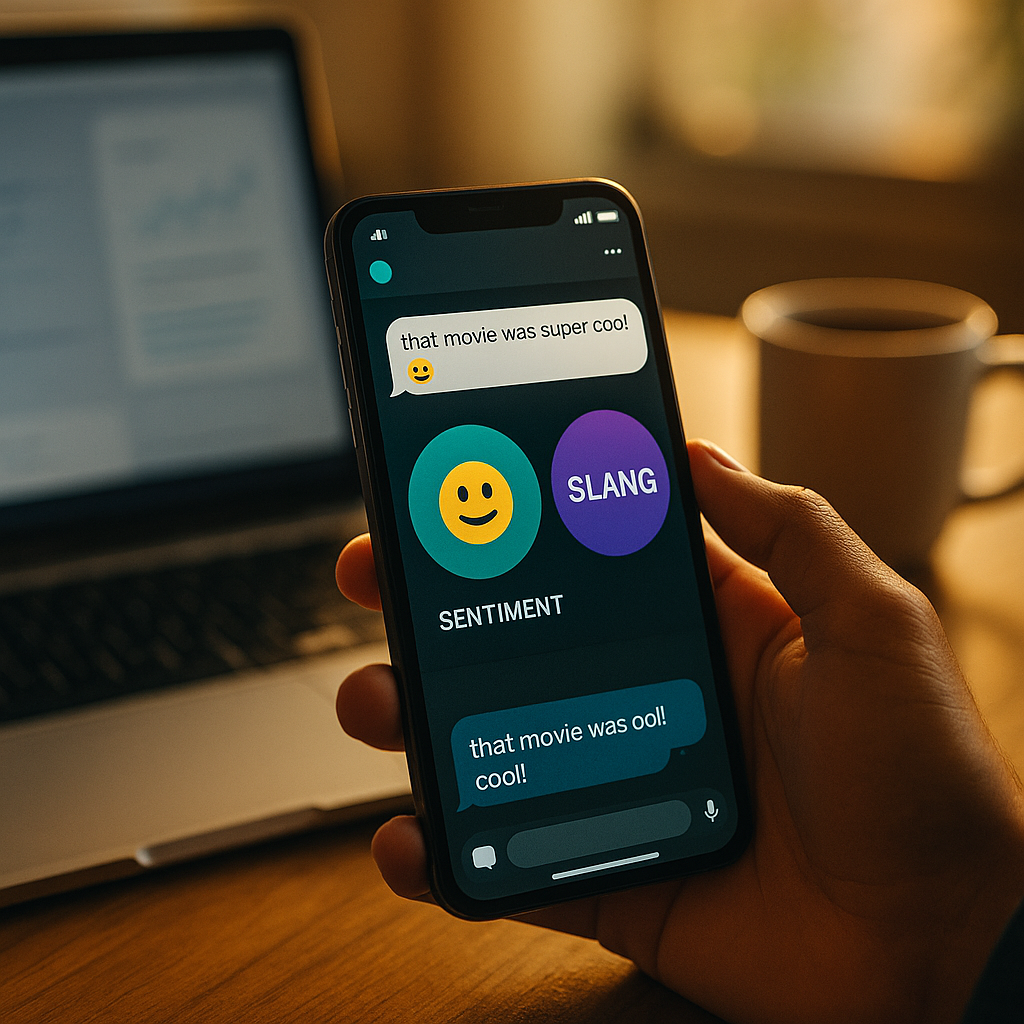
Brands, platforms, and public institutions now rely on AI For Contextual Sentiment and Understanding Real Time Cultural Slang to interpret what people actually mean, not just what they type. In 2026, language moves at feed speed, shaped by niche communities, memes, and shifting norms. The challenge is no longer collecting conversations. It is decoding context before relevance disappears. So how can AI keep up?
Contextual sentiment analysis in a fast-moving language landscape
Traditional sentiment analysis often classifies text as positive, negative, or neutral by matching words to predefined scores. That approach breaks quickly when people use irony, coded humor, in-group slang, or reclaimed language. A phrase that looks negative in isolation may signal approval inside a specific community. Likewise, a positive-sounding phrase may be sarcastic in context.
Contextual sentiment analysis solves this by looking beyond isolated words. Modern systems evaluate surrounding phrases, speaker intent, conversational history, platform norms, and audience cues. They process emojis, abbreviations, punctuation, repeated letters, GIF descriptions, and even reply chains to estimate the emotional meaning of a message more accurately.
For example, words like insane, dead, cooked, or crazy may signal admiration, exhaustion, mockery, or criticism depending on who says them and where they appear. The same term can carry one meaning on a gaming forum, another on short-form video comments, and another in customer support chats.
In practice, organizations use contextual sentiment models to:
- Monitor brand perception across social and community channels
- Detect shifts in public mood during live events
- Improve customer support routing and prioritization
- Reduce false positives in moderation systems
- Understand emerging audience language before campaigns launch
The strongest systems combine large language models with domain-specific tuning. They do not just ask whether language sounds positive or negative. They ask who is speaking, what cultural frame they are using, and how that meaning changes in real time.
Real-time cultural slang detection and why static dictionaries fail
Real-time cultural slang detection has become essential because slang now evolves across micro-communities at extreme speed. What starts in one creator circle or regional community can spread globally within hours, then change meaning within days. Static lexicons cannot keep up.
Dictionary-based approaches usually fail for three reasons. First, they lag behind actual usage. By the time a term is added, its meaning may already have shifted. Second, they ignore audience segmentation. A term can mean different things across age groups, regions, and subcultures. Third, they struggle with multimodal communication, where meaning depends on an image, audio trend, or meme format rather than the text alone.
Effective slang recognition in 2026 depends on dynamic inputs such as:
- Live social and community data streams
- Topic clustering and semantic similarity mapping
- Geographic and demographic usage patterns
- Creator and influencer language networks
- Time-sensitive co-occurrence analysis
These systems identify not only new terms but also semantic drift, meaning when familiar words take on new emotional or cultural significance. That matters for brands and analysts because misreading slang can lead to poor campaign choices, inaccurate reporting, or moderation errors that alienate users.
Consider a customer intelligence team tracking reactions to a product launch. A static system might flag certain slang-heavy comments as hostile. A real-time model may recognize them as praise common within a target audience. That difference affects dashboards, executive decisions, and public responses.
To stay reliable, slang-aware AI needs continuous retraining, active human review, and clear thresholds for uncertainty. When a model lacks confidence, it should escalate for human interpretation rather than forcing a weak classification.
Natural language understanding for social media and community platforms
Natural language understanding for social media requires more than language fluency. It requires cultural fluency. Social platforms are not uniform environments. Each has its own pace, grammar, humor, and reward system. Users write differently in livestream chats, private communities, review sites, and public comment threads.
Modern natural language understanding systems interpret language through layered context:
- Linguistic context: syntax, phrasing, references, and ambiguity
- Conversation context: previous messages, reply targets, and thread dynamics
- Platform context: channel norms, post formats, and native behaviors
- Cultural context: community identity, shared jokes, and current discourse
- Temporal context: whether a term is trending, fading, or being redefined
This layered approach improves sentiment scoring, intent recognition, and topic modeling. It also helps answer practical questions that leaders care about. Is a spike in mentions a sign of excitement or backlash? Is the audience mocking a campaign or embracing it? Are users adopting a phrase organically or using it to criticize a brand?
For customer experience teams, contextual understanding can improve chatbot performance. Instead of reacting literally to slang-heavy complaints, support AI can detect urgency, frustration, or humor with greater precision. For trust and safety teams, it can distinguish playful banter from harassment patterns more effectively, especially when harmful language is coded or indirect.
Still, social language is messy by design. That is why high-performing systems pair model predictions with governance rules, annotation standards, and ongoing quality checks. Helpful AI is not just accurate in a benchmark. It is dependable in a live environment where meaning is unstable.
Multilingual sentiment AI across regions, dialects, and subcultures
Multilingual sentiment AI is now central to global communication analysis because slang rarely stays within one language. Online culture blends English terms with local dialects, transliteration, abbreviations, and code-switching. A single post may combine multiple languages, regional references, and internet-native shorthand.
This creates a serious challenge. Many models perform well on standard language benchmarks but struggle when users write the way they actually speak online. Regional humor, local irony, and mixed-language slang can distort results if training data lacks diversity.
To address this, teams increasingly build multilingual pipelines that include:
- Region-specific corpora from public digital channels
- Annotations from native speakers familiar with local internet culture
- Code-switching detection and token-level language identification
- Dialect-sensitive embeddings and adaptation layers
- Continuous evaluation on fresh, community-relevant samples
These practices improve not just accuracy but fairness. Without them, AI may over-penalize marginalized dialects, misclassify reclaimed language, or misread sentiment from communities that communicate differently from dominant training datasets.
For enterprises, multilingual cultural understanding supports better localization, market research, and risk monitoring. For public sector and health communication, it helps teams interpret public responses in ways that reflect actual community voice rather than formal language expectations.
Experience matters here. Teams that deploy multilingual sentiment systems successfully tend to combine data science expertise with local cultural input. They test models with real edge cases, update taxonomies often, and avoid assuming that one global sentiment framework fits every audience.
AI governance, bias reduction, and trust in cultural language models
AI governance for sentiment analysis is no longer optional. When models interpret cultural slang and public emotion, errors can produce reputational harm, skewed strategy, and discriminatory outcomes. Organizations need safeguards that make systems useful, reviewable, and accountable.
Strong governance starts with data transparency. Teams should know where language samples come from, whether consent and platform policies were respected, and which communities are underrepresented. If a dataset overindexes one region or age group, the model may generalize poorly in other contexts.
Bias reduction also depends on annotation quality. Labeling sarcasm, humor, or coded speech requires clear guidelines and culturally informed reviewers. Inconsistent labels create noisy training signals, which reduce reliability in production. Many organizations now use layered review processes, where uncertain or high-impact cases receive specialist review before being added to training sets.
Key governance practices include:
- Documenting model scope, limitations, and intended use
- Monitoring performance across regions and demographic proxies
- Tracking drift when slang meaning changes over time
- Setting escalation paths for ambiguous or high-risk outputs
- Auditing moderation and sentiment decisions regularly
Trust also depends on explainability. Stakeholders should understand why a model assigned a sentiment score or flagged a term as risky. While not every deep model can provide simple reasoning, teams can still surface confidence levels, similar examples, or influential context factors to support review.
Google’s helpful content principles align closely with this approach. Content and systems should demonstrate experience, expertise, authoritativeness, and trustworthiness. In AI terms, that means grounding decisions in quality data, testing with domain experts, disclosing limitations, and designing for real user benefit rather than automation for its own sake.
Business applications of cultural sentiment intelligence in 2026
Cultural sentiment intelligence now supports decisions across marketing, product, customer care, policy, and media operations. The value is not just in listening to audiences. It is in understanding them while meaning is still actionable.
For marketing teams, contextual sentiment analysis improves campaign planning and creative testing. Teams can evaluate how different audiences interpret slogans, visuals, and creator partnerships before scaling spend. They can also identify whether community adoption is genuine, ironic, or adversarial.
For product teams, real-time language analysis reveals how users discuss friction points, workarounds, and feature requests in community-driven language. This often uncovers issues that formal surveys miss. People may not describe a bug in technical terms, but they will describe how it made them feel and how it disrupted their routine.
For customer service, slang-aware AI helps classify inbound conversations more accurately and prioritize urgent cases. It can detect hidden frustration in casual phrasing, reducing the risk of missing customers who sound joking but are close to churn.
For trust and safety teams, the biggest benefit is nuance. Harmful behavior is often indirect, coded, or context-dependent. Systems that understand evolving slang can support faster, fairer interventions, especially when paired with human moderation expertise.
To implement these capabilities well, organizations should:
- Define a narrow use case first, such as campaign monitoring or support triage
- Collect representative, permission-aware data from relevant channels
- Build human-in-the-loop review for ambiguous language
- Measure not just accuracy, but drift, fairness, and business outcomes
- Update models continuously as communities and language evolve
The takeaway is practical. AI can now interpret sentiment with far more nuance than earlier tools, but only when teams treat language as cultural data, not just text. The organizations that win in 2026 are the ones that combine advanced models with human judgment, local expertise, and strong operational discipline.
FAQs about AI, contextual sentiment, and real-time slang
What is contextual sentiment analysis?
Contextual sentiment analysis is the process of identifying emotional tone by considering surrounding language, speaker intent, platform norms, timing, and cultural cues instead of scoring words in isolation.
Why is real-time slang hard for AI to understand?
Slang changes quickly, varies by community, and often depends on irony, memes, or shared references. Static dictionaries and older models miss these shifts because they are not updated fast enough or lack cultural context.
Can AI detect sarcasm and irony accurately?
It can detect them better than earlier rule-based systems, especially when models use conversation history and platform context. However, sarcasm remains one of the hardest tasks, so human review is still important for high-stakes decisions.
How do companies use cultural sentiment intelligence?
Common uses include brand monitoring, campaign testing, customer support triage, moderation, product feedback analysis, market research, and crisis response.
Is multilingual slang analysis reliable?
It can be reliable when models are trained on region-specific data and reviewed by native speakers familiar with local internet culture. Performance drops when systems rely only on standard language datasets.
What are the biggest risks of using AI for sentiment and slang interpretation?
The main risks are bias, misclassification, privacy issues, overconfidence in ambiguous cases, and poor decisions based on incomplete cultural understanding. Governance and human oversight reduce these risks.
Does AI replace human cultural expertise?
No. AI increases speed and scale, but human experts remain essential for annotation, validation, edge-case review, and understanding fast-changing community norms.
AI can now read online language with far greater nuance, but success depends on context, culture, and continuous learning. The most effective systems blend contextual sentiment models, real-time slang tracking, multilingual coverage, and human oversight. In 2026, the winning approach is clear: treat language as living behavior, build for change, and never separate technical accuracy from cultural understanding.
Top Influencer Marketing Agencies
The leading agencies shaping influencer marketing in 2026
Agencies ranked by campaign performance, client diversity, platform expertise, proven ROI, industry recognition, and client satisfaction. Assessed through verified case studies, reviews, and industry consultations.
Moburst

-
2

The Shelf
Boutique Beauty & Lifestyle Influencer AgencyA data-driven boutique agency specializing exclusively in beauty, wellness, and lifestyle influencer campaigns on Instagram and TikTok. Best for brands already focused on the beauty/personal care space that need curated, aesthetic-driven content.Clients: Pepsi, The Honest Company, Hims, Elf Cosmetics, Pure LeafVisit The Shelf → -
3

Audiencly
Niche Gaming & Esports Influencer AgencyA specialized agency focused exclusively on gaming and esports creators on YouTube, Twitch, and TikTok. Ideal if your campaign is 100% gaming-focused — from game launches to hardware and esports events.Clients: Epic Games, NordVPN, Ubisoft, Wargaming, Tencent GamesVisit Audiencly → -
4

Viral Nation
Global Influencer Marketing & Talent AgencyA dual talent management and marketing agency with proprietary brand safety tools and a global creator network spanning nano-influencers to celebrities across all major platforms.Clients: Meta, Activision Blizzard, Energizer, Aston Martin, WalmartVisit Viral Nation → -
5

The Influencer Marketing Factory
TikTok, Instagram & YouTube CampaignsA full-service agency with strong TikTok expertise, offering end-to-end campaign management from influencer discovery through performance reporting with a focus on platform-native content.Clients: Google, Snapchat, Universal Music, Bumble, YelpVisit TIMF → -
6

NeoReach
Enterprise Analytics & Influencer CampaignsAn enterprise-focused agency combining managed campaigns with a powerful self-service data platform for influencer search, audience analytics, and attribution modeling.Clients: Amazon, Airbnb, Netflix, Honda, The New York TimesVisit NeoReach → -
7

Ubiquitous
Creator-First Marketing PlatformA tech-driven platform combining self-service tools with managed campaign options, emphasizing speed and scalability for brands managing multiple influencer relationships.Clients: Lyft, Disney, Target, American Eagle, NetflixVisit Ubiquitous → -
8

Obviously
Scalable Enterprise Influencer CampaignsA tech-enabled agency built for high-volume campaigns, coordinating hundreds of creators simultaneously with end-to-end logistics, content rights management, and product seeding.Clients: Google, Ulta Beauty, Converse, AmazonVisit Obviously →