


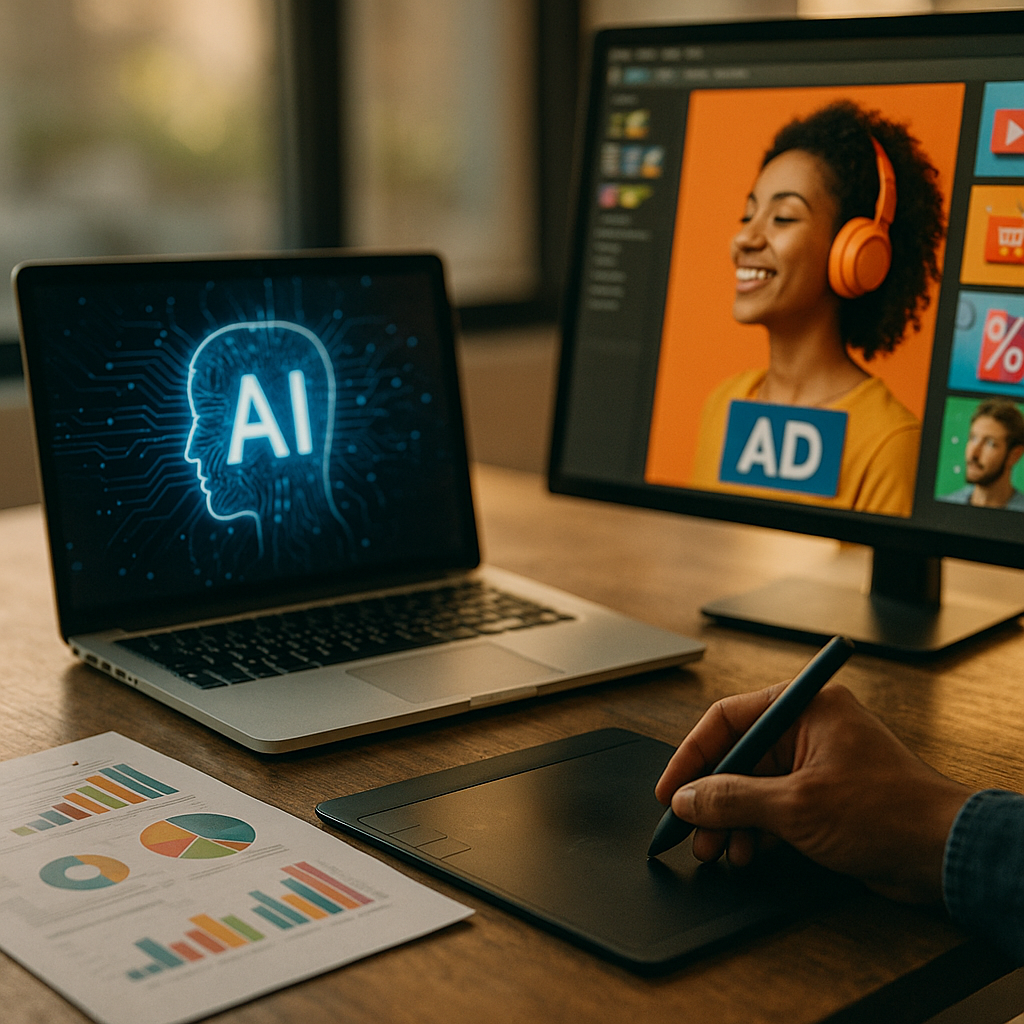
AI for ad creative evolution is changing how brands produce, test, and refine campaigns at scale in 2026. Instead of building one static concept and hoping it works, marketers can let models generate iterative variations based on performance signals, audience context, and channel requirements. The result is faster learning, stronger relevance, and a critical question: how should teams use it well?
Generative ad design: what iterative creative evolution actually means
Generative ad design is the process of using AI models to create multiple ad concepts, then improve them through repeated testing cycles. In practice, this means a model can produce dozens or hundreds of versions of a headline, visual layout, call to action, caption, background treatment, offer framing, or video opening. Teams do not replace strategy with automation. They use automation to expand creative options and shorten the path to a better-performing ad.
The key shift is from one-time production to continuous refinement. Traditional ad development often starts with a brief, moves through rounds of review, launches a limited set of assets, and then waits for enough performance data to justify updates. AI compresses that cycle. A brand can launch controlled creative families, collect early signals such as click-through rate, hold rate, conversion rate, thumb-stop rate, and cost per acquisition, and then feed those learnings into the next variation set.
This approach works because ad performance is rarely driven by a single big idea alone. It is often shaped by small details:
- Whether the product appears in the first two seconds
- Whether the headline emphasizes pain point or aspiration
- Whether social proof is explicit or implied
- Whether color contrast improves visual stopping power
- Whether the call to action feels urgent, clear, or low-friction
AI can surface and recombine those elements rapidly. But effective teams still define guardrails first. They decide what the brand stands for, what claims are allowed, which visual cues are on-brand, and which business outcomes matter most. In other words, models design variations; humans define the system they are allowed to evolve within.
Creative iteration at scale: how models generate better variations over time
Creative iteration at scale starts with a structured input. The strongest results usually come from a workflow that includes a detailed creative brief, audience segments, platform specifications, brand rules, historical performance data, and a clear success metric. When those inputs are weak, the output tends to be generic. When they are strong, the model can produce useful divergence without losing strategic intent.
A practical process often looks like this:
- Define the base concept. Establish the offer, audience, format, and core message.
- Map variable elements. Decide which components can change, such as hooks, visuals, proof points, pacing, or CTA language.
- Generate controlled variants. Ask the model to produce versions that isolate one or two variables at a time.
- Launch in measured cohorts. Test across matched audiences, placements, or geographies to keep comparisons meaningful.
- Read signal quality carefully. Separate noise from pattern by looking at enough volume and using platform-native diagnostics.
- Feed learnings back into prompts and creative rules. This is where evolution happens.
For example, a DTC brand may discover that product-first video intros outperform lifestyle-led intros for retargeting audiences, while prospecting audiences respond better to creator-style framing. The next AI prompt can reflect that finding and produce a new wave of assets built for each funnel stage.
This is why iterative variation is not the same as random content generation. The value comes from compounding learning. Every new version should be tied to a hypothesis. If the prior round suggested that shorter copy works better for mobile feeds but longer copy converts better on landing-page lead forms, then the next batch should test that insight deliberately. The model becomes a rapid execution layer for experimentation, not a replacement for analytical discipline.
Dynamic creative optimization: where AI fits in the testing workflow
Dynamic creative optimization has existed for years, but AI makes it more flexible and more useful. Older systems largely relied on predefined asset combinations. Today, models can create new combinations and, in some cases, entirely new executions informed by prior engagement patterns. That changes the scale of experimentation, especially for brands running multi-platform campaigns across paid social, display, connected TV, app install, and retail media.
Still, the best workflows combine automation with review. There are several reasons for this:
- Brand safety: A model can drift into claims, tone, or visual language that conflicts with legal or brand standards.
- Platform compliance: Different ad ecosystems have specific rules around text overlays, disclosures, targeting implications, and sensitive categories.
- Context accuracy: A model may create a persuasive asset that misrepresents the product or audience reality.
- Performance interpretation: Short-term engagement can be misleading if it does not correlate with qualified conversions or customer quality.
Strong teams therefore set up AI-assisted review layers. These often include approved claim libraries, prohibited phrase lists, visual style references, accessibility checks, and channel-specific output templates. Human reviewers then evaluate only the most promising candidates instead of inspecting every draft from scratch.
Another smart practice is to track performance at both the asset level and the creative principle level. Asset-level data tells you which specific ad won. Principle-level analysis tells you why. Did urgency language outperform educational framing? Did founder-led creative beat polished studio footage? Did subtitles improve completion rates on muted autoplay placements? Those insights help the next generation of AI outputs become more strategic.
AI marketing automation: balancing speed, brand control, and measurement
AI marketing automation can cut production time dramatically, but speed is only useful when paired with governance. If a team can create 500 ad variants in a day but cannot evaluate them properly, the workflow becomes inefficient. The goal is not maximum output. The goal is maximum useful learning per test cycle.
To make that possible, brands need a measurement framework before they scale generation. At minimum, that framework should answer:
- Which KPI determines success for this campaign?
- Which early metrics are directional only, and which are decision-grade?
- What audience split will allow a fair comparison?
- How long should a test run before the team acts?
- What amount of change justifies calling a result meaningful?
Marketers also need to account for creative fatigue. One reason AI-driven variation matters is that audience attention decays quickly. Even strong ads lose efficiency when seen too often. Models can help refresh assets before fatigue becomes expensive, while still preserving the visual and verbal cues that support brand recognition.
However, over-rotation creates its own problem. If every ad looks and sounds different, the campaign may gain novelty but lose memory structure. The best approach is a modular one: keep a recognizable set of brand anchors, then vary the peripheral elements around them. These anchors might include logo treatment, color signatures, mnemonic audio, product demonstration style, or a consistent value proposition. This allows the model to innovate without dissolving identity.
Teams should also evaluate downstream impact. A flashy ad that lowers cost per click but attracts low-intent users may hurt efficiency later in the funnel. Useful AI systems therefore connect creative performance to business outcomes such as qualified leads, revenue per user, retention, or lifetime value proxies. In 2026, this connection is no longer optional. It is what separates creative experimentation from creative waste.
Predictive creative analytics: using data to guide model-led design
Predictive creative analytics helps teams decide what to test next, not just what worked last time. By analyzing patterns across prior campaigns, AI can estimate which combinations of message, format, visual composition, and audience context are most likely to perform. This does not guarantee a winner, but it improves prioritization.
For instance, a subscription app might learn that ads featuring immediate product demonstration, concise benefit-led copy, and creator voiceover perform best in upper-funnel acquisition. A predictive system can then rank future concepts against that pattern and recommend where to allocate budget first.
This is especially valuable when teams face common follow-up questions:
- How many variations are too many? Enough to explore meaningful differences, but not so many that spend fragments and learning slows.
- What should the model vary first? Start with hooks, value propositions, and opening visuals because they often shape attention fastest.
- Should AI create final assets or first drafts? That depends on brand risk, regulatory sensitivity, and internal review capacity. Many brands use AI for first drafts plus selected final production.
- Can small brands benefit too? Yes. Smaller teams often gain the most because AI expands creative bandwidth without requiring a larger production staff.
Reliable predictive systems depend on clean data and thoughtful interpretation. If historical campaigns were poorly segmented or measured against inconsistent KPIs, the model may learn weak patterns. Likewise, if teams optimize only for cheap clicks, predictions may reinforce low-quality creative decisions. This is why expertise still matters. Experienced marketers know when the data reflects a real audience preference and when it merely captures a short-term anomaly.
EEAT matters here as well. Helpful content and credible marketing practice both rely on transparent methods, accurate claims, and evidence-based conclusions. Brands should be able to explain how AI-generated ads are reviewed, how tests are designed, and how performance is validated. That trust-building discipline supports better outcomes internally and externally.
Ad creative testing strategy: practical guidelines for teams in 2026
Ad creative testing strategy in 2026 should be built around repeatable systems, not one-off wins. Teams that succeed with AI-driven creative evolution usually follow a few practical rules.
- Begin with a clear hypothesis. “Shorter headlines convert better” is stronger than “let’s see what happens.”
- Isolate variables when possible. If you change everything at once, insight quality drops.
- Create variation tiers. Use low-risk micro-iterations for constant optimization and larger conceptual swings for periodic breakthroughs.
- Use audience-aware prompts. A variation for warm users should not sound like a first-touch ad.
- Keep a learning library. Document what won, what lost, and what likely explains the result.
- Protect compliance and accessibility. Review claims, disclosures, captions, readability, and inclusivity standards before launch.
It is also wise to separate ideation from deployment. Let the model produce broadly in the ideation phase, then narrow outputs using strategic filters before anything goes live. This reduces risk and keeps teams focused on the variants most likely to generate useful learning.
Finally, invest in collaboration between media buyers, creative strategists, analysts, and brand leads. AI performs best when these functions are aligned. Media teams understand delivery mechanics. Creative teams understand message and visual meaning. Analysts understand signal quality. Brand leaders protect long-term equity. When those disciplines work together, model-led creative variation becomes a durable advantage rather than a novelty.
FAQs about AI creative optimization
What is AI for ad creative evolution?
It is the use of AI to generate, test, and refine ad variations over multiple cycles. The goal is to improve performance by learning which creative elements work best for each audience, platform, and campaign objective.
Can AI design ad variations without human input?
AI can generate variations on its own, but strong results usually require human input for strategy, brand rules, compliance, and performance interpretation. Human oversight is especially important in regulated or brand-sensitive categories.
How many ad variations should a team test at once?
There is no universal number. Teams should test enough versions to compare meaningful differences without spreading budget too thin. Start with a manageable set tied to clear hypotheses, then expand once the measurement framework is stable.
What elements should AI vary first?
Start with the components that most strongly influence attention and action: opening visuals, headline or hook, value proposition, social proof, and call to action. Secondary refinements can include format, pacing, color treatment, and caption style.
Does AI-generated ad creative improve ROI?
It can improve ROI when used within a disciplined testing process. Gains come from faster experimentation, better audience-message fit, and quicker response to fatigue. ROI drops when teams generate too much low-quality content or optimize for weak metrics.
How do brands keep AI-generated ads on-brand?
They use guardrails such as prompt templates, approved messaging libraries, visual style systems, compliance checks, and final human review. The most effective brands define which elements are fixed and which are open to variation.
Is AI ad variation useful for small marketing teams?
Yes. Smaller teams often benefit significantly because AI increases creative output without requiring a large in-house production operation. The key is to stay focused on quality, testing discipline, and measurable business outcomes.
AI-driven ad creative evolution gives marketers a faster way to learn what truly persuades audiences. When models design iterative variations inside clear strategic and brand guardrails, teams can test smarter, reduce fatigue, and improve performance over time. The takeaway is simple: use AI to expand disciplined experimentation, not to replace judgment, and creative quality will scale with measurable impact.
Top Influencer Marketing Agencies
The leading agencies shaping influencer marketing in 2026
Agencies ranked by campaign performance, client diversity, platform expertise, proven ROI, industry recognition, and client satisfaction. Assessed through verified case studies, reviews, and industry consultations.
Moburst

-
2

The Shelf
Boutique Beauty & Lifestyle Influencer AgencyA data-driven boutique agency specializing exclusively in beauty, wellness, and lifestyle influencer campaigns on Instagram and TikTok. Best for brands already focused on the beauty/personal care space that need curated, aesthetic-driven content.Clients: Pepsi, The Honest Company, Hims, Elf Cosmetics, Pure LeafVisit The Shelf → -
3

Audiencly
Niche Gaming & Esports Influencer AgencyA specialized agency focused exclusively on gaming and esports creators on YouTube, Twitch, and TikTok. Ideal if your campaign is 100% gaming-focused — from game launches to hardware and esports events.Clients: Epic Games, NordVPN, Ubisoft, Wargaming, Tencent GamesVisit Audiencly → -
4

Viral Nation
Global Influencer Marketing & Talent AgencyA dual talent management and marketing agency with proprietary brand safety tools and a global creator network spanning nano-influencers to celebrities across all major platforms.Clients: Meta, Activision Blizzard, Energizer, Aston Martin, WalmartVisit Viral Nation → -
5

The Influencer Marketing Factory
TikTok, Instagram & YouTube CampaignsA full-service agency with strong TikTok expertise, offering end-to-end campaign management from influencer discovery through performance reporting with a focus on platform-native content.Clients: Google, Snapchat, Universal Music, Bumble, YelpVisit TIMF → -
6

NeoReach
Enterprise Analytics & Influencer CampaignsAn enterprise-focused agency combining managed campaigns with a powerful self-service data platform for influencer search, audience analytics, and attribution modeling.Clients: Amazon, Airbnb, Netflix, Honda, The New York TimesVisit NeoReach → -
7

Ubiquitous
Creator-First Marketing PlatformA tech-driven platform combining self-service tools with managed campaign options, emphasizing speed and scalability for brands managing multiple influencer relationships.Clients: Lyft, Disney, Target, American Eagle, NetflixVisit Ubiquitous → -
8

Obviously
Scalable Enterprise Influencer CampaignsA tech-enabled agency built for high-volume campaigns, coordinating hundreds of creators simultaneously with end-to-end logistics, content rights management, and product seeding.Clients: Google, Ulta Beauty, Converse, AmazonVisit Obviously →