


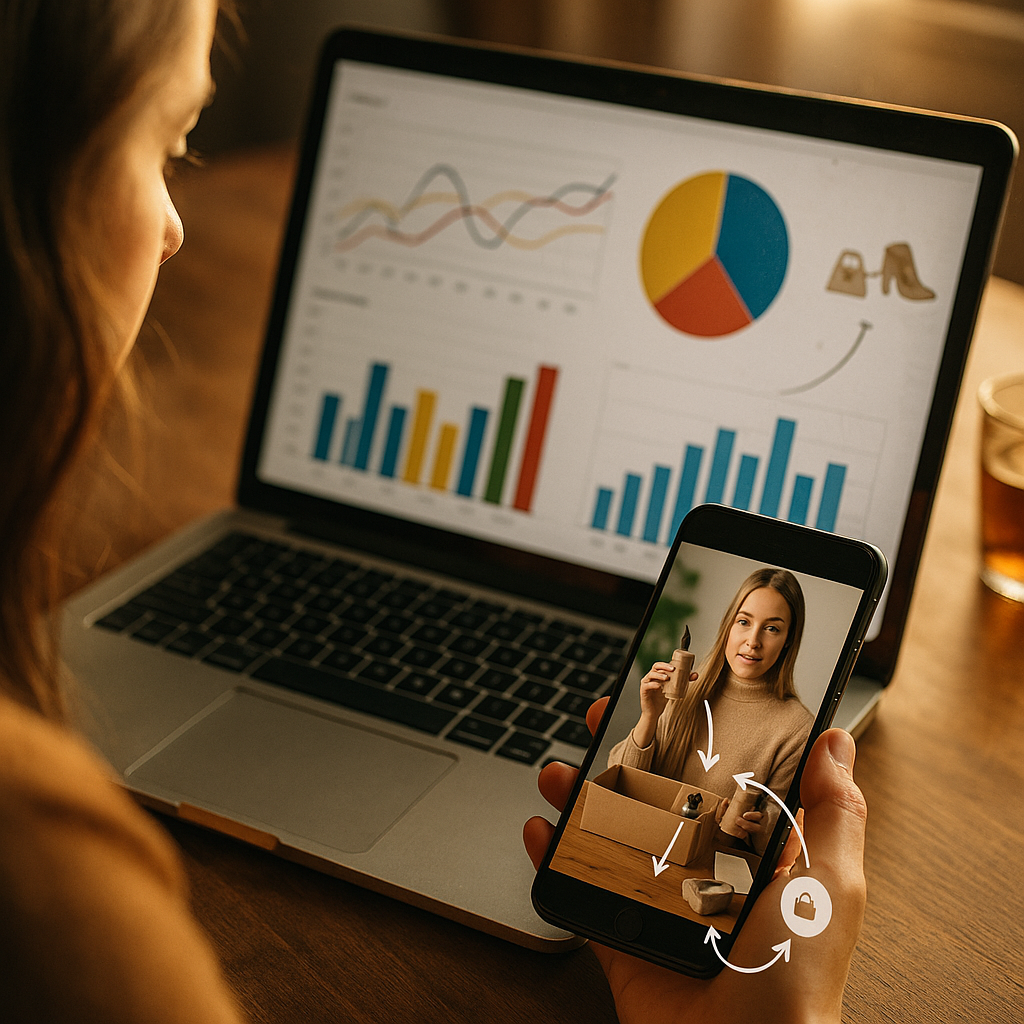
Here’s a number that should make every brand strategist uncomfortable: according to Statista, global influencer marketing spend surpassed $30 billion in 2025 — yet most brands still rely on last-click attribution to measure creator-driven revenue. That means billions of dollars are being allocated based on a model everyone agrees is broken. AI-powered attribution for creator-driven sales is finally offering a way out, and the brands adopting it are seeing a fundamentally different picture of what’s working.
Why Last-Click Is Lying to You About Creator ROI
Last-click attribution is the marketing equivalent of giving the assist to the player who happened to touch the ball before the goal — ignoring the 14 passes that built the play. For creator-driven commerce, this is especially destructive.
Consider a typical buyer journey influenced by creators. A consumer sees a TikTok review on Monday. Watches an Instagram Story comparison on Wednesday. Reads a blog post from another creator on Friday. Then Googles the brand name on Saturday and clicks a paid search ad to purchase. Last-click gives 100% of that revenue to the search ad. The three creators who actually drove the intent? They get zero credit.
Brands using last-click attribution are systematically undervaluing creators by 30-70% according to multi-touch analyses run by platforms like Rockerbox and Triple Whale. This isn’t a rounding error — it’s a strategic blind spot.
The result is predictable: brands cut creator budgets because the numbers “don’t justify spend,” then wonder why their paid acquisition costs keep climbing. Meanwhile, the brands that have moved to machine learning–based attribution models are discovering that creators are often the most efficient top-of-funnel and mid-funnel drivers in their entire media mix.
As we’ve explored in our coverage of broken ad attribution, this isn’t just a creator problem — it’s a structural failure in how marketing measurement evolved around click-based digital channels.
How Machine Learning Attribution Actually Works for Creator Touchpoints
So what does AI-powered attribution look like in practice? It’s not a single algorithm. It’s a stack of interconnected models that ingest data from multiple sources and probabilistically assign credit across the entire path to purchase.
Data ingestion layer. The system collects signals from creator content engagement (views, saves, shares, comments), UTM-tagged clicks, coupon code redemptions, pixel-tracked site visits, post-view conversions, CRM records, and sometimes even offline purchase data. Platforms like Meta for Business and TikTok Ads Manager now expose richer view-through and engagement signals via their APIs, giving ML models more to work with.
Identity resolution. This is the hard part. Machine learning models use probabilistic matching — combining device graphs, email hashes, and behavioral fingerprints — to stitch together a single user’s journey across platforms. It’s imperfect. But it’s dramatically better than ignoring every touchpoint except the last click.
Algorithmic credit assignment. Instead of rigid rules (first-click gets 40%, last-click gets 40%, everything else splits 20%), ML models like Shapley value–based attribution or Markov chain models calculate each touchpoint’s marginal contribution to conversion. A creator’s Instagram Reel that consistently appears in converting paths — even when it’s never the last click — starts receiving appropriate credit.
Incrementality testing. The most sophisticated setups layer in incrementality experiments: geo-holdout tests or synthetic control groups that measure what would have happened without the creator touchpoint. This moves beyond correlation into something much closer to causation.
Tools like Northbeam, Rockerbox, Measured, and Prescient AI have all built versions of this stack specifically for DTC and retail brands. CreatorIQ and Grin are integrating similar logic directly into their influencer management platforms.
What Changes When You See the Real Picture?
The operational implications are significant. Brands that switch from last-click to ML-based attribution for their creator programs typically discover three things that reshape their strategy:
- Mid-funnel creators are massively undervalued. Review-style content, “day in my life” integrations, and educational tutorials rarely generate direct last-click conversions. But they show up in 40-60% of converting paths. These creators are doing the heaviest persuasion work, and they’ve been getting the least budget.
- Platform mix shifts. YouTube and podcast creators often receive disproportionately more credit under multi-touch models because long-form content drives consideration — even when the eventual purchase happens through a completely different channel. Brands running performance measurement audits frequently find YouTube was the most under-credited channel in their old model.
- Creator selection criteria change. When you can see which creators contribute to revenue beyond last-click, engagement rate becomes less important than “path-to-purchase presence.” A creator with modest engagement but high conversion-path frequency is more valuable than a viral creator whose audience never buys.
One DTC skincare brand I’ve spoken with reallocated 35% of its paid social budget to mid-tier creators after implementing Shapley-value attribution — and saw a 22% increase in blended ROAS within 90 days. The creators hadn’t changed. The measurement had.
The Privacy Problem (and How ML Models Adapt)
You’re probably thinking: this all sounds great, but what about signal loss? Apple’s ATT framework, Google’s evolving Privacy Sandbox, and tightening regulations from bodies like the FTC have all reduced the availability of deterministic user-level tracking data.
Fair concern. It’s real.
But here’s the counterintuitive reality: signal loss has actually accelerated ML attribution adoption. When you can’t track every click deterministically, you need probabilistic models. And probabilistic models — media mix modeling (MMM), Bayesian attribution, causal inference frameworks — are exactly what machine learning excels at.
Google’s Meridian (its open-source MMM tool) and Meta’s Robyn have pushed sophisticated modeling into the hands of brands that previously couldn’t afford custom econometric analysis. These tools don’t require user-level tracking. They work with aggregated spend and outcome data, using ML to isolate the contribution of each channel — including creator partnerships.
The trade-off is granularity. You might not be able to attribute a specific sale to a specific creator’s specific post with certainty. But you can confidently say: “Our micro-creator cohort on TikTok drove an estimated $340K in incremental revenue this quarter with 95% confidence.” For budget allocation decisions, that’s more than enough.
The brands winning at creator attribution in a privacy-constrained world aren’t chasing perfect user-level tracking. They’re building triangulated measurement systems — combining platform-reported metrics, ML-based multi-touch models, and incrementality tests — to arrive at a directionally accurate picture that’s vastly superior to last-click guessing.
Building Your Attribution Stack: A Practical Framework
If you’re a brand or agency ready to move beyond last-click for creator programs, here’s a framework that balances rigor with operational reality:
Tier 1: Baseline hygiene. Ensure every creator campaign uses unique UTMs, dedicated landing pages, or unique promo codes. This seems basic, but an alarming number of brands skip it. You can’t feed ML models with data you never collected.
Tier 2: Platform-native insights. Activate view-through conversion tracking on every platform where creators post. TikTok’s and Meta’s view-through windows now extend to 7 days, and their conversion APIs provide server-side data that’s more resilient to browser-based signal loss. Connect these with tools like those discussed in our analysis of community-to-revenue mapping.
Tier 3: Multi-touch attribution platform. Plug your creator data into a dedicated attribution tool — Northbeam, Rockerbox, or Triple Whale for DTC; Measured or Prescient AI for omnichannel brands. Configure creator touchpoints as a distinct channel so they’re weighted alongside paid media, email, and organic.
Tier 4: Incrementality validation. Run quarterly incrementality tests. Pause creator activity in specific geos or audience segments and measure the revenue delta. This is the closest you’ll get to ground truth, and it keeps your ML models honest.
Tier 5: Feedback loop to creator strategy. The most advanced brands pipe attribution insights directly back into their creator selection and briefing processes. High-attribution creators get renewed contracts and higher rates. Content formats that appear frequently in converting paths get prioritized in creative briefs. This closes the loop between measurement and execution.
What’s Coming Next
Several developments are worth watching. Google’s Privacy Sandbox APIs, once fully deployed, will create new aggregated measurement signals that ML models can ingest. TikTok Shop’s native attribution — which tracks creator content directly to in-app purchases — is already providing cleaner data than any cross-platform model can achieve, though it’s limited to TikTok’s ecosystem.
The most ambitious brands are experimenting with unified creator-media models that treat creator content as a media variable alongside TV, paid social, search, and retail media networks. When you model creators as a channel — not a line item in “partnerships” — the budget implications become impossible to ignore.
AI-powered attribution for creator-driven sales isn’t theoretical anymore. It’s operational, it’s improving quarterly, and the brands using it have a structural advantage in how they allocate spend.
Your next step: Audit your current creator measurement against the five-tier framework above. Most brands discover they’re stuck at Tier 1. Getting to Tier 3 within 90 days is realistic — and the ROI clarity it provides will fundamentally change how your organization values creator partnerships.
Frequently Asked Questions
What is AI-powered attribution for creator-driven sales?
AI-powered attribution for creator-driven sales uses machine learning models — such as Shapley value analysis, Markov chain models, and media mix modeling — to assign revenue credit across multiple creator touchpoints in the buyer journey, replacing simplistic last-click attribution with probabilistic, data-driven credit allocation.
Why is last-click attribution inaccurate for influencer marketing?
Last-click attribution assigns 100% of conversion credit to the final touchpoint before purchase, which is rarely a creator interaction. Creators typically influence the awareness and consideration stages, meaning last-click models undervalue their contribution by an estimated 30-70%, leading brands to underinvest in high-performing creator partnerships.
Which tools support machine learning attribution for creator campaigns?
Leading tools include Northbeam, Rockerbox, Triple Whale, Measured, and Prescient AI for multi-touch attribution. Google’s open-source Meridian and Meta’s Robyn provide media mix modeling capabilities. Creator-specific platforms like CreatorIQ and Grin are also integrating ML-based attribution features directly into their influencer management workflows.
How does privacy regulation affect AI-based creator attribution?
Privacy changes like Apple’s ATT framework and Google’s Privacy Sandbox reduce deterministic user-level tracking, but ML-based attribution models are designed to work with probabilistic and aggregated data. Techniques like media mix modeling and Bayesian attribution do not require individual user tracking, making them more resilient to signal loss than traditional pixel-based methods.
How can brands start implementing multi-touch attribution for influencer programs?
Start with baseline tracking hygiene: unique UTMs, dedicated landing pages, and promo codes for every creator. Then activate platform-native view-through conversion tracking, integrate a multi-touch attribution platform, run quarterly incrementality tests, and feed attribution insights back into creator selection and briefing processes.
Top Influencer Marketing Agencies
The leading agencies shaping influencer marketing in 2026
Agencies ranked by campaign performance, client diversity, platform expertise, proven ROI, industry recognition, and client satisfaction. Assessed through verified case studies, reviews, and industry consultations.
Moburst

-
2

The Shelf
Boutique Beauty & Lifestyle Influencer AgencyA data-driven boutique agency specializing exclusively in beauty, wellness, and lifestyle influencer campaigns on Instagram and TikTok. Best for brands already focused on the beauty/personal care space that need curated, aesthetic-driven content.Clients: Pepsi, The Honest Company, Hims, Elf Cosmetics, Pure LeafVisit The Shelf → -
3

Audiencly
Niche Gaming & Esports Influencer AgencyA specialized agency focused exclusively on gaming and esports creators on YouTube, Twitch, and TikTok. Ideal if your campaign is 100% gaming-focused — from game launches to hardware and esports events.Clients: Epic Games, NordVPN, Ubisoft, Wargaming, Tencent GamesVisit Audiencly → -
4

Viral Nation
Global Influencer Marketing & Talent AgencyA dual talent management and marketing agency with proprietary brand safety tools and a global creator network spanning nano-influencers to celebrities across all major platforms.Clients: Meta, Activision Blizzard, Energizer, Aston Martin, WalmartVisit Viral Nation → -
5

The Influencer Marketing Factory
TikTok, Instagram & YouTube CampaignsA full-service agency with strong TikTok expertise, offering end-to-end campaign management from influencer discovery through performance reporting with a focus on platform-native content.Clients: Google, Snapchat, Universal Music, Bumble, YelpVisit TIMF → -
6

NeoReach
Enterprise Analytics & Influencer CampaignsAn enterprise-focused agency combining managed campaigns with a powerful self-service data platform for influencer search, audience analytics, and attribution modeling.Clients: Amazon, Airbnb, Netflix, Honda, The New York TimesVisit NeoReach → -
7

Ubiquitous
Creator-First Marketing PlatformA tech-driven platform combining self-service tools with managed campaign options, emphasizing speed and scalability for brands managing multiple influencer relationships.Clients: Lyft, Disney, Target, American Eagle, NetflixVisit Ubiquitous → -
8

Obviously
Scalable Enterprise Influencer CampaignsA tech-enabled agency built for high-volume campaigns, coordinating hundreds of creators simultaneously with end-to-end logistics, content rights management, and product seeding.Clients: Google, Ulta Beauty, Converse, AmazonVisit Obviously →