


The Add-to-Cart Rate Problem Nobody Talks About
Here’s a number that should make every brand strategist uncomfortable: the average TikTok Shop add-to-cart rate from creator videos sits at just 1.2%, according to TikTok’s own business platform data. Meanwhile, creators who embed shoppable product links with the right placement strategy are hitting 4-6%. That’s a 3-5x gap — and it has almost nothing to do with the product. TikTok Shop optimization is now a technical discipline, not just a creative one, and the brands closing that gap understand how link architecture interacts with the algorithm’s organic reach signals.
Why Shoppable Links Can Quietly Destroy Your Distribution
Let’s start with the uncomfortable truth. TikTok’s recommendation engine doesn’t treat all videos equally once commerce elements get attached. The algorithm evaluates watch time, completion rate, shares, and saves. When a shoppable product link gets dropped into a video clumsily — an early verbal CTA, a distracting pinned product overlay in the first three seconds — viewers bounce. That bounce tanks completion rate. And tanked completion rate means the algorithm stops distributing your video to the broader For You feed.
This is the central tension of TikTok Shop for brands: every commerce signal you add to a video creates friction that can suppress the organic reach signals you need for that video to actually find buyers.
The solution isn’t removing commerce. It’s embedding it surgically.
The brands winning on TikTok Shop treat shoppable link placement as a post-production decision, not a creative brief footnote. Where, when, and how the product tag appears matters as much as the content itself.
The Anatomy of a High-Converting Shoppable Video
After analyzing hundreds of TikTok Shop campaigns across beauty, consumer electronics, and apparel verticals, a clear pattern emerges. The highest-performing shoppable creator videos share five structural elements:
- Delayed product tag visibility. The pinned product link doesn’t appear until at least 40% into the video. This protects the critical early-watch retention window that TikTok’s algorithm weighs most heavily.
- Native hook, not a sales hook. The first 1.5 seconds function exactly like a non-commerce video — curiosity gap, unexpected visual, or pattern interrupt. No product in frame. No logo. Nothing that signals “ad.”
- Contextual product reveal. The product appears as a solution to a problem the video has already established. The shoppable link activates simultaneously with the product’s on-screen appearance, creating a seamless “see it, tap it” moment.
- Single product focus. Videos with one shoppable link outperform multi-product carousels by roughly 2.3x on add-to-cart rate. Decision fatigue is real even in 30-second videos.
- Verbal CTA alignment. The creator’s verbal call-to-action (“link’s right here,” “tap the orange cart”) coincides with the product tag’s most prominent on-screen moment — typically the last 20% of the video.
If you’re working with creators at scale, these structural elements need to be codified in your brief. Not suggested. Required. The difference between a 1.2% and a 5% add-to-cart rate often comes down to whether the creator knew to delay the product tag by eight seconds. For more on maintaining quality in scaled programs, see our guide on creator partnerships at scale.
Technical Setup: Embedding Product Links the Right Way
The mechanics matter more than most brand teams realize. TikTok Shop offers multiple product link integration methods, and they don’t all perform the same way.
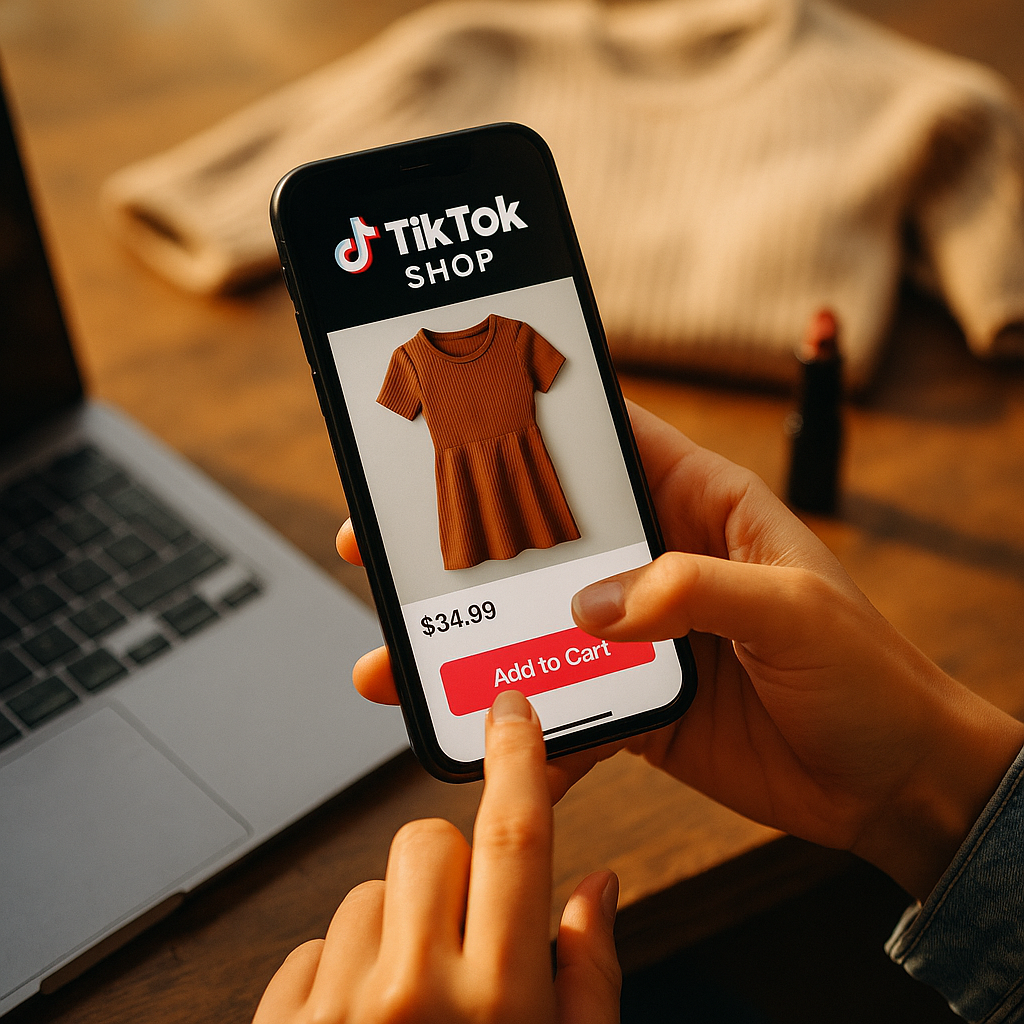
Product tags via TikTok Shop Seller Center. This is the standard method. The seller or affiliate manager assigns a product to a video during or after upload. The orange shopping bag icon appears in the lower left. It’s the most algorithmically “safe” method because TikTok’s system recognizes it as native commerce, not an external redirect.
Affiliate links through TikTok Shop’s creator marketplace. When creators select products from your affiliate catalog, the product link gets embedded automatically. This method carries a key advantage: TikTok treats affiliate-linked videos as part of its commerce ecosystem, which means they’re eligible for the Shop tab feed — a secondary distribution channel most brands underutilize.
What to avoid. External link stickers pointing to Shopify or Amazon storefronts. These trigger a full-screen redirect warning that craters conversion. More critically, industry benchmark data suggests videos with external link stickers receive 15-30% less organic distribution than identical videos using native TikTok Shop tags.
The operational takeaway: if your product isn’t listed on TikTok Shop’s native catalog, you’re fighting the algorithm with one hand tied behind your back. Get your catalog synced through TikTok Shop Seller Center before you brief a single creator.
Protecting Organic Reach While Driving Commerce
This is where most brand strategies fall apart. Teams optimize for add-to-cart rate in isolation, then wonder why their creator videos get 12,000 views instead of 1.2 million.
TikTok’s algorithm doesn’t penalize commerce per se. It penalizes poor engagement signals. A shoppable video that gets shared, saved, and watched to completion will distribute just as broadly as a non-commerce video with the same engagement metrics. The problem is that most shoppable videos don’t hit those engagement benchmarks because the commerce elements suppress them.
Here’s the playbook for maintaining reach:
- A/B test with and without product tags on the same creator. Have your creator post two versions of similar content — one with the shoppable tag, one without. Compare reach after 72 hours. If the shoppable version drops more than 25% in views, your commerce integration is too aggressive.
- Use the “comment pinning” CTA strategy. Instead of relying solely on the product tag, have the creator pin a comment with a shopping prompt. This drives comment engagement (an algorithmic positive) while giving a secondary conversion pathway.
- Leverage the Remix feature for extended reach. When a shoppable video performs well, other creators can Remix it — extending your product’s visibility without additional spend. We’ve covered TikTok Remix for brand amplification in detail if you want to build this into your strategy.
- Monitor the “Shop tab” vs. “For You” feed split. TikTok Shop analytics now breaks down traffic sources. If 80%+ of your views come from the Shop tab, your video isn’t breaking through to the organic feed. That’s a content problem, not a commerce problem.
The real metric to watch isn’t add-to-cart rate alone — it’s add-to-cart rate per impression. A 5% add-to-cart rate on 10,000 views generates fewer carts than a 2% rate on 500,000 views. Reach and conversion are not opposing forces; they’re multipliers.
Creator Briefing: What Your Brief Is Probably Missing
Most creator briefs for TikTok Shop campaigns include product talking points, brand guidelines, and maybe a hashtag list. Almost none include what actually drives add-to-cart performance: structural timing instructions for the shoppable link.
Add these to every brief:
- Exact second range for product tag activation (e.g., “product tag should appear between seconds 12-15 of a 30-second video”)
- Screen quadrant guidance — where on screen the product should appear relative to the shopping icon
- Verbal CTA script options (provide 2-3 natural-sounding options; don’t let creators improvise “link in bio” when the link is actually an in-video tag)
- Explicit instruction to avoid mentioning the product in the first 3 seconds
This level of specificity might feel controlling. It isn’t. It’s the difference between treating TikTok Shop as a performance channel and treating it as a hope-and-pray experiment. Your best creators will appreciate the clarity. The ones who push back probably aren’t optimizing for your KPIs anyway.
For brands also exploring how AI is reshaping the discovery-to-purchase pipeline, our coverage of AI product discovery strategies connects directly to this commerce optimization mindset.
Compliance and Disclosure in Shoppable Content
A quick but critical note. The FTC’s endorsement guidelines apply fully to TikTok Shop creator videos. The native product tag does not satisfy disclosure requirements on its own. Creators must still include clear “#ad” or “#sponsored” disclosures when the brand is compensating them — whether through flat fees, affiliate commissions, or gifted product.
TikTok’s branded content toggle (the “Paid Partnership” label) is the minimum threshold. Pair it with an in-video verbal disclosure for maximum compliance protection. The risk calculus here is straightforward: one FTC inquiry costs more in legal fees and brand damage than a thousand properly disclosed videos.
For brands building micro-influencer syndicates, disclosure compliance at scale requires templated language and automated monitoring — don’t leave it to individual creators.
Measurement Framework: Beyond Add-to-Cart
Add-to-cart rate is the headline metric. But it’s not the only one that matters for TikTok Shop optimization.
Build your reporting around these four layers:
- Reach efficiency: Impressions per dollar spent on creator fees. This tells you whether your commerce integration is suppressing distribution.
- Cart-to-checkout rate: How many people who add actually buy? TikTok Shop’s in-app checkout has meaningfully less drop-off than external redirect flows — eMarketer estimates native checkout reduces abandonment by up to 35% versus off-platform carts.
- Organic amplification ratio: What percentage of total views came from non-paid distribution? Anything above 70% means your content is genuinely resonating beyond the initial push.
- Creator-level variance: Track add-to-cart rates by individual creator, not just campaign aggregate. You’ll quickly identify which creators naturally integrate commerce without hurting watch time — and those are the ones worth long-term contracts.
Your next step: Audit your last five TikTok Shop creator videos. Note the exact second the product tag first appears, compare it to the video’s average watch time, and calculate whether viewers even see the shoppable link before they scroll. That single data point will tell you more about your add-to-cart problem than any dashboard.
FAQs
Does adding a TikTok Shop product link reduce a video’s organic reach?
Not inherently. TikTok’s algorithm evaluates engagement signals like watch time, shares, and completion rate — not the presence of a product tag. However, poorly placed shoppable links can suppress these engagement metrics indirectly by causing viewers to bounce early. The key is delaying product tag visibility until at least 40% into the video and leading with entertainment-first content.
What is a good add-to-cart rate for TikTok Shop creator videos?
The platform average hovers around 1.2%, but well-optimized creator videos with strategic product link placement consistently achieve 4-6%. Top-performing campaigns in beauty and consumer electronics verticals have reported rates above 7% when using single-product focus and delayed CTA strategies.
Should I use TikTok Shop native product tags or external link stickers?
Always use native TikTok Shop product tags. External link stickers trigger redirect warnings that reduce conversion, and industry data suggests they receive 15-30% less organic distribution. Native tags also make your videos eligible for the TikTok Shop tab feed, an additional distribution channel.
How do I ensure FTC compliance on shoppable TikTok creator videos?
The native product tag alone does not satisfy FTC disclosure requirements. Creators must include clear “#ad” or “#sponsored” disclosures and use TikTok’s branded content toggle (Paid Partnership label). A verbal in-video disclosure adds an extra layer of compliance protection. This applies whether compensation is a flat fee, affiliate commission, or gifted product.
How many products should I feature in a single TikTok Shop video?
One. Videos with a single shoppable product link outperform multi-product carousels by approximately 2.3x on add-to-cart rate. Decision fatigue impacts even short-form content, so focusing on one product keeps the viewer’s attention and simplifies the purchase pathway.
Top Influencer Marketing Agencies
The leading agencies shaping influencer marketing in 2026
Agencies ranked by campaign performance, client diversity, platform expertise, proven ROI, industry recognition, and client satisfaction. Assessed through verified case studies, reviews, and industry consultations.
Moburst

-
2

The Shelf
Boutique Beauty & Lifestyle Influencer AgencyA data-driven boutique agency specializing exclusively in beauty, wellness, and lifestyle influencer campaigns on Instagram and TikTok. Best for brands already focused on the beauty/personal care space that need curated, aesthetic-driven content.Clients: Pepsi, The Honest Company, Hims, Elf Cosmetics, Pure LeafVisit The Shelf → -
3

Audiencly
Niche Gaming & Esports Influencer AgencyA specialized agency focused exclusively on gaming and esports creators on YouTube, Twitch, and TikTok. Ideal if your campaign is 100% gaming-focused — from game launches to hardware and esports events.Clients: Epic Games, NordVPN, Ubisoft, Wargaming, Tencent GamesVisit Audiencly → -
4

Viral Nation
Global Influencer Marketing & Talent AgencyA dual talent management and marketing agency with proprietary brand safety tools and a global creator network spanning nano-influencers to celebrities across all major platforms.Clients: Meta, Activision Blizzard, Energizer, Aston Martin, WalmartVisit Viral Nation → -
5

The Influencer Marketing Factory
TikTok, Instagram & YouTube CampaignsA full-service agency with strong TikTok expertise, offering end-to-end campaign management from influencer discovery through performance reporting with a focus on platform-native content.Clients: Google, Snapchat, Universal Music, Bumble, YelpVisit TIMF → -
6

NeoReach
Enterprise Analytics & Influencer CampaignsAn enterprise-focused agency combining managed campaigns with a powerful self-service data platform for influencer search, audience analytics, and attribution modeling.Clients: Amazon, Airbnb, Netflix, Honda, The New York TimesVisit NeoReach → -
7

Ubiquitous
Creator-First Marketing PlatformA tech-driven platform combining self-service tools with managed campaign options, emphasizing speed and scalability for brands managing multiple influencer relationships.Clients: Lyft, Disney, Target, American Eagle, NetflixVisit Ubiquitous → -
8

Obviously
Scalable Enterprise Influencer CampaignsA tech-enabled agency built for high-volume campaigns, coordinating hundreds of creators simultaneously with end-to-end logistics, content rights management, and product seeding.Clients: Google, Ulta Beauty, Converse, AmazonVisit Obviously →