


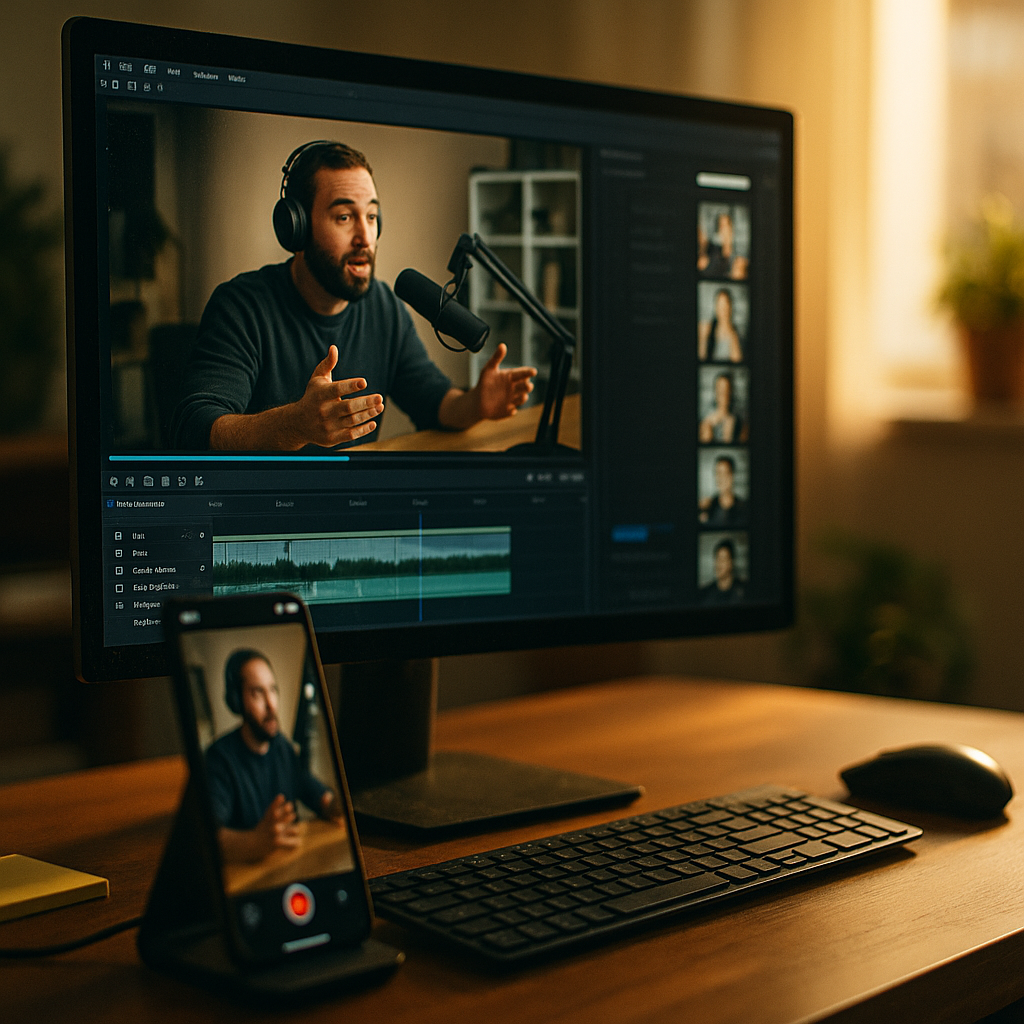
One Live Stream, Hundreds of Clips: The Reformatting Strategy Rewriting Content ROI
A single 90-minute live stream shopping event generates, on average, fewer than 72 hours of meaningful traffic. Then it dies. But brands running automated vertical reformatting workflows are now extracting 80 to 150 platform-optimized clips from that same broadcast—clips that continue driving discovery and commerce for six to eight weeks after the original event ends. The live stream isn’t the product anymore. It’s the raw material.
Why the Live Stream Afterlife Matters More Than the Broadcast
Live commerce has matured. According to Statista’s commerce data, global live-stream shopping revenue surpassed $500 billion in 2025, with North American brands finally catching up to the APAC playbook. But here’s what most marketing teams still get wrong: they treat the live event as the entire funnel. Promotion builds to a broadcast, the broadcast happens, sales spike, and then the team moves on to planning the next one.
That’s an enormous waste of high-quality creator content.
The brands seeing outsized returns—Fenty Beauty, GymShark, Alo Yoga, and an increasing number of DTC mid-market players—are flipping the model. They invest in the live event not primarily for the synchronous audience, but for the content library it produces. The live stream becomes an evergreen asset factory.
Think about what a two-hour creator-hosted live event actually contains: product demonstrations, unscripted reactions, Q&A segments, social proof moments when viewers comment on purchases, styling tips, comparison walkthroughs, and emotional storytelling. Each of those is a standalone piece of short-form video for conversion—if you can extract and reformat it fast enough.
What Automated Vertical Reformatting Actually Does
Let’s get specific, because “automated reformatting” sounds vague until you see the pipeline.
Most live streams are captured in 16:9 landscape or, increasingly, in a split-screen format with a creator camera and product feed. Automated vertical reformatting tools ingest that raw footage and perform several operations simultaneously:
- Scene detection and segmentation: AI identifies natural topic shifts, applause moments, product callouts, and high-engagement segments based on audio peaks, chat velocity, and visual transitions.
- Aspect ratio conversion: The tool crops and reframes the footage to 9:16 (Reels, Shorts, TikTok), 1:1 (feed posts), and 4:5 (Pinterest, LinkedIn) while keeping the speaker or product in the active zone using subject tracking.
- Caption and overlay generation: Burned-in captions, branded lower thirds, and CTA overlays are applied automatically, calibrated per platform spec.
- Metadata tagging: Each clip gets auto-tagged with product SKUs, creator handles, topic categories, and suggested hashtags.
Tools like Opus Clip, Vizard, Riverside’s editor, and Descript have all pushed aggressively into this space. Enterprise solutions from Restream and StreamYard now integrate AI clip engines directly into their post-broadcast workflows. The result? A brand can go from “stream ended” to “120 clips queued across four platforms” in under three hours—with minimal human editing.
The real competitive advantage isn’t producing live content. It’s the speed at which you can atomize that content into platform-native clips and distribute them before the cultural moment fades.
The Commerce Tail: How Clips Keep Selling
This isn’t just a content volume play. It’s a commerce architecture.
When a brand like e.l.f. Cosmetics runs a live shopping event on TikTok Shop, the synchronous audience might generate $200K in attributed revenue during the broadcast. Impressive. But the 60-second clips extracted from that stream—reformatted vertically with product links, pushed through creator affiliate accounts, and seeded into the TikTok AI discovery layer—can collectively outperform the live event’s revenue within two weeks.
Why? Three reasons:
- Algorithmic surface area. One live stream gets one shot at the algorithm. One hundred clips get one hundred shots. Each clip enters its own recommendation cycle, finding micro-audiences the live broadcast never reached.
- Intent matching. A 45-second clip of a creator demonstrating a single product feature matches search and browse intent far better than a two-hour stream. It’s the right content at the right moment.
- Cross-platform distribution. The live stream lived on one platform. The clips live everywhere—Reels, Shorts, TikTok, Pinterest Idea Pins, even LinkedIn video for B2B-adjacent categories.
Brands following this model report that 40-60% of total campaign revenue attributed to a live event now comes from the post-broadcast clip library, not the synchronous viewing window. That fundamentally changes how you should budget for, plan, and measure live commerce.
Building the Operational Workflow
If you’re a brand-side marketing lead or agency strategist considering this, the operational design matters as much as the technology.
Start upstream. Your shoppable content creator briefs need to account for clip extraction from day one. This means coaching creators to deliver “modular” live streams: distinct product segments with clear verbal transitions, individual product holds of at least three seconds (for clean thumbnail pulls), and moments of direct-to-camera address that work as standalone hooks.
The best briefs include what we call a “clip map”—a rough rundown that identifies the 10-15 must-capture moments during the stream. Think of it as a shot list for a film, except the “shots” are self-contained stories within the live experience.
Post-stream, the workflow typically looks like this:
- Hour 0-1: AI tool ingests footage, generates initial clip candidates (typically 80-200 depending on stream length).
- Hour 1-3: A human editor reviews, selects the top 30-50%, adjusts framing where the AI missed, and approves captions.
- Hour 3-6: Clips are distributed across platforms with platform-specific metadata. Commerce links are attached. Creator accounts receive their share for co-posting.
- Week 1-2: Performance data identifies the top 10-15% of clips. These get paid amplification.
- Week 3-8: Evergreen performers are recycled into organic content calendars, email sequences, and PDP embeds.
This isn’t theoretical. It’s the operational model already running inside teams using an AI-enhanced UGC operations stack to scale what used to require a full post-production team.
Brands that treat live streams as one-time events leave 60% or more of the content’s potential revenue on the table. The clip library is where the compounding returns live.
What About Rights, Authenticity, and Creator Buy-In?
Two concerns come up immediately from brand legal and creator relations teams. Both are manageable.
Content rights: Your creator contracts must explicitly include clip derivation rights. Standard influencer agreements often grant “use of deliverables” but don’t clearly cover AI-generated derivative clips from live content. Work with legal to add a clause covering automated reformatting, platform redistribution, and paid amplification of derivative clips. The FTC’s endorsement guidelines also require that each clip retains proper sponsorship disclosure—automated captioning tools can handle this, but you need to verify.
Authenticity: There’s a valid concern that over-polishing raw live content strips its authenticity. The data suggests the opposite. Clips that retain the unscripted energy of the live moment—the laugh after a product mishap, the genuine surprise at a chat comment—outperform studio-produced equivalents by 2-3x on engagement. The reformatting should be structural (cropping, captioning, aspect ratio) not tonal. Don’t add slick transitions to what was a raw, human moment. That’s how you maintain the Gen Z authenticity signals that drive social commerce trust.
As for creator buy-in: most creators welcome this model because it multiplies their visible output without additional labor. A creator who hosted one live stream now has 50+ clips with their name on them circulating across platforms. That’s career-building distribution. Structure the deal so creators benefit—shared analytics, affiliate commissions on clip-driven sales, and co-ownership of high-performing content.
Measuring What Matters
Legacy live-stream metrics—concurrent viewers, peak chat velocity, session duration—tell you about the broadcast. They tell you nothing about the clip library’s performance.
Track these instead:
- Clip yield rate: How many usable clips per hour of live content? Benchmark: 40-70 clips per hour.
- Platform coverage: How many distinct platforms received clips within 24 hours?
- Tail revenue ratio: Revenue attributed to derivative clips vs. live broadcast. Target: 1:1 or better.
- Discovery half-life: How many days until clip-driven impressions drop below 50% of peak? Best-in-class: 21+ days.
- Cost per clip: Total production and reformatting cost divided by usable clips. With automation, this should be under $5 per clip at scale.
These metrics reframe the entire ROI conversation. You’re no longer justifying a live event’s production cost against a three-hour sales window. You’re amortizing it across weeks of multi-platform commerce.
Your Next Move
Audit your last three live stream events. How many derivative clips did you produce? If the answer is fewer than 30 per hour of content, you’re leaving money on the table. Pilot one automated vertical reformatting tool on your next broadcast, pre-brief your creator with a clip map, and measure the tail revenue at 30 days. That single test will change how you budget every live event going forward.
Frequently Asked Questions
What is automated vertical reformatting for live stream content?
Automated vertical reformatting uses AI-powered tools to ingest long-form live stream footage and convert it into multiple short-form, platform-optimized video clips. The process includes scene detection, aspect ratio conversion (such as 16:9 to 9:16), automated captioning, branded overlays, and metadata tagging—all with minimal human intervention.
How many clips can brands realistically extract from a single live stream?
Brands typically extract 40 to 70 usable clips per hour of live stream content using automated reformatting tools. A two-hour broadcast can yield 80 to 150 platform-ready clips, though a human editor should review and approve the top 30-50% for quality before distribution.
Which platforms work best for distributing reformatted live stream clips?
TikTok, Instagram Reels, and YouTube Shorts are the primary distribution channels for vertical clips. Pinterest Idea Pins, Facebook Reels, and even LinkedIn video work well for specific categories. Cross-platform distribution is key because each clip enters a separate algorithmic recommendation cycle, multiplying discovery opportunities.
Do reformatted clips actually drive commerce after the live stream ends?
Yes. Brands using this strategy report that 40-60% of total campaign revenue attributed to a live event comes from post-broadcast derivative clips, not the live viewing window. Clips continue driving product discovery and purchases for six to eight weeks after the original broadcast.
What tools are available for automated live stream clip extraction?
Popular tools include Opus Clip, Vizard, Descript, and Riverside’s built-in editor. Enterprise-grade platforms like Restream and StreamYard also offer integrated AI clip engines. Most can process a full live stream and generate clip candidates within one to three hours.
How should creator contracts address automated clip derivation?
Creator agreements should explicitly include clauses covering AI-generated derivative clips from live content, platform redistribution rights, and paid amplification of those clips. Each derivative clip must also retain proper FTC sponsorship disclosures, which automated captioning tools can apply but should be manually verified.
Top Influencer Marketing Agencies
The leading agencies shaping influencer marketing in 2026
Agencies ranked by campaign performance, client diversity, platform expertise, proven ROI, industry recognition, and client satisfaction. Assessed through verified case studies, reviews, and industry consultations.
Moburst

-
2

The Shelf
Boutique Beauty & Lifestyle Influencer AgencyA data-driven boutique agency specializing exclusively in beauty, wellness, and lifestyle influencer campaigns on Instagram and TikTok. Best for brands already focused on the beauty/personal care space that need curated, aesthetic-driven content.Clients: Pepsi, The Honest Company, Hims, Elf Cosmetics, Pure LeafVisit The Shelf → -
3

Audiencly
Niche Gaming & Esports Influencer AgencyA specialized agency focused exclusively on gaming and esports creators on YouTube, Twitch, and TikTok. Ideal if your campaign is 100% gaming-focused — from game launches to hardware and esports events.Clients: Epic Games, NordVPN, Ubisoft, Wargaming, Tencent GamesVisit Audiencly → -
4

Viral Nation
Global Influencer Marketing & Talent AgencyA dual talent management and marketing agency with proprietary brand safety tools and a global creator network spanning nano-influencers to celebrities across all major platforms.Clients: Meta, Activision Blizzard, Energizer, Aston Martin, WalmartVisit Viral Nation → -
5

The Influencer Marketing Factory
TikTok, Instagram & YouTube CampaignsA full-service agency with strong TikTok expertise, offering end-to-end campaign management from influencer discovery through performance reporting with a focus on platform-native content.Clients: Google, Snapchat, Universal Music, Bumble, YelpVisit TIMF → -
6

NeoReach
Enterprise Analytics & Influencer CampaignsAn enterprise-focused agency combining managed campaigns with a powerful self-service data platform for influencer search, audience analytics, and attribution modeling.Clients: Amazon, Airbnb, Netflix, Honda, The New York TimesVisit NeoReach → -
7

Ubiquitous
Creator-First Marketing PlatformA tech-driven platform combining self-service tools with managed campaign options, emphasizing speed and scalability for brands managing multiple influencer relationships.Clients: Lyft, Disney, Target, American Eagle, NetflixVisit Ubiquitous → -
8

Obviously
Scalable Enterprise Influencer CampaignsA tech-enabled agency built for high-volume campaigns, coordinating hundreds of creators simultaneously with end-to-end logistics, content rights management, and product seeding.Clients: Google, Ulta Beauty, Converse, AmazonVisit Obviously →