


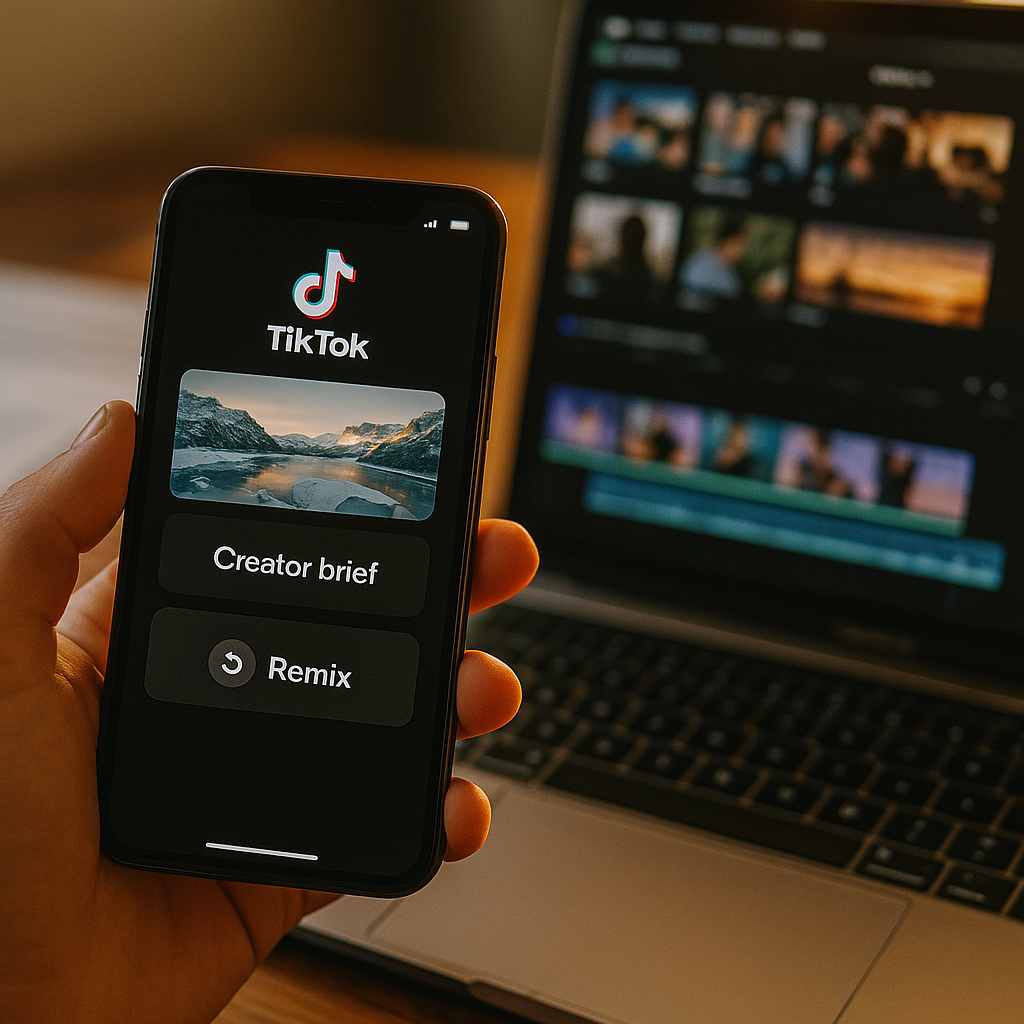
TikTok’s AI Discovery Layer Just Made Your Content Brief Obsolete
Sixty-eight percent of TikTok users now encounter branded content through AI-curated feeds rather than following creators directly, according to TikTok for Business data from early 2026. That single stat should reshape how every brand writes a creator brief. Short-form creator formats optimized for TikTok’s AI discovery layer aren’t a nice-to-have — they’re the new prerequisite for earned reach. The old playbook of scripted hooks, branded outros, and rigid shot lists? It’s fighting the algorithm instead of feeding it.
What Changed — and Why Most Briefs Haven’t Caught Up
TikTok’s algorithmic remix engine, which rolled out incrementally throughout late 2025, fundamentally altered content distribution. The platform now decomposes videos into semantic segments — audio loops, visual motifs, text overlays, narrative structures — and reassembles them into AI-curated feed clusters. Think of it less like a recommendation engine and more like a content DJ: it samples, loops, and resurfaces fragments based on emergent user interest graphs.
This means a single 22-second clip can be surfaced in dozens of contextual “micro-feeds” — stitched alongside adjacent creator content, paired with trending audio remixes, or slotted into thematic compilations the user never searched for. The implication for brands is enormous.
Content that performs in the AI discovery layer isn’t the most polished — it’s the most modular. The algorithm rewards videos built from discrete, remixable elements over monolithic brand narratives.
Most brand briefs still read like TV spot instructions adapted for vertical video. They specify exact messaging hierarchies, mandatory logo placements at second 3 and second 18, and scripted CTAs. None of that maps to how TikTok’s AI actually selects and amplifies content.
The Anatomy of an Algorithm-Ready Creator Format
So what does “remix-optimized” actually look like in a brief? Let’s break it into the structural components that matter.
Hooks that function as standalone units. The first 1.5 seconds of any TikTok are always critical, but under the AI discovery layer, they also need to work when divorced from the rest of the video. TikTok’s system sometimes surfaces just the opening as a teaser within curated clusters. If your hook requires context from the rest of the video to make sense, it fails this test. Brief creators to open with a self-contained provocation, question, or visual disruption — something that generates curiosity independent of what follows.
Layered audio architecture. Original audio remains one of the highest-signal elements for TikTok’s remix engine. Briefs should explicitly encourage creators to produce original sound — a catchphrase, a rhythmic verbal pattern, even a distinctive sound effect — that other users can stitch, duet, or remix. This is how content enters the algorithmic loop: other creators build on the audio, and each remix feeds the original video’s discovery score. If you’re still mandating licensed music beds in your briefs, you’re actively suppressing remixability. For more on how kinetic typography boosts engagement, consider pairing text animation with these audio-first strategies.
Visual modularity over narrative arcs. Long narrative arcs — setup, conflict, resolution — work for YouTube. TikTok’s AI layer prefers content with clear visual “chapters” that can be segmented. Think: a product demo broken into three distinct 5-second movements, each with its own visual identity, rather than a smooth 15-second flow. The algorithm can then surface individual segments in different feed contexts.
Text overlays as metadata. On-screen text isn’t just for accessibility anymore. TikTok’s AI reads text overlays as semantic signals, using them to classify and cluster content. Creators should be briefed to use specific, descriptive text — not vague brand taglines — because those text elements directly influence which AI-curated feeds the content enters. “3 ways to layer this moisturizer” beats “Feel the glow” every time.
Rewriting the Brief: A Practical Framework
Here’s where theory meets the spreadsheet. If you’re a brand or agency updating creator briefs for the AI discovery layer, these are the operational changes that actually move metrics.
1. Replace “key message” with “key signal.” Traditional briefs center on a core message the creator must communicate. Algorithm-ready briefs center on a core signal — a visual, audio, or textual element designed to trigger classification by TikTok’s AI. The message still exists, but it’s embedded within a format the algorithm can parse and distribute.
2. Build remix permissions into the brief. Explicitly state that the content should be designed for duet, stitch, and audio reuse. This isn’t just a creative philosophy — it has contractual implications. Your influencer agreements need to account for derivative content. If a creator’s audio gets remixed 10,000 times, who owns the usage rights? Settle this upfront. The FTC’s endorsement guidelines also apply to remixed content where brand messaging persists, so your legal team should weigh in.
3. Specify format variants, not a single deliverable. Instead of briefing one 30-second video, brief a content system: one anchor video plus two to three derivative cuts optimized for different algorithmic entry points. One version might lead with the product demo, another with the reaction hook, a third with the text-heavy educational angle. Each variant targets a different AI-curated feed cluster. This is where an AI-enhanced UGC operations stack becomes essential — producing multiple variants at scale without blowing your production budget.
4. Kill the mandatory brand intro. Branded intros actively hurt discovery. TikTok’s AI evaluates the opening frame for engagement prediction; a logo splash reads as interstitial, and the algorithm down-ranks it. The brand should appear naturally — on packaging, in the environment, through audio mention — not as a gated preamble.
5. Brief for “response surface,” not just reach. The AI discovery layer doesn’t just distribute content; it measures how content generates responses. Comments, stitches, duets, saves — these are the signals that keep content in circulation. Brief creators to include explicit response triggers: a question, a controversial take, an incomplete list that invites additions. Response rate now correlates more strongly with sustained reach than raw view count, per Statista’s social media engagement data.
What Kinds of Creator Formats Are Getting Amplified?
Theory is useful. Examples are better. Here are the short-form creator formats currently winning disproportionate distribution through TikTok’s AI layer:
- “Interrupted routine” demos: Creator begins a standard product routine, then something unexpected disrupts it — a pet, a roommate, a wardrobe malfunction. The interruption creates a visual “break point” the algorithm can segment and resurface.
- Micro-debate openers: Videos that start with a divisive statement (“This $12 serum replaced my $90 one — and my dermatologist agrees”) generate comment volume that feeds the discovery loop.
- Layered POV formats: A single scenario shot from multiple perspectives in one video. TikTok’s AI treats each POV shift as a new content unit, increasing surface area for distribution.
- Audio-first storytelling: Creator records a voiceover-only track that’s designed to be reused over different visuals. The audio becomes the “meme unit” that carries brand messaging across remixes.
Brands investing in short-form video for conversion should note that conversion-optimized formats and discovery-optimized formats aren’t always the same thing. The smartest programs use the AI discovery layer for top-of-funnel amplification, then retarget engaged users with more direct conversion content.
The brands seeing the strongest ROI are running two-tier creator programs: discovery-optimized content designed for algorithmic remix at the top, and conversion-focused formats — tutorials, comparisons, unboxings — retargeted to engaged audiences at the bottom.
Measurement Has to Change Too
If your reporting still centers on per-video views and CPMs, you’re measuring the wrong things. The AI discovery layer distributes content in fragments. A single video might generate 50,000 views on the original post and another 300,000 across remixes, stitches, and AI-curated placements. Most brand dashboards only capture the first number.
Push your measurement partners — whether that’s Sprout Social, CreatorIQ, or an in-house analytics stack — to track “total content surface area”: the aggregate reach of all derivative and algorithmically remixed versions of a piece of content. This metric better reflects actual brand exposure in an AI-curated environment.
Attribution gets murkier, too. When a user converts after seeing a remixed fragment of your creator’s audio over someone else’s video, traditional last-touch attribution misses the brand entirely. Brands serious about understanding AI-layer impact need to invest in post-purchase surveys and brand lift studies alongside platform analytics.
The Compliance Wrinkle Nobody’s Talking About
Algorithmic remix raises a genuine compliance risk. When TikTok’s AI resurfaces a creator’s content in a new context — paired with unrelated audio, stitched with another creator’s take — the original disclosure (“ad” or “#sponsored”) may not carry over. The FTC has been increasingly clear that material connections must be disclosed wherever the content appears, not just on the original post.
Brands should require creators to embed disclosures within the visual content itself — burned-in text overlays like “Brand Partner” that survive any remix or recontextualization. Relying on captions or hashtags alone is no longer sufficient when the algorithm can strip and redistribute visual content independent of its original metadata. Investing in better creator briefing practices is one of the simplest ways to mitigate this risk before it becomes a regulatory headache.
Your Next Move
Pull up your last five creator briefs. Count how many mandate a specific narrative arc, a branded intro, or licensed audio. Every one of those requirements is a friction point against TikTok’s AI discovery layer. Rewrite one brief this week using the modular, signal-first framework above — and measure the difference over 30 days.
Frequently Asked Questions
What are short-form creator formats optimized for TikTok’s AI discovery layer?
These are creator videos intentionally structured with modular, remixable elements — standalone hooks, original audio, segmented visual chapters, and descriptive text overlays — that TikTok’s AI can decompose, classify, and redistribute across multiple curated feed clusters. They prioritize algorithmic parseability over traditional narrative polish.
How should brands change their content briefs for TikTok’s algorithmic remix system?
Brands should shift from prescribing rigid scripts and branded intros to briefing “key signals” — remixable audio, segmented visuals, and descriptive on-screen text. Briefs should request multiple format variants per deliverable, build in explicit remix permissions, and include response triggers like questions or debate-worthy statements that drive comments and stitches.
Does algorithmic remix affect FTC compliance for sponsored content?
Yes. When TikTok’s AI resurfaces creator content in remixed or stitched contexts, caption-based disclosures may not carry over. Brands should require creators to embed sponsorship disclosures as burned-in text overlays within the visual content itself, ensuring disclosures remain visible regardless of how the algorithm redistributes the material.
How do you measure ROI when TikTok’s AI distributes content in fragments?
Traditional per-video view counts understate actual brand exposure. Brands should track “total content surface area” — the aggregate reach of the original post plus all derivative remixes, stitches, and AI-curated placements. Post-purchase surveys and brand lift studies complement platform analytics for more accurate attribution.
What types of short-form video formats perform best in TikTok’s AI-curated feeds?
Formats with clear visual break points — interrupted routine demos, micro-debate openers, layered POV videos, and audio-first storytelling — consistently earn disproportionate distribution. These formats give TikTok’s AI multiple content segments to classify and surface across different feed contexts.
Top Influencer Marketing Agencies
The leading agencies shaping influencer marketing in 2026
Agencies ranked by campaign performance, client diversity, platform expertise, proven ROI, industry recognition, and client satisfaction. Assessed through verified case studies, reviews, and industry consultations.
Moburst

-
2

The Shelf
Boutique Beauty & Lifestyle Influencer AgencyA data-driven boutique agency specializing exclusively in beauty, wellness, and lifestyle influencer campaigns on Instagram and TikTok. Best for brands already focused on the beauty/personal care space that need curated, aesthetic-driven content.Clients: Pepsi, The Honest Company, Hims, Elf Cosmetics, Pure LeafVisit The Shelf → -
3

Audiencly
Niche Gaming & Esports Influencer AgencyA specialized agency focused exclusively on gaming and esports creators on YouTube, Twitch, and TikTok. Ideal if your campaign is 100% gaming-focused — from game launches to hardware and esports events.Clients: Epic Games, NordVPN, Ubisoft, Wargaming, Tencent GamesVisit Audiencly → -
4

Viral Nation
Global Influencer Marketing & Talent AgencyA dual talent management and marketing agency with proprietary brand safety tools and a global creator network spanning nano-influencers to celebrities across all major platforms.Clients: Meta, Activision Blizzard, Energizer, Aston Martin, WalmartVisit Viral Nation → -
5

The Influencer Marketing Factory
TikTok, Instagram & YouTube CampaignsA full-service agency with strong TikTok expertise, offering end-to-end campaign management from influencer discovery through performance reporting with a focus on platform-native content.Clients: Google, Snapchat, Universal Music, Bumble, YelpVisit TIMF → -
6

NeoReach
Enterprise Analytics & Influencer CampaignsAn enterprise-focused agency combining managed campaigns with a powerful self-service data platform for influencer search, audience analytics, and attribution modeling.Clients: Amazon, Airbnb, Netflix, Honda, The New York TimesVisit NeoReach → -
7

Ubiquitous
Creator-First Marketing PlatformA tech-driven platform combining self-service tools with managed campaign options, emphasizing speed and scalability for brands managing multiple influencer relationships.Clients: Lyft, Disney, Target, American Eagle, NetflixVisit Ubiquitous → -
8

Obviously
Scalable Enterprise Influencer CampaignsA tech-enabled agency built for high-volume campaigns, coordinating hundreds of creators simultaneously with end-to-end logistics, content rights management, and product seeding.Clients: Google, Ulta Beauty, Converse, AmazonVisit Obviously →