


Most Brands Are One DOOH Campaign Away from a Serious Legal Problem
Programmatic digital out-of-home advertising now reaches over 50% of U.S. adults weekly, and brands are rushing to repurpose high-performing social creator content for those screens. The compliance framework for doing so is anything but simple — and “programmatic DOOH compliance” is a gap most brand legal teams haven’t fully closed.
The appeal is obvious. A creator’s 15-second product demo that crushed it on TikTok feels like a natural fit for a Times Square digital billboard or a grocery store screen network. The content exists. The creative cost is sunk. Why not extend the reach?
Because the rights you negotiated for social media don’t automatically transfer to out-of-home placements. Not even close.
The Rights Gap Nobody Talks About
Most influencer contracts are scoped for digital social channels. When legal teams drafted those agreements, they were thinking Instagram Reels, TikTok, YouTube Shorts — not programmatic screens in airport terminals, gas stations, or elevator banks. The specific language around usage rights, territory, and channel typically defines social as the boundary.
Repurposing a creator’s face and voice onto a DOOH placement without explicit out-of-home rights is a right-of-publicity violation in most U.S. states. California, New York, Texas, and Illinois each have distinct statutes governing commercial use of a person’s likeness. In Illinois, the Biometric Information Privacy Act adds an additional layer of exposure if the placement involves any facial recognition or audience measurement technology that processes creator biometrics from the screen.
Brands that repurpose influencer content for DOOH without renegotiating usage rights are not saving money on creative — they’re trading a budget line for an open liability position.
The fix is procedural, but it requires a proactive contract amendment workflow. Before any creator content enters your programmatic DOOH queue, legal needs to confirm: Does the existing agreement grant OOH rights? Does it specify geographic territory — national, regional, or local DMA? Does it have a defined display duration? If any of those answers are “no” or “unclear,” you need a signed amendment before the campaign goes live. See how other influencer contract gaps are catching brands off guard for a broader view of where these agreements typically break down.
FTC Disclosure in a Non-Skippable Environment
Here’s the question legal and creative teams consistently struggle with: If a creator’s Instagram Reel carries a “#ad” disclosure, does that disclosure carry over when the same video plays on a programmatic DOOH screen?
It does not. The FTC’s endorsement guidelines require that disclosures be clear and conspicuous in the medium where the consumer encounters the content. A small hashtag overlay readable on a mobile screen may be completely illegible at billboard scale, and a passive viewer in a retail environment has no ability to pause, zoom, or re-read the way a social scroller can.
The practical requirement: Any creator content repurposed for DOOH must include a visible, clearly legible “Ad,” “Paid Partnership,” or “Sponsored” disclosure that’s sized and positioned for the specific screen format — not inherited from the original social post. This means your creative team needs to rebuild disclosure elements for each screen format, not just export the original file. For a deeper review of how FTC disclosure obligations extend across paid channels, the brand disclosure liability guide covers enforcement patterns your legal team should understand.
And don’t assume programmatic DOOH vendors are monitoring disclosure compliance. They aren’t. That obligation sits entirely with the brand and agency.
Audience Targeting Restrictions: The Programmatic Layer Adds Complexity
Programmatic DOOH targeting is more sophisticated than most marketers realize. Platforms like The Trade Desk and Vistar Media allow buyers to target by audience segment, behavioral data, proximity to points of interest, and in some cases, real-time foot traffic patterns. That’s powerful. It’s also a compliance minefield when layered on top of creator content.
Several restrictions apply depending on your brand category:
- Alcohol brands must comply with DISCUS and Beer Institute voluntary codes requiring audiences to be at least 71.6% legal drinking age. Programmatic DOOH targeting near college campuses, schools, or venues that skew young requires pre-campaign audience composition verification.
- Financial services and healthcare brands face additional constraints under FTC, FDA, and sector-specific regulations about where endorsement-style creative can appear and what disclosures must accompany it.
- Brands targeting minors — or whose creator content is likely to appeal to minors — need to actively exclude placements near schools, children’s entertainment venues, and any screen inventory where COPPA-relevant audience exposure is probable.
The programmatic layer doesn’t remove brand responsibility for where content lands. If your DSP’s algorithm places a creator-endorsed alcohol product video on a screen adjacent to a high school at 3:15 PM, the brand owns that exposure. Build category-specific geo-exclusions into every DOOH campaign brief and confirm with your buying team that those exclusions are enforced at the DSP level, not just noted in a media plan.
For teams using AI-assisted media buying tools, the stakes are even higher — automated systems can and do make placement decisions that violate these category rules without human review. The guidance on AI media-buying oversight protocols is directly applicable here.
Music, Soundalike, and Background IP — The Silent Liability
If a creator’s original social content includes a licensed track, that license almost certainly does not extend to out-of-home display. Music licensing is notoriously channel-specific. Sync licenses for social media, digital advertising, and OOH are negotiated and priced separately — and the organizations that enforce these rights (ASCAP, BMI, SESAC for performing rights; Harry Fox for mechanical rights) monitor commercial display environments actively.
This extends to soundalike compositions, AI-generated tracks that closely resemble copyrighted works, and even ambient music captured in the background of a creator’s video shoot. Before any creator content with an audio component enters a DOOH campaign, your licensing team needs a channel-by-channel rights clearance. The implications of this are detailed further in the social-first brand music risk audit.
The content that performs best on social is often the content with the most complex IP stack — original sound, ambient music, creator likeness, and third-party product appearances all layered together. DOOH amplification without full rights clearance amplifies the liability, not just the reach.
Building the Compliance Checkpoint Into Your Campaign Workflow
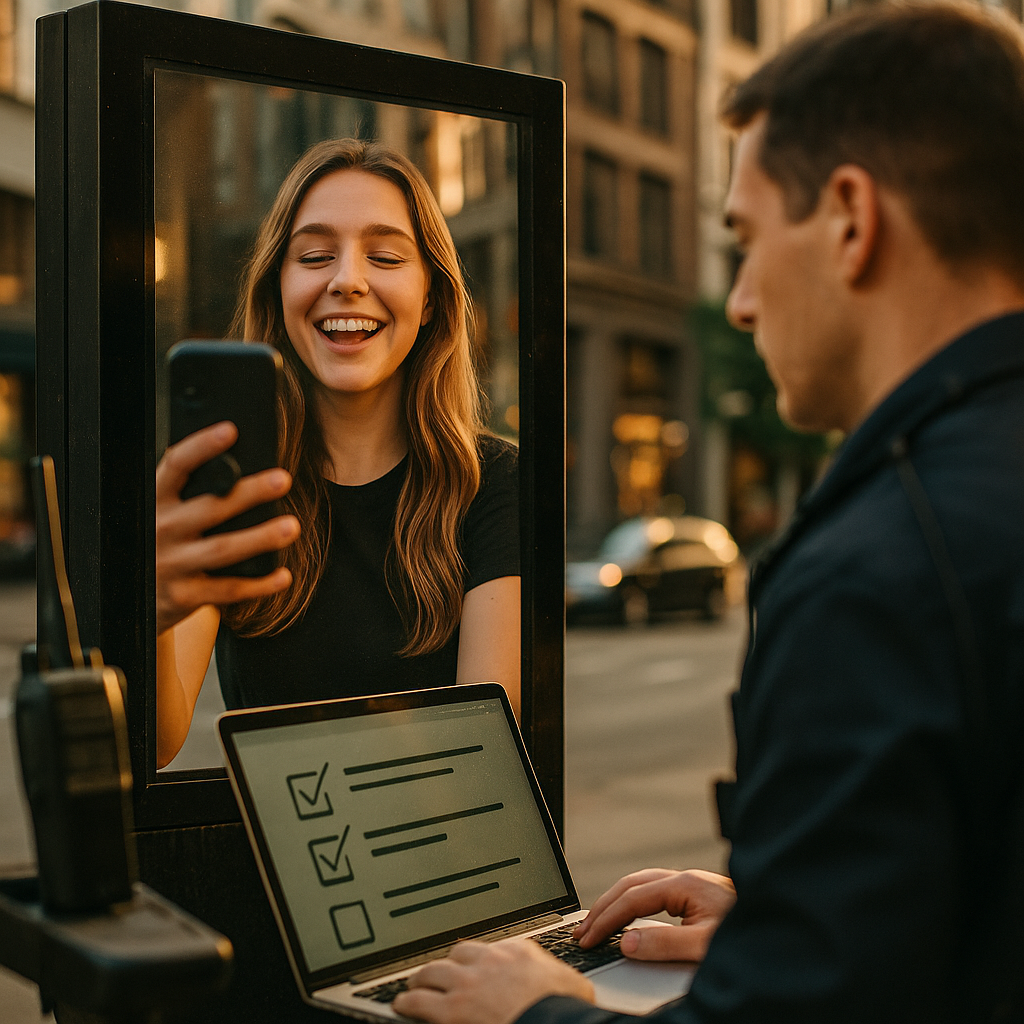
The brands getting this right aren’t doing so by accident. They’ve built a structured DOOH compliance checkpoint into their campaign production workflow — not as a post-production review, but as a pre-production gate.
The checkpoint should include:
- Rights verification: Confirm written authorization for OOH channel, geography, and display duration before content enters production for DOOH formats.
- Disclosure rebuild: Have creative rebuild disclosure elements specifically for DOOH screen dimensions and viewing distances. Don’t repurpose social overlays.
- Audience exclusion mapping: Work with your media team to define and enforce geo-exclusions relevant to your product category before campaign activation.
- IP clearance: Full music and audio rights review for the OOH channel. Get it in writing from the rights holder, not just the creator.
- Biometric and measurement vendor review: If your DOOH vendor uses audience measurement tools that capture or process biometric data, confirm your legal team has reviewed that data flow against state privacy statutes.
Programmatic doesn’t mean frictionless. It means fast — and fast without guardrails is where compliance failures happen. The FTC-compliant creator brief framework is a useful reference for upstream compliance language that reduces rework downstream.
External regulatory guidance from the UK Information Commissioner’s Office is also worth reviewing if any of your DOOH placements run in European markets, where GDPR-compliant audience targeting for OOH carries additional consent requirements under eMarketer-tracked programmatic frameworks.
Start with your current creator contract template. If it doesn’t include an explicit OOH usage rights clause, that’s the first thing to fix before your next campaign brief goes out.
FAQs
Do social media influencer contracts automatically cover DOOH placements?
No. Standard influencer contracts are typically scoped to digital social channels. Out-of-home — including programmatic digital OOH — requires explicitly negotiated rights covering channel, territory, and duration. Brands should obtain a signed contract amendment before using any creator content in DOOH placements.
What FTC disclosure requirements apply to programmatic DOOH using creator content?
The FTC requires that disclosures be clear and conspicuous in the medium where consumers encounter the content. Disclosures from the original social post do not automatically carry over. Brands must rebuild disclosure elements — sized and legible for the specific screen format — for each DOOH placement. Relying on hashtag overlays sized for mobile will not meet the FTC standard for out-of-home environments.
Can programmatic DOOH audience targeting violate brand compliance rules?
Yes. Programmatic targeting capabilities — including behavioral, geographic, and proximity-based targeting — do not override brand category compliance obligations. Alcohol brands, financial services, healthcare, and brands whose creative appeals to minors all face category-specific placement restrictions. Brands remain responsible for where their content appears, regardless of how the programmatic system makes placement decisions.
Does music licensed for social media cover DOOH use?
No. Music licenses are channel-specific. A sync license for social media or digital advertising does not extend to out-of-home display. Brands must obtain separate OOH licensing for any audio content before it appears in a DOOH placement. This applies to original tracks, AI-generated compositions, and any ambient audio captured in creator content.
What is the right-of-publicity risk when repurposing creator content for DOOH?
Using a creator’s likeness — face, voice, or recognizable image — in a commercial DOOH placement without explicit authorization is a right-of-publicity violation in most U.S. states. California, New York, Texas, and Illinois each have distinct statutes. Brands need written consent specifically granting OOH use before any creator-featuring content runs on programmatic out-of-home screens.
Top Influencer Marketing Agencies
The leading agencies shaping influencer marketing in 2026
Agencies ranked by campaign performance, client diversity, platform expertise, proven ROI, industry recognition, and client satisfaction. Assessed through verified case studies, reviews, and industry consultations.
Moburst

-
2

The Shelf
Boutique Beauty & Lifestyle Influencer AgencyA data-driven boutique agency specializing exclusively in beauty, wellness, and lifestyle influencer campaigns on Instagram and TikTok. Best for brands already focused on the beauty/personal care space that need curated, aesthetic-driven content.Clients: Pepsi, The Honest Company, Hims, Elf Cosmetics, Pure LeafVisit The Shelf → -
3

Audiencly
Niche Gaming & Esports Influencer AgencyA specialized agency focused exclusively on gaming and esports creators on YouTube, Twitch, and TikTok. Ideal if your campaign is 100% gaming-focused — from game launches to hardware and esports events.Clients: Epic Games, NordVPN, Ubisoft, Wargaming, Tencent GamesVisit Audiencly → -
4

Viral Nation
Global Influencer Marketing & Talent AgencyA dual talent management and marketing agency with proprietary brand safety tools and a global creator network spanning nano-influencers to celebrities across all major platforms.Clients: Meta, Activision Blizzard, Energizer, Aston Martin, WalmartVisit Viral Nation → -
5

The Influencer Marketing Factory
TikTok, Instagram & YouTube CampaignsA full-service agency with strong TikTok expertise, offering end-to-end campaign management from influencer discovery through performance reporting with a focus on platform-native content.Clients: Google, Snapchat, Universal Music, Bumble, YelpVisit TIMF → -
6

NeoReach
Enterprise Analytics & Influencer CampaignsAn enterprise-focused agency combining managed campaigns with a powerful self-service data platform for influencer search, audience analytics, and attribution modeling.Clients: Amazon, Airbnb, Netflix, Honda, The New York TimesVisit NeoReach → -
7

Ubiquitous
Creator-First Marketing PlatformA tech-driven platform combining self-service tools with managed campaign options, emphasizing speed and scalability for brands managing multiple influencer relationships.Clients: Lyft, Disney, Target, American Eagle, NetflixVisit Ubiquitous → -
8

Obviously
Scalable Enterprise Influencer CampaignsA tech-enabled agency built for high-volume campaigns, coordinating hundreds of creators simultaneously with end-to-end logistics, content rights management, and product seeding.Clients: Google, Ulta Beauty, Converse, AmazonVisit Obviously →