


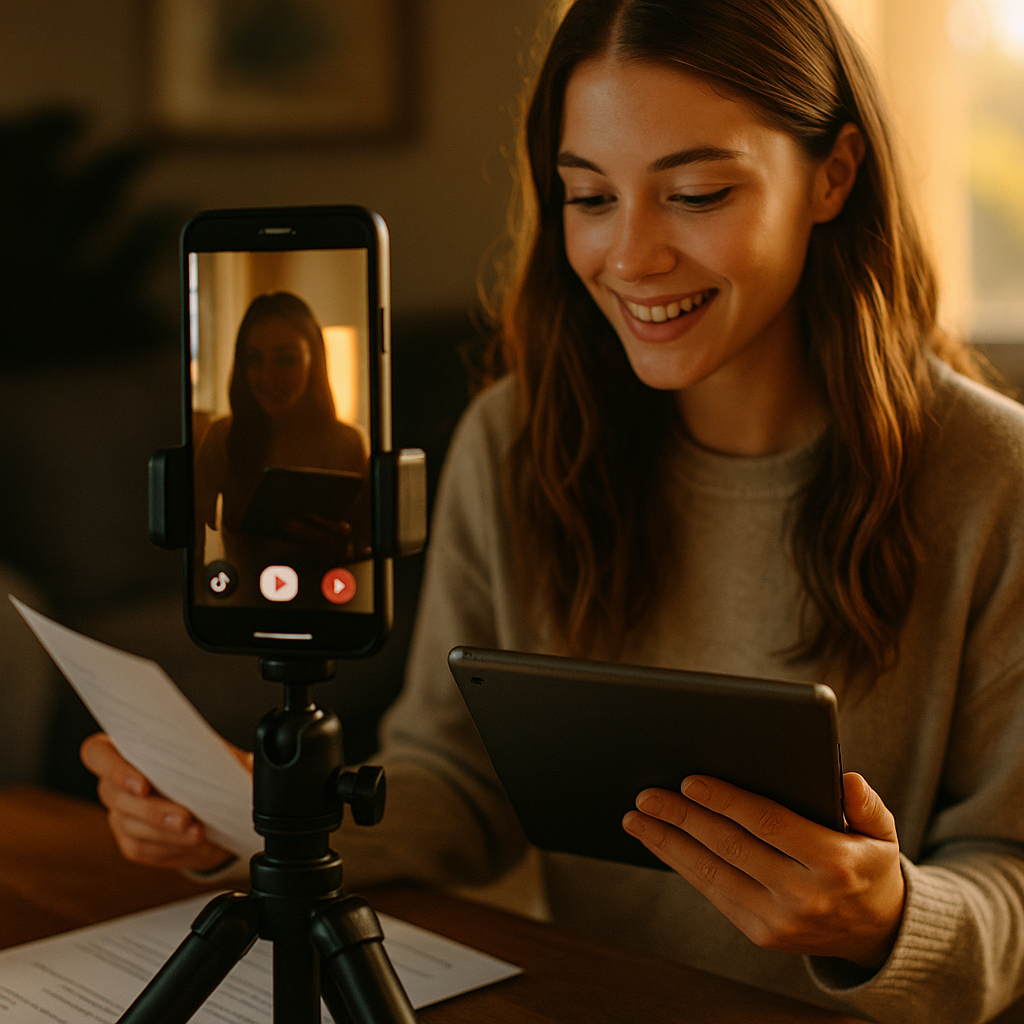
One Shoot, Three Platforms — Without Breaking the Algorithm
Brands running vertical video across TikTok, Instagram Reels, and YouTube Shorts are wasting an estimated 40% of their production budget on redundant creator sessions. The fix isn’t more money — it’s a smarter brief. Vertical video fragmentation is the core operational challenge for any brand managing multi-platform influencer programs at scale, and most creator briefs aren’t designed for it.
The problem isn’t that the platforms share a 9:16 aspect ratio. It’s that their ranking algorithms weight completely different behavioral signals. A piece of sponsored content that performs in the top 10% on TikTok can flatline on Shorts if it’s treated as a straight repurpose. Understanding why — and encoding that knowledge into the brief — is what separates efficient programs from expensive ones.
Why the Algorithms Are Not the Same Animal
TikTok’s ranking model is heavily weighted toward watch-through rate in the first two seconds, caption keyword density, and sound-on engagement. Its For You Page distribution uses an interest graph, not a social graph, which means a creator with 10,000 followers can reach 2 million people if the content signals match a high-demand interest cluster. That changes how the first frame needs to be constructed.
Instagram Reels, by contrast, weights heavily toward shares to Stories and DMs. The Reels algorithm interprets a share as a strong relevance signal — stronger than a like. Meta’s placement engine also feeds Reels into ad inventory, so sponsored content that earns organic shares gets a cost-per-result advantage in paid amplification. If you want to understand how those paid-ready assets should be structured, the brief has to specify share-bait moments explicitly.
YouTube Shorts operates differently still. Its algorithm integrates with the broader YouTube recommendation engine, which means channel-level authority and subscriber engagement history influence distribution. Shorts with high click-through rates from the Shorts shelf get pushed into long-form recommendation carousels — a cross-surface amplification opportunity TikTok doesn’t offer. The brief needs to account for this by specifying that the creator’s channel niche must be coherent with the product category.
Platform algorithms don’t reward the same creative signals. A brief that treats TikTok, Reels, and Shorts as one identical surface will produce content that ranks poorly on all three.
The Modular Brief Architecture That Makes This Work
The solution is a layered brief structure with a shared creative core and platform-specific execution modules. Think of it as a brand constitution at the top and tactical amendments below it. Here’s how to build it.
Layer 1 — The Brand Core (platform-agnostic): This section covers the mandatory brand elements: product claim, key message, FTC disclosure language, and any visual identity requirements like logo placement or color rules. This layer stays constant across all three versions. Critically, it should also specify the emotional arc of the content — not just what to say, but what the viewer should feel at the 3-second, 15-second, and end-of-video marks. Check out how the GEM Framework approaches this emotional architecture in creator briefs.
Layer 2 — The Production Container: This is where you specify the single-session production logic. Instruct the creator to record three distinct openings — one hook formatted for TikTok’s pattern-interrupt style (jump cut, text overlay in the first half-second), one for Reels (visually aesthetic, share-worthy scene), and one for Shorts (curiosity-gap question, optimized for the Shorts shelf thumbnail). The body of the video can be identical. You’re only shooting three different opens and, where needed, three different closes.
Layer 3 — Platform Execution Modules: This is where the brief gets granular. Each module should specify:
- TikTok module: Caption must include 2-3 niche interest hashtags (not generic ones), trending audio or original audio instruction, text overlay copy, and a stitch/duet permission signal if the campaign benefits from UGC amplification. See more on how emotional triggers on TikTok drive downstream conversions.
- Reels module: Brief must specify a “shareable moment” — a frame or line between seconds 8 and 12 that’s designed to be screenshotted or shared to Stories. Include a call-to-comment question in the caption. Note any product tag or Instagram Shopping link requirements.
- Shorts module: Specify that the creator should verbally mention the channel’s broader content niche within the first 10 seconds to reinforce topic authority. End screen must include a verbal CTA pointing to a related long-form video on the same channel, which helps the Shorts algorithm route the content into the recommendation carousel.
What to Shoot in a Single Session
A production-efficient brief schedules the session in deliberate blocks. Start with the three opens — back to back, same wardrobe, same set. Then shoot the shared body once. Then record the three closes. Total additional time versus a single-platform shoot: roughly 25-35 minutes for most lifestyle or product review formats. The brief should include a shot list structured in this exact order, with timing guidance per segment.
One operational detail most brands miss: instruct the creator to record body segments in multiple takes without resetting their energy. TikTok’s algorithm has shown sensitivity to videos where pacing drops in the middle — the watch-through curve flattens and distribution throttles. If the creator records the body section across three low-energy takes stitched together in post, the platform will read that as a retention drop. Brief for continuous takes on the body segment.
For brands managing this at volume, this connects directly to your UGC repurposing stack — the modular brief feeds into a modular asset library. Every production session should yield at minimum nine exportable assets: three platform-native videos, three sets of captions with platform-specific hashtag stacks, and three thumbnail options for Shorts.
The Compliance Layer Most Teams Forget
When a single piece of sponsored content is adapted for three platforms, the FTC’s disclosure requirements apply independently on each. A “paid partnership” label on Instagram does not satisfy the disclosure requirement for the TikTok version. Each platform has its own native disclosure mechanism — TikTok’s branded content toggle, Meta’s paid partnership label, YouTube’s paid promotion disclosure — and the brief must instruct the creator to activate all three independently for their respective uploads.
Failure here isn’t just a compliance risk. It’s an algorithm risk. FTC guidelines are increasingly being operationalized inside platform policies, and TikTok in particular has begun suppressing sponsored content that lacks the branded content toggle. The brief should include a compliance checklist as an appendix — not buried in the brand core layer where creators skim past it.
Each platform’s native disclosure mechanism must be activated independently. A single disclosure label does not transfer across TikTok, Meta, and YouTube — and missing one can trigger algorithmic suppression, not just regulatory risk.
Measuring Whether the Brief Actually Worked
Benchmarking multi-platform performance from a single production run requires separating creative variables from distribution variables. If the TikTok version outperforms Reels by 3x, is that because of the hook, the platform’s audience composition, or the algorithm’s treatment of sponsored content in that category? You need a measurement framework that isolates these.
Run the same product category across at least three creators using the same modular brief before drawing conclusions. Sprout Social and HubSpot‘s analytics integrations can help normalize performance data across platforms into comparable CPV and engagement rate metrics. The goal is to identify which platform module is underperforming — and then update that specific module in the brief, not the entire brief architecture. That’s the compounding efficiency benefit of the layered approach. For teams testing creative variations systematically, the modular brief framework for A/B testing extends this logic further.
One signal worth tracking explicitly: Shorts-to-long-form spillover. If a creator’s Shorts video is driving subscriptions or views on their long-form channel content, that’s the cross-surface amplification at work. YouTube’s analytics surfaces this in the “Shorts” tab under audience acquisition sources. A brief that successfully encodes channel-topic coherence will show this signal within 72 hours of posting.
Brands investing in vertical video at scale should also audit whether their brief structure supports authentic algorithm signals — not just creative compliance. The distinction matters more than most teams realize.
Start Here on Your Next Brief
Pull your last vertical video brief and ask one question: does it specify different behavioral goals for each platform, or does it just say “post to TikTok, Reels, and Shorts”? If it’s the latter, replace the platform section with three separate modules before the next creator onboarding call. That single structural change will produce measurably different distribution outcomes within the first campaign cycle. You can also reference the dedicated vertical video production brief framework as a starting point for building your own layered template.
Frequently Asked Questions
Can a creator really produce TikTok, Reels, and Shorts assets in a single shoot session?
Yes, with the right brief structure. The key is recording three distinct openings (and optionally three closes) while keeping the body segment identical across versions. Most creators add 25-35 minutes to a standard session to capture platform-specific variations. The brief must specify the exact sequence and timing for each segment so the creator doesn’t have to make those decisions on set.
Do the FTC disclosure requirements differ across TikTok, Instagram, and YouTube?
Each platform has its own native disclosure mechanism — TikTok’s branded content toggle, Meta’s paid partnership label, and YouTube’s paid promotion checkbox — and each must be activated independently. A disclosure on one platform does not satisfy the requirement on another. Brands should include a platform-specific compliance checklist as a mandatory appendix in every multi-platform creator brief.
What’s the most important algorithm signal to encode in a TikTok creator brief?
Watch-through rate in the first two seconds is the dominant ranking signal on TikTok. The brief should specify a pattern-interrupt hook — a jump cut, an on-screen text overlay, or an unexpected visual — within the first half-second of the video. Caption keyword density targeting niche interest clusters also significantly impacts For You Page distribution for sponsored content.
How is YouTube Shorts’ algorithm different from TikTok’s for sponsored content?
YouTube Shorts integrates with the broader YouTube recommendation engine, meaning channel-level topic authority influences distribution. Shorts that perform well on the Shorts shelf can be routed into long-form recommendation carousels — a cross-surface amplification opportunity. Briefs should instruct creators to reference their channel’s content niche early in the video and include a verbal CTA pointing to related long-form content to activate this spillover effect.
What metrics should brands track to evaluate a multi-platform modular brief?
Track CPV (cost per view), watch-through rate, and shares-to-DMs for each platform version independently. For YouTube Shorts, monitor audience acquisition data in YouTube Analytics to identify Shorts-to-subscription spillover. Run the same brief structure across at least three creators before drawing conclusions, so you can separate platform distribution variables from individual creator performance variables.
How often should the platform execution modules in a brief be updated?
Platform algorithm updates typically require brief module revisions every two to three months. TikTok in particular shifts its ranking weights frequently. Brands should establish a quarterly brief audit process that reviews performance benchmarks by platform and updates the specific underperforming module — without rebuilding the entire brief architecture from scratch each time.
Top Influencer Marketing Agencies
The leading agencies shaping influencer marketing in 2026
Agencies ranked by campaign performance, client diversity, platform expertise, proven ROI, industry recognition, and client satisfaction. Assessed through verified case studies, reviews, and industry consultations.
Moburst

-
2

The Shelf
Boutique Beauty & Lifestyle Influencer AgencyA data-driven boutique agency specializing exclusively in beauty, wellness, and lifestyle influencer campaigns on Instagram and TikTok. Best for brands already focused on the beauty/personal care space that need curated, aesthetic-driven content.Clients: Pepsi, The Honest Company, Hims, Elf Cosmetics, Pure LeafVisit The Shelf → -
3

Audiencly
Niche Gaming & Esports Influencer AgencyA specialized agency focused exclusively on gaming and esports creators on YouTube, Twitch, and TikTok. Ideal if your campaign is 100% gaming-focused — from game launches to hardware and esports events.Clients: Epic Games, NordVPN, Ubisoft, Wargaming, Tencent GamesVisit Audiencly → -
4

Viral Nation
Global Influencer Marketing & Talent AgencyA dual talent management and marketing agency with proprietary brand safety tools and a global creator network spanning nano-influencers to celebrities across all major platforms.Clients: Meta, Activision Blizzard, Energizer, Aston Martin, WalmartVisit Viral Nation → -
5

The Influencer Marketing Factory
TikTok, Instagram & YouTube CampaignsA full-service agency with strong TikTok expertise, offering end-to-end campaign management from influencer discovery through performance reporting with a focus on platform-native content.Clients: Google, Snapchat, Universal Music, Bumble, YelpVisit TIMF → -
6

NeoReach
Enterprise Analytics & Influencer CampaignsAn enterprise-focused agency combining managed campaigns with a powerful self-service data platform for influencer search, audience analytics, and attribution modeling.Clients: Amazon, Airbnb, Netflix, Honda, The New York TimesVisit NeoReach → -
7

Ubiquitous
Creator-First Marketing PlatformA tech-driven platform combining self-service tools with managed campaign options, emphasizing speed and scalability for brands managing multiple influencer relationships.Clients: Lyft, Disney, Target, American Eagle, NetflixVisit Ubiquitous → -
8

Obviously
Scalable Enterprise Influencer CampaignsA tech-enabled agency built for high-volume campaigns, coordinating hundreds of creators simultaneously with end-to-end logistics, content rights management, and product seeding.Clients: Google, Ulta Beauty, Converse, AmazonVisit Obviously →