


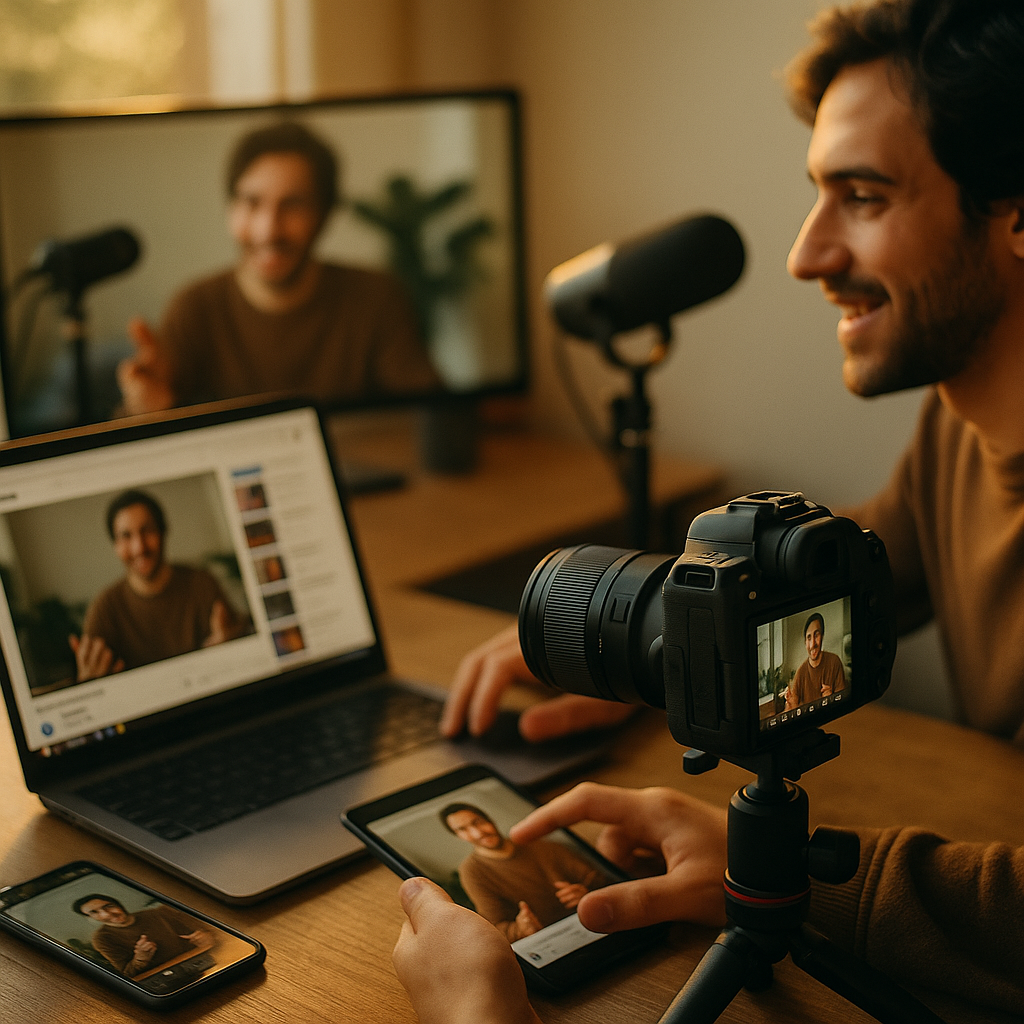
The average consumer touches seven different screens and platforms in a single purchase journey. Seven. And they’re not switching between them sequentially — they’re running all four behaviors concurrently. If your creator strategy is built around a single platform, a single format, or a single moment, you’re intercepting one-seventh of the opportunity. Cross-platform creator distribution isn’t a nice-to-have anymore. It’s the architecture that separates brands who capture attention from brands who buy it and waste it.
The Four-Behavior Stack: What’s Actually Happening in the Room
Let’s be precise about what “simultaneous consumption” means in practice. A consumer is watching a Netflix series (streaming), has TikTok open on their phone (scrolling), just asked a voice assistant what protein powder a specific creator recommends (searching), and has three tabs open from a Reddit thread they visited an hour ago (residual shopping intent). That’s not a hypothetical. eMarketer research consistently shows media multitasking as the norm, not the exception, particularly among 18–44 cohorts who represent the core of most brand budgets.
The implication for creator strategy is structural. You’re not competing for attention — you’re competing for the right intersection of attention, platform, and intent. A creator’s long-form YouTube review intercepts the searching behavior. A TikTok hook intercepts the scrolling behavior. A shoppable Instagram Reel or a TikTok Shop integration intercepts the shopping behavior. Streaming adjacency — whether through podcast sponsorships or CTV creator content — handles the lean-back state. The mistake most brands make is funding one of these channels and calling it a distribution strategy.
Why Single-Platform Creator Briefs Are a Structural Failure
When a brand manager writes a creator brief for “a TikTok and an Instagram post,” they’ve already lost. Not because those platforms are wrong — but because the brief assumes a linear consumer who finishes one thing before starting another. That consumer doesn’t exist.
The failure compounds at the algorithmic level. If your creator content only lives where the algorithm places it organically, you’re outsourcing your distribution strategy to platforms that have no obligation to serve your commercial objectives. This is precisely the tension explored in the problem of creator campaign underperformance — creative quality and algorithmic placement are two separate variables, and brands routinely conflate them.
The most expensive mistake in creator marketing isn’t paying too much for a creator — it’s distributing their content in only one environment and measuring the result as if the full opportunity was reached.
Cross-platform distribution requires that you think of creators not as content producers tied to a channel, but as narrative assets whose output can be sliced, reformatted, and amplified across every surface where your consumer’s attention fragments.
Building the Interception Architecture
Here’s how to operationalize a four-behavior interception model without doubling your budget or your team’s workload.
Start with the scrolling layer. Short-form vertical content — TikTok, Instagram Reels, YouTube Shorts — is your highest-frequency touchpoint. It’s where brand awareness is seeded at scale. Your creator briefs for this layer should prioritize the first two seconds above everything else. Hook data, not aesthetic. This is also the layer where automated paid boost triggers deliver the most leverage: when organic performance signals fire, paid amplification should follow automatically within 24 hours, not after a three-week approval cycle.
The streaming layer requires patience and precision. Podcast integrations, CTV pre-rolls featuring creator-sourced content, and YouTube long-form reviews serve consumers in a lean-back state. These consumers aren’t ready to act immediately — but they’re forming opinions. A creator’s 12-minute skincare review on YouTube isn’t competing with a TikTok hook; it’s doing a completely different job. Invest in both, measure them separately, and resist the executive pressure to evaluate them on the same 7-day attribution window.
The searching layer is where most brands leave serious money on the table. When a consumer voice-searches “best creatine brand according to influencers” or types a creator’s name plus your product category into Google or an AI search engine, you need content that surfaces. This means creator content must be indexed, linkable, and semantically rich — not just locked inside platform-native formats. Long-form YouTube content, creator-authored blog posts, and structured FAQ content that appears in AI-generated answers are critical assets here. Linking this to your GEM creator program for AI search visibility is no longer optional for brands that care about organic discovery.
The shopping layer demands commerce-native formats. TikTok Shop creator storefronts, Amazon affiliate integrations, shoppable Instagram content, and live commerce events are all commerce-layer touchpoints. The consumer who lands here has usually already been primed by the scroll or search layer. Your creator selection for this layer should prioritize conversion affinity, not just reach — which is a distinct profile. Blended cost-per-sale modeling is essential here, because the economics of a commerce-layer creator look very different from an awareness-layer creator.
Creator Selection Across the Stack
Not every creator can serve all four layers. This matters more than most brand teams acknowledge.
A mega-influencer with 8 million TikTok followers and strong scrolling-layer performance may have zero authority in the searching layer — their content isn’t indexed, their YouTube channel is dormant, and their audience doesn’t look to them for considered purchasing decisions. Meanwhile, a mid-tier YouTube creator with 180,000 subscribers and 14-minute average view times could be your most valuable searching-layer asset, even if their TikTok presence is minimal.
The implication: your creator roster should be deliberately segmented by layer, not just by size or category. AI-driven creator discovery using intrinsic affinity signals — not just follower counts — is the only scalable way to build a roster that covers all four behaviors without inflating your creator headcount to an unmanageable number.
When you do find creators who can serve multiple layers, treat them as strategic assets rather than campaign talent. Build long-term structures around them. Performance escalators in contracts incentivize consistent output across formats, which is exactly what cross-platform interception requires. The specifics of how to structure those arrangements are worth studying carefully if this is new territory for your team.
Measurement Across Four Simultaneous Behaviors
This is where programs collapse. Brands with sophisticated creative strategies and intelligent creator selection routinely destroy their own insights by forcing multi-layer campaigns into a single attribution model.
The scrolling layer should be measured on reach, thumb-stop rate, and share velocity. The streaming layer on aided recall, search lift, and branded query volume. The searching layer on ranking position for key creator + product queries, AI answer inclusion, and organic traffic to product pages. The shopping layer on conversion rate, add-to-cart events, and blended CAC.
These are four different dashboards. Trying to collapse them into a single ROAS number will produce misleading conclusions that cause you to defund the layers doing the most valuable work — usually the streaming and searching layers, which have longer attribution windows and less obvious last-click signals.
Brands that measure every layer of their creator distribution strategy by the same short-term conversion metric will consistently defund the layers building the most durable demand.
If your analytics infrastructure isn’t ready for this level of segmentation, start with Sprout Social’s cross-platform reporting capabilities or integrate HubSpot’s attribution modeling to create clean separation between upper-funnel creator signals and lower-funnel conversion events. Tools like Northbeam and Triple Whale have also built multi-touch attribution models specifically designed for creator-heavy media mixes — worth piloting if you’re running more than $500K in creator spend annually.
Budget Reallocation: The Operational Reality
Cross-platform interception requires budget reallocation, not budget inflation. Most brands are over-indexed on creator fees for platform-native content and under-indexed on the paid amplification that makes that content work across layers.
A useful benchmark: if you’re spending less than 30–40% of your total creator program budget on distribution and amplification (as opposed to creator fees alone), you’re likely getting a fraction of the reach your content could deliver. The amplification-first budget model for CMOs offers a concrete framework for restructuring this allocation without going back to the board for incremental dollars.
The other lever is content repurposing efficiency. A single long-form YouTube video, properly briefed, can yield: three TikTok clips (scrolling layer), one podcast-ready audio edit (streaming layer), five SEO-indexed blog paragraphs (searching layer), and a shoppable short with a creator affiliate link (shopping layer). That’s seven distribution assets from one production session. Build your content agreements with creators to include repurposing rights explicitly — and consult your legal team on data ownership language if any of this content feeds into first-party data collection. Data ownership clauses in creator contracts are increasingly consequential as brands build owned audiences from creator-driven traffic.
The consumer isn’t waiting for your strategy to catch up with their behavior. Start by auditing which of the four layers your current creator program actually serves — then build a roadmap to close the gaps, one layer at a time.
FAQs
What is a cross-platform creator distribution strategy?
A cross-platform creator distribution strategy is a deliberate plan to deploy creator content across multiple platforms and formats — including short-form social (scrolling), long-form video and podcasts (streaming), search-indexed content (searching), and shoppable formats (shopping) — so that brand messaging intercepts consumer attention regardless of where or how they’re consuming content at any given moment.
How many creators do I need to cover all four consumption behaviors?
There’s no universal number, but the principle is segmentation over volume. You need creators who are strong in each layer — scrolling-layer creators who dominate short-form, streaming-layer creators with long-form authority, search-layer creators whose content gets indexed and surfaces in Google and AI answers, and commerce-layer creators who convert. A roster of 15–20 well-matched creators, properly segmented, will outperform a roster of 100 creators all doing the same format on the same platform.
How should I measure creator performance across multiple platforms?
Use layer-specific KPIs rather than a single blended ROAS. The scrolling layer should track reach, engagement rate, and share velocity. The streaming layer should track aided recall and branded search lift. The searching layer should track keyword rankings, AI answer inclusion, and organic referral traffic. The shopping layer should track conversion rate, add-to-cart events, and blended cost-per-acquisition. Collapsing all four into one metric creates misleading conclusions and causes teams to defund high-value upper-funnel activity.
What budget split should I use for creator fees versus amplification?
A useful starting benchmark is 60% creator fees and content production, 40% paid amplification and distribution. Most brand programs are currently inverted from optimal — heavy on fees, light on amplification — which means their content is underperforming not because of creator quality but because it’s not reaching the audiences it could. Review your current split before adding new creator partnerships.
How does AI search change the creator distribution equation?
AI search engines — including Google’s AI Overviews and emerging tools like Perplexity — pull from indexed, authoritative content when generating answers. Creator content that exists only inside platform-native formats (TikTok videos, Instagram Reels) is largely invisible to these systems. Brands that want creator content to influence AI-generated recommendations need to invest in indexable formats: YouTube transcripts, creator-authored blog content, structured FAQ assets, and review content that search engines can crawl and cite.
Top Influencer Marketing Agencies
The leading agencies shaping influencer marketing in 2026
Agencies ranked by campaign performance, client diversity, platform expertise, proven ROI, industry recognition, and client satisfaction. Assessed through verified case studies, reviews, and industry consultations.
Moburst

-
2

The Shelf
Boutique Beauty & Lifestyle Influencer AgencyA data-driven boutique agency specializing exclusively in beauty, wellness, and lifestyle influencer campaigns on Instagram and TikTok. Best for brands already focused on the beauty/personal care space that need curated, aesthetic-driven content.Clients: Pepsi, The Honest Company, Hims, Elf Cosmetics, Pure LeafVisit The Shelf → -
3

Audiencly
Niche Gaming & Esports Influencer AgencyA specialized agency focused exclusively on gaming and esports creators on YouTube, Twitch, and TikTok. Ideal if your campaign is 100% gaming-focused — from game launches to hardware and esports events.Clients: Epic Games, NordVPN, Ubisoft, Wargaming, Tencent GamesVisit Audiencly → -
4

Viral Nation
Global Influencer Marketing & Talent AgencyA dual talent management and marketing agency with proprietary brand safety tools and a global creator network spanning nano-influencers to celebrities across all major platforms.Clients: Meta, Activision Blizzard, Energizer, Aston Martin, WalmartVisit Viral Nation → -
5

The Influencer Marketing Factory
TikTok, Instagram & YouTube CampaignsA full-service agency with strong TikTok expertise, offering end-to-end campaign management from influencer discovery through performance reporting with a focus on platform-native content.Clients: Google, Snapchat, Universal Music, Bumble, YelpVisit TIMF → -
6

NeoReach
Enterprise Analytics & Influencer CampaignsAn enterprise-focused agency combining managed campaigns with a powerful self-service data platform for influencer search, audience analytics, and attribution modeling.Clients: Amazon, Airbnb, Netflix, Honda, The New York TimesVisit NeoReach → -
7

Ubiquitous
Creator-First Marketing PlatformA tech-driven platform combining self-service tools with managed campaign options, emphasizing speed and scalability for brands managing multiple influencer relationships.Clients: Lyft, Disney, Target, American Eagle, NetflixVisit Ubiquitous → -
8

Obviously
Scalable Enterprise Influencer CampaignsA tech-enabled agency built for high-volume campaigns, coordinating hundreds of creators simultaneously with end-to-end logistics, content rights management, and product seeding.Clients: Google, Ulta Beauty, Converse, AmazonVisit Obviously →