


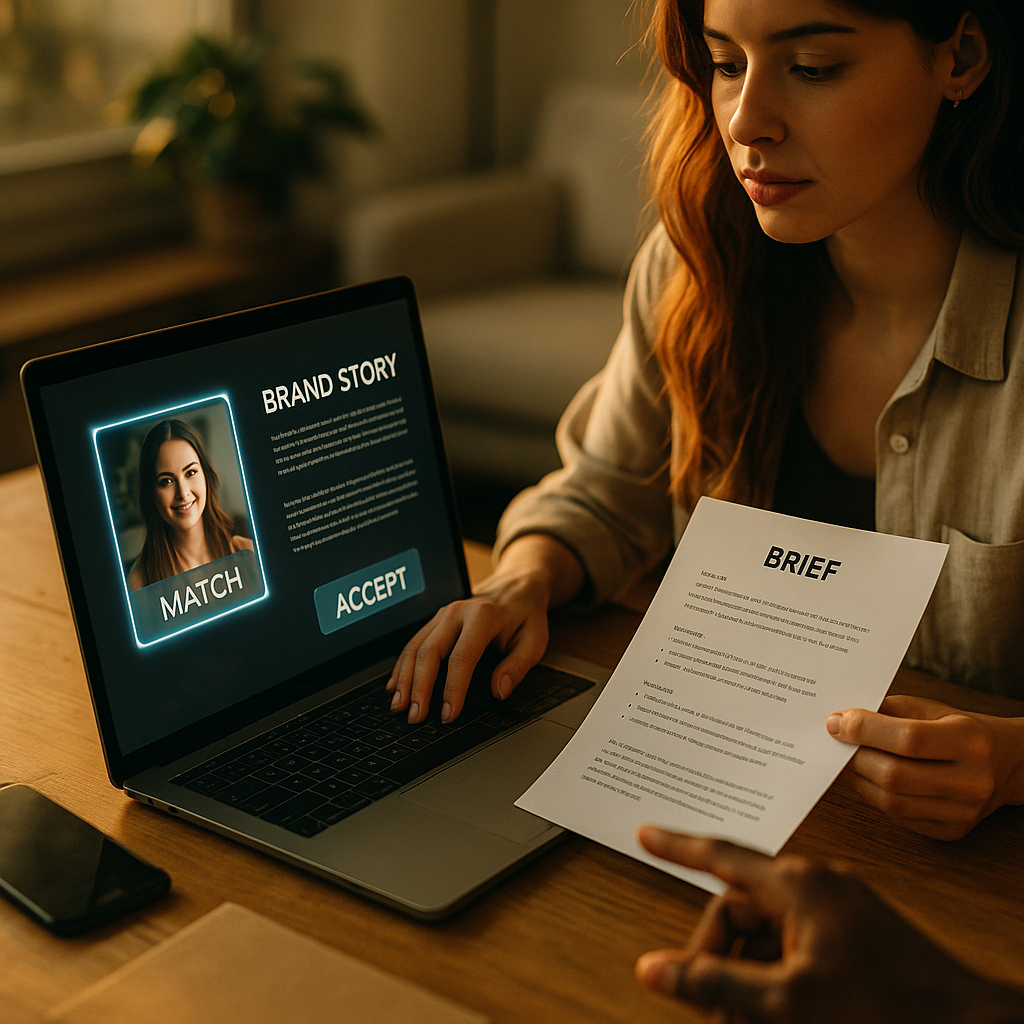
Brief rejection rates in influencer marketing hover around 60–70% for cold outreach. What if the problem isn’t the brief itself — it’s that brands are pitching the wrong creators entirely? AI-assisted story-centric creator matching changes that calculus before a single email gets sent.
The Real Cost of Mismatched Outreach
Most influencer teams still select creators based on audience demographics, follower counts, and engagement rates. These are necessary inputs. But they’re not sufficient. A creator with 400K followers and a 6% engagement rate can still produce content that feels off-brand, generates low-quality UGC, and quietly poisons your content pipeline for the quarter.
The mismatch isn’t always obvious upfront. A creator might share your audience. They might even share your values on paper. But if their narrative voice — the way they structure stories, the emotional register they operate in, the cadence of how they build trust with their audience — conflicts with your brand story assets, the content will underperform. Full stop.
This is the gap that AI-assisted story-centric creator matching is built to close.
What “Story-Centric Matching” Actually Means
Strip away the jargon. At its core, this approach uses generative AI to analyze two bodies of content simultaneously: your brand’s existing story assets (campaign briefs, brand voice guides, hero content, past high-performing creator videos) and a creator’s published output across platforms. The AI looks for alignment in narrative structure, emotional tone, storytelling cadence, and thematic vocabulary — not just topical overlap.
Think of it as the difference between matching a creator who talks about wellness versus one who tells wellness stories the same way your brand does. One produces content that fits your feed. The other produces content that feels like it was made by your brand.
Brands that align creator narrative voice with brand story architecture before outreach report significantly higher first-draft approval rates and fewer revision cycles — directly cutting campaign production costs.
Tools like AI-powered talent discovery platforms are already indexing creator content at scale — some covering upward of 67 million creators. The next layer is applying generative AI on top of that index to do narrative-level analysis, not just categorical tagging.
How the Matching Process Works in Practice
Here’s how forward-thinking brand teams are operationalizing this in their pre-outreach workflows:
- Encode your brand story DNA. Feed your AI tool a curated set of brand assets: top-performing creator content from previous campaigns, brand voice documentation, hero brand films, and your current campaign brief. The system builds a semantic and stylistic profile of what “on-brand storytelling” looks like for your specific context.
- Run narrative analysis on creator content. The AI scrapes and analyzes a creator’s recent posts, videos, and captions — not just for topic relevance but for structural patterns: Do they open with conflict or aspiration? Do they favor humor or sincerity? How do they handle product integration? What’s their narrative resolution style?
- Generate a story-fit score. Creators receive a composite score that weights narrative alignment alongside traditional audience metrics. A creator might score highly on demographics but low on story fit — a signal to either deprioritize them or build a very different brief for them.
- Personalize outreach based on fit signals. High story-fit creators get briefs that reference specific elements of their existing content style, demonstrating the brand has done genuine homework. This alone materially improves acceptance rates.
Platforms like Sprout Social and purpose-built influencer tools are beginning to integrate these capabilities, while enterprise teams are building custom pipelines using APIs from large language model providers to process creator content libraries at scale.
Why Brief Acceptance Rates Improve
Creators are gatekeepers of their own audiences. The best ones — especially those in the mid-tier and macro tiers — receive dozens of outreach messages weekly. They filter ruthlessly. A brief that clearly understands their storytelling approach signals respect and creative partnership. A generic brief signals commodity thinking.
When you use AI to surface story-fit alignment and then personalize the brief accordingly, you’re not flattering the creator. You’re showing them the creative case for why this partnership makes sense. That’s a fundamentally different conversation.
Pair this with smarter creator briefs for AI feeds and you’re also improving how the content performs once it’s published — not just how it gets approved in the first place.
The Content Quality Payoff
Better matching upstream means fewer revision cycles downstream. When a creator’s natural storytelling style already aligns with your brand narrative, the first draft is closer to what you actually need. Creative directors spend less time explaining brand voice. Legal and compliance teams see fewer brand safety flags. And the content that does ship feels native — which is the entire point of influencer marketing.
This is particularly critical for brands managing large creator rosters. If you’re running 50+ creator activations per quarter, even a 20% reduction in revision cycles translates directly into production cost savings and faster campaign velocity. For context on how those efficiencies compound, UGC ROI reinvestment strategies become far more viable when you’re not burning budget on revision rounds.
Story-fit matching isn’t a creative luxury — it’s an operational efficiency play. Every revision cycle you eliminate is budget you can redeploy into paid amplification or additional creator activations.
Governance and Human Oversight: Non-Negotiable
Let’s be direct about the limits. Generative AI is exceptionally good at pattern recognition and stylistic analysis. It is not infallible on nuance — especially cultural nuance, recent creator controversies, or the kind of off-platform signals that a seasoned talent manager would catch immediately.
Story-fit scores should inform human judgment, not replace it. Your talent team still needs to review shortlists. Your creative director still needs to sign off on brief personalization. The AI accelerates and improves the matching process; it doesn’t automate away the strategic layer. Teams that understand how to set AI creative governance policies will extract more value from these tools while managing risk appropriately.
There’s also a data provenance question. What content are you feeding into the brand story encoding process? Ensure you’re using licensed content and that your AI vendor’s data practices align with platform terms of service. FTC guidelines on endorsements still apply to AI-assisted outreach processes — the tool doesn’t change the compliance requirement.
Building the Capability Inside Your Stack
You don’t need a bespoke AI system to start. The practical path for most brand teams in this environment involves three steps: selecting a creator intelligence platform that already provides narrative-level analysis (several are now offering this as a feature layer on top of traditional discovery), establishing a structured brand story asset library that can be used as a training input, and defining what “story fit” means for your brand specifically before you hand it to any AI.
That last point is the one teams consistently underinvest in. The AI is only as good as the story inputs you give it. A vague brand voice guide produces vague matching. Specific, annotated examples of high-performing creator content produce specific, actionable fit scores.
For teams thinking about broader workflow integration, the agentic creative brief generation model offers a natural extension of this matching process — automatically drafting personalized briefs based on the story-fit analysis output.
Research from eMarketer consistently shows that content authenticity is a top purchase driver for creator-influenced categories. Story-fit matching is the operational mechanism that makes authenticity scalable — not a post-hoc aspiration, but a pre-outreach engineering decision.
For additional context on how Meta’s creator tools and TikTok’s Creative Center are surfacing performance signals that can feed into these matching models, both platforms have expanded their API access for brand partners significantly — making it easier to pull creator content data into your own matching pipeline.
Your immediate next step: Audit your last 10 creator campaigns and identify the three that produced the highest-quality first drafts. Analyze what those creators had in common narratively — not demographically. That pattern is your story-fit benchmark. Build the AI matching model around it.
Frequently Asked Questions
What is AI-assisted story-centric creator matching?
It’s the use of generative AI to analyze and compare a brand’s narrative style, voice, and story assets against a creator’s published content — before outreach — to identify creators whose storytelling approach is most likely to produce on-brand, high-quality content with fewer revision cycles.
How does story-fit matching improve brief acceptance rates?
When outreach demonstrates genuine understanding of a creator’s storytelling style — referencing specific narrative techniques they use — it signals creative partnership rather than transactional interest. Creators respond significantly better to briefs that feel tailored, which directly increases acceptance rates.
What data inputs does the AI need to build a brand story profile?
Typically: past high-performing creator content, brand voice documentation, hero campaign assets, and annotated examples of both approved and rejected content. The more specific and curated the inputs, the more precise the story-fit scoring output.
Can small brand teams use this approach without custom AI infrastructure?
Yes. Several creator intelligence platforms now offer narrative-level matching as a feature layer. Smaller teams can also use general-purpose LLM tools with structured prompts to analyze creator content against brand story assets manually, then scale once the methodology is proven.
What are the governance risks of using AI for creator matching?
The primary risks are over-reliance on automated scores (missing cultural nuance or recent creator controversies), data provenance issues with content used for training, and platform terms of service compliance when scraping creator content. Human review of AI-generated shortlists remains essential, and teams should establish clear AI governance policies before deploying these workflows at scale.
How does story-fit matching affect content quality beyond acceptance rates?
When a creator’s natural narrative style already aligns with brand storytelling requirements, first drafts require fewer revisions, brand voice consistency improves across a creator roster, and the final content feels more native — which directly impacts audience trust and content performance metrics.
Top Influencer Marketing Agencies
The leading agencies shaping influencer marketing in 2026
Agencies ranked by campaign performance, client diversity, platform expertise, proven ROI, industry recognition, and client satisfaction. Assessed through verified case studies, reviews, and industry consultations.
Moburst

-
2

The Shelf
Boutique Beauty & Lifestyle Influencer AgencyA data-driven boutique agency specializing exclusively in beauty, wellness, and lifestyle influencer campaigns on Instagram and TikTok. Best for brands already focused on the beauty/personal care space that need curated, aesthetic-driven content.Clients: Pepsi, The Honest Company, Hims, Elf Cosmetics, Pure LeafVisit The Shelf → -
3

Audiencly
Niche Gaming & Esports Influencer AgencyA specialized agency focused exclusively on gaming and esports creators on YouTube, Twitch, and TikTok. Ideal if your campaign is 100% gaming-focused — from game launches to hardware and esports events.Clients: Epic Games, NordVPN, Ubisoft, Wargaming, Tencent GamesVisit Audiencly → -
4

Viral Nation
Global Influencer Marketing & Talent AgencyA dual talent management and marketing agency with proprietary brand safety tools and a global creator network spanning nano-influencers to celebrities across all major platforms.Clients: Meta, Activision Blizzard, Energizer, Aston Martin, WalmartVisit Viral Nation → -
5

The Influencer Marketing Factory
TikTok, Instagram & YouTube CampaignsA full-service agency with strong TikTok expertise, offering end-to-end campaign management from influencer discovery through performance reporting with a focus on platform-native content.Clients: Google, Snapchat, Universal Music, Bumble, YelpVisit TIMF → -
6

NeoReach
Enterprise Analytics & Influencer CampaignsAn enterprise-focused agency combining managed campaigns with a powerful self-service data platform for influencer search, audience analytics, and attribution modeling.Clients: Amazon, Airbnb, Netflix, Honda, The New York TimesVisit NeoReach → -
7

Ubiquitous
Creator-First Marketing PlatformA tech-driven platform combining self-service tools with managed campaign options, emphasizing speed and scalability for brands managing multiple influencer relationships.Clients: Lyft, Disney, Target, American Eagle, NetflixVisit Ubiquitous → -
8

Obviously
Scalable Enterprise Influencer CampaignsA tech-enabled agency built for high-volume campaigns, coordinating hundreds of creators simultaneously with end-to-end logistics, content rights management, and product seeding.Clients: Google, Ulta Beauty, Converse, AmazonVisit Obviously →