


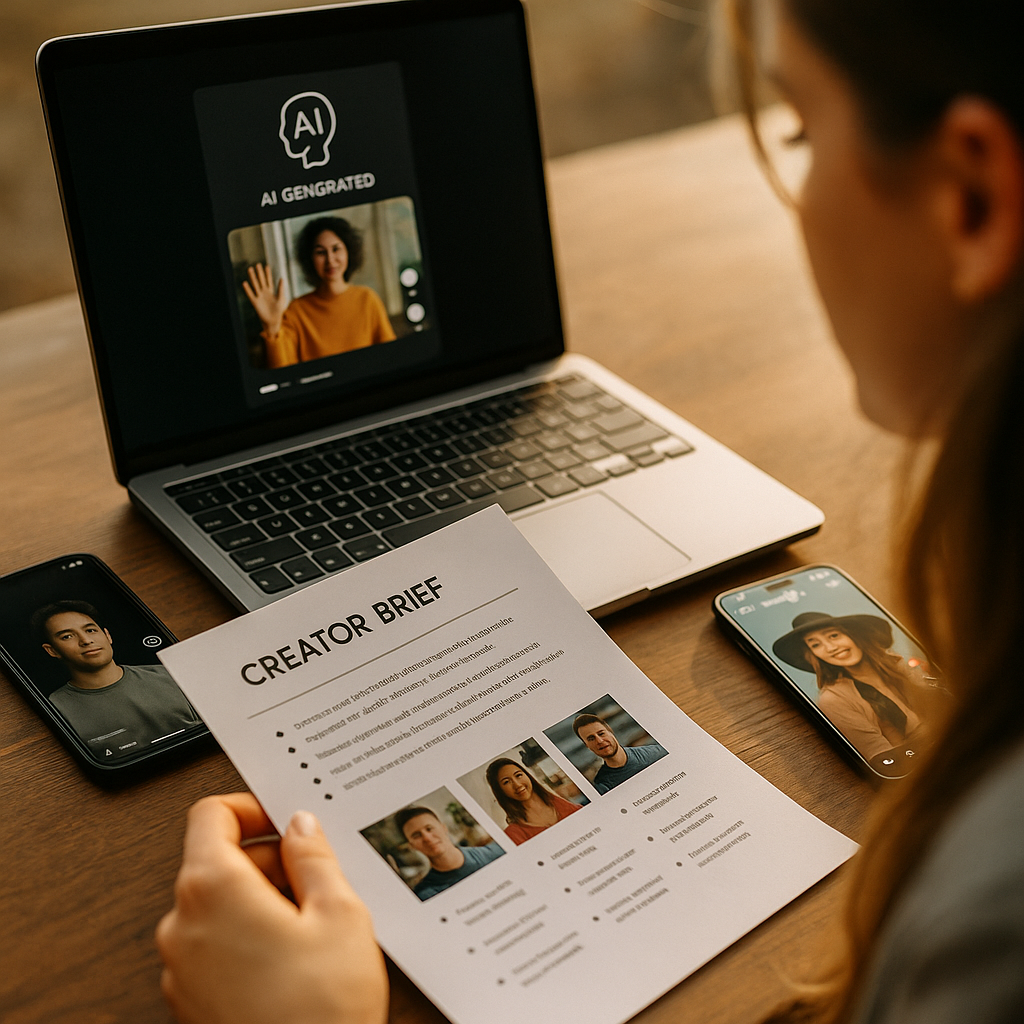
If your creator brief still leads with brand messaging instead of format signals, the algorithm has already decided to bury your content before a single human sees it. AI-curated feeds on TikTok and Instagram now control distribution more than follower counts ever did — and most brand creative teams are still writing briefs for 2019.
The Algorithm Is the Audience Now
This isn’t hyperbole. TikTok’s For You Page processes over a billion content pieces daily through a recommendation engine that prioritizes behavioral signals — completion rate, replays, shares, and save rate — over account authority. Instagram’s Reels distribution follows a similar logic: Meta’s own guidance confirms that content is first shown to a small non-follower test cohort, and distribution scales only if that cohort engages. Your creator’s 800K followers are essentially irrelevant if the initial test pool scrolls past.
What does this mean operationally? It means the brief is no longer just a creative directive — it’s a distribution strategy document. Every creative decision your team encodes into that brief either helps or hurts the AI’s confidence that the content deserves reach.
Format Signals the Algorithm Actually Reads
Platform AI systems don’t watch content the way humans do. They extract signals. Here’s what those signals are, and how briefs should address each one.
Video length and pacing. On TikTok, videos in the 21–34 second range consistently outperform longer formats for completion rate among cold audiences, according to TikTok for Business benchmarking data. But this isn’t a blanket rule — niche tutorial content and storytelling formats can sustain 60–90 seconds when the hook is strong. The brief should specify a target duration range, not just a maximum, and explain the strategic rationale so the creator understands the pacing intention.
Text overlay and caption behavior. Both platforms’ AI systems read on-screen text and auto-generated captions as content classification signals. This affects which interest graphs the content gets served into. If a creator is promoting a skincare product but never says the word “skincare” or shows relevant text on screen in the first five seconds, the algorithm may misclassify the content. Brief creators to include category-specific language early — not as a keyword-stuffing exercise, but as an accurate content signal.
Native format compliance. Vertical 9:16 isn’t optional. Watermarks from competing platforms trigger suppression. Logos in the lower-right corner get obscured by interface elements. These aren’t aesthetic preferences — they’re distribution penalties. A brief that doesn’t specify these constraints is leaving reach on the table.
The brief is no longer a creative directive — it’s a distribution strategy document. Every creative decision either helps or hurts the algorithm’s confidence that the content deserves reach.
Engineering the Hook: The First Three Seconds Are a Bet
Scroll-stop rate in the first three seconds is the primary sorting mechanism for AI feed selection. This is the moment the algorithm is essentially asking: does this content earn the next frame?
Strong opening hooks fall into predictable categories that brand teams can actively prescribe in briefs:
- Visual disruption: An unexpected visual cut, an extreme close-up, or motion that starts mid-action. The brain is wired to pause for incomplete patterns.
- Verbal tension: Opening with a claim that creates cognitive dissonance — “I stopped using SPF for three weeks” before a skincare product reveal creates more friction (and attention) than “Here’s my morning routine.”
- Direct address with specificity: “If you’ve been dealing with X” outperforms “Hey guys” every time. The specificity signals relevance to the algorithm’s interest-graph matching.
- Pattern interrupt: Breaking the expected visual or audio grammar of the platform at the open. Silence when music is expected. Static when motion is expected.
Brief your creators with 2–3 approved hook options, not just one. This gives them creative latitude while keeping you within distribution-optimized parameters. It also generates A/B test data at scale — useful input for AI creative performance measurement frameworks your team should already be running.
Completion Rate Is the Metric Nobody Briefs For
Ask most brand managers what metric they optimize creator content for, and they’ll say views, engagement rate, or saves. Almost none say completion rate — and that’s a structural error, because completion rate is the signal that most directly tells the algorithm the content has value.
Completion rate is earned, not assumed. It requires deliberate structural engineering in the content itself:
- Narrative loops: Tease a payoff early and deliver it late. “I’ll show you exactly how much I spent” at second 4 keeps viewers through to second 30.
- Serial reveals: List-based formats (“three things I wish I’d known”) create micro-commitments that sustain watch time through each item.
- Mid-content re-hooks: At the 50% watch-time mark, creators should introduce a new piece of tension or information — not a brand mention. Re-engagement beats completion attrition.
These aren’t tricks. They’re structural decisions that belong in the brief as explicit direction, not left to creator intuition. The most algorithmically successful creators already do this instinctively. Your brief should encode it systematically so it applies across your entire creator roster.
This structural thinking connects directly to how teams are applying AI creative data feedback loops — using performance signals from live content to iterate briefs in near real-time rather than waiting for post-campaign reviews.
Save Rate and Share Rate: The Distribution Multipliers
Both TikTok and Instagram weight save rate and share rate heavily because these actions indicate durable utility, not just passive consumption. Content that gets saved signals to the algorithm: this had enough value that a user wanted to return to it. That’s a powerful distribution multiplier.
Most brand content doesn’t brief for saves. It should. Content that earns saves tends to be:
- Instructional or reference-worthy (how-to formats, product comparisons, ingredient explainers)
- Emotionally resonant in a way that makes users want to share with a specific person
- Visually or informationally dense enough that one viewing isn’t sufficient
This doesn’t mean every creator post needs to be a tutorial. It means the brief should specify what utility the content delivers, not just what message it communicates. There’s a difference between a brand message and a content asset — and algorithms reward the latter.
There’s a difference between a brand message and a content asset. Algorithms reward utility. Brief for saves, not just views.
Adapting Your Brief Template: A Practical Restructure
Most legacy creator briefs lead with brand background, key messages, do’s and don’ts, and then a vague “be authentic” sign-off. Functionally useless for algorithmic distribution. Here’s how to restructure:
- Distribution intent first: What algorithm behavior are we optimizing for? Completion rate? Save rate? Share velocity? State it explicitly.
- Hook options: Provide 2–3 tested hook formats with rationale, not just a topic prompt.
- Format specifications: Duration range, on-screen text requirements, native format compliance checklist.
- Structural arc: Where in the video should the brand integration land? (Hint: not second 3.) What re-hook should appear at the midpoint?
- Utility signal: What value does this content deliver to the viewer independent of the brand? This is what earns saves.
- Compliance and brand elements: FTC disclosure placement, logo constraints, approved claims. These belong at the end of the brief, not the beginning — because distribution logic should drive structure, compliance refines it.
Teams already working with agentic brief generation tools are beginning to automate this restructuring using performance data from prior campaigns — feeding completion rates, save rates, and hook performance back into brief templates dynamically.
For teams managing creator rosters at scale, AI predictive segmentation across creator audience cohorts adds another layer: different completion rate triggers and hook formats work differently across age, interest, and platform cohorts, so your brief strategy shouldn’t be one-size-fits-all.
Additionally, how you balance automation with premium content production decisions will increasingly shape whether your creative infrastructure can iterate fast enough to keep pace with algorithmic shifts.
External research supports the urgency here. Sprout Social’s platform benchmarking and HubSpot’s video engagement data both reinforce that format-native content consistently outperforms brand-led content when distribution is algorithm-driven. eMarketer projects that AI-curated feed placements will account for the dominant share of creator content impressions across major platforms — the window for teams still running legacy briefs is closing faster than most realize.
The Bottom Line
Audit one live campaign this week: pull completion rate, save rate, and average watch time by creator. Map those numbers back to what the brief actually specified — and you’ll see exactly where the brief failed the algorithm. That gap is your starting point.
Frequently Asked Questions
What is an AI-curated feed brief?
An AI-curated feed brief is a creator brief designed specifically to optimize content for algorithmic distribution on platforms like TikTok and Instagram. Rather than leading with brand messaging, it encodes format signals, hook structures, completion rate triggers, and utility cues that help the platform’s AI rank and distribute the content to larger audiences.
Why does completion rate matter more than views for creator content?
Completion rate tells the algorithm that the content delivered enough value to hold attention through to the end. TikTok and Instagram use completion rate as a primary confidence signal before expanding distribution beyond the initial test cohort. High view counts with low completion rates often result in distribution being throttled, limiting the content’s total reach.
How should brand teams brief creators for TikTok’s algorithm specifically?
Brand teams should specify target video duration, provide multiple hook options for the first three seconds, require category-relevant language in on-screen text or spoken audio early in the video, include mid-content re-hooks to sustain watch time, and define what utility the content delivers that would motivate a viewer to save or share it.
What format signals does Instagram’s algorithm use to decide distribution?
Instagram’s Reels algorithm tests content against a small non-follower cohort first. It reads signals including completion rate, save rate, share rate, scroll-stop behavior, and native format compliance. Watermarks from competing platforms, off-format aspect ratios, and poor initial cohort engagement all suppress broader distribution.
How do save rate and share rate affect algorithmic reach?
Save rate and share rate are weighted heavily on both TikTok and Instagram because they signal durable utility — the viewer found the content valuable enough to return to or pass along. Content that earns saves tends to be instructional, reference-worthy, or emotionally resonant in a shareable way. Briefing explicitly for these actions rather than just views or comments significantly improves organic distribution potential.
Top Influencer Marketing Agencies
The leading agencies shaping influencer marketing in 2026
Agencies ranked by campaign performance, client diversity, platform expertise, proven ROI, industry recognition, and client satisfaction. Assessed through verified case studies, reviews, and industry consultations.
Moburst

-
2

The Shelf
Boutique Beauty & Lifestyle Influencer AgencyA data-driven boutique agency specializing exclusively in beauty, wellness, and lifestyle influencer campaigns on Instagram and TikTok. Best for brands already focused on the beauty/personal care space that need curated, aesthetic-driven content.Clients: Pepsi, The Honest Company, Hims, Elf Cosmetics, Pure LeafVisit The Shelf → -
3

Audiencly
Niche Gaming & Esports Influencer AgencyA specialized agency focused exclusively on gaming and esports creators on YouTube, Twitch, and TikTok. Ideal if your campaign is 100% gaming-focused — from game launches to hardware and esports events.Clients: Epic Games, NordVPN, Ubisoft, Wargaming, Tencent GamesVisit Audiencly → -
4

Viral Nation
Global Influencer Marketing & Talent AgencyA dual talent management and marketing agency with proprietary brand safety tools and a global creator network spanning nano-influencers to celebrities across all major platforms.Clients: Meta, Activision Blizzard, Energizer, Aston Martin, WalmartVisit Viral Nation → -
5

The Influencer Marketing Factory
TikTok, Instagram & YouTube CampaignsA full-service agency with strong TikTok expertise, offering end-to-end campaign management from influencer discovery through performance reporting with a focus on platform-native content.Clients: Google, Snapchat, Universal Music, Bumble, YelpVisit TIMF → -
6

NeoReach
Enterprise Analytics & Influencer CampaignsAn enterprise-focused agency combining managed campaigns with a powerful self-service data platform for influencer search, audience analytics, and attribution modeling.Clients: Amazon, Airbnb, Netflix, Honda, The New York TimesVisit NeoReach → -
7

Ubiquitous
Creator-First Marketing PlatformA tech-driven platform combining self-service tools with managed campaign options, emphasizing speed and scalability for brands managing multiple influencer relationships.Clients: Lyft, Disney, Target, American Eagle, NetflixVisit Ubiquitous → -
8

Obviously
Scalable Enterprise Influencer CampaignsA tech-enabled agency built for high-volume campaigns, coordinating hundreds of creators simultaneously with end-to-end logistics, content rights management, and product seeding.Clients: Google, Ulta Beauty, Converse, AmazonVisit Obviously →