


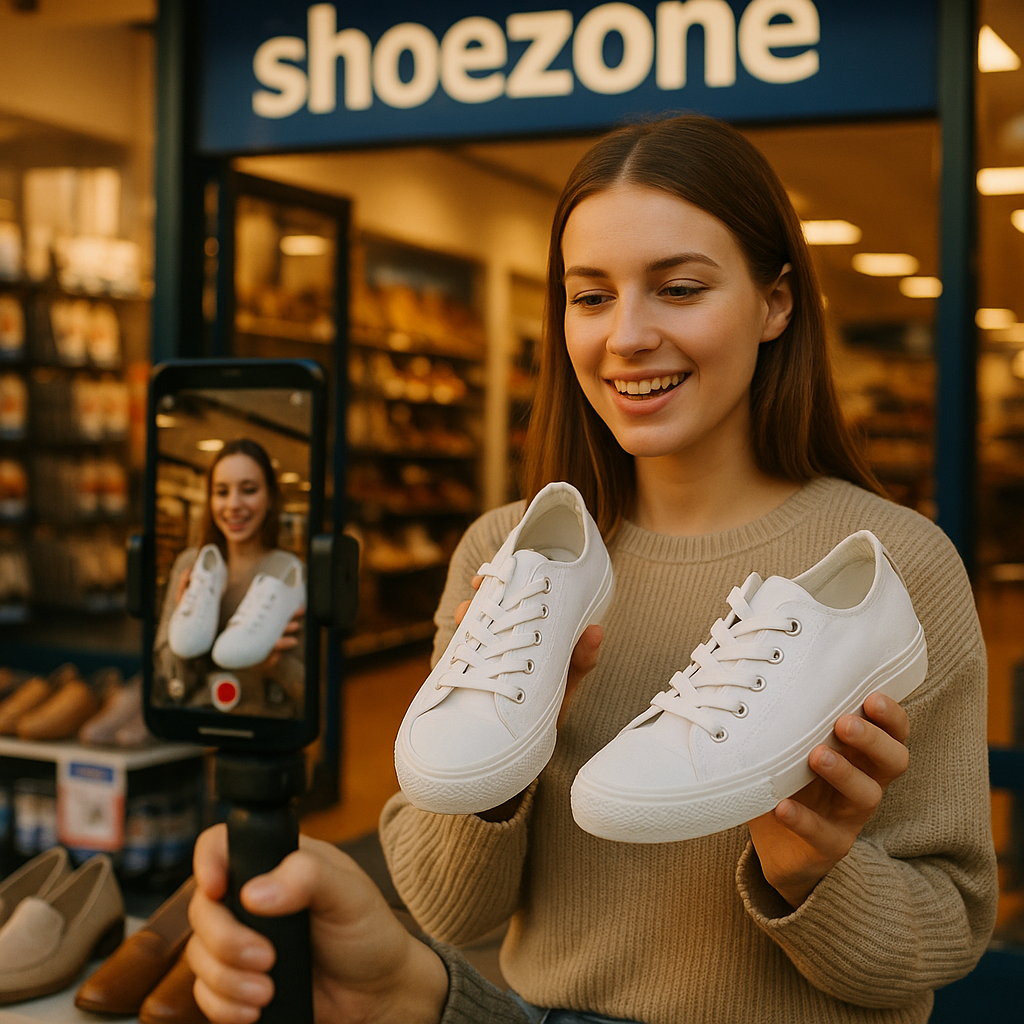
Most fashion retailers are still briefing creators like it’s a TV ad campaign. Shoezone isn’t.
The UK footwear retailer has become a quiet case study in how a value-oriented, non-luxury brand can engineer genuine social commerce traction on TikTok Shop, specifically by rethinking how it structures creator briefs, commission mechanics, and product link placement. If you’re a brand or agency trying to make TikTok Shop work for a fashion retail client, the Shoezone approach offers a more useful framework than anything coming out of a premium sneaker launch.
Why Shoezone’s TikTok Shop Brief Is Worth Reverse-Engineering
Shoezone operates at the affordable end of the UK footwear market, selling shoes in the £10 to £40 price range. That positioning creates an interesting strategic challenge: the average order value is too low to justify heavy paid-media investment per unit, but the product is highly visual, impulse-friendly, and naturally suited to haul content and try-on videos. TikTok Shop is practically built for this category.
What makes their creator brief structure notable isn’t innovation for innovation’s sake. It’s the operational discipline. Shoezone’s briefs for TikTok Shop creators are designed around three things: clear product link integration instructions, a commission-first incentive model, and creative guardrails that keep content resonating with a 16-to-24-year-old audience without sounding like a brand trying too hard. That combination is harder to execute than it looks.
Brands with lower average order values often outperform premium competitors on TikTok Shop because their price point removes purchase hesitation. The brief needs to be engineered around that friction reduction, not ignored.
Structuring Product Link Integration Without Killing Organic Feel
The most common mistake brands make on TikTok Shop is treating the product link as an afterthought. A creator films their content, drops a link in the caption, and the brand wonders why click-through rates are disappointing. Shoezone’s approach, based on available brief templates and creator onboarding documentation that has circulated in UK creator community forums, front-loads the product link strategy into the brief itself.
Specifically, the brief specifies where in the video the creator should reference the in-video product tag: typically between the 8-second and 15-second mark, after the hook has landed but before the viewer has decided to scroll. This isn’t arbitrary. TikTok’s own ad platform data consistently shows that engagement rates drop sharply after 15 seconds, so any conversion-oriented action needs to be seeded early.
The brief also distinguishes between two types of product link placements: the in-video tag (which appears as an overlay during playback) and the pinned comment link. Creators are instructed to use both, because different viewer behaviors drive different discovery paths. Some users tap the overlay mid-video; others finish watching and scroll to comments. Covering both surfaces without making the content feel like an infomercial requires precise brief writing.
For brands building their own TikTok Shop briefs, the lesson here is to treat product link placement as a creative decision, not a technical afterthought. It belongs in the brief alongside shot lists and hook options. If you want more detail on how to structure this kind of brief architecture, the TikTok Shop brief template framework we’ve covered previously maps out the structural logic.
The Commission Model as the Real Creator Incentive
Flat fees don’t scale on TikTok Shop. Shoezone understands this. Their creator incentive model is weighted toward commission rather than upfront payment, with rates understood to sit in the 10-15% range for affiliate sales tracked through TikTok Shop’s native attribution. For a £25 pair of shoes, that’s not a life-changing commission per unit. But for a creator whose try-on video hits 200,000 views and converts at even 1%, the economics become meaningful quickly.
The psychological mechanics here are worth examining. Commission-based models change how creators approach content. They have skin in the game. A creator who earns a flat fee has little incentive to optimize their CTA delivery, product placement, or posting time. A creator earning commission will self-optimize toward conversion, often in ways that no brief could mandate. They’ll respond to comments. They’ll post follow-up content. They’ll A/B test their own hooks.
Shoezone’s brief reinforces this by providing creators with performance benchmarks: historical click-through rates for similar products, average commission earned per 10,000 views, and category-level conversion data. This transparency is unusual in the fast-fashion and footwear space, where brands typically guard performance data. But it serves a strategic purpose: informed creators make better content decisions, and better content decisions drive more commission, which keeps creators motivated to produce more.
This aligns with broader thinking around emotional engagement briefs for TikTok Shop creators, where motivation architecture is as important as the creative direction itself.
Youth Audience Targeting Without the Cringe
Targeting a 16-to-24-year-old audience on TikTok with fashion retail content is easy to do badly. The failure mode is always the same: brand voice that’s trying to sound young, creative direction that references trends six weeks after they’ve peaked, and product styling that looks like a corporate photoshoot edited to look casual. Gen Z audiences are remarkably effective at detecting inauthenticity, and they penalize it with disengagement.
Shoezone’s brief sidesteps this by doing something counterintuitive: giving creators significant creative latitude while tightening the conversion mechanics. The brief specifies what the video must accomplish (hook, product reference, CTA, product link) but is deliberately loose on how the creator gets there. A creator who makes comedy content can frame Shoezone shoes as a budget-smart decision for a night out. A creator who makes aesthetic GRWM (get ready with me) content can style the shoes in a bedroom mirror video. The product is the constant; the creative wrapper is the creator’s domain.
This is the right call for a youth-skewing fashion brand. Gen Z creator briefs that perform consistently tend to give creators ownership over the cultural framing while the brand controls the commercial mechanics. Shoezone’s brief essentially says: you know your audience better than we do, so handle the tone. We’ll handle the conversion infrastructure.
The brief also flags specific content types to avoid: overly produced unboxings, direct-to-camera sales pitches, and any content that features pricing comparisons with named competitors. These aren’t arbitrary restrictions. They reflect an understanding of what performs with a younger TikTok audience and what triggers the algorithm’s preference for native-feeling content over promotional content.
Giving Gen Z creators creative latitude over tone while controlling the conversion mechanics is not a compromise. It’s the brief structure that actually works.
What This Means for Fashion Retail Brands Running TikTok Shop Programs
The Shoezone model is scalable for any fashion retailer operating in a similar price bracket, whether that’s budget apparel, accessories, or seasonal footwear. The underlying brief structure maps cleanly to brands that need volume over prestige: many creators, modest fees, commission upside, and tight conversion mechanics.
A few operational points worth actioning:
- Build product link placement timing into your brief explicitly. Don’t leave it to creator judgment. Specify the second range and the surface (in-video tag, pinned comment, or both).
- Share performance benchmarks with creators upfront. Conversion data transparency improves creator motivation and content quality. It also reduces the back-and-forth on whether a campaign is working.
- Weight compensation toward commission for any creator with a proven conversion track record. Reserve flat fees for awareness-phase creators who are building audience but not yet converting at scale.
- Separate brand voice from creative format. Lock down the conversion elements; free up the tone, framing, and cultural references to the creator.
- Plan for repurposing from day one. High-performing TikTok Shop videos can be repurposed across product pages and paid social. The UGC on product pages approach turns creator content into a conversion asset beyond its original TikTok life.
It’s also worth thinking about how TikTok Shop briefs interact with broader multi-platform strategy. A creator brief that works on TikTok Shop can often be adapted for Instagram Reels shopping or YouTube Shorts affiliate links with modest adjustments. If you’re managing a multi-channel creator program, building briefs with that flexibility built in from the start saves significant operational overhead. The multi-platform brief approach is worth reviewing if that’s your situation.
TikTok Shop’s reported GMV data shows fashion and footwear consistently ranking as top-performing categories. The platform is not going to become less important for fashion retail brands. The question is whether your brief infrastructure is built to capture that opportunity systematically, or whether you’re still relying on creator instinct and hoping for the best.
For any brand managing social commerce investment in this category, the Shoezone creator brief framework is a practical model worth adapting. Start by auditing your current TikTok Shop brief for the three gaps this case study surfaces: product link placement instructions, commission transparency, and creative latitude for tone.
Frequently Asked Questions
What should a TikTok Shop creator brief for a fashion retailer include?
A strong TikTok Shop creator brief for fashion retail should include explicit product link placement instructions (timing within the video and which surfaces to use), the commission structure and any performance benchmarks, creative guardrails that define what the brand needs the video to accomplish without over-scripting the creator’s tone or format, and content restrictions that protect brand safety and algorithmic performance. The brief should be specific about conversion mechanics and flexible about creative expression.
How does a commission-based incentive model improve TikTok Shop creator performance?
Commission models align creator incentives with brand outcomes. When creators earn a percentage of sales they drive, they self-optimize toward conversion: improving CTA delivery, responding to comments, testing different hooks, and producing follow-up content. This behavioral incentive is difficult to replicate with flat fees alone. Providing creators with performance benchmarks (average commission per view range, historical click-through rates) amplifies this effect by giving them data to make better content decisions.
What commission rate is typical for TikTok Shop fashion affiliate creators?
Commission rates for TikTok Shop creator affiliates in the fashion and footwear category typically range from 10% to 20% depending on brand margins, product category, and creator tier. Value-oriented retailers with lower price points tend to offer rates toward the higher end of this range to ensure meaningful earnings per sale. Brands should model expected earnings per 10,000 views at their category’s average conversion rate before setting rates, to ensure the incentive is genuinely motivating for creators.
How do you target Gen Z audiences on TikTok Shop without content feeling promotional?
The most effective approach is to separate the commercial mechanics from the creative framing. Lock down the conversion elements (product link placement, pricing reference, CTA) in the brief while giving creators significant latitude over tone, humor, aesthetics, and cultural references. Gen Z creators who know their audiences will frame products in ways that feel native to their content style, which performs better with both the audience and the TikTok algorithm. Avoid over-scripting tone, mandating specific language, or referencing trends by name in the brief.
Can a TikTok Shop creator brief be adapted for other platforms?
Yes. The structural logic of a strong TikTok Shop brief (hook timing, product integration point, CTA placement, commission mechanics) translates well to Instagram Reels Shopping and YouTube Shorts affiliate links with modest adaptations for each platform’s format and audience behavior. Building platform flexibility into your brief framework from the start reduces operational overhead when running multi-channel creator programs. The core conversion architecture remains consistent; the format and timing parameters shift per platform.
Top Influencer Marketing Agencies
The leading agencies shaping influencer marketing in 2026
Agencies ranked by campaign performance, client diversity, platform expertise, proven ROI, industry recognition, and client satisfaction. Assessed through verified case studies, reviews, and industry consultations.
Moburst

-
2

The Shelf
Boutique Beauty & Lifestyle Influencer AgencyA data-driven boutique agency specializing exclusively in beauty, wellness, and lifestyle influencer campaigns on Instagram and TikTok. Best for brands already focused on the beauty/personal care space that need curated, aesthetic-driven content.Clients: Pepsi, The Honest Company, Hims, Elf Cosmetics, Pure LeafVisit The Shelf → -
3

Audiencly
Niche Gaming & Esports Influencer AgencyA specialized agency focused exclusively on gaming and esports creators on YouTube, Twitch, and TikTok. Ideal if your campaign is 100% gaming-focused — from game launches to hardware and esports events.Clients: Epic Games, NordVPN, Ubisoft, Wargaming, Tencent GamesVisit Audiencly → -
4

Viral Nation
Global Influencer Marketing & Talent AgencyA dual talent management and marketing agency with proprietary brand safety tools and a global creator network spanning nano-influencers to celebrities across all major platforms.Clients: Meta, Activision Blizzard, Energizer, Aston Martin, WalmartVisit Viral Nation → -
5

The Influencer Marketing Factory
TikTok, Instagram & YouTube CampaignsA full-service agency with strong TikTok expertise, offering end-to-end campaign management from influencer discovery through performance reporting with a focus on platform-native content.Clients: Google, Snapchat, Universal Music, Bumble, YelpVisit TIMF → -
6

NeoReach
Enterprise Analytics & Influencer CampaignsAn enterprise-focused agency combining managed campaigns with a powerful self-service data platform for influencer search, audience analytics, and attribution modeling.Clients: Amazon, Airbnb, Netflix, Honda, The New York TimesVisit NeoReach → -
7

Ubiquitous
Creator-First Marketing PlatformA tech-driven platform combining self-service tools with managed campaign options, emphasizing speed and scalability for brands managing multiple influencer relationships.Clients: Lyft, Disney, Target, American Eagle, NetflixVisit Ubiquitous → -
8

Obviously
Scalable Enterprise Influencer CampaignsA tech-enabled agency built for high-volume campaigns, coordinating hundreds of creators simultaneously with end-to-end logistics, content rights management, and product seeding.Clients: Google, Ulta Beauty, Converse, AmazonVisit Obviously →