


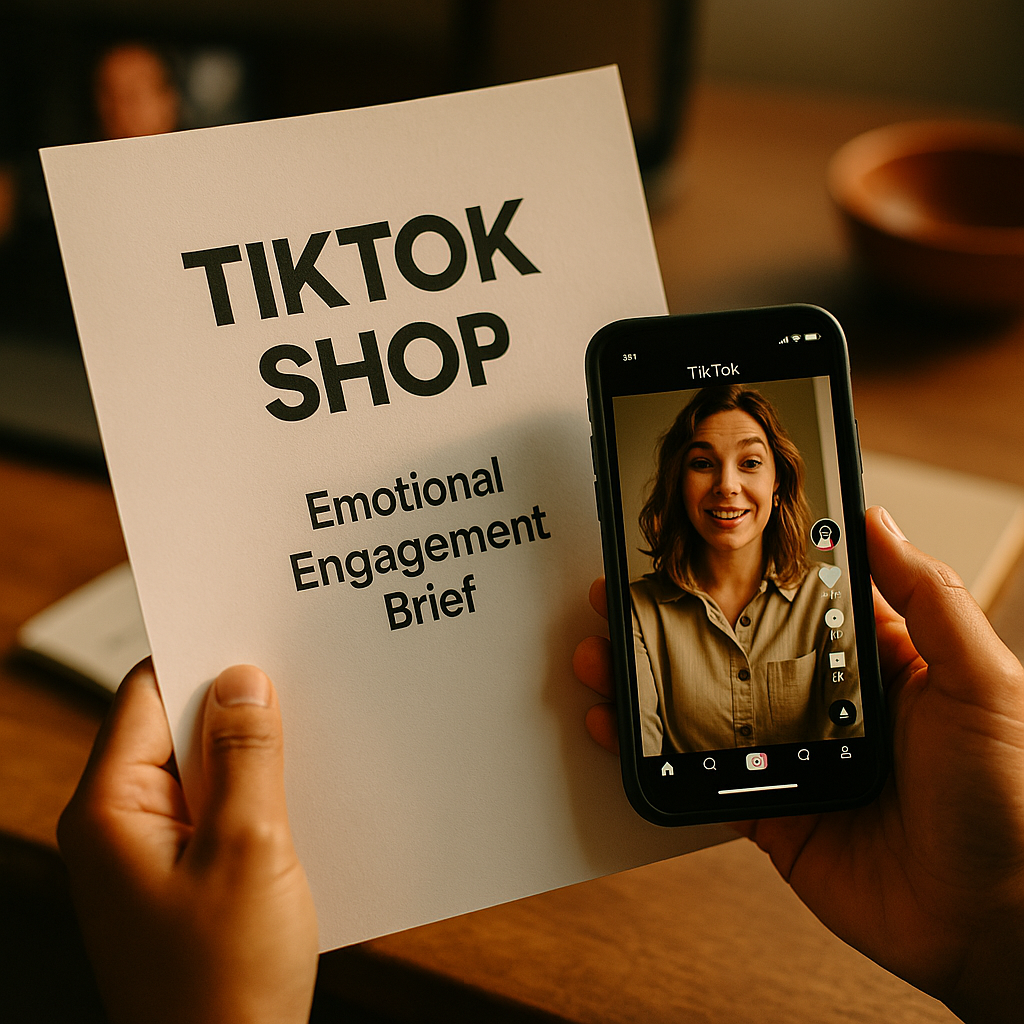
Brands that brief for emotion on TikTok Shop convert at nearly double the rate of those that brief for product features alone. That’s the operational implication buried inside Ipsos research on emotional engagement and social commerce — and most brand teams are still writing briefs that ignore it entirely. Here’s how to fix your social commerce emotional engagement brief before your next campaign.
Why Emotional Triggers Are a Conversion Mechanism, Not a Creative Nicety
Ipsos has consistently documented a link between emotional intensity in video advertising and both brand recall and purchase intent. The mechanism isn’t mystical — it’s neurological. When content triggers a genuine emotional response (surprise, warmth, aspiration, humor, even mild anxiety), the brain encodes the experience more deeply. That encoding is what produces brand recall days or weeks after exposure. On TikTok Shop, where the path from discovery to checkout can be under 90 seconds, deeper encoding also accelerates the trust signal that converts browsers into buyers.
The problem: most creator briefs are written by brand managers optimizing for compliance, not emotion. They specify product claims, hashtags, disclosure language, and posting windows. They do not specify how the creator should make the viewer feel — and that omission is where conversion leaks.
Emotional resonance isn’t a soft metric. On TikTok Shop, it’s a direct lever on add-to-cart rate. Briefs that don’t specify target emotional states are leaving conversion on the table.
The Four Emotional States That Ipsos Research Maps to Commerce Outcomes
Based on Ipsos’s emotional measurement frameworks — particularly their work using facial coding, biometric response, and self-report tools — four emotional states repeatedly correlate with stronger brand recall and faster purchase completion in short-form video commerce contexts:
- Warm surprise: The “I didn’t know that existed and I need it” moment. Triggered by unexpected product demos, unusual use cases, or a creator’s genuine discovery reaction.
- Social aspiration: The “I want to be that person” response. Activated by lifestyle context, not product shots. The product appears as part of an aspirational scene, not the scene itself.
- Vicarious relief: The “that would solve my exact problem” feeling. Particularly potent in categories like personal care, home organization, fitness, and parenting. Requires the creator to articulate a specific pain point before revealing the product.
- Shared amusement: Humor that lands without undermining product credibility. Harder to brief than the others, but when executed correctly, generates the highest share rates — which extend organic reach and reduce paid amplification costs.
Your brief needs to select one primary emotional target per asset. Not two. Not “emotion and education.” One emotional north star that the creator’s concept, hook, pacing, and CTA all serve.
How to Write the Emotional Direction Section of Your Brief
Most brands have a creative brief template with sections for product claims, mandatories, and usage rights. Few have an emotional direction section. Add one. Here’s what it should contain:
Target emotional state: Name it specifically. “We want viewers to feel warmly surprised” is actionable. “We want viewers to feel good about the product” is useless.
Emotional entry point: Where in the video should the emotional trigger land? The first three seconds determine whether the viewer stays. If your target emotion is vicarious relief, the creator needs to open with the pain point — the mess, the struggle, the frustration — before any product mention. If the emotion is warm surprise, the product reveal itself can serve as the entry point, but only if the setup creates genuine curiosity.
What to avoid: Specify the emotional tones that would undermine your objective. If you’re selling a premium skincare line, brief against self-deprecating humor that signals low stakes. If you’re selling a value-positioned household product, brief against aspirational lifestyle imagery that feels inaccessible.
Proof point that earns the emotion: The creator can’t manufacture genuine emotion without a real reason. Your brief must give them the product truth — a specific ingredient, a measurable outcome, a founder story — that makes the emotional response feel earned rather than performed. Performed emotion reads as advertising. Earned emotion reads as recommendation.
For a deeper look at how brief structure drives creator performance across formats, the live commerce creator brief framework addresses pacing and emotional beats specifically for real-time conversion environments.
Platform Mechanics That Amplify (or Kill) Emotional Engagement
TikTok’s algorithm doesn’t measure emotion directly — but it measures proxies for it extremely well. Watch-through rate, comment sentiment, share velocity, and save rate all respond to emotional content more sharply than to informational content. A video that makes someone feel something generates comments that express that feeling, which signals topical relevance and emotional resonance to the recommendation engine simultaneously.
Sound design matters more than most brand teams brief for. Ipsos research on video advertising effectiveness consistently flags audio as a disproportionate driver of emotional response — particularly for surprise and warmth. Your brief should specify whether the creator should use trending audio, original voice-only content, or a hybrid approach, and explain why in emotional terms, not just algorithmic ones.
Pacing is the other under-briefed variable. Vicarious relief builds through slow revelation. Warm surprise requires a compressed setup and a fast payoff. Shared amusement often needs an unexpected rhythm break. None of this can happen if your brief only specifies video length without specifying the emotional arc within that length.
For brands scaling creator programs across multiple formats, understanding how vertical video production briefs differ by platform is essential context before deploying an emotion-first approach at scale.
Selecting Creators Who Can Execute Emotional Direction
This is where most brand teams underinvest. You can write the most precise emotional brief in the industry — and hand it to a creator whose content profile is purely informational or purely comedic, and get nothing. Emotional range is a creator skill, and it’s measurable before you cast.
Review the creator’s last 30 posts with one question: does their audience react emotionally in comments, or just informationally? Comments like “I cried laughing,” “this is exactly me,” or “I immediately ordered this” indicate an audience primed for emotional response. Comments that are purely question-based (“what’s the link?” “what brand is this?”) indicate an audience in information-seeking mode — valuable for different objectives, but not optimized for emotional conversion.
Creator selection for emotional commerce content also requires a category alignment check. A creator who reliably triggers warm surprise in the cooking category may not be able to transfer that skill to personal finance or supplements. The emotional register has to match the category’s natural emotional vocabulary.
When briefing across creator tiers, the Gen Z creator brief approach offers useful scaffolding for communicating emotional expectations without over-scripting creators who have built audiences through authentic spontaneity.
Creator selection for emotional commerce isn’t about follower count. It’s about whether their audience has a documented pattern of emotional response — and whether that emotional register matches your category.
Measuring Whether the Emotional Brief Worked
Brand recall and purchase completion are the ultimate KPIs here, but they require measurement infrastructure that most TikTok Shop programs don’t have at the campaign level. Practical proxies that you can track immediately:
- Comment sentiment analysis: Use a tool like Sprout Social or Brandwatch to classify comments as emotional versus informational. A higher ratio of emotional comments to total comments is a leading indicator of brand recall lift.
- Save rate: Saves indicate that the viewer wants to return to the content — a behavior more associated with emotional resonance than with information retrieval.
- Share-to-view ratio: Sharing is a social emotion act. People share content that made them feel something they want to extend to others.
- TikTok Shop attribution window behavior: Look at the gap between first exposure and purchase completion. Emotionally resonant content tends to produce shorter attribution windows because it accelerates trust. If your window is consistently longer than 48 hours, the emotional brief isn’t landing.
For programs layering interactive elements onto emotional content, the intersection of shoppable video and engagement data provides additional measurement frameworks worth building into your analytics stack.
If you’re also syndicating creator content programmatically, understanding how emotional signals translate across placements is critical — particularly as eMarketer forecasts continued growth in retail media and social commerce convergence through the remainder of the decade.
The Brief You Should Actually Ship
Stop writing briefs that describe your product. Start writing briefs that describe your viewer’s emotional journey — from the first frame to the checkout screen. Specify the emotional state by name, the entry point that earns it, the product truth that justifies it, and the platform mechanics that amplify it. Then select creators with a documented track record of triggering that specific emotion in that specific category. Run comment sentiment analysis as a fast-feedback loop to iterate before scaling spend.
The operational lift is minimal. The conversion upside, based on what Ipsos’s emotional engagement data consistently shows, is significant enough to treat this as a standard element of every TikTok Shop brief your team ships from this point forward.
Start by auditing your last five TikTok Shop briefs: identify which — if any — specified a target emotional state. That gap is your benchmark. Close it on the next brief.
Frequently Asked Questions
What does an emotional engagement brief include that a standard creator brief doesn’t?
A standard creator brief typically covers product claims, usage rights, disclosure requirements, and posting specifications. An emotional engagement brief adds a defined target emotional state (e.g., warm surprise, vicarious relief), an emotional entry point within the video structure, specific product truths that earn the emotional response, and guidance on what emotional tones to avoid. It treats the viewer’s emotional journey as the primary creative architecture, with product messaging serving that journey rather than leading it.
How does Ipsos research connect emotional response to brand recall and purchase completion?
Ipsos uses a combination of facial coding, biometric measurement, and self-report surveys to quantify emotional intensity during video exposure. Their findings consistently show that content producing higher emotional intensity scores generates stronger brand recall at 24 and 72-hour intervals. In commerce contexts, emotional intensity also correlates with shorter decision-to-purchase timelines, because emotional engagement accelerates the trust formation that normally requires multiple touchpoints.
Can you brief for emotion without over-scripting the creator?
Yes, and this distinction is critical. Over-scripted emotional direction produces performed emotion, which audiences — particularly on TikTok — identify immediately and reject. Effective emotional briefs specify the target feeling and the product truth that should earn it, then give creators latitude to find their own authentic path to that emotional destination. The brief sets the emotional destination; the creator chooses the route.
Which TikTok Shop product categories benefit most from emotion-first briefs?
Categories with high personal relevance or identity association respond most strongly to emotional briefs: personal care and beauty, parenting and family, home organization, fitness, and food. Categories that are primarily functional or price-driven (consumer electronics, commodity goods) can still benefit, but the dominant emotional lever shifts toward warm surprise at value or vicarious relief at complexity reduction, rather than aspiration or social identity.
How do you measure whether an emotional brief produced the intended response?
The most accessible real-time proxies are comment sentiment ratio (emotional versus informational comments), save rate, and share-to-view ratio. For programs with measurement infrastructure, TikTok’s Brand Lift Study tools can capture recall and purchase intent shifts. Attribution window length within TikTok Shop is also a useful proxy: emotionally resonant content tends to produce shorter gaps between first exposure and purchase completion compared to purely informational content.
Top Influencer Marketing Agencies
The leading agencies shaping influencer marketing in 2026
Agencies ranked by campaign performance, client diversity, platform expertise, proven ROI, industry recognition, and client satisfaction. Assessed through verified case studies, reviews, and industry consultations.
Moburst

-
2

The Shelf
Boutique Beauty & Lifestyle Influencer AgencyA data-driven boutique agency specializing exclusively in beauty, wellness, and lifestyle influencer campaigns on Instagram and TikTok. Best for brands already focused on the beauty/personal care space that need curated, aesthetic-driven content.Clients: Pepsi, The Honest Company, Hims, Elf Cosmetics, Pure LeafVisit The Shelf → -
3

Audiencly
Niche Gaming & Esports Influencer AgencyA specialized agency focused exclusively on gaming and esports creators on YouTube, Twitch, and TikTok. Ideal if your campaign is 100% gaming-focused — from game launches to hardware and esports events.Clients: Epic Games, NordVPN, Ubisoft, Wargaming, Tencent GamesVisit Audiencly → -
4

Viral Nation
Global Influencer Marketing & Talent AgencyA dual talent management and marketing agency with proprietary brand safety tools and a global creator network spanning nano-influencers to celebrities across all major platforms.Clients: Meta, Activision Blizzard, Energizer, Aston Martin, WalmartVisit Viral Nation → -
5

The Influencer Marketing Factory
TikTok, Instagram & YouTube CampaignsA full-service agency with strong TikTok expertise, offering end-to-end campaign management from influencer discovery through performance reporting with a focus on platform-native content.Clients: Google, Snapchat, Universal Music, Bumble, YelpVisit TIMF → -
6

NeoReach
Enterprise Analytics & Influencer CampaignsAn enterprise-focused agency combining managed campaigns with a powerful self-service data platform for influencer search, audience analytics, and attribution modeling.Clients: Amazon, Airbnb, Netflix, Honda, The New York TimesVisit NeoReach → -
7

Ubiquitous
Creator-First Marketing PlatformA tech-driven platform combining self-service tools with managed campaign options, emphasizing speed and scalability for brands managing multiple influencer relationships.Clients: Lyft, Disney, Target, American Eagle, NetflixVisit Ubiquitous → -
8

Obviously
Scalable Enterprise Influencer CampaignsA tech-enabled agency built for high-volume campaigns, coordinating hundreds of creators simultaneously with end-to-end logistics, content rights management, and product seeding.Clients: Google, Ulta Beauty, Converse, AmazonVisit Obviously →