


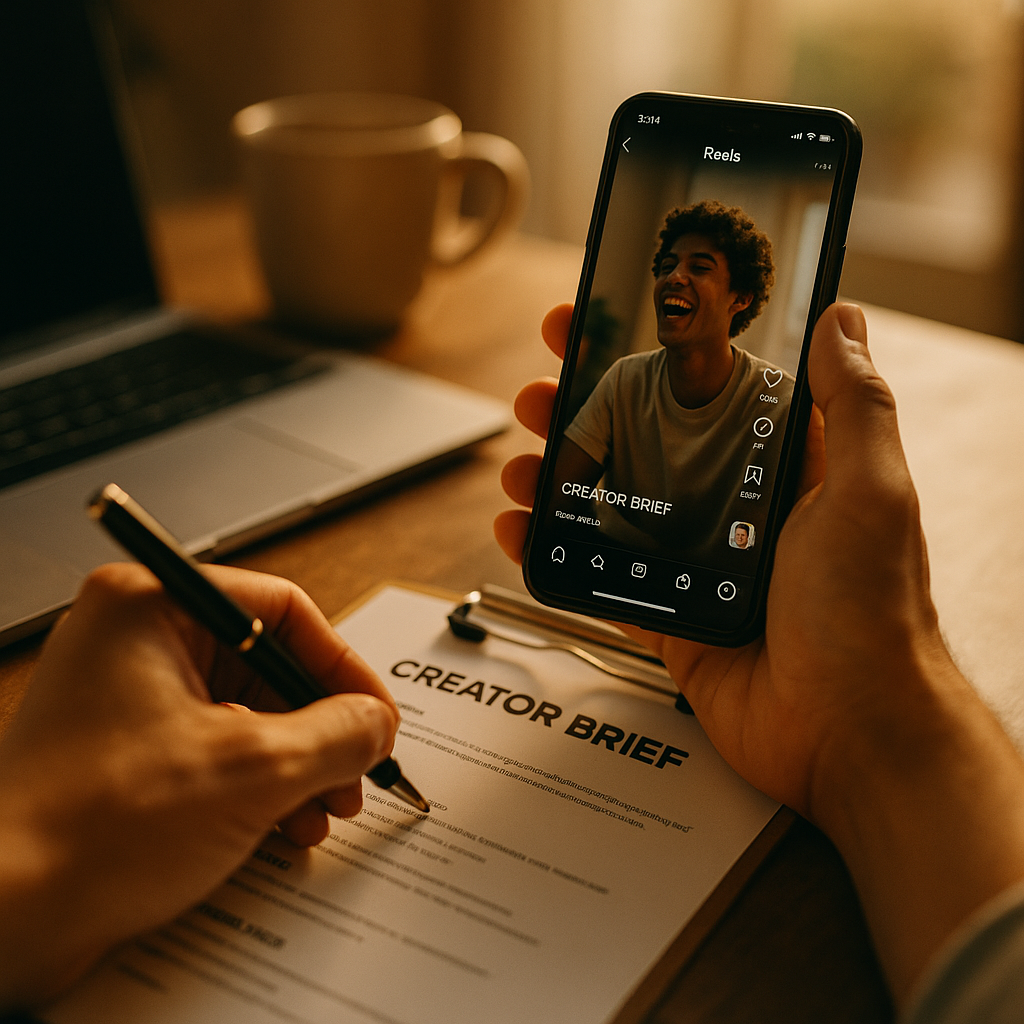
Sponsored Reels Are Losing the Algorithm — and Your Brief Is Why
Roughly 50% of the content Instagram users see now comes from accounts they don’t follow — served entirely by AI recommendation logic. If your sponsored Reels are still built around brand guidelines first and distribution signals second, you’re funding content that the algorithm is actively deprioritizing before a single real user sees it.
This isn’t a creator problem. It’s a brief problem.
Instagram’s ongoing Reels personalization updates — built on Meta’s Andromeda and Lattice systems — have shifted how the algorithm surfaces content to non-followers. The ranking logic now weighs viewer behavioral signals, watch-through rates, and early engagement velocity far more heavily than it did in previous iterations. Sponsored content that looks and feels like an ad gets deprioritized fast. Content that mimics the grammar of organic discovery gets surfaced far and wide.
The implication for brand teams is direct: your creator brief needs a structural redesign, not just a tone refresh.
What the Algorithm Actually Rewards Now
Before you can fix the brief, you need to understand the signal stack. Instagram’s Reels recommendation engine doesn’t evaluate content the way a human media buyer would. It processes behavioral proxies — and it does so within the first 30 to 90 minutes of a Reel going live.
The signals that matter most right now:
- Watch-through rate: What percentage of viewers watch past the 3-second mark, past the midpoint, and to completion. Sponsored Reels with a hard product mention in the first two seconds crater here.
- Saves and shares: Both are weighted more heavily than likes or comments. A save signals intent; a share signals distribution value. Briefs that don’t give creators latitude to make content worth saving are burning budget.
- Replay rate: Content that gets replayed — whether for a detail, a laugh, or a how-to step — signals high value to the recommendation engine.
- Profile taps and follows from non-followers: A meaningful proxy for discovery quality. The algorithm rewards content that earns new attention.
- Early negative signals: Skips, scroll-aways in the first second, and “Not Interested” taps actively suppress distribution. Overly branded openers reliably trigger these.
Instagram’s AI recommendation layer doesn’t know your campaign is paid. It only knows whether real users are watching, saving, sharing — or not. Your brief needs to optimize for those signals, not your brand style guide.
The deeper issue: many brand briefs are written to satisfy legal, compliance, and brand consistency requirements. Those are legitimate constraints. But when they override creative direction entirely, they produce content the algorithm treats as low-quality regardless of production value.
The Brief Architecture That’s Killing Your Organic Distribution
Here’s what a typical brand-controlled Reels brief looks like in practice: mandatory logo placement in the first three seconds, a list of approved talking points in order, required verbal brand mention within the first five seconds, product in-hand from the opening frame, and a scripted CTA at the close.
That structure was designed for paid media delivery — where your ad is forced in front of an audience regardless of engagement quality. It has no organic distribution logic baked in. In an AI-ranked feed where the Reels recommendation engine is filtering for content that earns attention, this brief format is a liability.
Compare this to what the GEM and Lattice AI frameworks reward: content that earns behavioral engagement from cold audiences. The two brief architectures are fundamentally incompatible.
The fix isn’t removing brand requirements. It’s restructuring when and how they appear — and giving creators enough creative latitude to hook non-followers before the brand moment lands.
Redesigning the Brief: A Framework for Distribution-First Sponsored Reels
Brand teams need to operate with a bifurcated mindset: organic distribution requirements and brand compliance requirements are separate tracks, and the brief needs to serve both without letting one sabotage the other. Here’s the structural redesign that works.
1. Separate the hook from the brand moment. The first three seconds belong to the creator’s audience, not your brand. Brief the creator on the emotional hook, the curiosity gap, or the relatable scenario — not the brand message. Brand integration should begin no earlier than the 5-7 second mark for short Reels (under 30s), or 10-15 seconds in for longer formats. If your legal team needs a disclosure, instruct creators to use Instagram’s native Paid Partnership label rather than a verbal cue in the opening frame.
2. Replace talking points with behavioral objectives. Instead of “mention these three product features in order,” brief toward outcomes: “the viewer should want to save this for later” or “the viewer should feel like they discovered something useful.” Creators who understand the behavioral target will instinctively make different creative decisions than creators who are reading from a bullet list.
3. Define what “organic” looks like for your category. What does a non-sponsored Reel in your vertical actually look like? If you’re a skincare brand, organic Reels in your category use ingredient close-ups, texture reveals, before/after transitions, and conversational voiceovers. Your brief should describe that format — and then show how the integration fits inside it, not on top of it.
4. Build in a “native formats” requirement. Brief creators on which Reels formats the algorithm is currently rewarding for your category: POV structures, day-in-the-life arcs, duet-bait setups, or teaching formats. The Reels recommendation signal updates have repeatedly favored specific structural formats over others, and your brief should reflect that intelligence.
5. Give explicit guidance on the save/share objective. Tell creators directly: “We want this content to be saved or shared, not just liked.” That instruction changes how creators think about information density, emotional resonance, and utility. A Reel designed to be saved is structurally different from a Reel designed to be watched once and forgotten.
6. Set brand compliance as a minimum floor, not a creative ceiling. Specify what’s non-negotiable (FTC disclosure, product accuracy, brand safety guardrails) and then get out of the creative process. The more prescriptive your brief is beyond those floors, the lower your organic distribution probability.
Platform Comparison: Why Instagram Reels Briefs Need Their Own Logic
It’s tempting to repurpose brief frameworks across platforms. Resist it. The recommendation logic on Instagram Reels operates differently from TikTok’s For You Page and from YouTube Shorts’ discovery layer — which means the brief requirements are genuinely platform-specific.
TikTok’s algorithm surfaces content based on content signals first, account signals second. Instagram’s Reels system weights both the content signals and the posting account’s prior engagement history. That means new creator relationships need a warm-up strategy on Instagram that isn’t as necessary on TikTok. For a detailed breakdown of how brief structures need to differ, the Instagram vs. TikTok brief comparison is worth reviewing before finalizing your Q3 media planning.
If your team is also managing YouTube Shorts spend, note that the YouTube Shorts partnership brief requirements have their own distinct algorithm logic — particularly around the role of subscriber behavior versus cold discovery.
A brief written for TikTok will underperform on Reels. A brief written for Reels will underperform on Shorts. Platform-specific brief architecture is not optional — it’s the single highest-leverage variable in organic distribution performance.
Compliance Without Killing Distribution
The FTC’s endorsement guidelines require clear and conspicuous disclosure of paid relationships. Instagram’s native Paid Partnership label satisfies this requirement and has the significant operational advantage of not requiring a verbal disclosure that damages the organic feel of the opening hook. Brief this explicitly: use the native label, not a verbal cue in the first five seconds.
For teams operating in the EU, ICO guidance on influencer disclosure aligns with this approach — native platform disclosure tools are generally accepted as sufficient when used correctly. Build this into your brief template as a standing requirement so it doesn’t become a negotiation on every campaign.
The compliance layer of your brief should be three lines maximum: use native disclosure, don’t make false claims, don’t use brand assets that aren’t pre-approved. Everything else is creative guidance, and it should be written to serve distribution, not legal review.
Measurement: What to Track When Organic Distribution Is the Goal
If you’re redesigning briefs for organic distribution, your measurement framework needs to catch up. Tracking reach and impressions from paid amplification tells you nothing about organic distribution quality. The metrics that reflect algorithm success are different.
Track these for every sponsored Reel with an organic distribution objective:
- Non-follower reach percentage: What share of total views came from accounts that don’t follow the creator? The higher this number, the better the algorithm is distributing the content.
- Save rate: Saves divided by views. Industry benchmarks vary by category, but anything above 2% on a cold audience is a strong signal.
- Watch-through rate at 50% and 100%: Available in creator analytics. Brief for these numbers explicitly by making the middle and end of the Reel as compelling as the hook.
- Share-to-view ratio: Shares (including DM shares, which Instagram now counts) divided by total views. This is one of the strongest organic distribution proxies available.
Build a post-campaign brief retrospective: which creative elements correlated with high save rates? Which openers drove the highest watch-through? Use that data to update your brief template before the next campaign cycle. According to Sprout Social’s benchmark data, Reels consistently outperform static posts on reach — but only when the content earns algorithmic distribution through behavioral signals, not just paid placement.
The brief is a living document. Treat it like one.
The Operational Shift Brand Teams Need to Make
The real blocker for most brand teams isn’t knowledge — it’s internal process. Briefs get written by brand managers, reviewed by legal, approved by brand strategy, and handed to creators as finished documents. By the time the creator sees it, there’s no room for the organic creative instincts that actually drive distribution.
The fix: bring creators into the brief earlier. A 30-minute discovery call with the creator before the brief is finalized will surface platform-specific insights your internal team won’t have. It also creates buy-in that produces better creative output. Platforms like Meta Business Suite give creators and brand managers shared access to campaign parameters — use that workflow to make the brief a collaborative draft, not a final decree.
For teams managing creator programs across multiple platforms, the platform-specific brief framework is a practical starting point for building distinct templates that reflect each algorithm’s actual requirements rather than a one-size-fits-all document. And if you’re debating how to split budget between Instagram and TikTok based on organic performance potential, the TikTok vs. Instagram budget allocation framework provides a structured decision model worth reviewing before your next planning cycle.
Redesign the brief now. The algorithm won’t wait for your next quarterly review.
Frequently Asked Questions
How has Instagram’s Reels algorithm changed how sponsored content gets distributed?
Instagram’s Reels recommendation engine now surfaces a large percentage of content to non-followers based on behavioral signals like watch-through rate, saves, shares, and replay rate. Sponsored content that looks overly branded — especially with hard product mentions in the first two seconds — tends to generate early negative signals (skips, scroll-aways) that suppress organic distribution. The algorithm doesn’t distinguish between paid and organic content; it responds only to how viewers actually behave when they encounter it.
What should a creator brief include to maximize organic Reels distribution?
An effective brief for organic distribution should: separate the hook (first 3-7 seconds) from the brand integration moment, define behavioral objectives (saves, shares) rather than just talking points, specify native format structures the algorithm rewards in your category, require native Paid Partnership disclosure instead of verbal cues, and treat brand compliance requirements as a minimum floor rather than a creative ceiling. The less prescriptive the creative direction beyond compliance requirements, the better the organic distribution performance tends to be.
Does using Instagram’s Paid Partnership label hurt organic reach?
No — and this is a common misconception worth correcting. Instagram’s native Paid Partnership label does not algorithmically penalize organic distribution. In fact, using it properly (as required by FTC guidelines) protects brands legally while allowing creators to open their content with organic-feeling hooks rather than verbal disclosures that damage early engagement metrics.
How is an Instagram Reels brief different from a TikTok brief?
Instagram’s algorithm weights both the content signals and the posting account’s prior engagement history, making account authority more important than it is on TikTok, where content signals dominate. This means new creator relationships require a warm-up period on Instagram before they achieve strong non-follower distribution. TikTok’s brief logic prioritizes entertainment velocity and content structure above account history, which makes the brief architectures genuinely different rather than interchangeable.
What metrics should brand teams track to evaluate organic distribution performance on Reels?
The most meaningful metrics for organic distribution objectives are: non-follower reach percentage, save rate (saves divided by views), watch-through rate at the 50% and 100% mark, and share-to-view ratio (including DM shares). Standard reach and impression metrics from paid amplification don’t reflect organic algorithm performance and should be tracked separately from these behavioral indicators.
Top Influencer Marketing Agencies
The leading agencies shaping influencer marketing in 2026
Agencies ranked by campaign performance, client diversity, platform expertise, proven ROI, industry recognition, and client satisfaction. Assessed through verified case studies, reviews, and industry consultations.
Moburst

-
2

The Shelf
Boutique Beauty & Lifestyle Influencer AgencyA data-driven boutique agency specializing exclusively in beauty, wellness, and lifestyle influencer campaigns on Instagram and TikTok. Best for brands already focused on the beauty/personal care space that need curated, aesthetic-driven content.Clients: Pepsi, The Honest Company, Hims, Elf Cosmetics, Pure LeafVisit The Shelf → -
3

Audiencly
Niche Gaming & Esports Influencer AgencyA specialized agency focused exclusively on gaming and esports creators on YouTube, Twitch, and TikTok. Ideal if your campaign is 100% gaming-focused — from game launches to hardware and esports events.Clients: Epic Games, NordVPN, Ubisoft, Wargaming, Tencent GamesVisit Audiencly → -
4

Viral Nation
Global Influencer Marketing & Talent AgencyA dual talent management and marketing agency with proprietary brand safety tools and a global creator network spanning nano-influencers to celebrities across all major platforms.Clients: Meta, Activision Blizzard, Energizer, Aston Martin, WalmartVisit Viral Nation → -
5

The Influencer Marketing Factory
TikTok, Instagram & YouTube CampaignsA full-service agency with strong TikTok expertise, offering end-to-end campaign management from influencer discovery through performance reporting with a focus on platform-native content.Clients: Google, Snapchat, Universal Music, Bumble, YelpVisit TIMF → -
6

NeoReach
Enterprise Analytics & Influencer CampaignsAn enterprise-focused agency combining managed campaigns with a powerful self-service data platform for influencer search, audience analytics, and attribution modeling.Clients: Amazon, Airbnb, Netflix, Honda, The New York TimesVisit NeoReach → -
7

Ubiquitous
Creator-First Marketing PlatformA tech-driven platform combining self-service tools with managed campaign options, emphasizing speed and scalability for brands managing multiple influencer relationships.Clients: Lyft, Disney, Target, American Eagle, NetflixVisit Ubiquitous → -
8

Obviously
Scalable Enterprise Influencer CampaignsA tech-enabled agency built for high-volume campaigns, coordinating hundreds of creators simultaneously with end-to-end logistics, content rights management, and product seeding.Clients: Google, Ulta Beauty, Converse, AmazonVisit Obviously →