


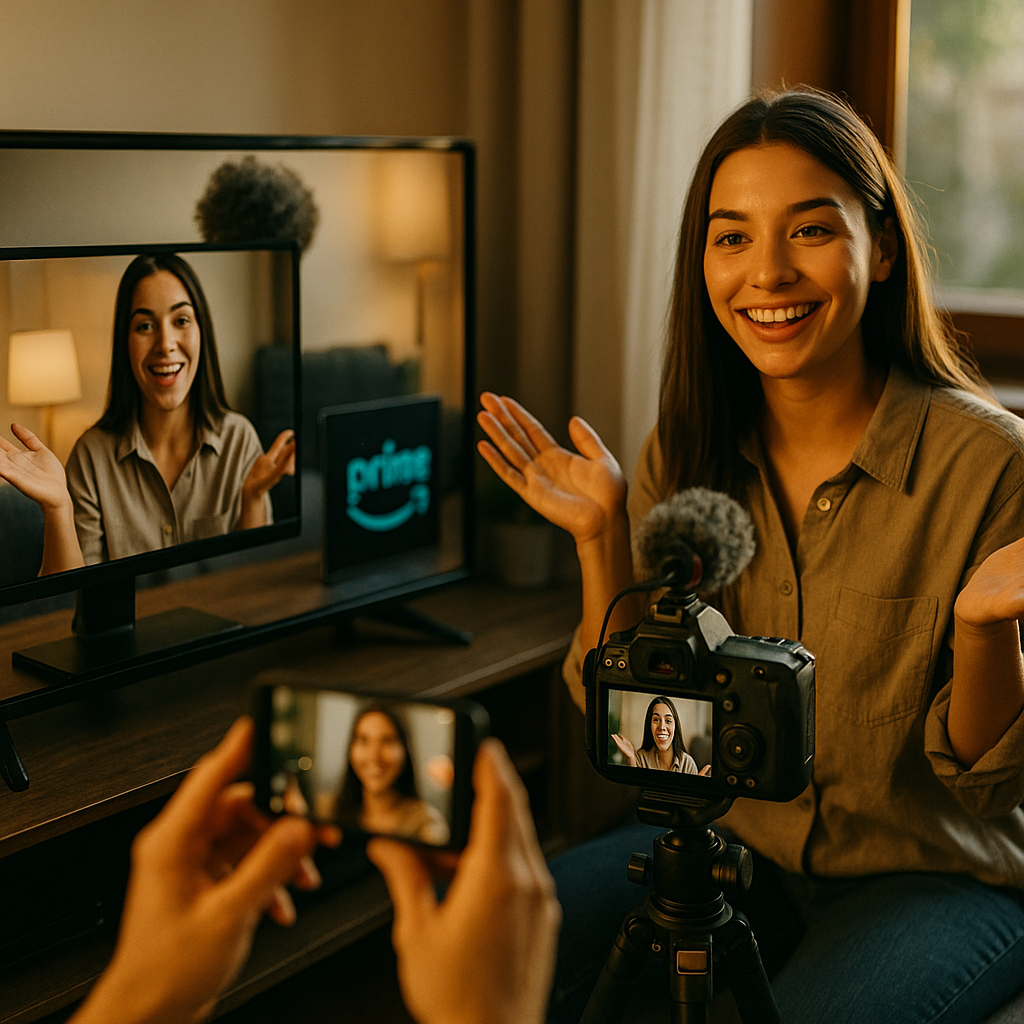
CTV ad spend is projected to surpass $42 billion globally, and the platforms controlling that inventory — Google, Netflix, Amazon — are actively courting creator content to fill it. Most brands are not ready. Their influencer assets were built for a 9:16 phone screen, not a 65-inch living room display with a 10-foot viewing distance and zero swipe-away behavior. That gap is the problem this article solves.
Why CTV Is Now a Creator Channel, Not Just a Broadcast One
The consolidation happening across CTV inventory is not incremental. Google’s integration of YouTube TV and YouTube Select into unified programmatic buys, Netflix’s expanded ad-supported tier, and Amazon’s Prime Video ad layer have effectively created a triopoly for premium CTV placements. Brands that previously siloed “digital creator content” from “TV media buys” now need a unified content architecture.
What makes this especially pressing for influencer marketing teams: these platforms are actively accepting creator-originated content as ad inventory. YouTube CTV impressions already rank among the top-three CTV platforms by reach in the U.S. according to eMarketer. When a creator video gets repurposed as a paid CTV placement, the production standard, aspect ratio, audio mix, and brand integration all need to be rethought from the ground up.
Creator content built for a phone feed will fail on a television. The failure mode is not obvious — the content plays — but viewer trust, brand recall, and completion rates all drop when production quality doesn’t match the context.
The Production Gap Most Briefs Ignore
Standard influencer briefs optimize for social feed performance: fast hook, native feel, lower-third text overlays, captions for silent viewing. CTV inverts almost every one of those parameters.
On a connected TV, viewers are not scrolling. They are committed to the content block. The 10-foot UI means on-screen text needs to be significantly larger and simpler. Silent viewing is irrelevant — audio is almost always on. And the “native feel” that signals authenticity on Instagram can read as low-budget on a 4K display.
Here is what needs to change at the brief level:
- Aspect ratio and safe zones: Shoot in 16:9 as the primary format. Vertical crops can be derived from it, not the other way around. Ensure key visuals and brand logos are centered and clear of the outer 10% of frame.
- Audio first: CTV viewers hear everything. Music beds, ambient noise, and creator vocal quality matter. Brief creators on clean audio capture — lavalier mic or treated room minimum.
- Completion-optimized structure: CTV ads often run as non-skippable 15- or 30-second spots. Build content to a 30-second master with a hard cut at 15 seconds for shorter placements, rather than editing down from a 60-second social asset.
- Reduced text dependency: Remove caption overlays and lower-thirds designed for silent feed consumption. Any text on screen should serve viewers who are watching, not compensating for viewers who have the sound off.
For brands running paid-first creator campaigns, this is a straightforward extension of the existing media amplification logic. The creator asset is planned as a media placement from the start, not retrofitted after social performance is measured.
Licensing and Rights: The Infrastructure Problem No One Wants to Talk About
Most influencer contracts are written for social platform use. They specify Instagram, TikTok, YouTube — sometimes “digital channels broadly.” CTV is a different distribution category and, in many jurisdictions, triggers different rights thresholds, particularly for music, talent appearance, and usage duration.
When Netflix or Amazon serves a creator asset as a programmatic CTV ad, that is broadcast-equivalent distribution reaching households in multiple markets simultaneously. Standard UGC licensing almost never covers this. The gap creates real legal exposure.
Build CTV rights language into contracts before production begins. Specifically:
- Define “connected television” explicitly as a permitted channel alongside social and digital display
- Specify geographic scope — a U.S.-only influencer campaign may now reach international households through global CTV buys
- Address music sync rights separately, or brief creators to use only royalty-free or brand-licensed audio
- Set usage duration terms that accommodate a 12-24 month media flight, not just a 30-day social window
For teams scaling creator programs across many creators, the contract and exclusivity framework deserves a dedicated CTV addendum. Don’t let a $40K media buy get killed by a rights issue on a $2K creator fee.
Matching Creator Tier to CTV Placement Type
Not every creator is the right fit for every CTV surface. The platform context matters enormously.
YouTube CTV placements accessed through Google’s DV360 can carry creator-authored content natively because the brand equity of the creator travels with the asset. Viewers recognize the creator format. Netflix and Amazon placements, by contrast, sit inside a premium long-form content environment where production parity with network-quality advertising is the expectation. A vlog-style creator video that performs brilliantly on YouTube feed may feel jarring mid-episode of a prestige drama.
A practical tiering approach:
- YouTube CTV (via Google DV360/YouTube Select): Creator-authored content works well. Lean into the creator’s voice and format. Viewers are primed for that register.
- Amazon Prime Video ads: Use creator talent but elevate production — proper lighting, clean backgrounds or deliberate set design, sound mixing. The creator’s credibility is the hook; the production needs to match the environment.
- Netflix ad-supported tier: Currently skewed toward traditional brand creative, but creator-talent-featured ads (creator appears as talent, not as creator persona) are gaining traction. Think of it as casting, not content licensing.
This maps directly to how forward-thinking brands are approaching the streaming era creator partnership architecture, where the same creator relationship supports multiple distribution contexts at different production tiers.
Measurement: What CTV Attribution Actually Looks Like
CTV attribution is meaningfully different from social. There is no click. No swipe-up. No link in bio. The conversion pathway is indirect and longer, which means brands that expect last-touch attribution from CTV creator content will consistently undervalue it.
The metrics that matter for CTV creator placements:
- Household reach and frequency: CTV buys are priced on CPM against household-level targeting. Measure reach, not impressions alone.
- Brand search lift: After a CTV flight, measure incremental branded search volume using Google Search Console or a brand lift study through Google’s measurement tools. This is often the clearest signal that creator CTV creative is working.
- Incrementality testing: Run geo-holdout tests — serve CTV creator ads in some markets, not others — and measure downstream purchase behavior differences. Amazon’s AMC (Amazon Marketing Cloud) makes this accessible for brands running Prime Video inventory.
- Completion rate: For non-skippable formats, completion is table stakes. For skippable CTV, completion rate at 15 and 30 seconds is the primary creative quality signal.
Teams already running incrementality and conversion window analysis on social creator content have the methodological foundation. CTV requires adapting the window — think 7-14 day attribution, not 1-day click.
Building the CTV-Ready Creator Pipeline
Operationally, the shift to CTV-ready creator content requires changes at three levels: briefing, production oversight, and asset management.
At the briefing stage, briefs that maintain brand voice at scale need a CTV-specific module. This doesn’t mean a longer brief — it means a format checklist embedded into the existing creative direction: 16:9 primary, clean audio, 30-second master, no caption dependency.
Production oversight for CTV creator content benefits from a simple review gate before final delivery: does this asset pass the TV test? Play it on a large screen at full volume before approving it for CTV distribution. That single step catches most of the common failures — background noise that’s invisible on mobile, text that’s illegible at 10 feet, cuts that feel too fast for lean-back viewing.
Asset management is the unglamorous part. CTV campaigns require multiple versioned deliverables: 15-second and 30-second cuts, 16:9 and potentially 9:16 for platforms that serve both, with and without end cards. Build this version structure into the creator deliverable spec from day one. Retrofitting it from a single social asset costs more in post-production than doing it right at brief.
For brands working through the creator amplification budget framework, CTV distribution should be treated as a separate line item from social amplification. The CPMs are different, the inventory sources are different, and the optimization logic is different. Bundling them obscures both ROI and spend efficiency.
The brands that will win CTV creator inventory aren’t the ones with the biggest budgets. They’re the ones that brief for television first and adapt to social — not the other way around.
One final consideration: as IAB and platform partners continue standardizing CTV ad formats, the technical specifications will evolve. Lock in a quarterly review of platform requirements — particularly for Amazon and Netflix — as their ad products are moving faster than most brand compliance processes can track.
The immediate next step: Audit your last three influencer campaigns and ask whether any assets could have run on CTV without modification. If the answer is no — and it almost certainly is — that gap is your production brief for the next campaign cycle.
Frequently Asked Questions
What makes CTV creator content different from standard influencer content?
CTV content is consumed on large screens with sound on, in lean-back viewing environments with no scroll behavior. This requires 16:9 aspect ratios, clean audio, larger on-screen text, and 15-30 second structured formats — all of which are different from the vertical, caption-heavy, fast-hook formats optimized for social feeds.
Which CTV platforms should brands prioritize for creator content distribution?
YouTube CTV (via Google DV360 or YouTube Select) is the most natural starting point because creator-format content is native to the platform. Amazon Prime Video is strong for brands with retail attribution needs. Netflix’s ad-supported tier is best approached with creator-as-talent executions rather than pure UGC-style content, given the premium content environment.
How should influencer contracts be updated for CTV distribution?
Contracts need to explicitly name connected television as a permitted distribution channel, address geographic scope for global CTV buys, resolve music sync rights separately, and set usage duration that accommodates 12-24 month media flights rather than standard 30-day social windows.
What attribution model works for CTV creator campaigns?
Last-touch attribution does not work for CTV. The most reliable approaches are brand search lift studies, geo-holdout incrementality testing (Amazon Marketing Cloud is useful for this), and household-level reach and frequency measurement. Conversion windows should extend to 7-14 days to account for indirect purchase behavior.
Can UGC assets be repurposed for CTV without re-shooting?
Rarely without modification. Most UGC shot vertically on mobile cannot be cropped to 16:9 without losing critical visual information. Audio quality is typically the biggest blocker — ambient noise that is acceptable on social is often disqualifying for CTV broadcast. A re-shoot or a dedicated CTV deliverable spec is almost always more cost-effective than attempting to retrofit existing UGC.
Top Influencer Marketing Agencies
The leading agencies shaping influencer marketing in 2026
Agencies ranked by campaign performance, client diversity, platform expertise, proven ROI, industry recognition, and client satisfaction. Assessed through verified case studies, reviews, and industry consultations.
Moburst

-
2

The Shelf
Boutique Beauty & Lifestyle Influencer AgencyA data-driven boutique agency specializing exclusively in beauty, wellness, and lifestyle influencer campaigns on Instagram and TikTok. Best for brands already focused on the beauty/personal care space that need curated, aesthetic-driven content.Clients: Pepsi, The Honest Company, Hims, Elf Cosmetics, Pure LeafVisit The Shelf → -
3

Audiencly
Niche Gaming & Esports Influencer AgencyA specialized agency focused exclusively on gaming and esports creators on YouTube, Twitch, and TikTok. Ideal if your campaign is 100% gaming-focused — from game launches to hardware and esports events.Clients: Epic Games, NordVPN, Ubisoft, Wargaming, Tencent GamesVisit Audiencly → -
4

Viral Nation
Global Influencer Marketing & Talent AgencyA dual talent management and marketing agency with proprietary brand safety tools and a global creator network spanning nano-influencers to celebrities across all major platforms.Clients: Meta, Activision Blizzard, Energizer, Aston Martin, WalmartVisit Viral Nation → -
5

The Influencer Marketing Factory
TikTok, Instagram & YouTube CampaignsA full-service agency with strong TikTok expertise, offering end-to-end campaign management from influencer discovery through performance reporting with a focus on platform-native content.Clients: Google, Snapchat, Universal Music, Bumble, YelpVisit TIMF → -
6

NeoReach
Enterprise Analytics & Influencer CampaignsAn enterprise-focused agency combining managed campaigns with a powerful self-service data platform for influencer search, audience analytics, and attribution modeling.Clients: Amazon, Airbnb, Netflix, Honda, The New York TimesVisit NeoReach → -
7

Ubiquitous
Creator-First Marketing PlatformA tech-driven platform combining self-service tools with managed campaign options, emphasizing speed and scalability for brands managing multiple influencer relationships.Clients: Lyft, Disney, Target, American Eagle, NetflixVisit Ubiquitous → -
8

Obviously
Scalable Enterprise Influencer CampaignsA tech-enabled agency built for high-volume campaigns, coordinating hundreds of creators simultaneously with end-to-end logistics, content rights management, and product seeding.Clients: Google, Ulta Beauty, Converse, AmazonVisit Obviously →