


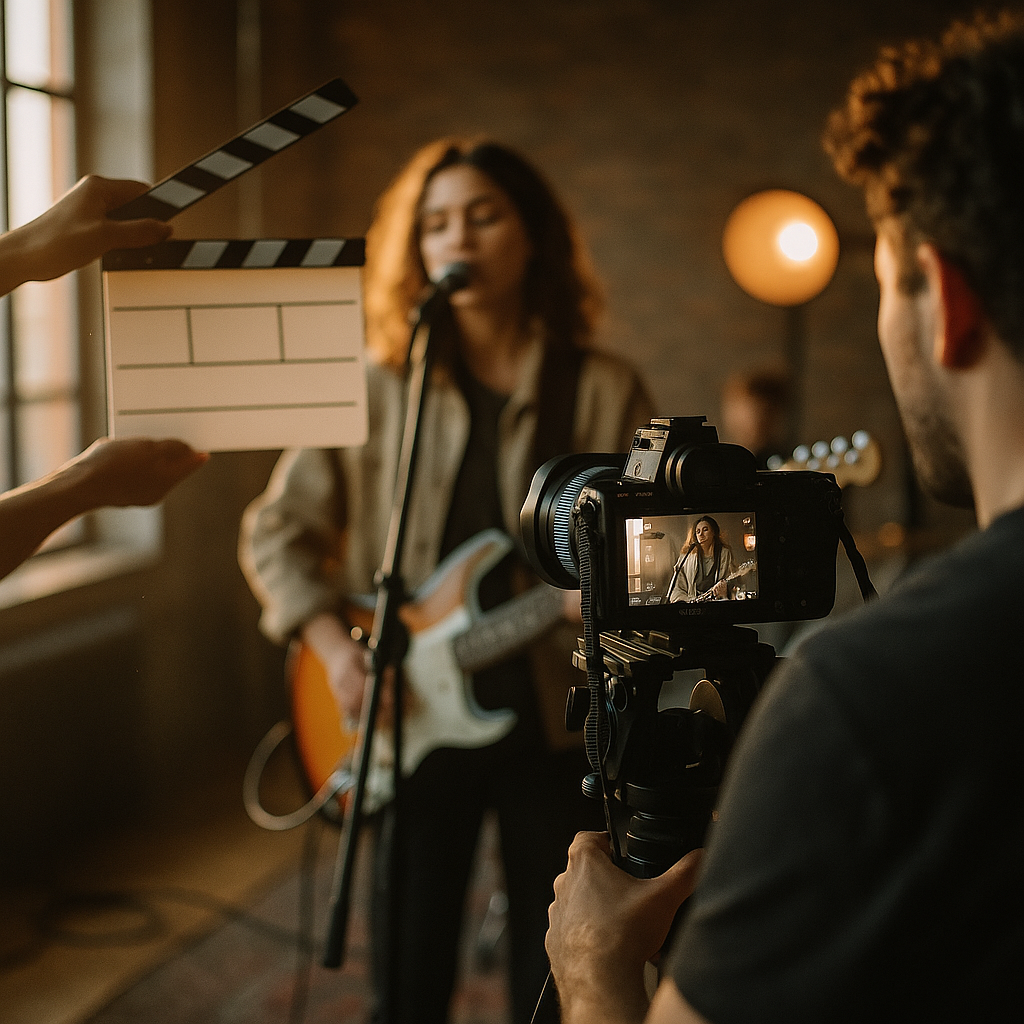
Music-style brand video ads generate up to 3x higher engagement rates than standard promotional formats, yet most brand teams have no repeatable framework for briefing creators on them. That gap is expensive. Here is the production playbook that closes it.
Why Music-Style Formats Are Back — and Performing Harder Than Ever
The format never really died. It evolved. What started as the classic TV jingle became MTV-era brand spots, then stalled when “authentic” UGC aesthetics dominated the 2020s feed. Now, with AI-curated feeds rewarding entertainment value and watch-time depth, high-energy music-driven video ads are outperforming stripped-back talking-head content on TikTok, Instagram Reels, and YouTube Shorts alike.
TikTok’s own ad research consistently shows that sound-on viewing rates for music-led creatives exceed platform averages by significant margins. Meanwhile, brands like e.l.f. Cosmetics have turned original song briefs into cultural moments, generating earned media that dwarfs the original production budget. The strategic logic is simple: entertainment earns attention; attention earns conversion opportunity.
The brands winning with music-style video ads aren’t the ones with the biggest budgets. They’re the ones with the tightest briefs — creators who know exactly what emotional territory to occupy, and production partners who know how to shoot for the feed, not the broadcast screen.
Understanding format revival dynamics is essential before you brief a single creator. The aesthetic expectations have shifted: today’s music-style brand ad must feel platform-native, not polished-to-death.
Anatomy of a Music-Style Brand Video Brief
Most creative briefs fail music-format productions because they were designed for static social posts or standard testimonials. A music-style brief has distinct components that standard templates omit entirely.
Emotional arc first, product second. The brief must define the emotional journey before it defines product features. Is this euphoric? Aspirational? Satirical? The emotional register determines everything: BPM, visual pace, wardrobe, set design, and creator performance style. If the brief starts with product specs, you will get a product ad with a music track slapped on top. That is not the same thing.
Mandatory brief components for this format:
- Brand sonic identity reference: Provide 2-3 reference tracks with notes on what specifically to borrow (tempo, instrumentation, energy) and what to avoid.
- Lyrical or spoken-word guardrails: Define which brand claims are factual requirements versus creative territory the creator can own.
- Shot rhythm alignment: Specify where cuts should land relative to the beat. Fast-cut on downbeat drops, or slow and fluid between verses — this needs to be explicit.
- Brand visibility windows: Define the exact moments (time codes, not just “naturally”) where product or logo must appear, and for how long.
- Platform-specific aspect ratio and hook timing: A 9:16 Reels cut behaves differently than a 1:1 YouTube Shorts preview. This is not optional detail.
For creators already experienced with hook design on short-form video, the music-style format adds a layer: the hook must now work rhythmically, not just visually. The first beat drop or lyric entry IS your hook. Brief accordingly.
Briefing Creators vs. Briefing Production Partners: Different Documents, Different Stakes
This is where brand teams consistently lose time and money. They send the same brief to the creator and the production house. These are two distinct audiences with fundamentally different needs.
The creator brief should be emotionally oriented and directionally loose on performance choices. Over-scripting a creator’s musical performance breaks authenticity. Instead, give them the emotional target, the 2-3 non-negotiable brand moments, and the platform context. Let them own the delivery. Reference FTC-compliant narrative integration frameworks to ensure disclosure language is baked into the brief structure from day one, not appended as an afterthought.
The production partner brief is a technical document. It should specify:
- Minimum resolution and codec requirements for each destination platform
- Audio mix specifications (stereo/mono splits, music-to-VO levels)
- Color grading reference and brand palette hex codes
- Cut deliverable list by platform and format (one shoot, multiple outputs)
- Backup B-roll requirements for the paid amplification team to remix
Running efficient multi-platform outputs from a single shoot is increasingly standard practice. A well-structured production brief for a single-session creator shoot can yield 8-12 distinct deliverables from one production day, which dramatically improves cost-per-asset and gives the paid media team real creative testing material.
Music Licensing: The Risk That Kills Timelines
This section exists because teams skip it until it is too late. Music licensing for brand advertising is categorically different from organic creator content.
Sync licensing (the right to pair a piece of music with visual content in an ad) requires clearance from both the master recording owner and the composition copyright holder. These are often different entities. A creator clearing a track for their personal content does not provide your brand with sync rights. Full stop.
Your options, in order of timeline reliability:
- Original composition: Commission a track specifically for the campaign. Slower to produce, but you own it outright and the sonic identity is unique to your brand.
- Production music libraries: Platforms like Musicbed, Artlist, and Epidemic Sound offer pre-cleared sync licenses at scale. Faster, lower cost, but less distinctive.
- Artist collaboration: Work directly with emerging artists through their management. Higher creative upside, longer negotiation cycle, better earned-media potential.
Build music licensing timelines into your production schedule at the brief stage. Campaigns that treat music as a post-production decision regularly miss launch windows. FTC compliance requirements around advertising claims also apply to any lyrical content making product assertions, so route final lyrics through legal before recording — not after.
The Brand Message Integrity Problem (and How to Solve It Without Killing Creative Energy)
Here is the real tension: the more you enforce brand message control in a music-style ad, the more you risk killing the entertainment quality that makes the format work.
The solution is constraint architecture, not blanket approval layers. Define 3 categories of creative elements up front:
Non-negotiable (locked): specific product claims, logo placement, required disclosures, prohibited competitor references.
Brand-guided (directional): color palette, tone, energy level, persona alignment.
Creator-owned (free): performance style, choreography, lyrical phrasing within approved themes, wardrobe interpretation.
When creators know exactly which constraints are real and which are suggestions, they stop fighting the brief and start creating within it. The best music-style brand ads come from creators who feel creatively autonomous within a well-designed fence, not creators who got a 12-page document and guessed at what mattered.
This constraint architecture also makes legal review faster. When the locked elements are isolated in the brief, legal can review just those components rather than re-reading the entire creative treatment every time there is a minor performance change.
Constraint architecture is not creative restriction. It is creative permission — a clear map of where the creator is free to run.
Distribution and Amplification Planning at Brief Stage
Most music-style brand video campaigns underperform on paid because the amplification team was not involved until post-production. Fix this upstream.
When briefing your production partner, include the paid media team’s asset requirements as a mandatory deliverable set. Specifically: cutdowns at 6s, 15s, and 30s; silent-viewable versions with burn-in captions; and a clean product-forward cut for retargeting audiences who have already seen the full-length version.
For TikTok social commerce placements, the music-style format needs an additional “shop now” moment designed into the creative, not edited in as an overlay. If the product reveal does not coincide with a musically satisfying moment (a chorus, a drop, a lyrical callback), the CTA feels intrusive and conversion rates suffer accordingly.
On the organic distribution side, consider how AI-curated feed optimization affects music-led content specifically. Feeds increasingly reward watch completion and replay rates. A hook that makes someone restart the video (common in well-executed music formats) is algorithmically powerful. Brief for the replay, not just the first-pass watch.
Finally, social listening tools like Sprout Social and analytics platforms like HubSpot can track earned sentiment and share-of-conversation generated by music-style campaigns, giving you a fuller ROI picture than paid metrics alone provide. Build these measurement frameworks before launch, not during the post-mortem.
Quality Control Before You Publish
Before any music-style brand video goes live, run it through a 5-point integrity check:
- Audio-off test: Does the visual narrative communicate the brand message without sound? It should, because autoplay feeds often start muted.
- Brand lock check: Are all non-negotiable brand elements present at the specified time codes?
- Sync clearance confirmation: Is written licensing confirmation in hand, not just verbally agreed?
- Platform compliance review: Does each cut meet the destination platform’s ad specs and content policies?
- Disclosure verification: Is paid partnership disclosure clearly visible per FTC guidelines on every version, including cutdowns?
Start your next music-style campaign by separating your creator brief from your production brief into two distinct documents, then map every creative element to one of three constraint tiers. That single structural change will reduce revision cycles and protect brand integrity without flattening creative energy.
FAQs
What makes a music-style brand video ad different from a standard video ad with background music?
A music-style brand video ad is structurally built around the music: cuts, reveals, emotional beats, and brand moments are choreographed to the track rather than set to it afterward. The music drives narrative pacing, not just mood. Standard video ads use music as an atmospheric layer; music-style ads use it as a structural framework.
How long should a music-style brand video ad be for short-form platforms?
For TikTok and Instagram Reels, 30-45 seconds is the current sweet spot for music-style formats. This allows a full verse-chorus structure while staying within the attention window where completion rates remain meaningful. For YouTube Shorts, 45-60 seconds is workable. Always produce a 15-second cutdown for paid retargeting alongside the full-length version.
Can smaller brands with limited budgets execute music-style video ads effectively?
Yes, especially using production music libraries like Artlist or Epidemic Sound for pre-cleared tracks, and briefing mid-tier creators who have demonstrated performance-style content in their existing portfolio. The brief quality matters more than the production budget. A $5,000 campaign with a precise creative brief will consistently outperform a $50,000 campaign with a vague one.
What is the biggest mistake brands make when briefing creators on music-style content?
Over-scripting the performance while under-specifying the brand requirements. Brands often include exhaustive notes on how the creator should move, deliver lines, or interpret the music, but leave brand visibility windows, exact claim language, and disclosure requirements vague. Invert that: lock the brand requirements tightly and give the creator maximum creative freedom on performance choices.
Do music-style video ads require separate FTC disclosure treatment?
No, the disclosure requirement is the same: any material connection between the creator and the brand must be clearly disclosed. However, music-style formats create a practical challenge because disclosures can be visually obscured by fast cuts or lyrics. Disclosures must be on-screen long enough to be read, not just present for a single frame. Always include the disclosure in the video itself, not only in the caption.
Top Influencer Marketing Agencies
The leading agencies shaping influencer marketing in 2026
Agencies ranked by campaign performance, client diversity, platform expertise, proven ROI, industry recognition, and client satisfaction. Assessed through verified case studies, reviews, and industry consultations.
Moburst

-
2

The Shelf
Boutique Beauty & Lifestyle Influencer AgencyA data-driven boutique agency specializing exclusively in beauty, wellness, and lifestyle influencer campaigns on Instagram and TikTok. Best for brands already focused on the beauty/personal care space that need curated, aesthetic-driven content.Clients: Pepsi, The Honest Company, Hims, Elf Cosmetics, Pure LeafVisit The Shelf → -
3

Audiencly
Niche Gaming & Esports Influencer AgencyA specialized agency focused exclusively on gaming and esports creators on YouTube, Twitch, and TikTok. Ideal if your campaign is 100% gaming-focused — from game launches to hardware and esports events.Clients: Epic Games, NordVPN, Ubisoft, Wargaming, Tencent GamesVisit Audiencly → -
4

Viral Nation
Global Influencer Marketing & Talent AgencyA dual talent management and marketing agency with proprietary brand safety tools and a global creator network spanning nano-influencers to celebrities across all major platforms.Clients: Meta, Activision Blizzard, Energizer, Aston Martin, WalmartVisit Viral Nation → -
5

The Influencer Marketing Factory
TikTok, Instagram & YouTube CampaignsA full-service agency with strong TikTok expertise, offering end-to-end campaign management from influencer discovery through performance reporting with a focus on platform-native content.Clients: Google, Snapchat, Universal Music, Bumble, YelpVisit TIMF → -
6

NeoReach
Enterprise Analytics & Influencer CampaignsAn enterprise-focused agency combining managed campaigns with a powerful self-service data platform for influencer search, audience analytics, and attribution modeling.Clients: Amazon, Airbnb, Netflix, Honda, The New York TimesVisit NeoReach → -
7

Ubiquitous
Creator-First Marketing PlatformA tech-driven platform combining self-service tools with managed campaign options, emphasizing speed and scalability for brands managing multiple influencer relationships.Clients: Lyft, Disney, Target, American Eagle, NetflixVisit Ubiquitous → -
8

Obviously
Scalable Enterprise Influencer CampaignsA tech-enabled agency built for high-volume campaigns, coordinating hundreds of creators simultaneously with end-to-end logistics, content rights management, and product seeding.Clients: Google, Ulta Beauty, Converse, AmazonVisit Obviously →