


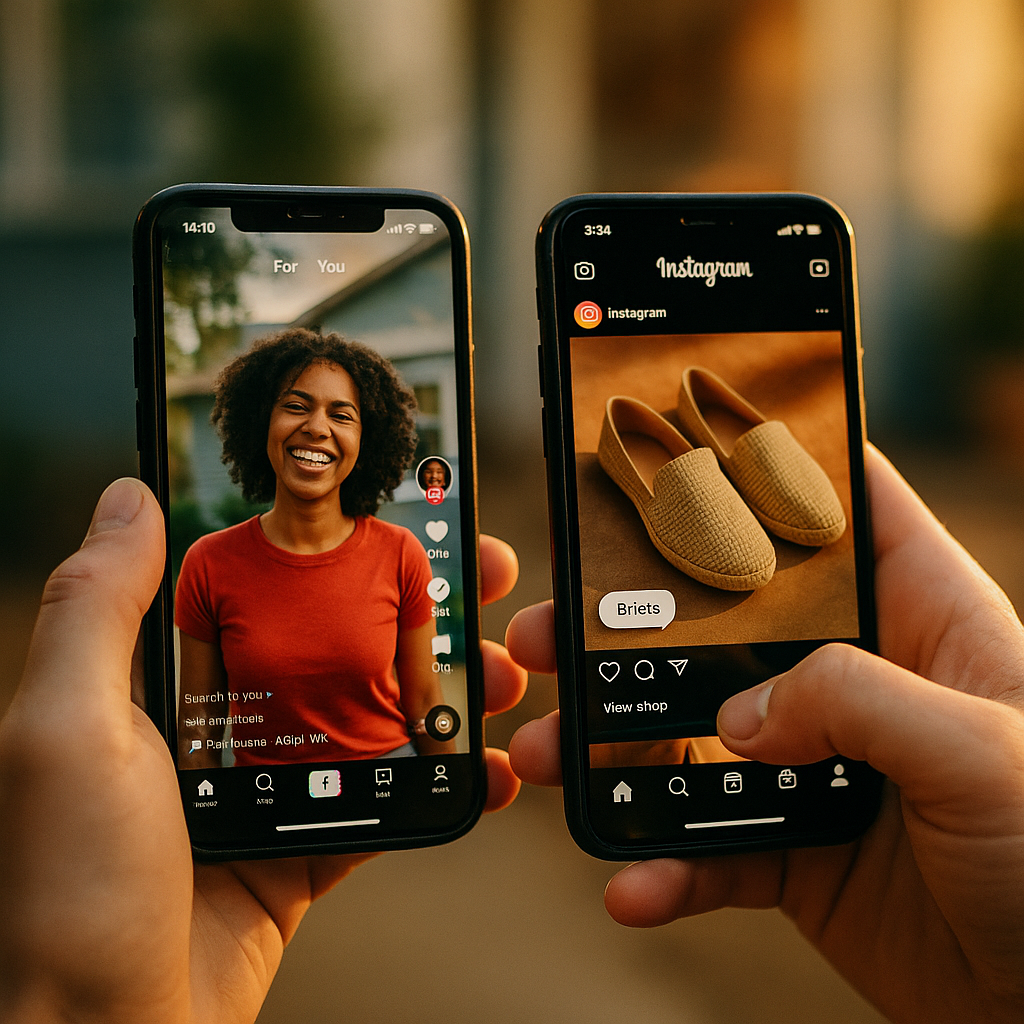
One Budget, Two Completely Different Buyer Mindsets
Brands running parallel TikTok and Instagram influencer programs share the same budget line but face radically different consumer intent signals on each platform — and most briefs treat them identically. That mismatch is costing conversions.
TikTok users are browsing. They are open to discovery, receptive to entertainment, and willing to follow a rabbit hole into a product category they never planned to explore. Instagram users, particularly those scrolling Reels or tapping through Stories, arrive with more intent context. They have often seen a product before. They are comparing. They are closer to the decision point.
A brief that ignores this distinction produces content that entertains on TikTok but never converts, or pushes hard selling on Instagram without enough social proof to close. Neither outcome justifies the spend.
According to Sprout Social data, Instagram consistently outperforms TikTok on purchase completion rates, while TikTok outperforms Instagram on initial product discovery — two completely different jobs that require two completely different briefs.
Why the Same Asset Fails Twice
The operational temptation is obvious: shoot one creator video, post it on TikTok, then repurpose it for Instagram Reels. The production math works. The platform logic does not.
TikTok’s algorithm rewards novelty signals. Watch-through rate, re-watches, and shares push content into new feeds. The first three seconds need to create curiosity, not close a sale. If a creator opens with a discount code or product name, TikTok’s feed interprets this as promotional and limits organic distribution before the content even has a chance to perform.
Instagram’s algorithm, by contrast, is increasingly weighting saves and DM shares — two actions that indicate “I want to come back to this.” That behavioral difference tells you everything about where users are in their decision journey. On Instagram, a clear product name, a visible result, and a low-friction call to action are assets, not liabilities. Brands that understand Instagram DM signals are already structuring briefs around this behavior.
Repurposing the same asset loses the optimization advantage on both platforms simultaneously.
Mapping the Intent Gap: What Each Platform Actually Rewards
Before rewriting a single brief, brand managers need a functional map of what purchase-related behavior each platform surfaces.
TikTok intent signals:
- Searching a product name after watching (TikTok’s internal search bar has become a discovery engine for Gen Z, rivaling Google for product queries)
- Adding to cart via TikTok Shop during or immediately after viewing
- Following the creator for more content about a category
- Saving or screenshotting for later reference
Instagram intent signals:
- Tapping the product tag directly from a Reel or Story
- DMing the creator to ask where to buy
- Saving the post for future purchase consideration
- Clicking through to the link in bio after watching
These are not subtle differences. TikTok’s signals are exploratory. Instagram’s signals are transactional. If your briefs do not encode these signal types into the creative direction, you are asking creators to do platform strategy work that belongs to the brand team.
For brands already running TikTok Shop creator programs, the consideration-phase brief architecture is already partly built. The challenge is mirroring that rigor on the Instagram side without treating it as an afterthought.
Brief Design Without Doubling the Budget
Here is the practical framework. One creator shoot, two distinct brief modules.
Module 1: TikTok Discovery Brief Elements
- Hook mandate: Open with a tension, a surprising outcome, or a relatable problem. Do not name the brand in the first five seconds.
- Narrative arc: Problem, experiment, result. Keep the brand reveal in the middle third, not the opening.
- Soft CTA: “I’ll link below” or “search [brand name] on TikTok” rather than “buy now.”
- Audio direction: Trending audio or platform-native sounds where the creator authentically fits. This is not optional for organic distribution.
- Length guidance: 30 to 60 seconds for most categories. Longer formats only when the creator has demonstrated strong average watch-through rates in their analytics.
Module 2: Instagram Conversion Brief Elements
- Visual clarity mandate: Product must be identifiable within the first two seconds. No slow burns.
- Social proof integration: Creator should reference personal use duration, visible results, or peer validation within the first 15 seconds.
- Hard CTA architecture: “Link in bio,” product tag activation, and a verbal call to action aligned with the current campaign offer.
- Save-bait framing: Structure content so viewers want to save it for reference. Tutorial formats, before/after reveals, and comparison frameworks outperform pure entertainment here.
- Caption strategy: Instagram captions are read. Write them as conversion copy, not hashtag dumps.
The production efficiency comes from briefing the creator to capture distinct opening sequences and closing segments for each platform during the same shoot. Two openings. Two closings. One middle section that serves both. Total additional production time: under 20 minutes per creator. Total improvement in platform-specific performance: measurable within the first attribution window.
Understanding how Instagram Reels attribution windows work is critical here, because the conversion signal from a well-structured Instagram brief may not surface for 72 hours post-posting, and most brands are cutting campaigns before that window closes.
Platform-Native Formatting as a Brief Requirement
Format is not a post-production detail. It belongs in the brief as a hard requirement.
TikTok’s 9:16 full-screen vertical format is non-negotiable, but beyond aspect ratio, the on-screen text behavior differs. TikTok creators who add their own text overlays generate higher comment engagement because viewers respond to on-screen claims. Brief for this explicitly. Tell creators which product claims they should overlay as text, and where in the video timeline they should appear.
Instagram Stories and Reels have different viewer behavior even within the same platform. Stories viewers are in a rapid-swipe mental state. Reels viewers are in a lean-back discovery mode more similar to TikTok. If your Instagram brief does not distinguish between these two placements, you are leaving placement-specific performance on the table. Brands investing in Instagram Reels paid tools for amplification will find that platform-native formatting dramatically improves their paid reach efficiency.
For budget allocation decisions between the two platforms, format compliance rates from creators are a useful proxy metric. If creators consistently struggle to follow platform-specific formatting in your briefs, the brief is too generic.
According to TikTok for Business research, ads with creator-style hooks (problem-forward, no brand reveal in the first three seconds) achieve up to 40% higher view-through rates than brand-forward formats — a direct brief design finding, not a production quality issue.
Compliance and Disclosure Without Killing Organic Reach
Both platforms require paid partnership disclosures. But the mechanics of how disclosure is delivered affects organic performance differently on each.
On TikTok, the paid partnership label inserted via the creator’s settings is the cleanest compliance path. Verbal disclosures in the first three seconds (“this is an ad for Brand X”) have been shown to reduce watch-through rates significantly. Brief creators to use the platform label tool and reserve verbal disclosure for later in the video if required by campaign terms. FTC guidelines require clear disclosure, not necessarily upfront verbal disclosure, so this approach remains compliant.
On Instagram, where conversion intent is higher and users are less deterred by commercial intent signals, verbal or on-screen disclosure earlier in the content has less negative impact. Structure Instagram briefs to allow creator acknowledgment of the partnership within the first ten seconds without penalty to conversion performance.
Brands operating in EU markets should layer in additional requirements. ICO data governance rules and platform-level DSA compliance add brief requirements around retargeting disclosures that most North American brand teams are still not accounting for in their standard templates.
Measuring Whether Your Brief Is Working
Performance measurement for dual-platform briefs should never use the same KPI set across both platforms. This sounds obvious. Most measurement dashboards make it structurally difficult to avoid.
For TikTok, the brief performance proxies are: watch-through rate above 60%, profile visit rate (a discovery signal), and TikTok Shop add-to-cart rate where applicable. Vanity metrics like view count are nearly meaningless for brief optimization purposes.
For Instagram, measure saves-to-reach ratio, link-in-bio click rate within 48 hours, and DM-initiated inquiries where the creator tracks and reports them. Meta’s Commerce Manager now provides product-tag-level attribution that many brand teams are not pulling into their regular reporting cadence.
Build a brief scorecard that assigns each creative deliverable a platform-specific performance grade at the 7-day mark. If a TikTok brief is generating low watch-through but high save rates, the brief is producing Instagram-intent content on the wrong platform. That is a brief design failure, not a creator failure.
The next step: pull your last five TikTok and Instagram creator briefs side by side and count how many brief elements are platform-specific versus shared. If more than 60% of the brief is identical across platforms, you have found your conversion gap.
FAQs
What is the purchase intent gap between TikTok and Instagram?
The purchase intent gap refers to the measurable difference in where users are in their buying journey on each platform. TikTok users are primarily in discovery mode — open to new products but not yet in decision-making mode. Instagram users, particularly on Reels and Stories, are more likely to be in a comparison or consideration phase, making them more responsive to conversion-oriented content like product tags, clear CTAs, and social proof.
Can brands use the same influencer video on both TikTok and Instagram?
Technically yes, but strategically it is a poor choice. The same video will underperform on both platforms because TikTok’s algorithm rewards discovery-style hooks and entertainment value, while Instagram rewards save-worthy, conversion-oriented content. A better approach is to brief creators to capture platform-specific opening and closing segments during the same shoot, keeping production costs nearly identical while dramatically improving per-platform performance.
How should briefs differ between TikTok and Instagram?
TikTok briefs should prioritize problem-forward hooks that delay brand identification, encourage native audio use, and use soft CTAs like search prompts or link-in-bio references. Instagram briefs should front-load visual product clarity, include social proof within the first 15 seconds, use hard CTAs tied to product tags or bio links, and frame content to encourage saves. Caption strategy also matters far more on Instagram and should be written as conversion copy.
How do you handle FTC disclosure requirements without hurting TikTok organic reach?
Use TikTok’s native paid partnership label tool rather than requiring verbal disclosure in the first three seconds. FTC guidelines require clear and conspicuous disclosure but do not mandate that it appear at the exact opening of the video. Placing verbal disclosure in the middle portion of the video — combined with the platform label — maintains compliance while protecting the critical first-seconds hook that drives TikTok watch-through rates.
What KPIs should brands track to evaluate brief performance on each platform?
For TikTok, the most useful brief performance metrics are watch-through rate (target above 60%), profile visit rate as a discovery signal, and TikTok Shop add-to-cart rate where applicable. For Instagram, prioritize saves-to-reach ratio, link-in-bio click rate within 48 hours of posting, and product-tag-level attribution through Meta’s Commerce Manager. Using identical KPIs across both platforms makes it impossible to accurately diagnose brief-level failures versus distribution failures.
Top Influencer Marketing Agencies
The leading agencies shaping influencer marketing in 2026
Agencies ranked by campaign performance, client diversity, platform expertise, proven ROI, industry recognition, and client satisfaction. Assessed through verified case studies, reviews, and industry consultations.
Moburst

-
2

The Shelf
Boutique Beauty & Lifestyle Influencer AgencyA data-driven boutique agency specializing exclusively in beauty, wellness, and lifestyle influencer campaigns on Instagram and TikTok. Best for brands already focused on the beauty/personal care space that need curated, aesthetic-driven content.Clients: Pepsi, The Honest Company, Hims, Elf Cosmetics, Pure LeafVisit The Shelf → -
3

Audiencly
Niche Gaming & Esports Influencer AgencyA specialized agency focused exclusively on gaming and esports creators on YouTube, Twitch, and TikTok. Ideal if your campaign is 100% gaming-focused — from game launches to hardware and esports events.Clients: Epic Games, NordVPN, Ubisoft, Wargaming, Tencent GamesVisit Audiencly → -
4

Viral Nation
Global Influencer Marketing & Talent AgencyA dual talent management and marketing agency with proprietary brand safety tools and a global creator network spanning nano-influencers to celebrities across all major platforms.Clients: Meta, Activision Blizzard, Energizer, Aston Martin, WalmartVisit Viral Nation → -
5

The Influencer Marketing Factory
TikTok, Instagram & YouTube CampaignsA full-service agency with strong TikTok expertise, offering end-to-end campaign management from influencer discovery through performance reporting with a focus on platform-native content.Clients: Google, Snapchat, Universal Music, Bumble, YelpVisit TIMF → -
6

NeoReach
Enterprise Analytics & Influencer CampaignsAn enterprise-focused agency combining managed campaigns with a powerful self-service data platform for influencer search, audience analytics, and attribution modeling.Clients: Amazon, Airbnb, Netflix, Honda, The New York TimesVisit NeoReach → -
7

Ubiquitous
Creator-First Marketing PlatformA tech-driven platform combining self-service tools with managed campaign options, emphasizing speed and scalability for brands managing multiple influencer relationships.Clients: Lyft, Disney, Target, American Eagle, NetflixVisit Ubiquitous → -
8

Obviously
Scalable Enterprise Influencer CampaignsA tech-enabled agency built for high-volume campaigns, coordinating hundreds of creators simultaneously with end-to-end logistics, content rights management, and product seeding.Clients: Google, Ulta Beauty, Converse, AmazonVisit Obviously →