


Platform Automation Isn’t Working for You — It’s Working for the Platform
Roughly 73% of brand marketers report that platform-native automation tools prioritize impressions and reach over downstream conversion metrics. That gap has a name: misaligned optimization. And for brands running creator campaigns at scale, it’s costing real budget. Embedding an independent AI layer with your own brand KPIs directly into live campaign logic is how leading teams are closing it.
What “Platform-Native” Actually Optimizes For
Let’s be direct about what Meta’s Advantage+, TikTok’s Smart Performance Campaigns, and YouTube’s AI-driven bidding actually optimize for: their own inventory efficiency. They are sophisticated systems, genuinely impressive in narrow contexts. But their objective function is to maximize engagement signals that justify ad spend on their platforms, not to reduce your customer acquisition cost or protect your brand safety guardrails.
This creates a structural tension. When you hand creative management and audience targeting to a platform’s native automation, you are delegating KPI authority to an entity with different financial incentives than yours. The platform wants impressions served. You want qualified pipeline or DTC purchases at a specific ROAS threshold.
For creator campaigns specifically, the misalignment runs deeper. Platform tools weren’t built for influencer content — they were built for paid media. Applying them to creator-led campaigns means you’re optimizing assets designed for authentic storytelling using logic built for display ads. The fit is poor, and the data shows it.
Platform automation optimizes to platform-defined success metrics. An independent AI layer lets your brand define what success means — and enforces it in real time across every creator touchpoint.
The Architecture of an Independent AI Layer
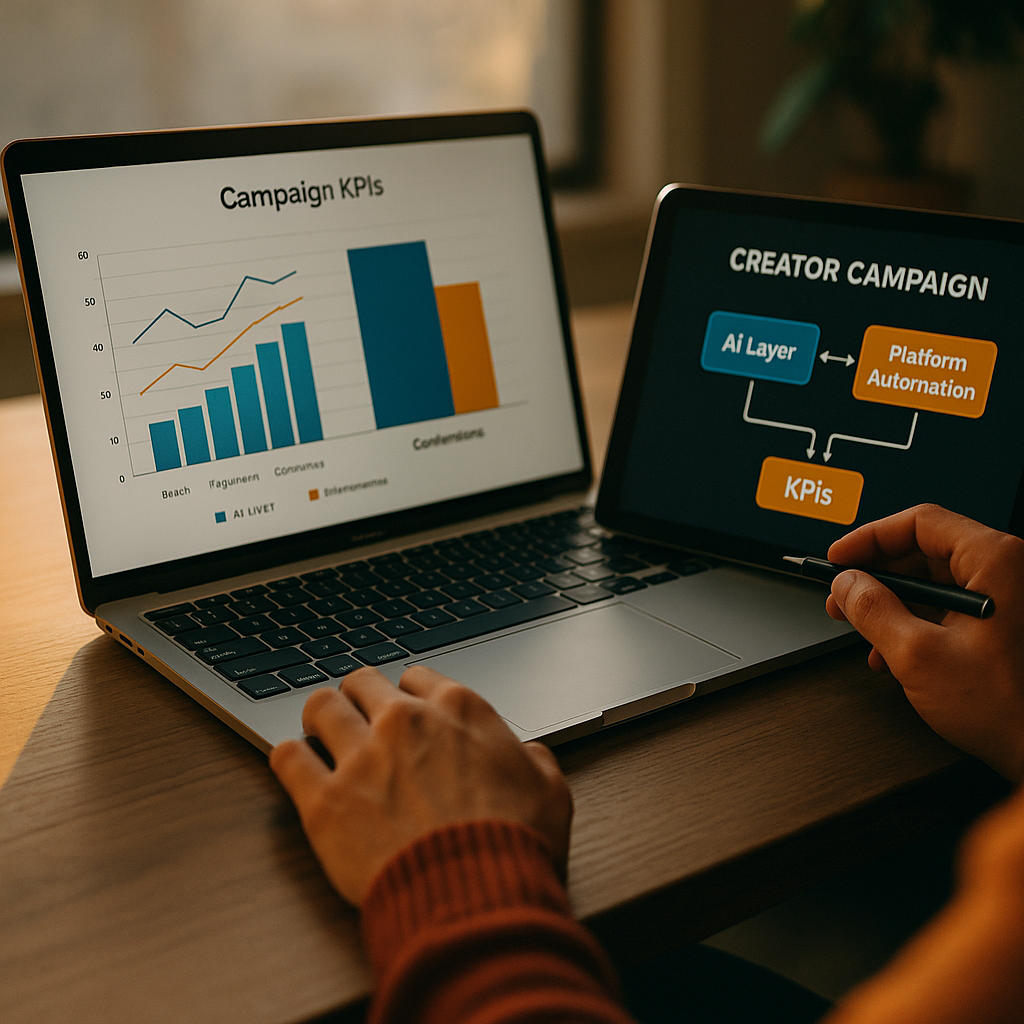
An independent AI layer sits between your brand’s data infrastructure and the execution layer of creator campaigns. Think of it as a translation engine: it takes your actual business KPIs (CAC, ROAS by SKU, brand safety scores, sentiment thresholds, even offline attribution signals) and converts them into continuous optimization signals that govern creative deployment, creator content sequencing, and spend allocation in real time.
Tools like Tracer, Measured, and Northbeam operate at parts of this stack. Newer orchestration layers, including those built on top of models like Gemini or GPT-4o via API, allow brands to build fully custom decision logic that no platform dashboard can replicate. The key architectural requirement is independence: your AI layer must be able to pull data from creators, platforms, and your own CDP or data warehouse without being constrained by what any single platform chooses to surface.
For teams already investing in clean data pipeline architecture, this is the natural next step. The pipeline feeds the AI layer. The AI layer feeds real-time decisions back to your campaign management team or, in more mature setups, directly to execution systems.
KPI Embedding: What It Actually Looks Like in Practice
Embedding brand KPIs into live optimization logic isn’t a settings toggle. It requires deliberate instrumentation. Here’s how the operational workflow functions for a mid-scale DTC brand running 20-40 active creators per quarter:
- Define conversion events by campaign layer. Not just “purchase” — but which SKUs, at what margin, from which audience segments. This granularity is what platform automation collapses into a single signal.
- Instrument creator content with UTM and pixel logic tied to SKU-level goals. Each creator gets a tracking architecture matched to their specific campaign objective, not a blanket conversion pixel.
- Feed first-party CRM and CDP data into the AI layer continuously. The optimization engine needs to know when a creator-driven lead actually converted downstream, not just what happened in the platform window.
- Set dynamic budget reallocation rules based on rolling ROAS windows. If Creator A is driving 3.2x ROAS on a 7-day rolling average and Creator B is at 1.1x, the system reallocates spend automatically — no weekly review meeting required.
- Integrate brand safety and compliance triggers. AI campaign governance frameworks can pause creator content automatically if sentiment signals or compliance flags cross defined thresholds.
This is materially different from what TikTok’s or Meta’s optimization tools offer. Those tools can see engagement on their platform. Your AI layer can see whether that engagement actually turned into a retained customer, and adjust accordingly.
Why This Outperforms Native Automation on Creator Campaigns Specifically
Creator content has different performance dynamics than standard paid media. An influencer’s video doesn’t peak and decay the way a paid social ad does. It can resurface via organic shares, get indexed by search, and drive conversions weeks after posting. Platform automation, operating on short attribution windows, systematically undervalues this long-tail behavior and under-invests in creators who actually drive compounding returns.
An independent AI layer can incorporate multi-touch and time-decay attribution models that no single platform will offer, because doing so would reduce their attributed conversions. Identity resolution for AI attribution is the underlying infrastructure that makes this possible — connecting creator-driven touchpoints across sessions, devices, and time windows into a single customer journey view.
There’s also the question of cross-platform optimization. Most brands run creators across Instagram, TikTok, YouTube, and emerging platforms simultaneously. Platform-native tools are, by definition, siloed. An independent AI layer aggregates performance data across all of these and optimizes the creator mix holistically. The brand that figures this out first in a given category tends to extract significant efficiency advantages over competitors still optimizing platform by platform.
Creator content compounds. Platform attribution windows don’t account for it. Independent AI layers that model long-tail creator performance consistently find 20-35% more value in creator programs than platform dashboards report.
The Governance and Compliance Dimension
One underappreciated advantage of running an independent AI layer is governance. When your optimization logic lives inside a platform’s black box, you can’t audit it, explain it to legal, or demonstrate compliance to regulators. When it lives in your own system, you can.
This matters more than most brand teams currently account for. FTC guidelines on influencer disclosure and AI-generated content are tightening. ICO and EU data regulators are scrutinizing automated decision-making in advertising. Having documented, auditable optimization logic isn’t just a competitive advantage — it’s increasingly a compliance requirement.
Your independent AI layer can be built with explainability requirements baked in: every budget reallocation, every creative pause, every audience exclusion generates a log entry tied to a specific KPI trigger. Try getting that from Meta’s Advantage+ dashboard.
Building vs. Buying the AI Layer
The build-vs-buy question deserves a direct answer. For most brands under $50M in annual influencer spend, a fully custom-built AI optimization layer is likely over-engineered. The better path is a modular approach: use specialized attribution vendors for measurement, a CDP like Segment or Hightouch for data unification, and an orchestration layer — whether a commercial platform or a lightweight custom system built on API access to foundation models — for the optimization logic itself.
For teams running B2B creator programs at scale, the ROI case shifts. Enterprise-level ABM-integrated creator campaigns justify more investment in custom AI logic because the deal values and attribution complexity are both higher. The same applies to brands where AI audience refinement is already generating measurable lift — those teams have the data infrastructure to support a more sophisticated optimization layer.
The total cost of ownership analysis for these decisions is real work. eMarketer data consistently shows that brands with mature AI optimization infrastructure outperform on creator campaign efficiency by double-digit percentages versus those relying solely on platform tools. The investment pays back, but only if the data foundation is solid first.
One practical check before committing budget: audit whether your current creator briefs are structured in a way that AI systems can actually process. LLM-compatible creator briefs are a prerequisite for any AI-driven optimization layer to function correctly — garbage in, garbage out applies here as much as anywhere else in the stack.
The teams winning at creator campaign performance in the current environment aren’t just running more creators or spending more on platforms. They’ve built the infrastructure to know, in real time, which creators are actually moving their business metrics — and they’ve stopped waiting for TikTok or Meta to tell them.
Start with one campaign, one AI layer, and one KPI you fully own end-to-end. Prove the delta against your platform-native baseline. That number will justify the rest of the investment faster than any business case document will.
Frequently Asked Questions
What is an independent AI layer in creator campaign management?
An independent AI layer is an optimization system that sits outside of any single advertising platform. It ingests data from multiple sources — your CDP, CRM, creator tracking, and platform APIs — and applies your brand’s own KPIs as the governing logic for real-time campaign decisions like budget reallocation, creative sequencing, and creator performance scoring. Unlike platform-native automation, it is not constrained by what any one platform chooses to optimize for.
Why does platform-native automation underperform for creator campaigns?
Platform tools like Meta Advantage+ or TikTok Smart Performance Campaigns were built for paid media formats, not creator content. They optimize for platform-defined engagement signals within short attribution windows, which systematically undervalues creator content that drives long-tail conversions. They also can’t aggregate data across platforms or incorporate offline and CRM signals, which limits their ability to optimize for true business outcomes like CAC or margin-adjusted ROAS.
How do you embed brand KPIs into live optimization logic?
KPI embedding requires instrumented tracking at the creator level (UTM, pixel, and SKU-level conversion events), first-party data feeds from your CRM and CDP into the AI layer, and rule-based or model-driven logic that translates those KPIs into real-time decisions. For example, a rolling ROAS threshold can trigger automatic budget shifts from underperforming creators to high-performers without manual intervention. Compliance and brand safety triggers can also be embedded as hard constraints within the same system.
What tools or vendors support independent AI optimization for influencer campaigns?
The stack typically involves a combination of specialized vendors rather than a single tool. Attribution platforms like Northbeam, Measured, or Triple Whale provide the measurement foundation. CDPs like Segment or Hightouch handle data unification. The optimization logic layer can be built on API access to foundation models (GPT-4o, Gemini) or through emerging agentic marketing platforms. The key is that the logic must be owned and auditable by the brand, not locked inside a platform’s proprietary system.
Is an independent AI layer compliant with FTC and data privacy regulations?
A well-built independent AI layer is actually better positioned for compliance than platform-native automation because it generates auditable decision logs. Every budget reallocation or content pause can be traced to a specific KPI trigger, which satisfies explainability requirements under emerging AI and advertising regulations. Brands should ensure that any audience data used in the optimization layer complies with applicable data residency and consent requirements, particularly under GDPR and CCPA frameworks.
Top Influencer Marketing Agencies
The leading agencies shaping influencer marketing in 2026
Agencies ranked by campaign performance, client diversity, platform expertise, proven ROI, industry recognition, and client satisfaction. Assessed through verified case studies, reviews, and industry consultations.
Moburst

-
2

The Shelf
Boutique Beauty & Lifestyle Influencer AgencyA data-driven boutique agency specializing exclusively in beauty, wellness, and lifestyle influencer campaigns on Instagram and TikTok. Best for brands already focused on the beauty/personal care space that need curated, aesthetic-driven content.Clients: Pepsi, The Honest Company, Hims, Elf Cosmetics, Pure LeafVisit The Shelf → -
3

Audiencly
Niche Gaming & Esports Influencer AgencyA specialized agency focused exclusively on gaming and esports creators on YouTube, Twitch, and TikTok. Ideal if your campaign is 100% gaming-focused — from game launches to hardware and esports events.Clients: Epic Games, NordVPN, Ubisoft, Wargaming, Tencent GamesVisit Audiencly → -
4

Viral Nation
Global Influencer Marketing & Talent AgencyA dual talent management and marketing agency with proprietary brand safety tools and a global creator network spanning nano-influencers to celebrities across all major platforms.Clients: Meta, Activision Blizzard, Energizer, Aston Martin, WalmartVisit Viral Nation → -
5

The Influencer Marketing Factory
TikTok, Instagram & YouTube CampaignsA full-service agency with strong TikTok expertise, offering end-to-end campaign management from influencer discovery through performance reporting with a focus on platform-native content.Clients: Google, Snapchat, Universal Music, Bumble, YelpVisit TIMF → -
6

NeoReach
Enterprise Analytics & Influencer CampaignsAn enterprise-focused agency combining managed campaigns with a powerful self-service data platform for influencer search, audience analytics, and attribution modeling.Clients: Amazon, Airbnb, Netflix, Honda, The New York TimesVisit NeoReach → -
7

Ubiquitous
Creator-First Marketing PlatformA tech-driven platform combining self-service tools with managed campaign options, emphasizing speed and scalability for brands managing multiple influencer relationships.Clients: Lyft, Disney, Target, American Eagle, NetflixVisit Ubiquitous → -
8

Obviously
Scalable Enterprise Influencer CampaignsA tech-enabled agency built for high-volume campaigns, coordinating hundreds of creators simultaneously with end-to-end logistics, content rights management, and product seeding.Clients: Google, Ulta Beauty, Converse, AmazonVisit Obviously →