


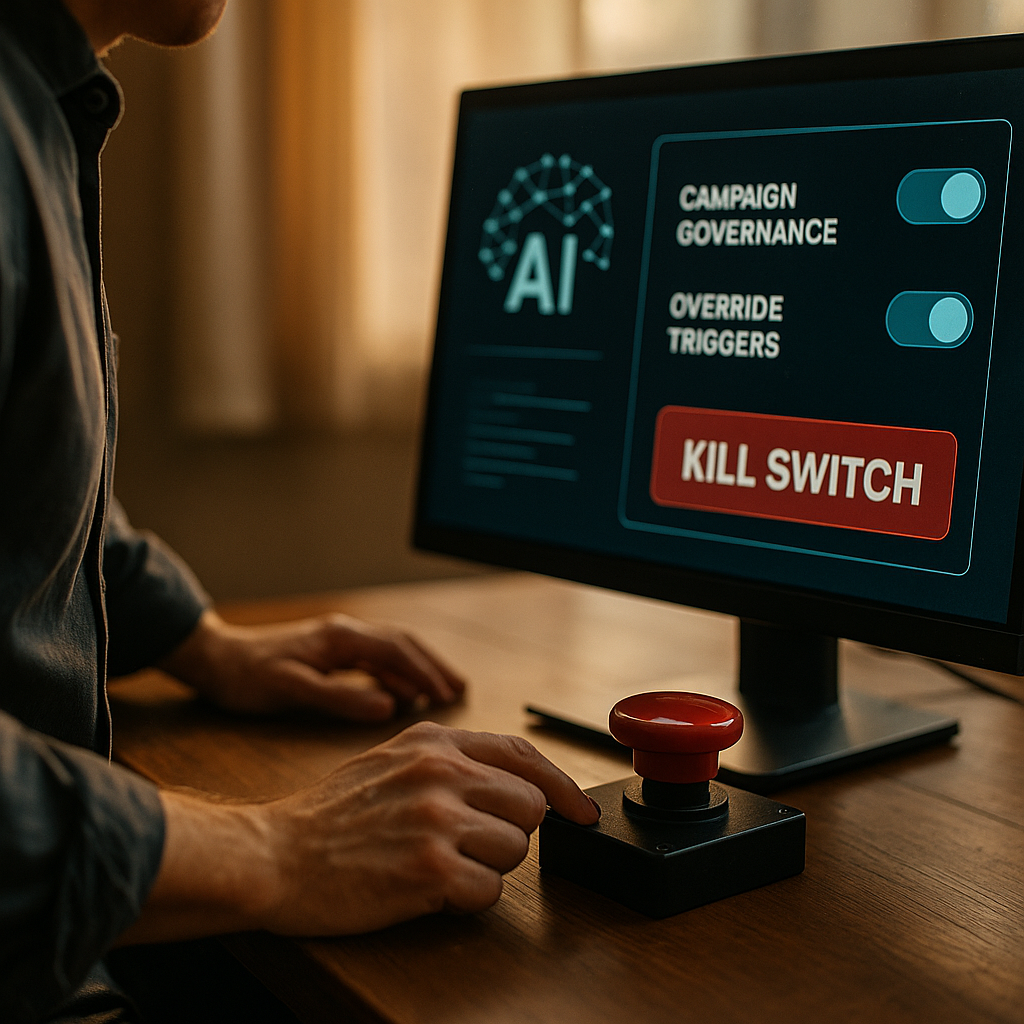
If Your AI Can Place a Creator Campaign Without Human Sign-Off, You Have a Governance Problem
Gartner projects that by the end of this decade, more than 40% of enterprise marketing workflows will involve some form of agentic AI operating without step-by-step human approval. For influencer and creator-adjacent campaigns, that autonomy creates regulatory exposure, brand safety risk, and liability gaps that most marketing operations teams have not yet closed. The agentic AI campaign governance framework is the operational infrastructure that closes those gaps before something goes wrong in market.
What “Agentic” Actually Means for Campaign Operations
Traditional AI tools assist humans. Agentic AI acts. It selects creators, adjusts bid strategies, reallocates budget across platforms, and triggers content placements based on performance signals, all without a human approving each discrete step. Tools like Persado’s agentic optimization layer, Smartly.io’s autonomous campaign management, and platform-native automation within Meta Advantage+ and TikTok Smart Performance Campaigns already operate this way at scale.
The operational efficiency case is real. Agentic systems reduce time-to-market, cut manual optimization overhead, and surface audience signals faster than any human analyst working a dashboard. The compliance case for governance is equally real, and it moves faster than most legal teams realize.
When an AI system places a sponsored creator post, adjusts disclosure copy, or shifts budget toward a new creator tier without explicit human review, the brand is still legally responsible for every output. The FTC does not have a “the algorithm did it” exemption. Neither does the EU’s Digital Services Act. Your FTC and DSA compliance obligations attach to the output, not the decision-making mechanism.
The Three Pillars of an Agentic Campaign Governance Framework
Governance for autonomous marketing systems is not a single policy document. It is an operational architecture built on three interdependent pillars: human override triggers, audit trail requirements, and kill-switch provisions. Each pillar addresses a different failure mode.
Pillar 1: Human Override Triggers
An override trigger is a defined condition that automatically pauses autonomous action and routes a decision to a human reviewer. The mistake most teams make is defining triggers too broadly (“escalate anything unusual”) or not defining them at all. Neither approach works operationally.
Effective override triggers for creator-adjacent campaigns should be specific and threshold-based. Consider building your trigger matrix around these categories:
- Creator risk signals: Any creator whose brand safety score drops below a defined threshold mid-campaign, or who has been flagged by a platform trust-and-safety action within the prior 30 days, should require human re-approval before the AI continues placing content against them.
- Spend velocity anomalies: If the system reallocates more than 20% of campaign budget away from originally approved line items within a 48-hour window, a human should review before the reallocation executes.
- Disclosure and regulatory adjacency: Any content placement touching regulated product categories (alcohol, financial products, supplements, youth-adjacent audiences) should have a mandatory human review gate. Pair this with your existing FTC disclosure audit workflow so the gate integrates into compliance operations rather than sitting outside them.
- Geographic expansion: If the AI proposes extending a campaign into a new market or jurisdiction, regulatory review should be mandatory. EU markets, in particular, carry DSA and GDPR implications that automated systems are not equipped to evaluate independently.
- Sentiment deterioration: If real-time social listening detects a net sentiment score decline of more than 15 points on brand mentions tied to an active campaign, the system should pause and escalate.
Override triggers are only valuable if they are operationally connected to someone who can actually make a decision in under two hours. A trigger that routes to a committee review process is not a safety mechanism. It is a bottleneck.
Pillar 2: Audit Trail Requirements
An audit trail is not a log file. A log file records what happened. An audit trail records what happened, why the system decided to do it, what data inputs informed that decision, and which human (if any) reviewed the decision before or after execution. That distinction matters enormously in a regulatory inquiry or brand safety post-mortem.
For agentic campaign systems, your audit trail architecture should capture the following at every autonomous decision point: the data inputs the system evaluated, the action taken, the timestamp, the confidence score or probability weighting if the system exposes one, and the human review status (approved in advance, reviewed post-execution, or flagged for exception). This structure also supports your CMO-level oversight policy documentation, which is increasingly a request from procurement and legal teams during vendor due diligence.
Retention matters too. The FTC’s current guidance on AI-generated and AI-placed advertising recommends retaining records sufficient to demonstrate compliance for a minimum of five years. Map your audit trail retention schedule to that standard, not to whatever default your platform vendor provides.
One practical implementation note: require your AI vendor to provide audit trail exports in a machine-readable format (JSON, CSV) that your compliance team can query independently. Audit trails locked inside a vendor’s proprietary interface are operationally useless the moment you change platforms or face a subpoena.
Pillar 3: Kill-Switch Provisions
A kill switch is a pre-authorized mechanism that immediately halts all autonomous campaign activity across every channel and placement simultaneously. “Immediately” means within minutes, not within a business day.
Most enterprise marketing teams have some version of a campaign pause capability, but they are almost never designed for the speed and completeness that agentic systems require. If your AI has placed content across TikTok creators, Meta placements, YouTube pre-roll adjacencies, and a programmatic display layer simultaneously, your kill switch needs to reach all of those channels in a single action. Manual channel-by-channel pausing is not adequate.
Design kill-switch provisions to address three scenarios: a brand safety incident in progress, a regulatory inquiry requiring immediate activity suspension, and a technical malfunction where the AI is producing anomalous or clearly erroneous outputs. Each scenario has different time pressure and different downstream documentation requirements. Your AI brand backlash response plan should directly reference the kill-switch procedure so incident response teams know exactly what to activate and in what order.
Contractually, kill-switch authority needs to be explicitly preserved in your agreements with any AI campaign management vendor. Some vendor contracts include “minimum run period” clauses that limit your ability to halt campaigns mid-flight. Those clauses are incompatible with a functional governance framework. Review your AI provisions in creator contracts alongside vendor agreements to ensure operational consistency across your entire campaign stack.
Operationalizing the Framework: What the RACI Actually Looks Like
Governance frameworks that live in policy documents and not in operating procedures fail. The RACI for an agentic AI governance framework in a mid-to-large brand marketing operation typically assigns responsibility as follows:
- Marketing Operations Lead: Owns trigger threshold definitions and audit trail architecture. Reviews anomaly reports weekly. Has direct authority to invoke the kill switch without escalation.
- Brand Safety Manager: Accountable for creator risk signal monitoring and sentiment-based escalation criteria. Interfaces with platform trust-and-safety teams directly.
- Legal/Compliance: Consulted on jurisdiction-based triggers and audit trail retention schedules. Signs off on vendor contract language covering kill-switch and audit export provisions.
- CMO or VP Marketing: Informed of any kill-switch activation within one hour. Reviews monthly governance exception reports.
Regulators, including the FTC and the UK ICO, are increasingly asking brands to demonstrate that named humans hold accountability for AI-generated marketing outputs. A RACI is not bureaucracy. It is your liability documentation.
The brands that will navigate agentic AI governance most effectively are not the ones that restrict AI autonomy the most. They are the ones that define, in precise operational language, exactly where human judgment is non-negotiable.
The Vendor Accountability Gap No One Is Talking About
Here is the gap that catches most teams off guard. AI campaign management vendors own the model. They own the inference logic. They almost never own the regulatory outcome. When an agentic system places a creator-adjacent ad that violates FTC disclosure rules or AI UGC disclosure requirements, the FTC investigation names the brand, not the software vendor.
Your governance framework needs a vendor accountability addendum that requires the platform to: document what data the model was trained on, provide access to decision explanation outputs on request, notify you within 24 hours of any model update that could affect campaign behavior, and indemnify you for direct damages caused by documented system malfunction. Some enterprise vendors, including Meta and TikTok for Business, have started publishing transparency documentation for their automated buying tools. Reviewing that documentation before deployment is a minimum standard, not a best practice.
For brands using Sprout Social or similar platforms with emerging agentic social publishing features, the same accountability logic applies. Automation depth should be directly proportional to governance depth.
Before You Deploy: A Pre-Launch Governance Checklist
Before any agentic AI system goes live on creator-adjacent campaigns, your marketing ops team should be able to answer yes to all of the following:
- Have all override triggers been defined in writing with specific, quantitative thresholds?
- Is there a named human with explicit authority to invoke the kill switch at any hour, including weekends?
- Does the audit trail architecture capture decision inputs, not just outputs?
- Has legal reviewed vendor contracts for minimum-run clauses and audit export rights?
- Has the compliance team confirmed that automated disclosure handling meets current FTC guidance?
- Is the kill-switch mechanism technically capable of halting all placements within 15 minutes across all active channels?
If any answer is no, the system is not ready. Partial governance is not governance.
Start with the kill switch. Build the mechanism before you build the rest of the framework. It forces every other governance conversation to become concrete, because you cannot define “what requires a full stop” without first defining what you cannot afford to get wrong.
FAQs
What is an agentic AI campaign governance framework?
It is the operational architecture a brand marketing team builds before deploying autonomous AI systems that can plan, optimize, and place campaigns without human approval at each step. It covers three core components: human override triggers (pre-defined conditions that pause the AI and escalate to a human), audit trail requirements (structured records of every autonomous decision), and kill-switch provisions (mechanisms to immediately halt all AI-driven campaign activity).
Why do agentic AI systems require different governance than traditional marketing automation?
Traditional automation executes rules a human explicitly programmed. Agentic AI makes independent decisions based on model inference, optimizes in real time, and can take actions (like shifting budget, selecting new creators, or adjusting placement targets) that were never explicitly approved by a human. That autonomy creates regulatory exposure because brands remain legally responsible for all campaign outputs under FTC rules and the EU Digital Services Act, regardless of whether a human approved each individual action.
How specific do human override triggers need to be?
Very specific. Vague triggers like “escalate unusual activity” are operationally useless. Effective triggers use quantitative thresholds: a budget reallocation exceeding a defined percentage, a creator safety score falling below a defined level, a sentiment score declining by a defined number of points, or any placement touching a regulated product category or age-sensitive audience segment. Specificity is what makes triggers enforceable and auditable.
What should an audit trail for an agentic campaign system include?
An audit trail should capture: the data inputs the AI evaluated before making a decision, the specific action taken, the timestamp, any confidence or probability score the system generated, and the human review status (pre-approved, post-reviewed, or flagged as an exception). Records should be retained for a minimum of five years in alignment with FTC guidance, and should be exportable in a machine-readable format independent of the vendor’s interface.
Can a kill switch be contractually limited by a vendor’s minimum-run clause?
It can be, and that is a serious governance risk. Some AI campaign management vendors include minimum campaign run periods in their contracts that limit a brand’s ability to pause mid-flight. Before deployment, legal teams must review vendor contracts specifically for these clauses and negotiate their removal or modification. A kill switch that cannot actually halt activity in real time is not a functional safety mechanism.
Who should own the kill-switch authority in a brand marketing operations team?
A named individual in the marketing operations function should hold primary kill-switch authority without requiring escalation approval. This is typically the Marketing Operations Lead or Brand Safety Manager. The CMO or VP Marketing should be notified of any kill-switch activation within one hour, but should not be a required approver for the initial action. Speed is the operative requirement in a brand safety or regulatory incident.
Top Influencer Marketing Agencies
The leading agencies shaping influencer marketing in 2026
Agencies ranked by campaign performance, client diversity, platform expertise, proven ROI, industry recognition, and client satisfaction. Assessed through verified case studies, reviews, and industry consultations.
Moburst

-
2

The Shelf
Boutique Beauty & Lifestyle Influencer AgencyA data-driven boutique agency specializing exclusively in beauty, wellness, and lifestyle influencer campaigns on Instagram and TikTok. Best for brands already focused on the beauty/personal care space that need curated, aesthetic-driven content.Clients: Pepsi, The Honest Company, Hims, Elf Cosmetics, Pure LeafVisit The Shelf → -
3

Audiencly
Niche Gaming & Esports Influencer AgencyA specialized agency focused exclusively on gaming and esports creators on YouTube, Twitch, and TikTok. Ideal if your campaign is 100% gaming-focused — from game launches to hardware and esports events.Clients: Epic Games, NordVPN, Ubisoft, Wargaming, Tencent GamesVisit Audiencly → -
4

Viral Nation
Global Influencer Marketing & Talent AgencyA dual talent management and marketing agency with proprietary brand safety tools and a global creator network spanning nano-influencers to celebrities across all major platforms.Clients: Meta, Activision Blizzard, Energizer, Aston Martin, WalmartVisit Viral Nation → -
5

The Influencer Marketing Factory
TikTok, Instagram & YouTube CampaignsA full-service agency with strong TikTok expertise, offering end-to-end campaign management from influencer discovery through performance reporting with a focus on platform-native content.Clients: Google, Snapchat, Universal Music, Bumble, YelpVisit TIMF → -
6

NeoReach
Enterprise Analytics & Influencer CampaignsAn enterprise-focused agency combining managed campaigns with a powerful self-service data platform for influencer search, audience analytics, and attribution modeling.Clients: Amazon, Airbnb, Netflix, Honda, The New York TimesVisit NeoReach → -
7

Ubiquitous
Creator-First Marketing PlatformA tech-driven platform combining self-service tools with managed campaign options, emphasizing speed and scalability for brands managing multiple influencer relationships.Clients: Lyft, Disney, Target, American Eagle, NetflixVisit Ubiquitous → -
8

Obviously
Scalable Enterprise Influencer CampaignsA tech-enabled agency built for high-volume campaigns, coordinating hundreds of creators simultaneously with end-to-end logistics, content rights management, and product seeding.Clients: Google, Ulta Beauty, Converse, AmazonVisit Obviously →