


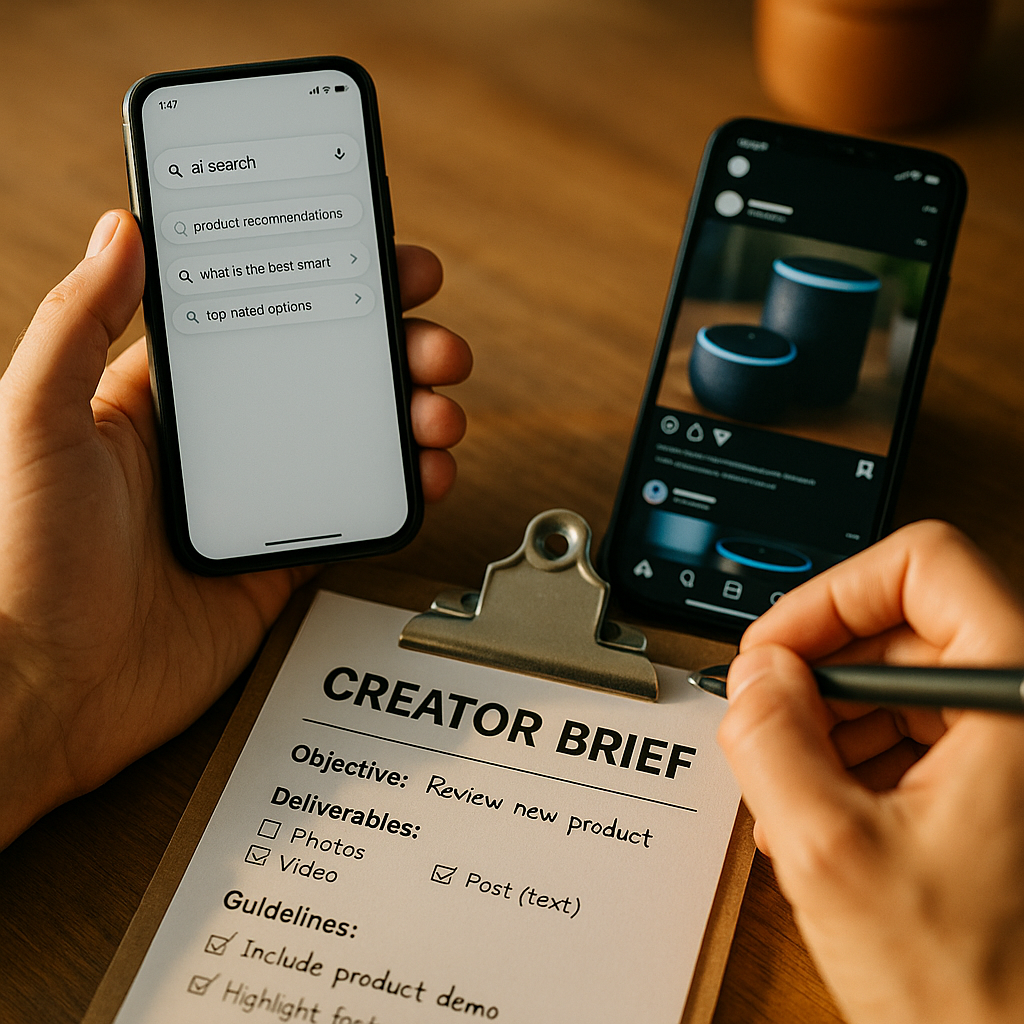
One in four consumers now encounters a brand recommendation through an AI answer engine before they ever touch a social feed. That shift rewrites the creator brief. Building a creator brief for the AI-default consumer is no longer a content experiment — it is a core brand infrastructure decision.
The Brief Is No Longer Just a Creative Document
For most of the last decade, a creator brief did one job: help a creator produce content that felt native to their platform while carrying the brand’s message. TikTok hooks. Instagram aesthetic cues. YouTube retention arcs. That was the game.
The game changed. When a prospective buyer asks ChatGPT “what’s the best magnesium supplement for sleep” or asks Gemini “which project management tool do small agencies actually use,” the AI doesn’t surface a Reel. It synthesizes text, pulls from structured web content, and returns a confident answer. If your creator content didn’t embed the factual signals those models need to retrieve and cite your brand, you were invisible in that moment.
The practical implication: a brief written only for human scroll behavior leaves significant discovery surface area on the table. The brief written for both audiences captures the full funnel.
A creator brief that ignores AI retrieval signals is optimized for only half the consumer journey. In a market where Statista tracks AI assistant usage growing quarter over quarter, that half is shrinking fast.
What “AI-Default Consumer” Actually Means for Your Brief
The AI-default consumer isn’t a demographic. It’s a behavior pattern. These are buyers who open ChatGPT before they open Google, who use Perplexity to research a SaaS tool before they click a paid ad, who ask Gemini for product comparisons before they visit a brand’s website. They are concentrated in the 25-44 age band, they over-index in B2B purchase roles, and they are increasingly showing up in CPG, wellness, and consumer tech categories.
What does that consumer need from creator content? They need it to be factually structured. AI large language models are trained on and retrieve from content that contains clear subject-entity relationships, specific claims with supporting context, and language patterns that answer recognizable question formats. Vague lifestyle content — “this product just makes me feel amazing” — produces almost no retrieval signal. Specific, structured claims — “this formula contains 400mg of magnesium glycinate, which is the form most studied for sleep onset” — creates an extractable, citable fact cluster.
The tension: that same specificity can kill platform-native authenticity if handled poorly. Nobody watches a Reel that reads like a Wikipedia entry. The brief is where you resolve that tension before the creator ever starts filming.
Anatomy of a Dual-Purpose Creator Brief
Structurally, the dual-purpose brief adds two layers to your existing framework without replacing what works. Think of it as a brief within a brief.
Layer 1: Platform-Native Creative Direction — This is what most briefs already cover well. Platform, format, duration, tone, aesthetic references, hook direction, CTA placement. If you need to sharpen this layer, the hook and CTA strategy framework is a strong starting point, particularly for short-form video where the first two seconds carry disproportionate weight.
Layer 2: Answer-Engine Signal Architecture — This is new. It contains three components:
- The Core Claim Set: Three to five specific, factual statements about the product that the creator must include verbatim or near-verbatim. These are the retrievable facts. Ingredient quantities, clinical references, specific use cases, category differentiators. Not marketing language. Facts.
- The Query Targets: Two to four natural-language questions that real consumers ask AI assistants in your category. Write them exactly as a consumer would type them. “What’s the difference between X and Y?” “Is [product] good for [specific outcome]?” The creator’s script should organically answer at least two of these.
- The Entity Mentions: Explicit instruction to mention the brand name, product name, and category descriptor within the first third of the script. AI retrieval depends on entity recognition. If the brand name appears only in a logo overlay or end card, it’s functionally invisible to language model parsing.
For a deeper structural template, the GEO-optimized brief template provides a practical scaffold that many brand teams have adapted for both shopping and awareness contexts.
Writing Creative Direction Creators Will Actually Use
Here’s where most brand strategists lose the room. They add the AI signal requirements and the brief becomes a compliance document. Creators read it, feel constrained, and produce technically correct but lifeless content that neither humans nor AI systems reward.
The framing fix: present the Core Claim Set not as “required talking points” but as “conversation starters.” Position each claim as something the creator’s audience would genuinely want to know. “Your audience probably gets asked about magnesium forms all the time — here’s the specific answer that will make you sound like an expert.” That framing invites creators into the fact rather than forcing compliance.
The Query Targets section works best when shared with creators as audience insight, not as SEO instruction. Tell them: “We’ve found that consumers in your niche are searching for answers to these exact questions.” Creators are audience-obsessed. Give them a real audience signal and they’ll work it into content naturally.
One note on length and format: for AI retrieval, a 90-second video with a clear verbal claim outperforms a 15-second clip with the same visual. Audio and transcript content is increasingly indexed by AI systems. Brief creators to prioritize verbal explicitness over visual implication, particularly for product attributes. The AI search and authenticity brief framework covers this tradeoff in practical detail.
Platform-by-Platform Calibration
Not every platform requires the same dual-purpose calibration. Here’s how to adjust.
TikTok and Reels: The hook must win the human audience. AI signal goes in the middle and close of the video, where verbal density is highest and algorithmic completion rate is already earned. Brief creators to deliver the Core Claim Set verbally between seconds 8 and 45. For commerce-specific applications, the TikTok, Reels, and AI shopping agents brief structure is the most current operational guide available.
YouTube (long-form and Shorts): The highest AI retrieval surface of any creator platform, because transcripts are deeply indexed. Brief creators to include a dedicated 30-45 second “product explainer” segment that functions as a standalone fact block. This segment is the one AI models are most likely to extract. eMarketer data consistently shows YouTube content has longer AI training data presence than short-form alternatives, which compounds retrieval advantage over time.
Podcasts and video podcasts: The highest verbal density of any format. AI retrieval from podcast transcripts is now a primary signal source for category queries. Brief hosts to answer the Query Targets as natural conversational responses rather than scripted reads. The AI podcast brief and attribution standards guide covers compliance and measurement alongside creative direction.
LinkedIn: Increasingly important for B2B AI discovery. Creator posts here are frequently cited in Perplexity and ChatGPT responses to professional queries. Brief creators to include structured opinion statements: “[Brand] does X better than alternatives because of Y specific reason.” That sentence pattern is nearly ideal for AI citation.
The creators who become AI-cited sources in their niche will hold compounding brand recall advantages that paid media cannot replicate. Your brief is the document that enables or prevents that outcome.
Compliance, FTC, and the Dual-Purpose Risk Layer
Embedding specific factual claims in creator content raises the compliance stakes. When a creator verbally states a clinical claim — “clinically studied,” “reduces inflammation,” “increases absorption by 40%” — that statement carries FTC liability whether the brief originated it or the creator improvised it. The dual-purpose brief must include explicit claim substantiation guardrails. Every item in the Core Claim Set should have a corresponding approved source the creator can cite if challenged. Review the FTC endorsement guidelines before finalizing any claim language, particularly for health, finance, or supplement categories.
Equally important: brief creators to avoid presenting AI-retrieval-optimized language as their own research. Transparency about what is brand-provided versus creator-validated is both an FTC requirement and an audience trust issue. Creators who cite sources and acknowledge brand involvement perform better on long-term audience trust metrics than those who don’t.
Measuring Whether the Dual-Purpose Brief Is Working
Standard influencer metrics, reach, engagement, link clicks, won’t tell you if the AI signal layer is performing. You need a parallel measurement track.
Run monthly AI citation audits. Query ChatGPT, Gemini, Perplexity, and similar tools with your Query Targets and track whether creator content, or language clearly derived from it, appears in responses. Track how brand entity mentions in creator content correlate with spikes in direct branded search volume, which is the most reliable downstream signal that AI-assisted discovery is driving intent. The gap between pre-campaign and post-campaign AI mention frequency is your clearest indicator of brief effectiveness.
Build this audit into your standard campaign reporting cadence. Four weeks post-publish, eight weeks post-publish. AI models update retrieval patterns continuously. Content that wasn’t cited in week one may be cited by week eight as the model indexes new sources.
Start by auditing your three most recent creator briefs against the dual-purpose framework: count how many specific, verbally deliverable factual claims you provided, and identify which natural-language consumer queries the resulting content would have answered. That gap analysis is the fastest way to prioritize which brief elements to rebuild first. For a practical operational template, the briefs optimized for ChatGPT guide offers ready-to-adapt language your team can implement in the next campaign cycle.
Frequently Asked Questions
What is a dual-purpose creator brief?
A dual-purpose creator brief is a creative direction document that contains instructions for producing platform-native, human-facing social content and a separate layer of factual claim architecture designed to generate AI retrieval signals. It enables a single piece of creator content to perform in human social feeds and in AI answer engine responses simultaneously.
How does creator content get picked up by ChatGPT or Gemini?
AI language models retrieve content through training data and real-time web indexing, depending on the model and query type. Creator content is more likely to be retrieved when it contains specific entity mentions (brand name, product name, category), structured factual claims, and language patterns that directly answer recognizable consumer questions. Video transcripts, podcast transcripts, and written creator posts on indexed platforms are the highest-retrieval-surface formats.
Do I need a different brief for every platform?
The AI signal layer of the brief (Core Claim Set, Query Targets, Entity Mentions) remains largely consistent across platforms. The platform-native creative layer is calibrated per platform, as it always has been. The key adjustment per platform is where in the content structure the factual claims appear, not whether they appear.
What types of claims should go in the Core Claim Set?
Specific, substantiated facts: ingredient quantities, clinical study references, measurable performance attributes, category differentiators, and specific use cases. Avoid marketing language or superlatives. Every claim in the Core Claim Set should be something your legal and compliance team has already approved, with a source document available for FTC substantiation purposes.
How do I measure AI discovery performance from creator content?
Run monthly query audits against your target consumer questions across ChatGPT, Gemini, and Perplexity. Track whether brand entity language from creator content appears in AI responses. Measure branded search volume lift in the weeks following creator content publishing. A sustained increase in branded search volume is the most reliable downstream indicator that AI-assisted discovery is generating intent.
Will adding AI signal requirements make creator content feel less authentic?
Only if the brief frames them as compliance requirements. When factual claims are positioned as audience-relevant information that makes the creator a more credible, knowledgeable voice in their niche, most experienced creators integrate them naturally. The brief’s framing of the Core Claim Set is as important as its content.
Top Influencer Marketing Agencies
The leading agencies shaping influencer marketing in 2026
Agencies ranked by campaign performance, client diversity, platform expertise, proven ROI, industry recognition, and client satisfaction. Assessed through verified case studies, reviews, and industry consultations.
Moburst

-
2

The Shelf
Boutique Beauty & Lifestyle Influencer AgencyA data-driven boutique agency specializing exclusively in beauty, wellness, and lifestyle influencer campaigns on Instagram and TikTok. Best for brands already focused on the beauty/personal care space that need curated, aesthetic-driven content.Clients: Pepsi, The Honest Company, Hims, Elf Cosmetics, Pure LeafVisit The Shelf → -
3

Audiencly
Niche Gaming & Esports Influencer AgencyA specialized agency focused exclusively on gaming and esports creators on YouTube, Twitch, and TikTok. Ideal if your campaign is 100% gaming-focused — from game launches to hardware and esports events.Clients: Epic Games, NordVPN, Ubisoft, Wargaming, Tencent GamesVisit Audiencly → -
4

Viral Nation
Global Influencer Marketing & Talent AgencyA dual talent management and marketing agency with proprietary brand safety tools and a global creator network spanning nano-influencers to celebrities across all major platforms.Clients: Meta, Activision Blizzard, Energizer, Aston Martin, WalmartVisit Viral Nation → -
5

The Influencer Marketing Factory
TikTok, Instagram & YouTube CampaignsA full-service agency with strong TikTok expertise, offering end-to-end campaign management from influencer discovery through performance reporting with a focus on platform-native content.Clients: Google, Snapchat, Universal Music, Bumble, YelpVisit TIMF → -
6

NeoReach
Enterprise Analytics & Influencer CampaignsAn enterprise-focused agency combining managed campaigns with a powerful self-service data platform for influencer search, audience analytics, and attribution modeling.Clients: Amazon, Airbnb, Netflix, Honda, The New York TimesVisit NeoReach → -
7

Ubiquitous
Creator-First Marketing PlatformA tech-driven platform combining self-service tools with managed campaign options, emphasizing speed and scalability for brands managing multiple influencer relationships.Clients: Lyft, Disney, Target, American Eagle, NetflixVisit Ubiquitous → -
8

Obviously
Scalable Enterprise Influencer CampaignsA tech-enabled agency built for high-volume campaigns, coordinating hundreds of creators simultaneously with end-to-end logistics, content rights management, and product seeding.Clients: Google, Ulta Beauty, Converse, AmazonVisit Obviously →