


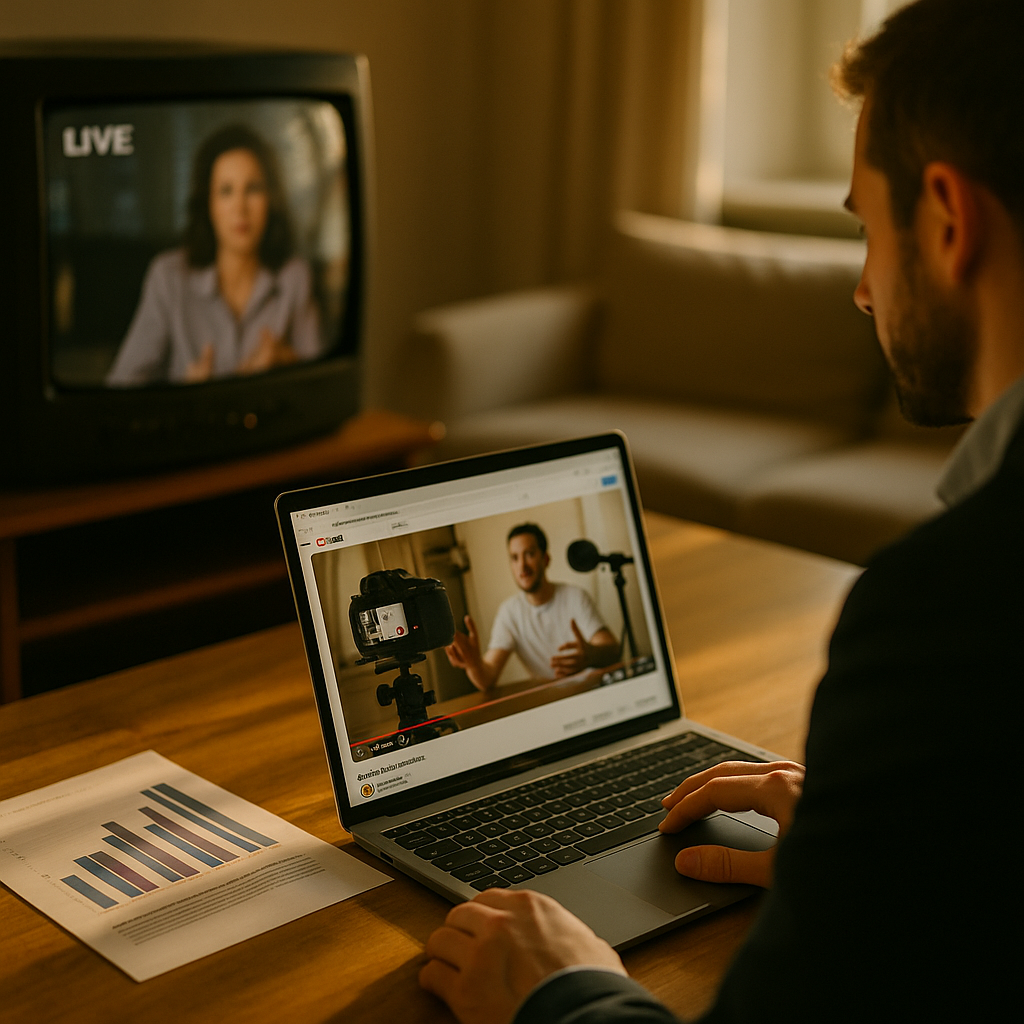
Linear TV’s prime-time audience has shed roughly a third of its viewers over the past five years, yet many brand media plans still allocate the majority of video budgets to broadcast and cable. That misalignment is no longer a rounding error — it’s a strategic liability. The linear TV to creator shift in video budgets is accelerating, and the brands repositioning their annual video planning assumptions right now will hold a compounding reach advantage for years.
The Viewership Math No Longer Supports the Spend
Nielsen’s data consistently shows live+same-day linear viewership declining across every key demo outside of live sports. Adults 18–49, the cohort most advertisers still optimize toward, have migrated to streaming, YouTube, and social video at a rate that broadcast CPMs simply cannot justify. Yet media plans built on legacy relationships, upfront commitments made 12 months prior, and internal inertia keep linear allocations locked in place.
The uncomfortable question every VP of Media should be asking right now: if your target audience watches an average of 90 minutes less linear TV per week than they did five years ago, why does linear still command 40–60% of your video budget?
This isn’t an argument to abandon linear entirely. Live sports, major tentpole events, and certain 50+ demographics still justify broadcast investment. (For a closer look at reaching older audiences through creator channels, see our coverage of Boomer and Gen X influencer marketing.) But the default assumption that linear deserves the anchor position in a video plan needs to be challenged every planning cycle, not just occasionally.
YouTube’s Upfront Momentum Is a Signal, Not a Trend
YouTube’s participation in the traditional upfront marketplace has shifted from novelty to mainstream. Major holding companies and independent agencies are now negotiating upfront commitments with Google for YouTube inventory — both for its ad-supported streaming environment on connected TV screens and for creator-adjacent placements. This is structurally significant.
When YouTube earns a seat at the upfront table alongside NBC and CBS, it signals that institutional media buyers have accepted creator-native video as a legitimate brand-safe, premium environment — not a supplemental digital line item.
YouTube’s CTV footprint is particularly relevant here. Over 150 million people in the U.S. watch YouTube on a television screen each month, according to eMarketer data. That’s not mobile-first social consumption — that’s lean-back, appointment-style viewing that directly competes with linear for the same living room attention. Brands still treating YouTube as a “digital” bucket separate from their TV strategy are operating with an outdated media taxonomy.
For brands navigating the broader CTV transition, the dynamics of CTV consolidation and creator content strategy are reshaping how streaming ad inventory gets structured and priced.
What “Reallocating” Actually Means in Practice
Reallocation isn’t just shifting dollars from one line to another. It requires rethinking the planning architecture itself.
Start with reach curve analysis. Most media mix models were calibrated during a period when linear delivered reach efficiently. Re-run your incremental reach modeling with current consumption data. You will almost certainly find that linear is delivering duplicated reach against a shrinking universe at a premium CPM, while creator and streaming channels are accessing unduplicated audiences at lower cost-per-reach point.
Second, redefine what counts as “video.” For too long, brand teams have siloed creator video (influencer content, YouTube partnerships, short-form social) under a separate “social” or “influencer” budget line that doesn’t compete directly with the TV budget. That organizational structure protects legacy linear spend from scrutiny. Consolidating video planning under a single video P&L — where creator, streaming, CTV, and linear all compete on audience delivery metrics — forces honest trade-off decisions.
Third, pressure-test your upfront commitments. If you made linear upfront commitments that leave limited flexibility for in-year reallocation, understand the make-good and cancellation terms now, not in Q3. Many contracts allow 25–50% cancellation at specific option windows. Use them strategically.
The growing role of paid amplification in creator budgets is also relevant here: creator content increasingly requires paid media support to hit reach targets, which means the line between “influencer budget” and “media budget” is already blurring operationally.
Creator Video as a Performance Channel, Not Just Brand Awareness
One reason linear has historically commanded brand budgets is the perception that it’s the premium awareness vehicle — the channel where you build brand equity at scale. Creator video was positioned as lower-funnel, direct-response territory. That distinction has largely collapsed.
Long-form YouTube content from mid-to-large creators now demonstrates meaningful brand recall, purchase intent lift, and category authority signals that track comparably to traditional TV creative in brand lift studies. The difference is that creator content also generates SEO value, search visibility, and social proof that compound over time. A linear spot delivers exactly once, then it’s gone. A well-executed creator video continues generating views, search impressions, and AI-surfaced references for months.
This compounding value is especially relevant as AI search and generative discovery reshape how consumers find brand information. Creator content that earns organic engagement is increasingly surfaced in AI-generated responses across Google‘s AI Mode and other generative engines. The media value extends well beyond the initial publish window.
A 30-second linear spot is a moment. A creator integration is an asset — one that keeps working in search, in social algorithms, and increasingly in AI-generated responses long after the campaign wraps.
The Budget Architecture Question
Most brand media plans operate on annual planning cycles with Q4 commitments for the following year. That structure was designed around upfront TV buying calendars. It’s now a poor fit for creator markets, where talent availability, platform algorithm changes, and audience behavior shift quarterly.
Progressive media teams are moving toward a hybrid architecture: a smaller committed base (upfront-style deals with anchor creators or YouTube reservation buys) combined with a meaningful flexible pool that can be deployed against creator partners within 60–90 days of activation. This preserves the pricing advantages of early commitment while maintaining the agility to respond to cultural moments, platform shifts, and emerging creator audiences.
As the creator economy approaches $250B in scale, the infrastructure for these kinds of strategic commitments is maturing. Talent agencies, creator platforms, and influencer marketing tools now offer reservation inventory, brand safety guarantees, and measurement frameworks that close the gap between creator buying and traditional media buying.
For teams building out a longer-term creator roster strategy alongside media reallocation, the dynamics of AOR strategy and creator economy consolidation have direct implications for how you structure agency relationships and creator contracts.
Risk Management in the Transition
Rapid reallocation carries its own risks. Brand safety in creator environments remains a legitimate operational concern, particularly for regulated categories. Creator content, by its nature, is less predictable than scripted broadcast advertising. This requires investment in vetting infrastructure, content guidelines, and monitoring capabilities that many brands are still building.
Measurement is also imperfect. Creator attribution models vary significantly by platform, and cross-channel measurement that fairly compares linear GRPs to creator view metrics isn’t yet standardized. Statista’s media measurement data and platforms like Nielsen are evolving their cross-platform currency frameworks, but brand teams should build in a measurement learning period rather than expecting like-for-like comparisons from day one.
These friction points are real but manageable. They are also temporary. The measurement infrastructure is catching up to consumption reality. The brand safety tooling is improving. The operational risk of moving too slowly — ceding audience access and brand relevance to competitors who shift first — is the risk that doesn’t improve with time.
The Next Planning Cycle Is the Right Moment
If your annual video planning process begins in Q3 or Q4, the window to influence next year’s allocation assumptions is now. Commission an updated reach and frequency analysis that incorporates current linear viewership data, YouTube CTV consumption, and creator channel audience composition for your core demos. Present it against your current allocation. The gap will likely make the case more clearly than any strategic memo.
Reframe creator video as a video channel first — not a social tactic. Compete it directly against linear for budget share. Build the hybrid committed/flexible architecture. And treat YouTube’s upfront participation not as a curiosity but as institutional confirmation that the shift has arrived.
Start with your reach modeling. The numbers will do the rest of the work.
Frequently Asked Questions
How much of a video budget should brands reallocate from linear TV to creator channels?
There’s no universal percentage, but a useful starting benchmark is to run an incremental reach analysis for your specific audience demo with current consumption data. Most brands targeting adults under 50 will find that linear delivers diminishing incremental reach above a relatively low GRP threshold. A common reallocation direction is moving 20–35% of linear-committed video budget toward YouTube, creator integrations, and CTV inventory over a 12–24 month transition, while preserving linear for live events and high-indexing 50+ audiences.
Is YouTube considered a creator channel or a traditional media buy in planning frameworks?
It’s increasingly both, and that dual identity is part of its strategic value. YouTube reservation buys (including YouTube Select and masthead placements) function like traditional media buys with predictable reach and brand safety controls. Creator integrations on YouTube function like influencer marketing with earned media compounding benefits. Progressive media teams plan both within the same video budget framework rather than splitting them across separate budget silos.
How do you measure creator video against linear TV performance?
The most operationally useful approach is to run parallel brand lift studies across both channels using a consistent methodology. Google’s Brand Lift tool covers YouTube placements; Nielsen and Kantar offer cross-platform brand lift solutions that include linear and digital. Reach and frequency metrics can be compared using cross-platform measurement providers. Expect a 6–12 month calibration period before you have a reliable apples-to-apples comparison for your specific brand and category.
What are the primary brand safety risks when shifting spend to creator video?
The main risks are creator conduct (off-platform behavior that creates reputational spillover), content adjacency (brand ads appearing near creator content that misaligns with brand values), and disclosure compliance under FTC guidelines. Mitigation strategies include allowlist-based buying on YouTube, detailed contractual conduct clauses for direct creator integrations, content approval workflows, and ongoing social monitoring. Many influencer marketing platforms now offer automated brand safety scoring and real-time monitoring dashboards.
Should brands negotiate creator upfront deals the same way they negotiate linear upfronts?
The principles overlap but the mechanics differ. Creator upfronts typically involve direct deals with talent agencies or creator-owned IP partnerships rather than network-level inventory commitments. The negotiating leverage points include content volume, exclusivity windows, category exclusivity, and usage rights for paid amplification. Unlike linear upfronts, creator deals can often include performance-linked compensation structures. For brands new to this model, working with an influencer AOR or a creator-specialized agency can accelerate the learning curve significantly.
Top Influencer Marketing Agencies
The leading agencies shaping influencer marketing in 2026
Agencies ranked by campaign performance, client diversity, platform expertise, proven ROI, industry recognition, and client satisfaction. Assessed through verified case studies, reviews, and industry consultations.
Moburst

-
2

The Shelf
Boutique Beauty & Lifestyle Influencer AgencyA data-driven boutique agency specializing exclusively in beauty, wellness, and lifestyle influencer campaigns on Instagram and TikTok. Best for brands already focused on the beauty/personal care space that need curated, aesthetic-driven content.Clients: Pepsi, The Honest Company, Hims, Elf Cosmetics, Pure LeafVisit The Shelf → -
3

Audiencly
Niche Gaming & Esports Influencer AgencyA specialized agency focused exclusively on gaming and esports creators on YouTube, Twitch, and TikTok. Ideal if your campaign is 100% gaming-focused — from game launches to hardware and esports events.Clients: Epic Games, NordVPN, Ubisoft, Wargaming, Tencent GamesVisit Audiencly → -
4

Viral Nation
Global Influencer Marketing & Talent AgencyA dual talent management and marketing agency with proprietary brand safety tools and a global creator network spanning nano-influencers to celebrities across all major platforms.Clients: Meta, Activision Blizzard, Energizer, Aston Martin, WalmartVisit Viral Nation → -
5

The Influencer Marketing Factory
TikTok, Instagram & YouTube CampaignsA full-service agency with strong TikTok expertise, offering end-to-end campaign management from influencer discovery through performance reporting with a focus on platform-native content.Clients: Google, Snapchat, Universal Music, Bumble, YelpVisit TIMF → -
6

NeoReach
Enterprise Analytics & Influencer CampaignsAn enterprise-focused agency combining managed campaigns with a powerful self-service data platform for influencer search, audience analytics, and attribution modeling.Clients: Amazon, Airbnb, Netflix, Honda, The New York TimesVisit NeoReach → -
7

Ubiquitous
Creator-First Marketing PlatformA tech-driven platform combining self-service tools with managed campaign options, emphasizing speed and scalability for brands managing multiple influencer relationships.Clients: Lyft, Disney, Target, American Eagle, NetflixVisit Ubiquitous → -
8

Obviously
Scalable Enterprise Influencer CampaignsA tech-enabled agency built for high-volume campaigns, coordinating hundreds of creators simultaneously with end-to-end logistics, content rights management, and product seeding.Clients: Google, Ulta Beauty, Converse, AmazonVisit Obviously →