


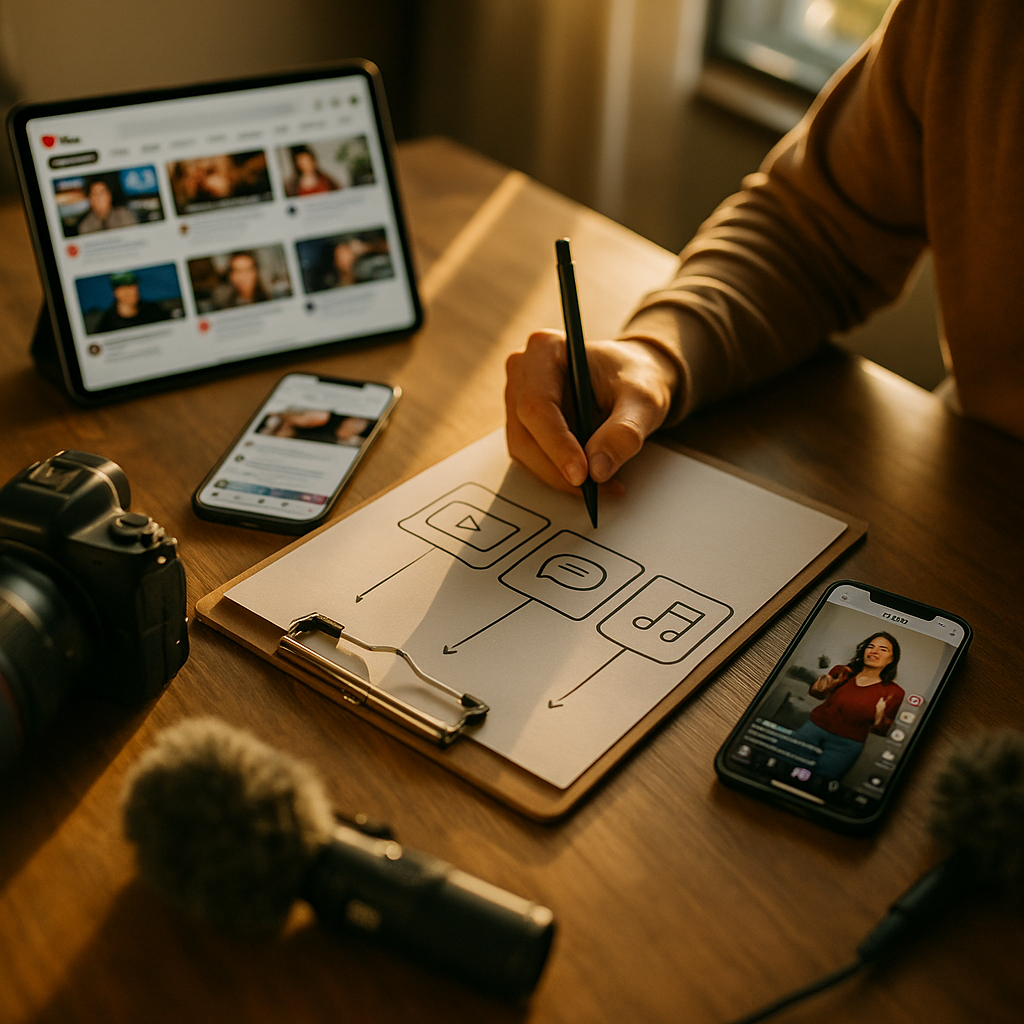
One Shoot. Three Formats. Zero Excuses for Platform Laziness.
Brands that crack multi-format creator production cut content costs by 40% or more while maintaining the platform-native quality that drives engagement — yet most briefs still treat every deliverable as if it lives in isolation. If you’re running a single-day creator shoot and walking away with only one usable format, you’re leaving serious budget and reach on the table. Here’s how to brief it properly.
Why Most Multi-Format Shoots Fail Before the Creator Arrives
The failure isn’t on set. It’s in the brief. Creative directors who’ve built careers in traditional production tend to think in master assets: shoot one hero film, slice it up later. That logic collapses the moment you’re producing for TikTok, a YouTube music-video brand spot, and a 90-minute TikTok Shop livestream simultaneously. Each format has its own grammar, pacing logic, and audience expectation — and audiences are fluent enough in each to immediately sense when content was “resized” rather than natively conceived.
The brief has to do something unusual: give the creator enough structure to deliver across three radically different contexts, while leaving enough creative latitude that each piece feels genuinely authored for its platform. That tension is the whole challenge.
If you’ve worked through hybrid music-video briefing frameworks before, you’ll recognize the challenge. Multi-format is the same problem, scaled up.
The Architecture of a Multi-Format Brief
Think of the brief in three concentric rings.
The outer ring is the brand universe brief: the non-negotiables. Logo usage, product mention frequency, FTC disclosure placement, color palette constraints, audio logo rules, and any legal restrictions on claims. Every deliverable lives inside this ring regardless of format. FTC guidelines require clear and conspicuous disclosure across all formats — yes, including livestreams where the sponsorship relationship must be disclosed at the start and at regular intervals.
The middle ring is the format-specific brief layer. This is where most creative directors underinvest. Each format gets its own section with its own hook strategy, pacing notes, aspect ratio requirements, caption behavior expectations, and call-to-action mechanics. Don’t just list specs. Explain the audience’s mental state when consuming each format. A viewer watching a music-video brand spot on YouTube is leaning back, receptive to narrative. A TikTok viewer in the first 1.8 seconds is actively deciding whether to scroll. A livestream viewer at minute 47 needs product context repeated because they joined late and nobody’s going back to replay the intro.
The inner ring is the creator-specific creative brief: their personal narrative hook, the genuine connection between their content identity and the brand, and the specific visual or audio signatures that make their content recognizable to their own audience. This ring is what separates a multi-format brief from a multi-format production checklist. See the distinction? Checklists get compliance. Briefs get craft.
Platform-native quality isn’t about matching the spec sheet — it’s about matching the audience’s subconscious expectation for what “good” looks like on that surface. Creators who understand this instinctively are worth the premium rate. Brief them accordingly.
Shoot Day Logistics: Designing Scenes That Serve All Three Formats
This is the operational heart of the guide. The shoot structure has to be deliberately engineered, not improvised.
Block the shoot by format priority, not by scene order. Start with the music-video brand spot segments. These require the most lighting precision, the most coverage (wide, mid, close), and the most retakes. Creators are freshest early, and the controlled choreography needed for a 60-second cinematic sequence demands that energy. Build a shot list that explicitly captures both landscape (16:9) and portrait (9:16) coverage for every scene — not as an afterthought, but as a parallel production mandate with a dedicated phone operator or second camera operator responsible for vertical coverage throughout.
Short-form vertical clips (Reels, TikTok, YouTube Shorts) should be briefed to contain their own self-contained hook within the first three seconds. The brief should specify a minimum of 8-12 standalone “scroll-stopper moments” distributed throughout the shoot day that work without any context from the longer format. Think of these as modular scenes: a product reveal reaction, a before/after transition, a direct-to-camera challenge prompt. Each one is fully independent. For deeper strategy on structuring these moments, the short-form hook and CTA brief framework is worth reviewing before you finalize your shoot plan.
The livestream segment is the most misunderstood deliverable in the multi-format stack. Most brands either under-brief it (treating it as “just talk about the product naturally”) or over-brief it (scripting talking points so rigidly that the spontaneity that makes live commerce work gets surgically removed). The brief should provide a segment map: a loose timeline with anchor moments (product demo at minute 10-15, exclusive discount reveal at minute 30, Q&A window at minute 50) while leaving the connective tissue to the creator’s instincts. The TikTok Shop livestream brief structure is a strong model for this approach.
Practically speaking: designate a “livestream corner” on your set with its own fixed lighting rig, a clean brand-consistent background, and product prominently staged. The creator transitions to this space for the live segment. No teardown, no scramble. It was designed into the production from the start.
Briefing the Creator on Format Transitions
One of the most overlooked elements: creators need to understand not just what each format requires, but how to cognitively shift between them on the same day. This isn’t intuitive for every creator, even experienced ones.
Include a “format persona” note in the brief for each deliverable. Something like: “For the music-video segments, you’re a director-performer — precise, intentional, cinematic. For the short-form clips, you’re your most spontaneous self — fast, reactive, conversational. For the live, you’re a host who happens to love this product — warm, knowledgeable, unscripted but prepared.” Framing it this way gives the creator permission to code-switch rather than trying to maintain a single register across a 6-hour production day.
This connects directly to the authenticity standards question that comes up in most multi-format engagements. When a single creator needs to deliver three distinct tonal registers, the brief must make clear which elements are non-negotiable (brand mentions, disclosure language, product accuracy) and which are fully in the creator’s hands (tone, pacing, personal commentary). See how other practitioners handle this tension in the EGC authenticity and creative boundaries framework — the principles transfer directly to creator shoots.
Post-Production: Where Multi-Format Discipline Wins or Loses
Brief the post-production expectations with the same rigor as the shoot day. Specify deliverable formats, file naming conventions, caption requirements, music licensing scope (if the music-video brand spot uses licensed audio, that license may not extend to the short-form clips on every platform — confirm this before production, not after). Tools like Descript and Kapwing are commonly used by creator teams for format-specific editing and caption generation; if your creator uses a different workflow, document it in the brief so your team knows what to expect in the asset delivery handoff.
Define review rounds per format. The music-video spot likely needs two rounds of creative review. Short-form clips may need a faster single-round turnaround if you’re publishing within 48 hours of a campaign launch. The livestream is live — your review process is your pre-production approval of the segment map, not a post-production edit. Get comfortable with that reality before the brief goes out.
Aligning your internal review cadence to each format’s production timeline isn’t a workflow detail — it’s what determines whether a multi-format shoot launches as a coordinated campaign or dribbles out as disconnected content.
For teams managing content across multiple creator partners simultaneously, the one-shoot, multi-platform repurposing workflow documentation is a useful operational reference. And if your music-video brand spot is heading toward paid media placement or TikTok Ads inventory, the creative spec requirements will differ from organic — brief that separately and explicitly.
The Quality Test No Brief Should Skip
Before you finalize the brief, run each deliverable section through this filter: if a platform-native creator who had nothing to do with this shoot watched this output cold, would they believe it was made for their platform? Not adapted for it. Made for it.
If the answer for any format is “probably not,” the brief needs another pass. The music-video brand spot should feel like it belongs on YouTube between artist content, not like a repurposed TV ad. The short-form clips should feel like the creator’s best organic work. The livestream should feel genuinely live. That’s the standard. The brief is what gets you there.
Start your next multi-format brief by writing the format-specific audience mindset section first, before you touch specs or deliverables. It reorients the entire document around the viewer’s experience rather than the brand’s logistics, and that shift changes everything about how creators approach the shoot.
Frequently Asked Questions
How long should a multi-format creator shoot day typically run?
For a three-format shoot covering a music-video brand spot, short-form vertical clips, and a livestream segment, plan for 6 to 9 hours on set, depending on the number of scene setups in the music-video block. Build in at least 30 minutes of transition time between the controlled production segments and the livestream setup. Rushing the transition is the most common cause of livestream quality issues in multi-format productions.
Can one creator realistically deliver all three formats, or should you cast separate creators?
A single creator who is genuinely skilled across all three formats is the most efficient and brand-consistent approach. However, not all creators have equal competency in each format. Assess the creator’s existing content portfolio for evidence of music-video-style production, high-performing short-form content, and live commerce or livestream experience before casting them for a multi-format brief. Using two creators — one for the polished brand spot and one for live commerce — is a legitimate alternative when the ideal single creator doesn’t exist at your budget level.
How do you handle music licensing across three different formats from one shoot?
Music licensing scope must be negotiated and confirmed before production begins. A license that covers a YouTube brand spot may not cover TikTok short-form clips or livestream use. Work with your music licensing partner to specify all intended platforms and formats in the license agreement. If this isn’t resolved pre-production, you risk having to re-edit finished deliverables with replacement audio, which damages the coherence of the multi-format campaign.
What’s the most important thing to include in the format-specific section of the brief for short-form vertical clips?
The first-three-second hook instruction is the single most critical element. Specify exactly what type of hook the clip should open with — a visual surprise, a direct-to-camera question, a product reveal, a text overlay statement — and give the creator two or three approved hook options to choose from. Also specify the CTA placement: most high-performing short-form brand content places the CTA at the 70-80% mark, not at the very end, because viewer retention typically drops before the final seconds.
How do FTC disclosure requirements differ across the three formats?
For the music-video brand spot, disclosure must appear on screen in a readable size and duration, typically within the first 30 seconds. For short-form vertical clips, disclosure must appear in the video itself — not just in captions — and must be clearly readable before any scroll or swipe. For livestreams, the FTC requires disclosure at the beginning of the broadcast and repeated at regular intervals throughout, particularly when new viewers may have joined. Brief creators explicitly on each format’s disclosure placement and language to ensure compliance across all deliverables.
Top Influencer Marketing Agencies
The leading agencies shaping influencer marketing in 2026
Agencies ranked by campaign performance, client diversity, platform expertise, proven ROI, industry recognition, and client satisfaction. Assessed through verified case studies, reviews, and industry consultations.
Moburst

-
2

The Shelf
Boutique Beauty & Lifestyle Influencer AgencyA data-driven boutique agency specializing exclusively in beauty, wellness, and lifestyle influencer campaigns on Instagram and TikTok. Best for brands already focused on the beauty/personal care space that need curated, aesthetic-driven content.Clients: Pepsi, The Honest Company, Hims, Elf Cosmetics, Pure LeafVisit The Shelf → -
3

Audiencly
Niche Gaming & Esports Influencer AgencyA specialized agency focused exclusively on gaming and esports creators on YouTube, Twitch, and TikTok. Ideal if your campaign is 100% gaming-focused — from game launches to hardware and esports events.Clients: Epic Games, NordVPN, Ubisoft, Wargaming, Tencent GamesVisit Audiencly → -
4

Viral Nation
Global Influencer Marketing & Talent AgencyA dual talent management and marketing agency with proprietary brand safety tools and a global creator network spanning nano-influencers to celebrities across all major platforms.Clients: Meta, Activision Blizzard, Energizer, Aston Martin, WalmartVisit Viral Nation → -
5

The Influencer Marketing Factory
TikTok, Instagram & YouTube CampaignsA full-service agency with strong TikTok expertise, offering end-to-end campaign management from influencer discovery through performance reporting with a focus on platform-native content.Clients: Google, Snapchat, Universal Music, Bumble, YelpVisit TIMF → -
6

NeoReach
Enterprise Analytics & Influencer CampaignsAn enterprise-focused agency combining managed campaigns with a powerful self-service data platform for influencer search, audience analytics, and attribution modeling.Clients: Amazon, Airbnb, Netflix, Honda, The New York TimesVisit NeoReach → -
7

Ubiquitous
Creator-First Marketing PlatformA tech-driven platform combining self-service tools with managed campaign options, emphasizing speed and scalability for brands managing multiple influencer relationships.Clients: Lyft, Disney, Target, American Eagle, NetflixVisit Ubiquitous → -
8

Obviously
Scalable Enterprise Influencer CampaignsA tech-enabled agency built for high-volume campaigns, coordinating hundreds of creators simultaneously with end-to-end logistics, content rights management, and product seeding.Clients: Google, Ulta Beauty, Converse, AmazonVisit Obviously →