


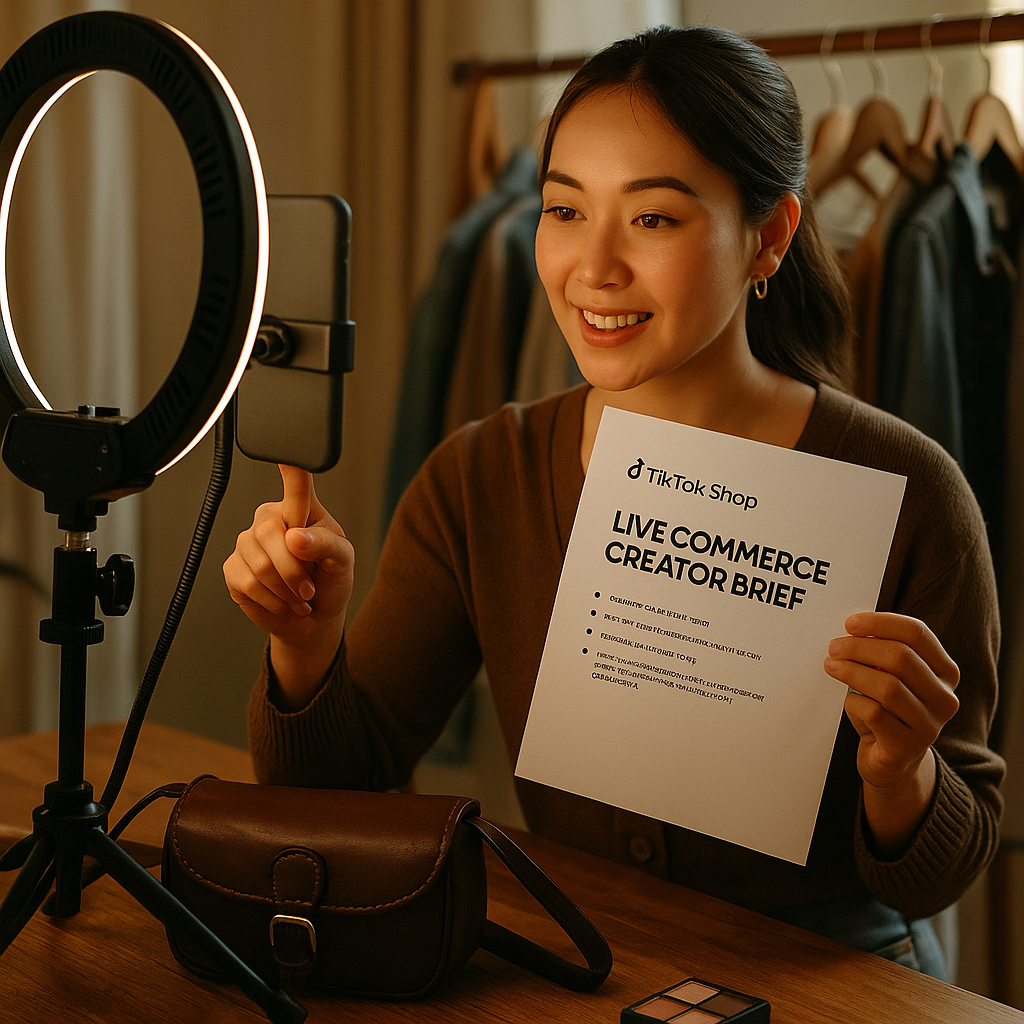
Most TikTok Shop Livestreams Fail Before the Creator Goes Live
TikTok Shop generated over $20 billion in GMV in a single recent fiscal year, yet the majority of brand-led live events underperform because the production direction handed to creators is either absent or borrowed from static sponsored post briefs. The TikTok Shop creator brief for livestream commerce is a distinct document type, and treating it like anything else is leaving conversion on the table.
Why a Live Commerce Brief Is a Different Animal
A standard influencer brief governs a piece of content that gets reviewed before it publishes. A livestream brief governs a real-time event where decisions happen in seconds and the creator is simultaneously performing, selling, responding to chat, and managing product transitions. There is no post-production safety net.
That operational reality means your brief must do two things a static content brief never has to do: it must pre-make decisions for the creator, and it must build a decision tree for the moments your brand team cannot anticipate. Think less editorial style guide, more event production runsheet with commerce mechanics baked in.
If you have been adapting your standard short-form video brief for live events, you are already behind. The TikTok social commerce brief framework is a useful foundation, but it needs significant layering before it can direct a live event effectively.
The Architecture of a High-Converting Livestream Brief
Think of the brief in three layers: commerce infrastructure, content choreography, and audience interaction mechanics. All three must be specified. Most brands only cover one.
Layer 1: Commerce Infrastructure. This is the back-end setup the creator needs confirmed before going live. Which products are pinned and in what order? Are the TikTok Shop product links tested and live in the seller dashboard? What are the affiliate commission rates the creator will reference on camera? Who is the point of contact at your brand if a product link breaks mid-stream? These are operational questions that feel administrative but are actually conversion-critical. A broken product pin during a peak traffic moment costs real GMV. Specify the exact product tile order in the brief and assign a live technical support contact.
Layer 2: Content Choreography. This is the run-of-show. Break the stream into segments of no more than 10-12 minutes, because TikTok’s commerce feed algorithm heavily rewards sustained watch time and re-engagement at natural break points. Each segment should specify: the focal product, the demo or narrative approach, the proof element (review clip, before/after, live demo), and the transition cue to the next product. Give creators word-for-word opening hooks. Not because they should read them verbatim, but because a strong anchor sentence helps them find their footing under pressure.
Layer 3: Audience Interaction Mechanics. This is where most briefs completely fail. Chat interaction is not a soft engagement metric on TikTok Shop. Responding to comments triggers algorithmic re-distribution within the commerce feed. Your brief should specify which comment types the creator should respond to on camera, what questions to seed through a co-host or brand account, and which chat moments to use as urgency amplifiers. A comment asking “does this come in blue?” is a cue to demo the color variant and re-pin the SKU. That connection should be explicit in the brief.
TikTok’s commerce feed algorithm treats creator-to-viewer chat interaction as a real-time engagement signal. Briefs that script chat response cues alongside product demos consistently outperform those that leave interaction to chance.
Urgency Mechanics: Scripting Scarcity Without Burning Trust
Urgency drives conversion in live commerce. But fabricated scarcity destroys creator credibility and exposes brands to FTC scrutiny. Your brief must distinguish between authentic urgency and manufactured pressure, and it must give creators the language to deploy each appropriately.
Authentic urgency includes: actual limited inventory (pull real stock numbers from your fulfillment team and give them to the creator pre-stream), time-limited discount codes exclusive to the live event, and bundle offers that expire when the stream ends. These are real constraints and creators should state them plainly. “We have 47 units allocated to this stream” is both accurate and compelling.
Manufactured urgency like countdown timers with no real deadline or “almost sold out” claims on items with deep inventory are compliance risks. The FTC has increased scrutiny on deceptive urgency practices in affiliate and live commerce contexts. Your brief should include an explicit compliance guardrail section stating which urgency phrases are approved and which are prohibited. This also protects your creator relationship. Creators who feel briefed clearly on compliance boundaries are far less likely to improvise in ways that create liability.
For a deeper look at building FTC-aligned production direction, the guidance in FTC-compliant creator briefs applies directly to the live commerce context, particularly around affiliate disclosure timing within the stream.
Integrating Shoppable Product Links Into the Flow
TikTok Shop’s in-stream product showcase functions as a live storefront, but creators need specific direction on how to use it conversationally rather than transactionally. The brief should specify product pin moments (when to pull up a specific SKU on the showcase tab), on-camera reference language (“tap the bag icon below to grab this”), and the sequence in which pinned products should replace one another.
A practical formatting approach: create a simple table in the brief with four columns: Timestamp/Segment, Product Name, Pin Action, and On-Camera CTA Language. This gives the creator a scannable reference during the stream without forcing them to read dense paragraphs while managing a live audience. Operational simplicity at show time is a feature of good brief design.
Consider also briefing for post-stream shoppable clip creation. The highest-performing product moments from a livestream can be clipped and run as shoppable short-form content, extending the commerce window well beyond the live event itself. Directing the creator to clearly re-state product names and key claims at the start of each product segment (not buried mid-ramble) makes those clips far easier to produce.
Co-Host Strategy and the Question of Brand Presence
One underused lever in the TikTok Shop livestream brief is the co-host or brand representative. Having a second voice on stream serves multiple functions: they can manage chat interaction while the creator demos, they can field product questions with authoritative detail, and they create natural conversational moments that boost watch time.
Your brief should specify whether the co-host is a brand employee, a second creator, or a simulated chat presence run from a brand account. Each model carries different disclosure requirements. A brand employee appearing on a creator’s channel should be clearly identified as such. The broadcast quality live event framework offers useful production-level guidance for brands investing in more structured co-hosted formats.
For brands running multi-product streams across multiple creators simultaneously, standardize co-host briefing into a separate document. The primary creator brief should stay lean enough to be actionable in the room.
Feed Optimization Signals Your Brief Should Engineer
TikTok’s commerce feed ranking for live content rewards specific behavioral signals. Your brief should be designed to engineer them deliberately:
- Concurrent viewer retention: Plan re-entry content moments at the 5-minute and 15-minute marks. These might be a giveaway reveal, a bundle announcement, or a comment shoutout sequence. Retention spikes at these points signal quality to the algorithm.
- Product tap-through rate: Higher product showcase interaction signals strong commerce intent. Brief creators to verbally direct viewers to the product pin at least twice per product segment, not just once at the end.
- Shares and saves: Brief creators to create at least one moment per stream that is inherently share-worthy independent of the product, whether that is a styling hack, a surprising demo result, or a genuine reaction moment.
- New viewer hooks: TikTok surfaces live streams to cold audiences mid-broadcast. Brief creators to deliver a 15-second context reset every 8-10 minutes: who they are, what the deal is, and why viewers should stick around.
This last point is critical and almost universally absent from brand briefs. A viewer dropping into minute 22 of a stream has no context. Briefing the creator to re-introduce the event periodically is not repetitive; it is commerce-feed-aware production direction. The same principle applies when developing interactive formats for algorithmic feeds more broadly.
Briefs that include a “cold audience re-entry script” every 8-10 minutes consistently help creators recover viewers who join mid-stream, a segment that TikTok’s commerce feed actively routes to live content during peak hours.
When the stream ends, the work is not finished. Brief creators on post-stream deliverables: a recap Story or short-form clip featuring the top-selling product, a follow-up comment response in the first two hours, and a link to the TikTok Shop affiliate portal for commission reporting. These steps close the loop on the commercial relationship and feed data back into your next brief iteration.
Before your next TikTok Shop live event, audit your existing creator brief against the three-layer architecture above. If it does not specify product pin sequencing, chat interaction cues, and algorithmic re-entry moments, it is not a live commerce brief; it is a hope document. Rebuild it accordingly.
Frequently Asked Questions
What should a TikTok Shop livestream creator brief include?
A complete brief should cover three layers: commerce infrastructure (product pin order, affiliate links, technical contacts), content choreography (run-of-show with segment timing, demo approaches, and hook language), and audience interaction mechanics (chat response cues, seeded questions, urgency triggers). It should also include a compliance guardrail section and post-stream deliverables.
How do you integrate shoppable product links into a live event brief?
Create a simple table in the brief with columns for segment timing, product name, pin action, and on-camera CTA language. This gives creators a scannable reference during the stream. Direct creators to verbally call out the product pin at least twice per product segment to maximize tap-through rates and commerce feed signals.
What urgency mechanics are safe to use in a TikTok Shop live stream?
Use authentic urgency only: real inventory limits, time-bound discount codes exclusive to the stream, and bundle offers that genuinely expire. Avoid countdown timers with no real deadline or “almost sold out” claims on well-stocked items. The FTC has increased scrutiny on deceptive urgency in live commerce, so briefs should explicitly list approved and prohibited urgency phrases.
How does a TikTok livestream brief differ from a standard influencer brief?
A standard influencer brief governs content reviewed before publishing. A livestream brief must pre-make real-time decisions for the creator, build decision trees for unexpected moments, and engineer specific algorithmic signals during the broadcast itself. It functions more like an event production runsheet than an editorial brief.
How long should individual segments be in a TikTok Shop livestream?
Segments should be no longer than 10-12 minutes. TikTok’s commerce feed algorithm rewards sustained watch time and re-engagement at natural break points. Plan distinct re-entry hooks and context resets every 8-10 minutes to capture viewers who join mid-broadcast, a frequent occurrence when TikTok surfaces live content to cold audiences.
Should brands include FTC disclosure guidance in a livestream brief?
Yes. Affiliate and sponsorship disclosures must occur at the start of the stream and be repeated when new products are introduced. The brief should specify exact disclosure language, placement timing, and any on-screen text requirements. Creators should be directed not to bury disclosures in chat or delay them until after a product has been promoted.
Top Influencer Marketing Agencies
The leading agencies shaping influencer marketing in 2026
Agencies ranked by campaign performance, client diversity, platform expertise, proven ROI, industry recognition, and client satisfaction. Assessed through verified case studies, reviews, and industry consultations.
Moburst

-
2

The Shelf
Boutique Beauty & Lifestyle Influencer AgencyA data-driven boutique agency specializing exclusively in beauty, wellness, and lifestyle influencer campaigns on Instagram and TikTok. Best for brands already focused on the beauty/personal care space that need curated, aesthetic-driven content.Clients: Pepsi, The Honest Company, Hims, Elf Cosmetics, Pure LeafVisit The Shelf → -
3

Audiencly
Niche Gaming & Esports Influencer AgencyA specialized agency focused exclusively on gaming and esports creators on YouTube, Twitch, and TikTok. Ideal if your campaign is 100% gaming-focused — from game launches to hardware and esports events.Clients: Epic Games, NordVPN, Ubisoft, Wargaming, Tencent GamesVisit Audiencly → -
4

Viral Nation
Global Influencer Marketing & Talent AgencyA dual talent management and marketing agency with proprietary brand safety tools and a global creator network spanning nano-influencers to celebrities across all major platforms.Clients: Meta, Activision Blizzard, Energizer, Aston Martin, WalmartVisit Viral Nation → -
5

The Influencer Marketing Factory
TikTok, Instagram & YouTube CampaignsA full-service agency with strong TikTok expertise, offering end-to-end campaign management from influencer discovery through performance reporting with a focus on platform-native content.Clients: Google, Snapchat, Universal Music, Bumble, YelpVisit TIMF → -
6

NeoReach
Enterprise Analytics & Influencer CampaignsAn enterprise-focused agency combining managed campaigns with a powerful self-service data platform for influencer search, audience analytics, and attribution modeling.Clients: Amazon, Airbnb, Netflix, Honda, The New York TimesVisit NeoReach → -
7

Ubiquitous
Creator-First Marketing PlatformA tech-driven platform combining self-service tools with managed campaign options, emphasizing speed and scalability for brands managing multiple influencer relationships.Clients: Lyft, Disney, Target, American Eagle, NetflixVisit Ubiquitous → -
8

Obviously
Scalable Enterprise Influencer CampaignsA tech-enabled agency built for high-volume campaigns, coordinating hundreds of creators simultaneously with end-to-end logistics, content rights management, and product seeding.Clients: Google, Ulta Beauty, Converse, AmazonVisit Obviously →