


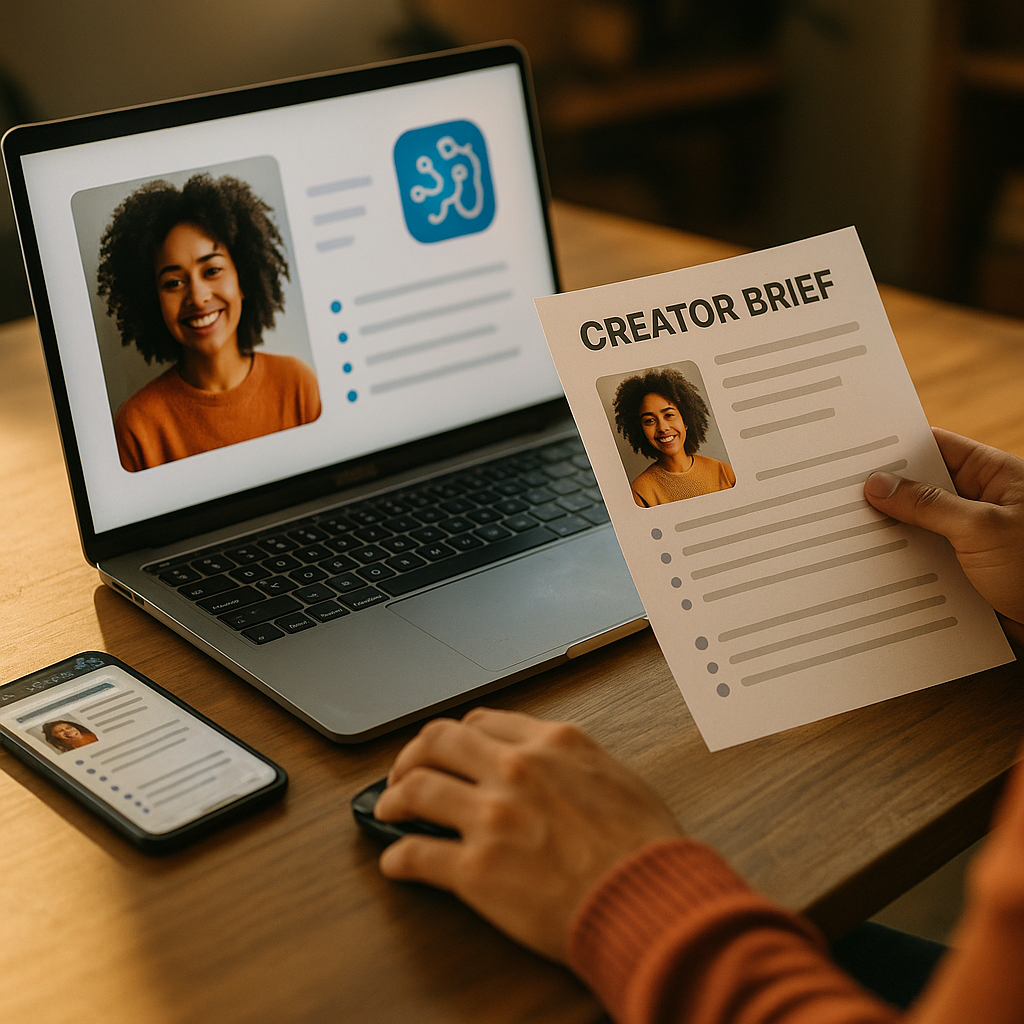
If your team is managing 50-plus creators per campaign, you already know the dirty secret: most of them get the same brief with their name swapped in. Generative AI is changing that. AI-powered creative brief generation now lets brand teams produce deeply personalized briefs for every creator in a program without rebuilding the wheel for each one.
The Brief Bottleneck Nobody Talks About
Scale kills personalization. That’s the core tension in every high-volume creator program. A beauty brand running 200 micro-creators across TikTok, Instagram, and YouTube cannot feasibly write tailored briefs for each — not without a team of 10 coordinators and a two-week production cycle. So they don’t. They send a generic master brief and hope creators translate it into something authentic.
That hope is expensive. Research from Sprout Social consistently shows that creator content performing in the top quartile for engagement rates is almost always content where the creator’s natural voice is preserved. Generic briefs squeeze out that voice. The result: on-brand but underperforming content.
Generative AI solves the production side of personalization. What used to take a coordinator 45 minutes per creator (reviewing their content history, noting their tone, flagging relevant audience demographics) can now be done in under 90 seconds at any volume.
How the Architecture Actually Works
The smart implementation isn’t “dump your master brief into ChatGPT and ask it to rewrite for each creator.” That produces shallow variation. The better approach is a structured prompt pipeline with three layers:
- Layer 1: The Campaign Core Object. This is your immutable campaign logic — brand voice rules, mandatory disclosures (per FTC guidelines), key message pillars, product claims that legal has approved, and conversion objectives. Nothing in this layer changes per creator.
- Layer 2: The Creator Context Object. Pulled from your creator CRM or platform data, this includes the creator’s typical content format, their audience demographics, historical engagement by content type, tone descriptors, and any prior brand history. Tools like Grin, Aspire, and Creator.co all export this data via API or CSV.
- Layer 3: The Variation Logic. The AI uses Layer 2 inputs to adapt Layer 1 outputs — adjusting the hook suggestion, recommended format, example talking points, and even the CTA phrasing based on what has historically worked for that creator’s audience.
The output is a brief that feels handwritten. The creator sees language calibrated to their style and platform. They see example hooks that sound like them, not like a brand press release. And critically, every single brief still contains the same approved product claims and compliance language.
The goal isn’t AI replacing your creative team. It’s AI doing the repeatable personalization work so your team can focus on the 10% of briefs that need genuine human creativity and strategic judgment.
For brands thinking about the broader content infrastructure, the alignment between AI-generated briefs and faster creative timelines is where the real efficiency gains compound.
Coherence Is the Real Risk — Here’s How to Protect It
The fear every brand manager has when they hear “AI-generated brief variations” is brand dilution. If every creator gets a different brief, will the campaign still read as a coherent campaign? Valid concern. Poorly implemented, yes, it can fracture your message.
The fix is what practitioners are calling a “message spine.” Before any AI variation begins, the team codifies three to five non-negotiable message elements that must appear in every brief, in every variation. These aren’t suggestions — they’re required fields the AI is explicitly instructed to preserve verbatim or in direct paraphrase.
Think of it like a franchise model. Every McDonald’s looks different depending on its location and local market context, but the Quarter Pounder ingredients never change. Your campaign’s message spine is the Quarter Pounder. The creator-specific framing is the local decor.
Operationally, this means your prompt template should include a hard constraint block: “The following phrases must appear in the output without modification.” Your legal-approved product descriptor goes there. Your required disclosure format goes there. Your campaign hashtag or CTA URL goes there.
This is also where the connection to LLM-compatible brief structures becomes relevant — because as AI shopping assistants increasingly surface creator content in recommendations, the structured language in your brief directly influences how that content gets interpreted downstream.
Tooling and Workflow Considerations
You don’t need a custom-built system to start. Several enterprise-grade options are worth evaluating:
- GPT-4o or Claude 3.5 Sonnet via API with a structured prompt template stored in your system. Cost-effective at scale and highly controllable.
- Jasper AI with brand voice training. Better for teams that want a UI rather than raw API access, and it integrates with some creator platforms.
- Typeface or Writer for brand compliance guardrails baked in. These platforms are specifically designed for marketing teams that need AI output to stay within brand and legal parameters.
Whatever tool you choose, the critical workflow step that most teams skip: human review at the brief level, not the campaign level. Don’t review one output and assume the other 199 are fine. Build a sampling protocol — review 10-15% of briefs per campaign, with mandatory review for any creator with over 500K followers (the stakes are higher) and any creator in a regulated category like finance, health, or supplements.
For teams building out the measurement side of this, a proper AI attribution pipeline helps you close the loop between brief variation quality and actual content performance — so you can iterate your prompt templates based on real outcome data.
The Personalization Variables That Move Performance
Not all brief personalization is created equal. Based on practitioner feedback across programs, the variables that actually change creator performance fall into a short list:
- Hook format: Some creators are strong on question-led openers, others on bold statement or visual-first hooks. Briefing them with a hook style that matches their historical content style improves their starting point significantly.
- Tone calibration: “Conversational and slightly irreverent” versus “authoritative and educational” are not minor adjustments. They change how a creator approaches the entire script.
- Platform-specific format guidance: A TikTok brief and a YouTube brief for the same creator should look fundamentally different even when the campaign message is identical. Many generic briefs ignore this.
- Audience pain point framing: If the AI has ingested the creator’s audience data, it can frame the product’s benefit in terms of the specific concerns that audience actually expresses in comments — which is far more persuasive than a generic brand benefit statement.
The data backs this up. HubSpot’s marketing research has repeatedly shown that audience-specific messaging outperforms generic messaging by significant margins in conversion contexts. Creator content is no different.
What AI Cannot (Yet) Replace in Brief Creation
Strategic intuition. When a campaign has a genuinely unusual angle, when you’re navigating a sensitive cultural moment, or when a creator relationship is complex enough that the brief needs to account for unspoken dynamics, AI won’t catch that. It generates competent variations from the inputs it’s given. It does not know what you didn’t tell it.
The brief for your anchor creator — your top-tier partnership with a creator who has deep audience trust and a differentiated content style — should still be written or heavily edited by a human strategist. The AI handles the long tail. Humans protect the flagship.
There’s also the evolving question of how brief language intersects with AI training data. As brands begin thinking carefully about creator contracts and AI reach, the language you use in briefs and the content those briefs generate may have longer-tail implications than the campaign itself.
High-volume creator programs that personalize briefs with AI are not just solving an operational problem. They’re building a data asset — a growing library of what brief inputs produce which content outputs and performance outcomes.
For brands exploring how AI-generated brief structures interact with generative search surfaces, the work being done on GEO-optimized creator briefs is worth reviewing alongside your brief generation framework.
Finally, standardization of AI creative outputs across campaigns is becoming a governance priority. eMarketer has flagged AI governance in creative production as a top operational concern for large marketing organizations, which is exactly why your prompt templates, review protocols, and compliance constraints need to be documented and owned by someone accountable — not just living in a shared Google Doc.
Start by auditing one campaign’s briefs against a structured AI variation framework. Build your message spine, define your creator context variables, and run a pilot cohort of 20-30 creators before rolling out at full volume. The quality delta will make the investment obvious.
Frequently Asked Questions
What is AI-powered creative brief generation for creator programs?
AI-powered creative brief generation uses large language models to produce personalized brief variations for individual creators at scale. Rather than sending every creator the same document, brands feed creator-specific data (tone, audience demographics, content history) alongside a fixed campaign brief into an AI system, which outputs tailored briefs that preserve core campaign messaging while adapting format, hooks, and framing to each creator’s style.
How do brands maintain campaign message coherence when using AI to vary briefs?
The primary method is defining a “message spine” before AI generation begins: a set of non-negotiable message elements, approved product claims, disclosure language, and campaign CTAs that the AI is explicitly instructed to preserve in every output. These function as hard constraints in the prompt template, ensuring that personalization applies only to stylistic and format elements, not to the core campaign message.
Which AI tools work best for generating creator brief variations at scale?
Commonly used options include GPT-4o and Claude 3.5 Sonnet via API for maximum control and cost efficiency, Jasper AI for teams preferring a marketing-focused UI, and Writer or Typeface for organizations that need built-in brand compliance guardrails. The right choice depends on your team’s technical capacity, the need for compliance controls, and whether you want API-based or platform-based workflows.
What creator data inputs does AI need to personalize a brief effectively?
The most impactful inputs are: the creator’s typical content format (Reel, long-form video, carousel), their tone descriptors, historical engagement rates by content type, audience demographic profile, and any previous brand collaboration notes. Most creator management platforms like Grin, Aspire, or Creator.co can export this data. The richer the context object, the more precise the AI’s personalization.
Should human reviewers still check AI-generated briefs before they go to creators?
Yes, always. The recommended practice is a sampling protocol where 10-15% of briefs are reviewed per campaign, with mandatory human review for high-reach creators (500K+ followers) and any creator in regulated categories like health, finance, or supplements. AI generates at scale; humans protect quality, legal compliance, and relationship nuance at the points where stakes are highest.
How does brief personalization impact creator content performance?
Personalized briefs improve performance primarily by preserving the creator’s authentic voice and working within their established content style. Creators briefed with hook formats and tone guidance that match their natural style tend to produce higher-engagement content because the output feels native to their audience rather than branded. Platform-specific format guidance within briefs also reduces friction and improves execution quality.
Top Influencer Marketing Agencies
The leading agencies shaping influencer marketing in 2026
Agencies ranked by campaign performance, client diversity, platform expertise, proven ROI, industry recognition, and client satisfaction. Assessed through verified case studies, reviews, and industry consultations.
Moburst

-
2

The Shelf
Boutique Beauty & Lifestyle Influencer AgencyA data-driven boutique agency specializing exclusively in beauty, wellness, and lifestyle influencer campaigns on Instagram and TikTok. Best for brands already focused on the beauty/personal care space that need curated, aesthetic-driven content.Clients: Pepsi, The Honest Company, Hims, Elf Cosmetics, Pure LeafVisit The Shelf → -
3

Audiencly
Niche Gaming & Esports Influencer AgencyA specialized agency focused exclusively on gaming and esports creators on YouTube, Twitch, and TikTok. Ideal if your campaign is 100% gaming-focused — from game launches to hardware and esports events.Clients: Epic Games, NordVPN, Ubisoft, Wargaming, Tencent GamesVisit Audiencly → -
4

Viral Nation
Global Influencer Marketing & Talent AgencyA dual talent management and marketing agency with proprietary brand safety tools and a global creator network spanning nano-influencers to celebrities across all major platforms.Clients: Meta, Activision Blizzard, Energizer, Aston Martin, WalmartVisit Viral Nation → -
5

The Influencer Marketing Factory
TikTok, Instagram & YouTube CampaignsA full-service agency with strong TikTok expertise, offering end-to-end campaign management from influencer discovery through performance reporting with a focus on platform-native content.Clients: Google, Snapchat, Universal Music, Bumble, YelpVisit TIMF → -
6

NeoReach
Enterprise Analytics & Influencer CampaignsAn enterprise-focused agency combining managed campaigns with a powerful self-service data platform for influencer search, audience analytics, and attribution modeling.Clients: Amazon, Airbnb, Netflix, Honda, The New York TimesVisit NeoReach → -
7

Ubiquitous
Creator-First Marketing PlatformA tech-driven platform combining self-service tools with managed campaign options, emphasizing speed and scalability for brands managing multiple influencer relationships.Clients: Lyft, Disney, Target, American Eagle, NetflixVisit Ubiquitous → -
8

Obviously
Scalable Enterprise Influencer CampaignsA tech-enabled agency built for high-volume campaigns, coordinating hundreds of creators simultaneously with end-to-end logistics, content rights management, and product seeding.Clients: Google, Ulta Beauty, Converse, AmazonVisit Obviously →