


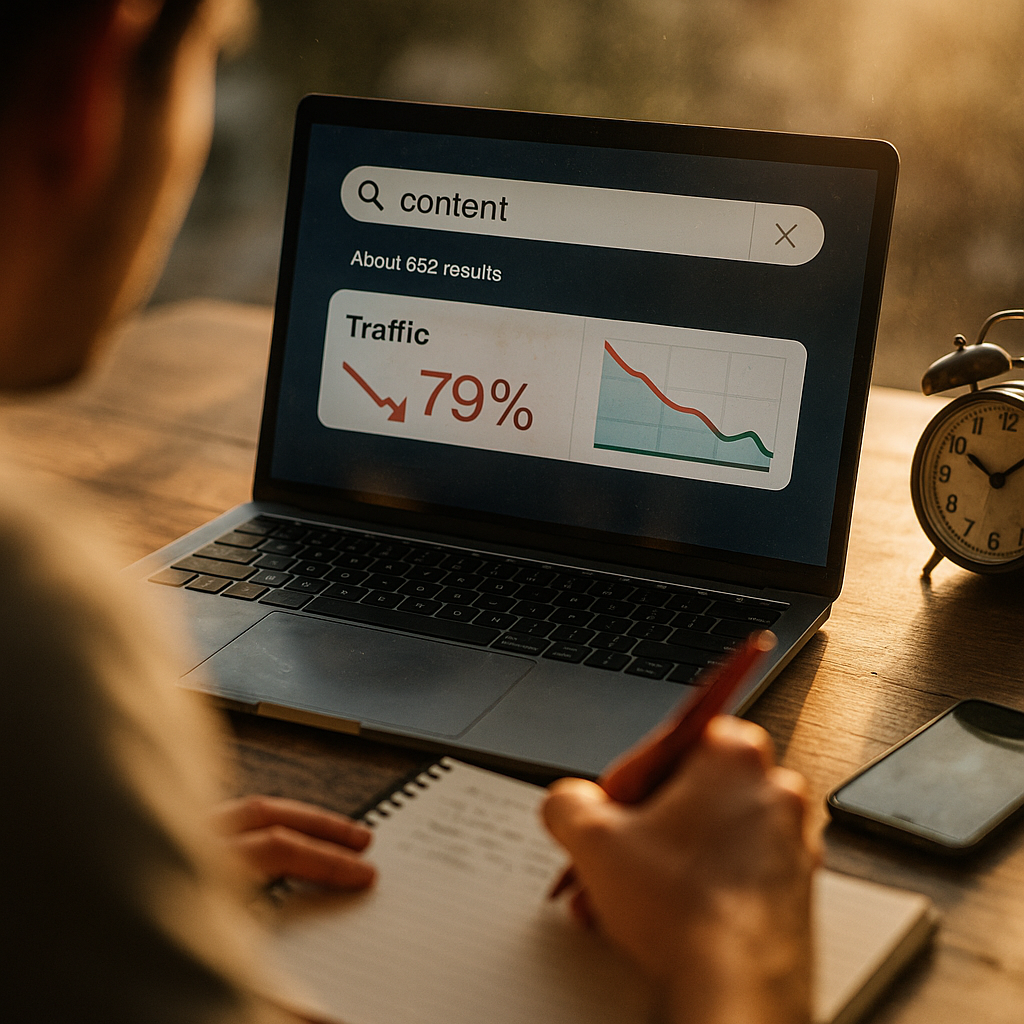
Content older than 90 days is 3.4 times less likely to surface in local AI recommendations, according to a July survey of AI search visibility across ten metro markets. If your team still treats content publishing as a one-and-done exercise, that stat should worry you. Fresh content in AI search isn’t a nice-to-have anymore — it’s the primary lever separating brands that get cited from brands that get ignored.
The survey tracked how often local businesses appeared in AI-generated recommendations across ChatGPT, Gemini, and Perplexity when users asked location-based questions — “best dentist near me,” “top-rated HVAC company in Austin,” that kind of query. The findings should reshape how brand and agency teams think about content calendars, budget allocation, and what “done” actually means for a content asset.
The Core Finding: Decay Happens Faster Than Anyone Expected
Marketers have known about content decay in traditional SEO for years. Rankings slip, traffic fades, you refresh the page, rankings recover. Slow cycle, predictable pattern. AI search doesn’t work that way.
The July survey found that local business content loses AI recommendation visibility within 60-90 days of publication if left untouched, compared to a 6-12 month decay window typical in classic organic search. Why the compressed timeline? Large language models weight recency heavily when synthesizing local recommendations, partly because they’re trying to avoid citing stale business hours, discontinued services, or outdated pricing — all common failure points that erode user trust in AI answers.
Businesses that updated core location and service pages at least once every 30 days captured 2.8x more AI-driven recommendation mentions than those updating quarterly or less, per the survey’s cross-market analysis.
That’s not a marginal edge. That’s the difference between being the answer and being invisible.
Why AI Engines Punish Stale Pages Harder Than Google Does
Traditional search engines cache and reindex, but they still surface older content if it’s authoritative and well-linked. An AI engine generating a conversational answer has a different job: it’s synthesizing a single recommendation from potentially dozens of sources, and it needs confidence that the facts it’s citing are current.
Think about it from the model’s perspective. If it recommends a restaurant that closed six months ago, that’s a visible, embarrassing failure. So the systems are tuned — whether through retrieval-augmented generation pipelines or training data recency weighting — to favor sources with clear, recent timestamps and updated structured data.
This matters enormously for local and multi-location brands. A national retailer with 400 store pages can’t just publish once and forget it. Each location page is a live data point that AI engines are constantly re-evaluating for freshness signals: last-modified dates, updated hours, new reviews, revised service lists.
This is closely related to the identity and structure problems we’ve covered before. If your content structure doesn’t help AI overviews quote your brand, freshness alone won’t save you. But freshness without structure is equally wasted effort.
What “Update Cadence” Actually Means in Practice
Here’s where a lot of teams get it wrong. Updating content doesn’t mean padding a page with fluff to bump the modified date. AI engines (and increasingly, savvy users) can tell the difference between substantive updates and cosmetic ones.
The survey’s methodology flagged three update types that correlated with sustained AI visibility:
- Factual refresh: hours, pricing, staff, service availability, inventory — anything that changes the operational truth of the business.
- Evidence refresh: new reviews, testimonials, case studies, or before/after content that signals ongoing activity.
- Structural refresh: updated schema markup, FAQ blocks answering newly common queries, revised headings that match how people are actually asking questions in voice and chat interfaces.
Pages that received all three update types monthly outperformed pages receiving only cosmetic date changes by a wide margin — the survey pegged it at roughly 4x more AI citation events over the 90-day tracking window.
None of this is a new discipline for teams who’ve already invested in generative engine optimization. It’s the same logic behind feeding AI engines a trusted identity signal — the freshness cadence just adds a time dimension to the trust equation.
The Budget Conversation No One Wants to Have
Let’s talk ROI, because that’s ultimately what gets this prioritized or deprioritized. Content refresh cycles cost money — writer hours, review cycles, publishing ops, sometimes agency retainers. Leadership will ask: is monthly cadence really worth it, or is quarterly good enough?
Based on the decay curve in this survey, quarterly is close to useless for AI search specifically. A page updated every 90 days spends most of its life in the “stale” zone where AI recommendation engines have already deprioritized it. You’re paying for the refresh but missing most of the visibility window.
The more efficient model, and the one several enterprise marketing teams are quietly shifting toward, is a tiered cadence:
- High-value local pages (top revenue-driving locations, flagship service pages): updated every 2-4 weeks.
- Mid-tier pages (secondary locations, supporting service content): updated every 6-8 weeks.
- Long-tail pages (archival, low-traffic locations): updated quarterly, with a lighter-touch factual check.
This isn’t dramatically different from how smart teams already prioritize CAC-focused resource allocation in influencer and paid programs. You put the update budget where the revenue is, not where it’s evenly distributed.
Operationalizing This Without Burning Out Your Content Team
Here’s the honest part: most content teams are already stretched thin. Adding a monthly refresh obligation on top of net-new content production sounds great in a strategy deck and terrible in a resourcing meeting.
A few practical fixes that surveyed brands reported using:
- Automate the factual layer. Hours, pricing, inventory status — these should sync from a single source of truth (your CRM or POS system) rather than being manually edited on every page. This is the same unified-data principle explored in GEO’s dependency on a unified source of truth.
- Use small language models for lightweight rewrites. You don’t need a flagship LLM to refresh an FAQ block or rephrase a service description. Teams report meaningful cost savings running these tasks through smaller, fine-tuned models, echoing findings from our piece on cutting marketing copy costs with smaller models.
- Build a prompt library for recurring update tasks so the same refresh instructions aren’t reinvented every cycle. Governance matters here too — see how prompt library governance stops rework at scale.
- Set override triggers for anything AI-assisted before it publishes live, particularly on pages tied to compliance-sensitive claims like pricing or licensing.
None of this requires a headcount doubling. It requires rethinking the workflow so freshness is a system output, not a manual chore assigned to whoever has bandwidth that week.
What This Means for Multi-Location and Franchise Brands
Franchise and multi-location brands face the sharpest version of this problem. A single national brand might operate hundreds of location pages, each one a candidate for AI recommendation — and each one a liability if left stale.
The survey noted that franchise brands with centralized content operations (one team managing update cadence across all locations) significantly outperformed franchises where individual location owners were responsible for their own page updates. Consistency mattered more than individual initiative.
That’s a governance question as much as a content question. Who owns the update calendar? Who audits it? What’s the escalation path when a location’s page goes six weeks without a factual check? These aren’t glamorous questions, but they’re the ones separating brands that show up in AI answers from brands that don’t.
Independent verification of these patterns is limited so far since this is an emerging discipline, but the direction lines up with what analysts at eMarketer and Statista have been tracking regarding AI-assisted search adoption and local query behavior more broadly. Search platforms themselves, including guidance from Google Search Central, have also emphasized content freshness and structured data accuracy as ongoing ranking considerations, not one-time setup tasks.
The Uncomfortable Trade-off: Speed vs. Accuracy
There’s a tension worth naming honestly. Pushing teams toward faster update cycles increases the risk of errors slipping through — a wrong price, an outdated claim, a hallucinated detail if AI tools are doing the drafting. Regulatory scrutiny on AI-generated marketing content isn’t going away, and the FTC has been explicit that businesses remain liable for inaccurate claims regardless of whether a human or a model wrote them.
Speed without a verification layer just trades one risk (invisibility) for another (compliance exposure). The brands getting this right pair fast update cadence with lightweight but consistent human review, not full editorial cycles, but a real check before anything factual goes live.
Takeaway
Audit your top 20 revenue-driving local pages this week, check the last-modified date on each, and if any exceed 60 days, schedule a factual and structural refresh before month-end. That single action, repeated monthly, is the highest-leverage move available right now for AI search visibility.
Frequently Asked Questions
What counts as “fresh content” for AI search purposes?
Fresh content means pages with recently verified factual details (hours, pricing, services), recent evidence (reviews, testimonials), and updated structural elements (schema, FAQs). A changed timestamp alone without substantive edits typically doesn’t count.
How often should local business pages be updated to stay visible in AI recommendations?
The July survey found meaningful visibility gains at a 30-day update cadence for high-value pages, with 60-90 days being the point where AI recommendation visibility drops sharply for untouched content.
Does content decay affect all AI search platforms equally?
The survey tracked ChatGPT, Gemini, and Perplexity and found broadly similar decay patterns across all three, though exact thresholds varied slightly by platform based on how each sources and weights recency in its retrieval process.
Can automation handle content freshness without human review?
Automation works well for factual syncs pulled from a verified source of truth like a CRM or POS system, but any AI-assisted rewrite touching claims, pricing, or compliance-sensitive language should still pass through human verification before publishing.
Is update cadence more important than content quality for AI recommendations?
No, they work together. Stale, high-quality content still loses visibility over time, but frequent low-value updates don’t sustain citations either. The survey showed the strongest results came from combining substantive updates with consistent cadence.
Top Influencer Marketing Agencies
The leading agencies shaping influencer marketing in 2026
Agencies ranked by campaign performance, client diversity, platform expertise, proven ROI, industry recognition, and client satisfaction. Assessed through verified case studies, reviews, and industry consultations.
Moburst

-
2

The Shelf
Boutique Beauty & Lifestyle Influencer AgencyA data-driven boutique agency specializing exclusively in beauty, wellness, and lifestyle influencer campaigns on Instagram and TikTok. Best for brands already focused on the beauty/personal care space that need curated, aesthetic-driven content.Clients: Pepsi, The Honest Company, Hims, Elf Cosmetics, Pure LeafVisit The Shelf → -
3

Audiencly
Niche Gaming & Esports Influencer AgencyA specialized agency focused exclusively on gaming and esports creators on YouTube, Twitch, and TikTok. Ideal if your campaign is 100% gaming-focused — from game launches to hardware and esports events.Clients: Epic Games, NordVPN, Ubisoft, Wargaming, Tencent GamesVisit Audiencly → -
4

Viral Nation
Global Influencer Marketing & Talent AgencyA dual talent management and marketing agency with proprietary brand safety tools and a global creator network spanning nano-influencers to celebrities across all major platforms.Clients: Meta, Activision Blizzard, Energizer, Aston Martin, WalmartVisit Viral Nation → -
5

The Influencer Marketing Factory
TikTok, Instagram & YouTube CampaignsA full-service agency with strong TikTok expertise, offering end-to-end campaign management from influencer discovery through performance reporting with a focus on platform-native content.Clients: Google, Snapchat, Universal Music, Bumble, YelpVisit TIMF → -
6

NeoReach
Enterprise Analytics & Influencer CampaignsAn enterprise-focused agency combining managed campaigns with a powerful self-service data platform for influencer search, audience analytics, and attribution modeling.Clients: Amazon, Airbnb, Netflix, Honda, The New York TimesVisit NeoReach → -
7

Ubiquitous
Creator-First Marketing PlatformA tech-driven platform combining self-service tools with managed campaign options, emphasizing speed and scalability for brands managing multiple influencer relationships.Clients: Lyft, Disney, Target, American Eagle, NetflixVisit Ubiquitous → -
8

Obviously
Scalable Enterprise Influencer CampaignsA tech-enabled agency built for high-volume campaigns, coordinating hundreds of creators simultaneously with end-to-end logistics, content rights management, and product seeding.Clients: Google, Ulta Beauty, Converse, AmazonVisit Obviously →