


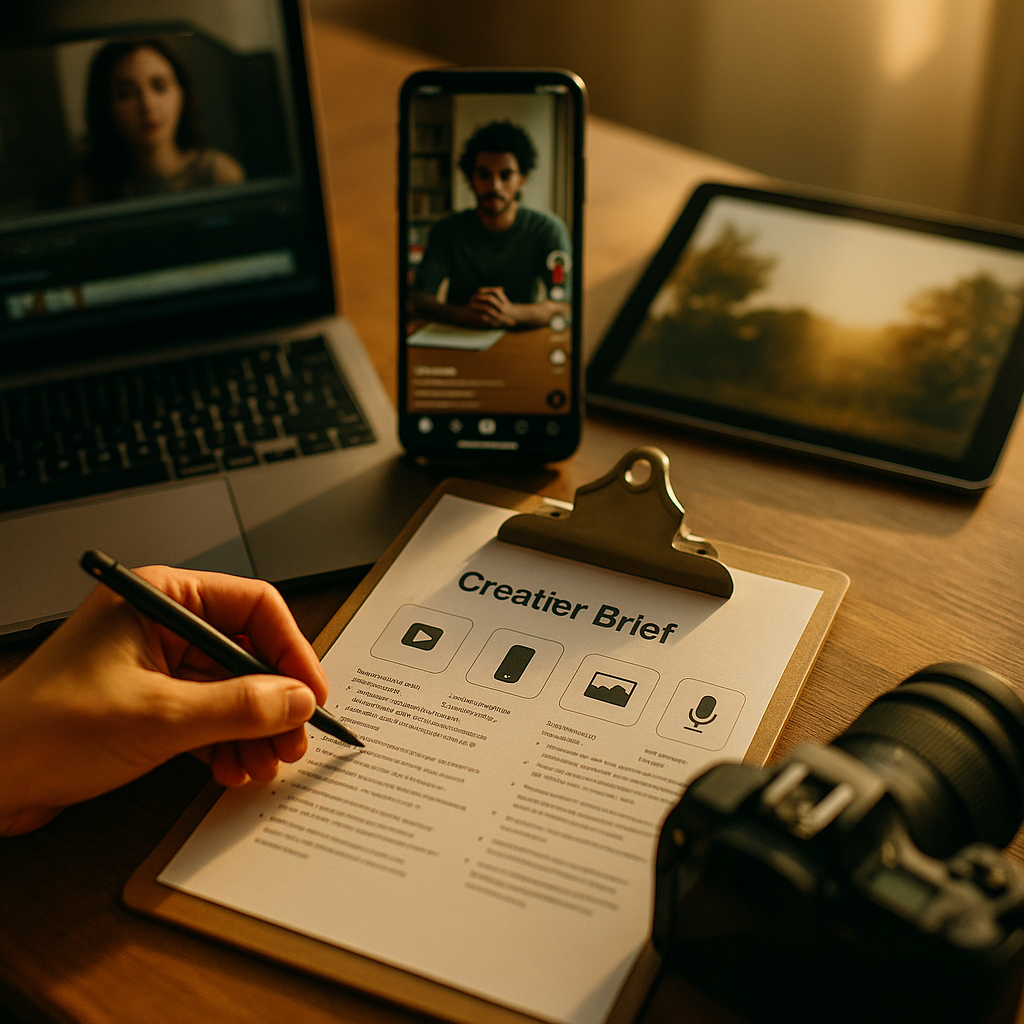
Brands running four separate creator briefs for four formats are burning budget they don’t need to spend. A single, well-architected brief can simultaneously produce a livestream, a video podcast segment, short-form vertical clips, and AI-generated asset variants — and most marketing teams have no idea how to build one.
Why Fragmented Audiences Broke the One-Format Model
The average consumer now splits attention across six or more platforms weekly, according to data tracked by Statista. That fragmentation isn’t a problem to solve — it’s a distribution reality to engineer around. The mistake most brand teams make is treating each platform as a discrete production event. A TikTok brief goes to one creator. A podcast brief goes to another. A livestream gets its own deck. By the time the campaign ships, you’ve tripled your coordination overhead and fragmented your brand message across four incompatible creative executions.
The smarter frame: every audience touchpoint is a format variant of the same core narrative. One campaign idea. One message architecture. Four distribution surfaces.
The Anatomy of a Multi-Format Master Brief
A multi-format brief isn’t a longer brief. It’s a more deliberately structured one. Think of it in three layers:
- Layer 1: The Campaign Core. Brand objective, messaging hierarchy, mandatory disclosures, and the single audience insight the whole campaign is built on. This layer doesn’t change across formats.
- Layer 2: Format Modules. Discrete sections that address the specific requirements of each distribution surface — aspect ratio, ideal duration, hook structure, CTA format, and platform-specific compliance notes.
- Layer 3: Asset Extraction Rules. Explicit instructions for which moments from the long-form execution get clipped, repurposed, or fed into AI generation workflows. This is the layer most brands skip entirely, and it’s the one that saves the most money.
When the brief is structured this way, a creator shooting a 45-minute livestream already knows exactly which 90-second segment becomes the TikTok clip, which talking-point block becomes the podcast mid-roll, and which visual moment gets flagged for AI asset generation. The creator isn’t making those decisions ad hoc. You are, in advance.
The brief is the production plan. If your creative brief doesn’t contain explicit asset extraction logic, you’re outsourcing production decisions to the creator — and paying for the inefficiency later.
Designing the Livestream-to-Short-Form Pipeline
Livestream is the richest source of repurposable content in a creator’s toolkit, and it’s chronically underused by brand teams who treat it as a one-and-done awareness play. For reaction livestream campaigns, the brief should pre-define three to five “clip moments”: structured narrative beats that a creator hits during the live session specifically because they’ll function as standalone short-form content post-broadcast.
Practically, this means briefing the creator to open with a 60-to-90-second product context segment (which becomes the TikTok hook), run a mid-stream demonstration or reaction segment (which becomes a Reels cut), and close with a direct-response moment (which becomes the YouTube Short with CTA overlay). None of this requires a separate shoot. It requires a brief that maps the live timeline to the post-production asset plan.
Platforms matter here. TikTok’s algorithm currently rewards content where the first three seconds contain motion and a spoken question. YouTube Shorts performs better with a declarative statement opener. Your brief should specify the clip’s opening line for each platform variant, not leave it to editing discretion. For deeper guidance on short-form hook architecture, the framework covered in short-form hook and CTA strategy applies directly here.
Integrating the Video Podcast Format
Video podcasts are now the fastest-growing creator format by advertiser spend, with eMarketer tracking consistent double-digit CPM growth among mid-tier video podcast audiences. The format’s value in a multi-format brief is its long-form credibility: a host-read integration inside a 40-minute video podcast carries far more persuasion weight than a 15-second pre-roll.
The integration challenge is structural. A podcast segment needs breathing room — a conversational setup, an organic brand mention, and a natural transition. That’s difficult to bolt onto a brief designed primarily around a livestream or short-form execution. The solution is to write the podcast segment as the “canonical” version of the brand message, then derive the shorter formats from it. If the host can articulate the full value proposition in a two-minute podcast segment, the 30-second TikTok version is a compression of that, not a separate creative idea.
For brands already investing in this format, the CPM benchmarks and brief structures outlined for hybrid video-podcast sponsorships provide a useful compliance and pricing baseline to layer into your multi-format budget model.
The AI Asset Variant Layer (Where Real Budget Savings Live)
This is where multi-format briefs generate the most measurable ROI. Once a creator has produced a livestream and a podcast segment, you have raw material: product demonstrations, spoken testimonials, visual B-roll, and on-camera reactions. AI generation tools, including platforms like Runway, Pika, and Adobe Firefly, can now take those raw assets and produce static ad variants, motion graphics, thumbnail options, and even localized versions with text overlay swaps at scale.
The brief’s asset extraction rules govern this layer. Specifically, the brief should identify: which product close-up moments are suitable for AI-enhanced static ads, which spoken lines are clearable for use in audio ads or AI voiceover remixes, and which visual backdrops can be extended or replaced by AI generation for platform-specific aspect ratios. This isn’t speculative technology. Brands running agile UGC operations at scale are already embedding these extraction rules directly into their creator agreements.
Legal clarity is non-negotiable here. Any brief that contemplates AI remixing of creator likeness, voice, or performance must include explicit licensing language covering those use cases. The FTC’s endorsement guidelines apply to AI-derived assets just as they do to original content: if an AI-generated image features a creator’s likeness promoting a product, the disclosure requirements follow the asset wherever it’s distributed.
AI asset generation doesn’t eliminate the need for creative strategy. It amplifies whatever creative decisions were made at the brief stage — good or bad.
Budget Architecture: One Brief, Four Formats
The economic case is straightforward. A typical influencer campaign with four separate format executions requires four separate talent fees, four sets of usage rights negotiations, four production coordination cycles, and four rounds of approval. A single multi-format brief consolidates talent fees into one negotiation (with a format premium baked in), streamlines approval to one creative review cycle, and generates all four format outputs from a single production event.
The format premium is real but manageable. Expect to pay a creator 30-50% above their single-format rate when asking for multi-format output. That delta is still significantly cheaper than four separate engagements, and it simplifies the contractual overhead considerably. Tools like Sprout Social and creator management platforms like Grin or Aspire can help track deliverable compliance across format variants without manual status-chasing.
One operational note: approval workflows need to account for format-specific compliance requirements simultaneously. A legal team reviewing a multi-format brief should be reviewing the livestream disclosure protocol, the podcast host-read language, the short-form hashtag compliance, and the AI asset licensing terms in a single pass. Staggered approvals by format are where timelines collapse. For teams handling reactive content alongside scheduled campaigns, the 60-second approval frameworks built for real-time content offer adaptable governance models.
What a Multi-Format Brief Actually Looks Like in Practice
Here’s a condensed example. A consumer electronics brand runs a product launch campaign with a single mid-tier creator. The master brief specifies: a two-hour product unboxing and review livestream on YouTube (with three pre-mapped clip moments flagged in the timeline); a 12-minute video podcast integration recorded the same day using the same setup; three short-form clips derived from the livestream (one for TikTok, one for Reels, one for YouTube Shorts, each with a platform-specific opening line specified in the brief); and an AI asset batch using product close-ups from the livestream B-roll, processed through Adobe Firefly for six static ad variants in three aspect ratios.
Total additional production cost beyond the creator fee: near zero. The live session generates the raw material. The brief generates the production plan. The AI tools generate the format variants. This is the model brand teams running sophisticated multi-platform creator shoots are already operating.
Platform algorithms reward consistency of message across surfaces. When your TikTok clip, your podcast segment, and your livestream replay all reinforce the same core claim using the same vocabulary, you’re not just saving production budget. You’re compounding the persuasion effect of every impression your audience accumulates across every touchpoint they use.
Build the master brief first. Let every format follow from it. Your next campaign brief should include an explicit asset extraction section before it goes to a single creator.
Frequently Asked Questions
What is a multi-format creator brief?
A multi-format creator brief is a single creative document that instructs a creator on how to produce content for multiple distribution formats — such as a livestream, video podcast, short-form vertical video, and AI-generated asset variants — from one production event. It includes a shared campaign core, format-specific modules for each platform, and asset extraction rules that govern how long-form content gets repurposed into shorter formats and AI-generated variants.
How do you avoid separate production budgets for each format?
By structuring the creator brief so that all format outputs derive from a single production event — typically a livestream or long-form recording session. The brief pre-maps which moments become short-form clips, which segments become podcast integrations, and which visual elements are flagged for AI asset generation. Brands typically pay a 30-50% format premium above a single-format creator rate, which is still significantly less expensive than commissioning four separate executions with four separate talent fees and approval cycles.
What are “asset extraction rules” in a creator brief?
Asset extraction rules are explicit instructions written into the brief that specify which moments, lines, or visual elements from the primary content production can be repurposed into secondary formats or AI-generated variants. For example, a brief might specify that the product close-up at minute 12 of the livestream is cleared for AI-enhanced static ads, or that the spoken testimonial at a specific segment is licensable for audio ad remixes. These rules prevent ambiguity during post-production and ensure legal clarity around creator likeness and AI usage rights.
Do FTC disclosure rules apply to AI-generated assets derived from creator content?
Yes. FTC endorsement and disclosure guidelines apply to any marketing content that promotes a brand, regardless of whether it was produced by a human creator or derived through AI generation. If an AI-generated image or video variant features a creator’s likeness or voice and promotes a product, the disclosure obligation follows that asset wherever it’s distributed. Brands should ensure their creator contracts include explicit licensing language covering AI-derived asset use cases and that disclosure tags are applied to all format variants at publication.
Which platforms benefit most from a multi-format brief approach?
Campaigns running across YouTube (for livestream and long-form), TikTok, Instagram Reels, and video podcast platforms (such as Spotify or YouTube Podcasts) see the strongest ROI from multi-format briefs because the content hierarchy is well-suited to a long-form-to-short-form repurposing pipeline. Brands with presence on Twitch or Discord can extend the same model to community formats. The critical requirement is that the platforms in scope have meaningfully different audience behaviors and content formats — otherwise, a multi-format brief adds complexity without adding distribution reach.
Top Influencer Marketing Agencies
The leading agencies shaping influencer marketing in 2026
Agencies ranked by campaign performance, client diversity, platform expertise, proven ROI, industry recognition, and client satisfaction. Assessed through verified case studies, reviews, and industry consultations.
Moburst

-
2

The Shelf
Boutique Beauty & Lifestyle Influencer AgencyA data-driven boutique agency specializing exclusively in beauty, wellness, and lifestyle influencer campaigns on Instagram and TikTok. Best for brands already focused on the beauty/personal care space that need curated, aesthetic-driven content.Clients: Pepsi, The Honest Company, Hims, Elf Cosmetics, Pure LeafVisit The Shelf → -
3

Audiencly
Niche Gaming & Esports Influencer AgencyA specialized agency focused exclusively on gaming and esports creators on YouTube, Twitch, and TikTok. Ideal if your campaign is 100% gaming-focused — from game launches to hardware and esports events.Clients: Epic Games, NordVPN, Ubisoft, Wargaming, Tencent GamesVisit Audiencly → -
4

Viral Nation
Global Influencer Marketing & Talent AgencyA dual talent management and marketing agency with proprietary brand safety tools and a global creator network spanning nano-influencers to celebrities across all major platforms.Clients: Meta, Activision Blizzard, Energizer, Aston Martin, WalmartVisit Viral Nation → -
5

The Influencer Marketing Factory
TikTok, Instagram & YouTube CampaignsA full-service agency with strong TikTok expertise, offering end-to-end campaign management from influencer discovery through performance reporting with a focus on platform-native content.Clients: Google, Snapchat, Universal Music, Bumble, YelpVisit TIMF → -
6

NeoReach
Enterprise Analytics & Influencer CampaignsAn enterprise-focused agency combining managed campaigns with a powerful self-service data platform for influencer search, audience analytics, and attribution modeling.Clients: Amazon, Airbnb, Netflix, Honda, The New York TimesVisit NeoReach → -
7

Ubiquitous
Creator-First Marketing PlatformA tech-driven platform combining self-service tools with managed campaign options, emphasizing speed and scalability for brands managing multiple influencer relationships.Clients: Lyft, Disney, Target, American Eagle, NetflixVisit Ubiquitous → -
8

Obviously
Scalable Enterprise Influencer CampaignsA tech-enabled agency built for high-volume campaigns, coordinating hundreds of creators simultaneously with end-to-end logistics, content rights management, and product seeding.Clients: Google, Ulta Beauty, Converse, AmazonVisit Obviously →