


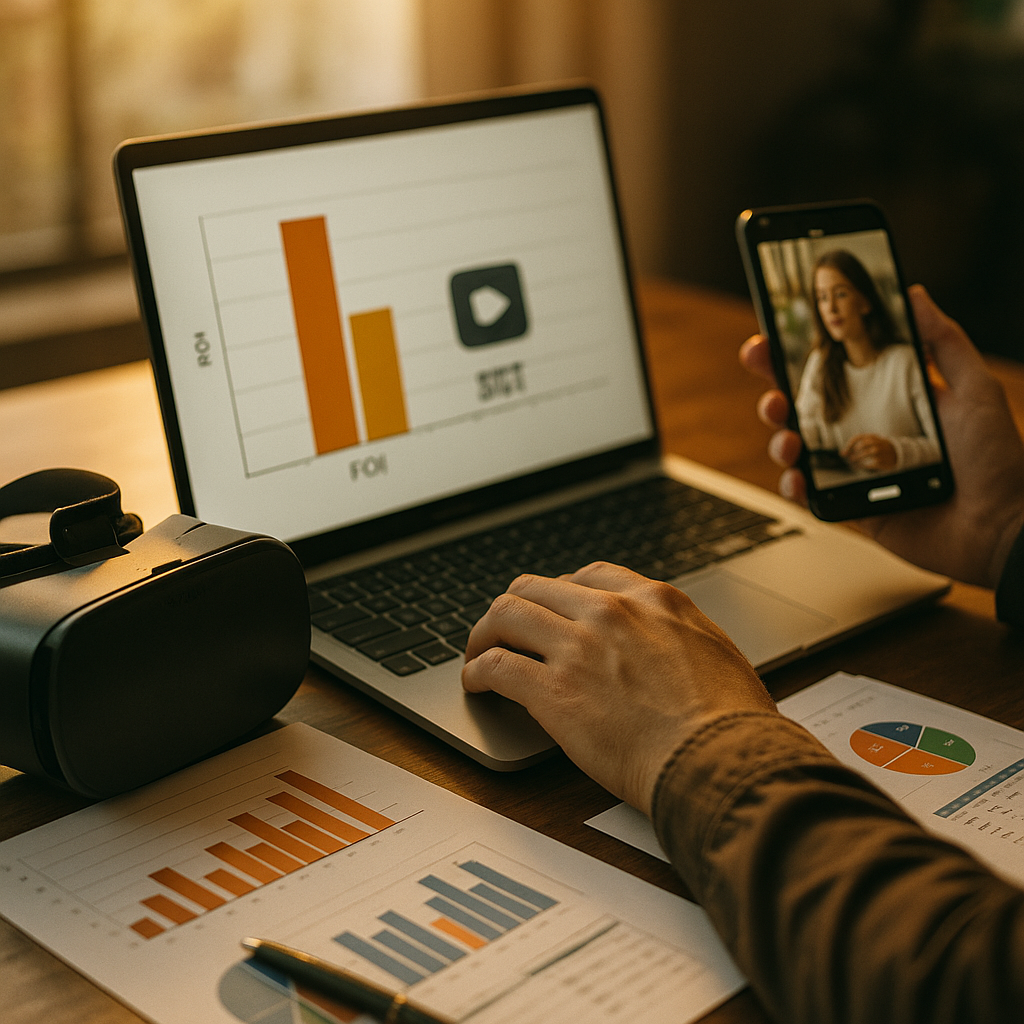
The Real Question Isn’t Whether Immersive Formats Work
Brands collectively spent over $1.8 billion testing immersive ad formats last year, and most couldn’t tell their CFO whether it moved the needle. Before you allocate a dollar to immersive brand format investments, the question isn’t whether 4K spatial video for Apple Vision Pro, interactive livestream commerce, or AR filter campaigns can work. It’s whether they can work better than what’s already working, at a cost your attribution stack can actually measure.
Setting the Baseline: What Short-Form Is Actually Delivering
Let’s anchor this conversation in reality. Short-form video, specifically TikTok, Instagram Reels, and YouTube Shorts, continues to deliver median CPMs in the $3–$8 range for broad awareness, with conversion-optimized campaigns regularly hitting ROAS above 3x for DTC brands. That’s the bar. Any emerging format you’re evaluating in your next budget cycle needs to clear it, or at minimum, justify its premium on grounds that short-form cannot replicate.
Your video budget allocation by format framework should already account for format maturity curves. New formats inflate CPMs during the novelty window, then compress. Short-form had its novelty window. Spatial and AR are entering theirs now.
The honest baseline for a mid-market brand running a disciplined creator program: short-form creator content generates measurable brand search lift, trackable cost-per-acquisition, and enough data volume to optimize within a single campaign flight. Immersive formats, currently, do not. That asymmetry shapes everything that follows.
4K Spatial Video for Apple Vision Pro: Who Actually Needs This?
Apple Vision Pro’s installed base sits under 1 million units globally. That’s not a typo. For most brands, the reach math fails before you open a creative brief. But reach isn’t why brands like BMW, LVMH, and Marriott are investing in spatial video production. They’re investing in earned media value, press coverage, and positioning as category innovators.
If your brand plays in luxury, hospitality, automotive, or high-consideration B2B, a spatial video activation can generate disproportionate PR lift relative to its direct audience size. Think of it as a premium trade show installation that also lives on a platform. The mistake is treating it as a reach channel. It isn’t one yet.
Spatial video’s current ROI case is built on earned media and brand equity signals, not direct conversion. Budget it like a brand stunt, not a performance channel, and your CFO won’t be surprised at the reconciliation.
Production costs for high-quality spatial video run $40,000–$150,000 per asset depending on complexity. Before you approve that spend, ask whether your creative team has a distribution plan that extends the asset’s life across 2D formats. A spatial hero film can be versioned into Reels, YouTube Shorts, and even LinkedIn clips. If the repurposing strategy isn’t in the brief, the budget case weakens significantly.
Interactive Livestream Commerce: The Format With Actual Revenue Data
Of the three immersive formats under consideration, interactive livestream commerce has the strongest commercial precedent. Statista data shows livestream commerce revenue in the U.S. surpassing $50 billion, with TikTok Shop, Amazon Live, and emerging platforms like Whatnot and Flip driving category expansion. In China, where the format matured first, livestream commerce represents roughly 20% of total e-commerce volume. That trajectory matters when you’re modeling Western adoption curves.
The operational complexity is real, though. Effective livestream commerce isn’t a camera pointed at a creator holding your product. It requires live inventory integration, real-time fulfillment coordination, comment moderation, and a creator who can sell under pressure. Brands that underinvest in production quality and creator selection for livestream consistently report abandoned cart rates above 60%.
For brands already running creator programs with strong conversion signals, multi-format creator bundles that include a livestream component offer the most defensible budget case. You’re not starting from zero on audience trust or creator relationship. You’re extending an existing high-performing partnership into a new format.
The KPIs that actually matter for livestream commerce: gross merchandise value per stream, average order value versus your standard e-commerce baseline, and repeat viewer rate across multiple stream events. If a creator’s audience watches once but doesn’t return, you have an audience problem, not a format problem.
AR Filter Campaigns: High Volume, Low Certainty
AR filters are the most accessible of the three immersive formats and the most misunderstood from an attribution standpoint. Meta’s Spark AR and TikTok’s Effect House have collectively enabled thousands of branded filter activations. Impressions are easy to generate. Proving that those impressions drove downstream business outcomes is significantly harder.
The most common measurement failure: brands count filter uses and UGC posts as KPIs without connecting them to any brand lift study or conversion event. A filter that generates 2 million impressions and zero measurable brand recall improvement is not a success story, it’s a vanity metric dressed in immersive clothing.
The brands getting AR filter ROI right are structuring activations around UGC distribution engines that amplify filter-generated content through paid media. The filter becomes a UGC seeding mechanism, and the real spend goes into promoting the best outputs. That model closes the attribution loop because you’re buying against content performance, not filter interaction volume.
Beiersdorf’s NIVEA and e.l.f. Beauty have both run AR filter campaigns where creator-seeded filter content was systematically tested as paid creative against standard studio assets. In both cases, the filter-origin UGC outperformed studio creative on thumb-stop rate while matching or beating it on conversion rate. That’s the playbook worth stealing.
Building the Budget Case: A Framework for CFO-Ready Decisions
The core framework for evaluating any immersive format comes down to four questions. First, does the format reach an audience your proven channels cannot? Second, does the creative mechanic produce an engagement signal that translates to downstream intent? Third, can your measurement infrastructure actually detect the signal, or are you relying on platform-reported metrics that can’t be independently validated? Fourth, what’s the repurposing ceiling on the creative asset?
A disciplined budget framework for revenue attribution treats immersive formats as a separate budget line from proven performance spend. The sizing guidance most senior practitioners apply: allocate no more than 10–15% of total creator and content budget to format experimentation, with explicit test parameters and a defined decision gate at the midpoint of the campaign flight.
For brands that need to win CFO approval before experimenting at all, the strongest argument is incremental reach among high-LTV segments. Spatial video reaches early adopter, high-income households. Livestream commerce reaches high-purchase-intent audiences at the moment of discovery. AR filters reach younger demographics with strong peer influence behavior. If your brand’s growth thesis depends on any of those segments, you have a story to tell.
eMarketer projections suggest combined immersive format spend will grow at roughly 34% annually through the next three years, faster than any other content category. But average spend growth is not the same as average return. Early movers capture novelty advantages; late movers often find mature formats with compressed CPMs and commoditized creative. The timing question is genuinely strategic, not just tactical.
Brands that pilot immersive formats with defined holdout groups and pre-registered KPIs generate the internal data they need to scale confidently. Brands that pilot without measurement rigor just generate costs.
Consider running holdout tests for incremental lift alongside any immersive format pilot. It’s the only way to isolate format contribution from the halo effect of your broader media mix. Without that isolation, you cannot attribute lift to the immersive investment with any credibility.
The Honest Verdict
Interactive livestream commerce has earned a real performance budget allocation for brands with strong e-commerce infrastructure and established creator relationships. AR filter campaigns deserve a UGC-amplification budget, not a standalone immersive budget. 4K spatial video belongs in brand equity spend, sized like a PR activation, measured accordingly. Short-form creator content remains the highest-confidence spend in your mix. None of that changes because a new format is generating trade press headlines.
Review your CFO-ready budget framework before your next planning cycle and use it to force an explicit conversation about which immersive formats are being tested, what success looks like, and what decision rule will determine whether you scale or cut. That conversation, structured and documented, is how mature marketing organizations avoid expensive novelty bias.
For your next planning cycle: assign a specific dollar amount to immersive format experimentation, define one falsifiable hypothesis per format, and commit to a decision gate with pre-agreed thresholds before the campaign launches. Then hold the line.
Frequently Asked Questions
What percentage of a brand’s content budget should go toward immersive formats like spatial video and AR?
Most senior practitioners recommend capping format experimentation, including spatial video, AR filters, and livestream commerce, at 10–15% of total creator and content budget. This preserves the majority of spend on proven channels with measurable ROI while generating actionable data on emerging formats. That percentage can increase once internal test results demonstrate consistent lift above baseline short-form performance.
Is Apple Vision Pro a viable distribution channel for brand campaigns?
Not as a reach channel, given the current installed base of under 1 million units globally. Spatial video for Apple Vision Pro is best evaluated as a brand equity and earned media investment rather than a performance channel. Brands in luxury, automotive, hospitality, and high-consideration B2B verticals are most likely to see positive ROI through press coverage, partnership announcements, and category positioning signals.
How do you measure ROI on AR filter campaigns?
Standard filter impression counts are insufficient for CFO-ready reporting. The most defensible measurement approach connects AR filter activations to a downstream event: brand lift survey results, paid media performance of filter-generated UGC, or conversion data from traffic sources that touched the filter experience. Brands using filters as UGC seeding mechanisms and then promoting the best outputs through paid amplification have the clearest attribution path.
What makes a creator well-suited for livestream commerce versus standard sponsored content?
Livestream commerce requires creators who can sustain real-time audience engagement, handle live product questions without scripting, and maintain consistent energy across multi-hour streams. Look for creators with high comment reply rates, active Q&A behavior in existing content, and demonstrated ability to drive click-through on time-sensitive offers. Sales fluency matters as much as audience size in this format.
How do immersive format CPMs compare to short-form video benchmarks?
Short-form video CPMs typically range from $3–$8 for broad awareness campaigns. Immersive formats carry significant premiums: spatial video production costs alone run $40,000–$150,000 per asset, AR filter development ranges from $15,000–$80,000 depending on complexity, and livestream commerce requires ongoing operational infrastructure investment. The CPM comparison is less useful than a cost-per-incremental-outcome comparison, which requires proper holdout testing to calculate accurately.
Top Influencer Marketing Agencies
The leading agencies shaping influencer marketing in 2026
Agencies ranked by campaign performance, client diversity, platform expertise, proven ROI, industry recognition, and client satisfaction. Assessed through verified case studies, reviews, and industry consultations.
Moburst

-
2

The Shelf
Boutique Beauty & Lifestyle Influencer AgencyA data-driven boutique agency specializing exclusively in beauty, wellness, and lifestyle influencer campaigns on Instagram and TikTok. Best for brands already focused on the beauty/personal care space that need curated, aesthetic-driven content.Clients: Pepsi, The Honest Company, Hims, Elf Cosmetics, Pure LeafVisit The Shelf → -
3

Audiencly
Niche Gaming & Esports Influencer AgencyA specialized agency focused exclusively on gaming and esports creators on YouTube, Twitch, and TikTok. Ideal if your campaign is 100% gaming-focused — from game launches to hardware and esports events.Clients: Epic Games, NordVPN, Ubisoft, Wargaming, Tencent GamesVisit Audiencly → -
4

Viral Nation
Global Influencer Marketing & Talent AgencyA dual talent management and marketing agency with proprietary brand safety tools and a global creator network spanning nano-influencers to celebrities across all major platforms.Clients: Meta, Activision Blizzard, Energizer, Aston Martin, WalmartVisit Viral Nation → -
5

The Influencer Marketing Factory
TikTok, Instagram & YouTube CampaignsA full-service agency with strong TikTok expertise, offering end-to-end campaign management from influencer discovery through performance reporting with a focus on platform-native content.Clients: Google, Snapchat, Universal Music, Bumble, YelpVisit TIMF → -
6

NeoReach
Enterprise Analytics & Influencer CampaignsAn enterprise-focused agency combining managed campaigns with a powerful self-service data platform for influencer search, audience analytics, and attribution modeling.Clients: Amazon, Airbnb, Netflix, Honda, The New York TimesVisit NeoReach → -
7

Ubiquitous
Creator-First Marketing PlatformA tech-driven platform combining self-service tools with managed campaign options, emphasizing speed and scalability for brands managing multiple influencer relationships.Clients: Lyft, Disney, Target, American Eagle, NetflixVisit Ubiquitous → -
8

Obviously
Scalable Enterprise Influencer CampaignsA tech-enabled agency built for high-volume campaigns, coordinating hundreds of creators simultaneously with end-to-end logistics, content rights management, and product seeding.Clients: Google, Ulta Beauty, Converse, AmazonVisit Obviously →