


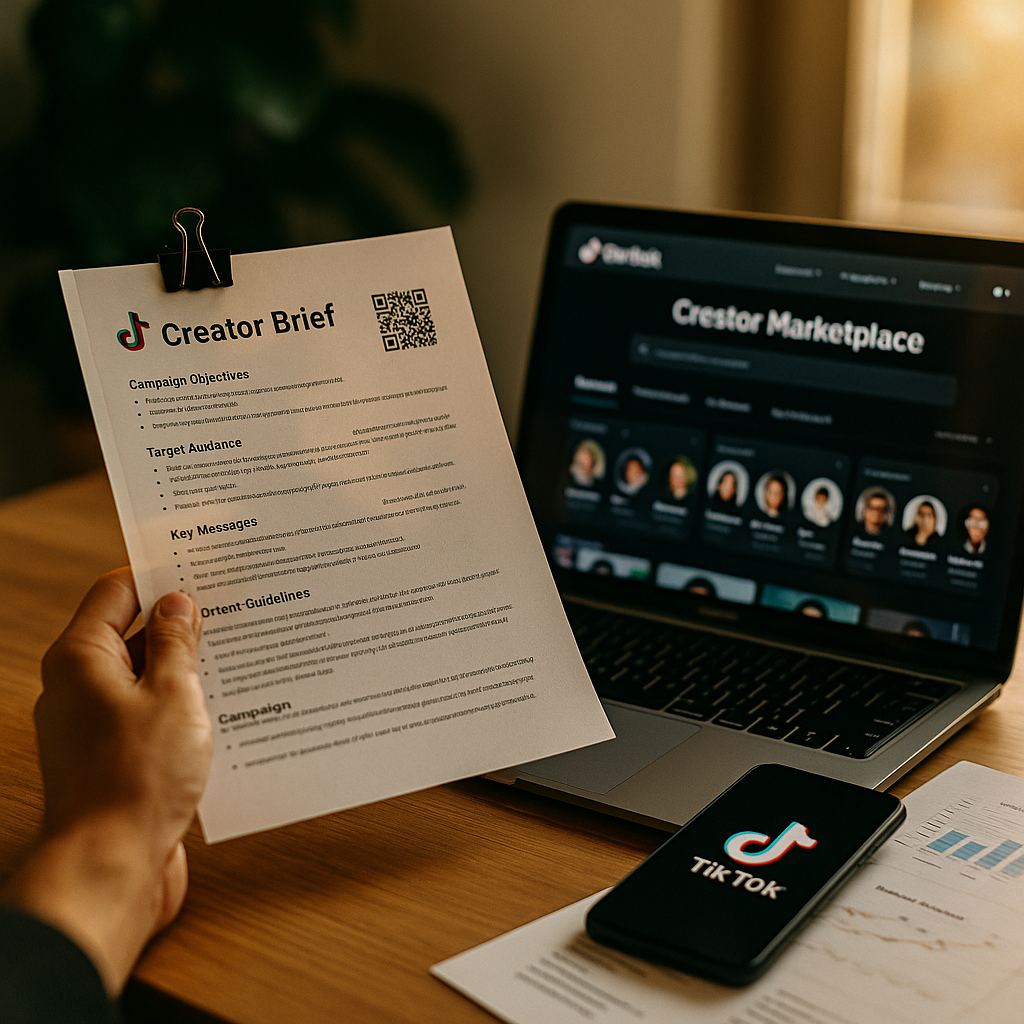
Fewer than 10% of sponsored TikTok posts break into the platform’s top distribution tier. The difference between a post that flatlines at 800 views and one that hits 800,000 is rarely the creator — it’s the brief. A TikTok watch-time creator brief engineered for algorithmic performance is the single highest-leverage document in your influencer program.
Why Most Sponsored Briefs Are Structurally Wrong
Most brand briefs are built for legal and compliance teams, not for TikTok’s recommendation engine. They specify what to say, what to avoid, which product claims are approved, and where to place the logo. What they almost never specify is when to say it, how fast to move between scenes, or what sound decision to make at the two-second mark. That silence is costing you distribution.
TikTok’s algorithm weighs watch-time completion rates, replay signals, early engagement velocity, and share behavior. Every one of those signals is a downstream consequence of production decisions the creator makes before they hit record. If your brief doesn’t direct those decisions, you’re leaving algorithmic performance entirely to chance.
The brief is the algorithm brief. If your production direction doesn’t speak to watch-time mechanics, you’ve written a legal document, not a performance document.
The Four Narrative Layers a Performance Brief Must Address
Think of a high-performing TikTok post as four interlocking layers: the visual hook sequence, the narrative pacing arc, the audio cue timing, and the retention loop. Each layer has a technical specification. Your brief needs to speak to all four.
Visual hook sequence. The first 1.5 seconds determine whether a viewer pauses the scroll. Your brief should specify not just “grab attention” but what type of visual opening achieves that. High-performing sponsored content consistently opens with one of three patterns: an unexpected or dissonant visual (something that doesn’t match the predicted context), a motion-first frame (movement from frame zero, no static opening shot), or a text-on-screen tension statement that creates an incomplete loop (“I almost didn’t post this”). Brief the creator with the specific opening type, not a vague instruction to “start strong.”
Narrative pacing arc. TikTok’s own internal data, referenced through TikTok for Business, consistently shows that sponsored posts retain viewers longer when the brand integration arrives after an established narrative tension — typically between the 30% and 50% timestamp of the video’s total duration. A 30-second post should introduce the product between seconds 9 and 15, never in the first five seconds unless the product IS the hook. Build this into the brief as a timestamp directive, not a suggestion.
Audio cue timing. Sound is not decoration on TikTok. It is a behavioral trigger. Trending audio drives search discovery. Original audio with a distinct sonic identity drives replays. Brief the creator on whether to use a trending sound (and which specific one, by name, with a fallback), or to build original audio using a defined beat structure. If the brief calls for voiceover, specify where the voiceover begins relative to the visual cut — a voiceover that starts 0.5 seconds before the first cut reads as polished; one that starts simultaneously reads as amateur.
Retention loops. The highest-performing TikTok content contains a micro-loop: something that happens in the final three seconds that makes a viewer want to rewatch from the beginning. This could be a callback to the opening frame, a punchline that recontextualizes an earlier moment, or a visual that only makes sense after you’ve heard the full audio. Brief this explicitly. Creators who understand retention loops build them instinctively — but most sponsored content briefs never ask for them, so creators deprioritize them in favor of clean outro brand mentions.
Writing Timestamp Directives That Don’t Strangle Creative
There’s a legitimate tension here. Creators push back — hard — on briefs that over-prescribe. And they’re right to. A creator who feels like they’re executing a storyboard rather than making content will produce something that looks like an ad. TikTok’s audience recognizes that immediately, and the algorithm responds to the resulting low engagement accordingly.
The solution is to separate structural direction from creative direction. Structural direction covers the when and how long. Creative direction covers the what and how. A brief can specify “brand integration lands between seconds 10-14” without specifying the exact words. It can specify “audio must be established before the first product close-up” without dictating the shot. For more on how this balance plays out across platforms, the comparison in TikTok vs Instagram creator briefs is useful framing for brand teams building multi-platform programs.
A practical format: write the brief in two columns. Left column: structural specifications (timestamps, duration ranges, audio type, opening pattern). Right column: creative latitude (tone, persona, product narrative, what to avoid saying). This format makes the brief scannable for creators and defensible for your team during review.
The 15-30-60 Duration Decision
Duration is not a creative preference. It’s an algorithmic signal. TikTok’s distribution behavior differs measurably across the 15-second, 30-second, and 60-second formats, and your brief should specify which format to use based on campaign objective, not based on how much the creator has to say.
For awareness-stage campaigns targeting cold audiences, 15-second posts with a single visual hook and one product moment consistently outperform longer formats on cost-per-view metrics. For consideration-stage campaigns where you need to communicate a value proposition or demonstrate a product, 30 seconds is the functional sweet spot — long enough to establish context, short enough to sustain completion rates above the 75% threshold that triggers broader distribution. Sixty-second posts require a narrative structure sophisticated enough to justify the duration; brief them only when the creator’s storytelling format genuinely needs the space, and only when you’ve validated through prior performance data that this creator’s audience tolerates longer content.
For teams running TikTok Shop campaigns, duration strategy interacts with the product link placement in ways that deserve a dedicated brief section. The mechanics are covered in depth in guidance on TikTok Shop briefs for watch-time.
Audio Strategy: The Most Underspecified Brief Element
Ask ten brand managers how they brief audio on TikTok creator posts. Most will say “we leave it to the creator.” That’s not a strategy. That’s an abdication.
Audio decisions affect three separate performance variables: algorithmic reach (trending audio gets surfaced in sound-based discovery), audience retention (audio pacing controls scroll velocity), and brand recall (original audio with distinct sonic branding compounds across multiple posts in a campaign). According to research aggregated by Sprout Social, content with original audio generates meaningfully higher saves and shares compared to content with generic trending sounds, particularly in the beauty and lifestyle categories.
Your audio brief should specify: sound type (trending or original), if trending — the specific sound by name and TikTok sound ID, the audio-to-visual synchronization expectation, and whether voiceover is required or optional. If the campaign involves a series of posts, specify whether the audio should be consistent across posts to build a recognizable sonic signature.
Hook Sequences Are Not Hook Moments
This distinction matters operationally. A hook moment is a single opening beat. A hook sequence is a series of micro-moments in the first five to seven seconds that create a compounding commitment to keep watching. The sequence typically runs: visual disruption (frame 0-0.8s), tension statement (0.8-2s), pattern interrupt (2-4s), implicit promise (4-7s). Each beat must be specified in the brief, or creators will default to their organic content structure, which may not include all four elements.
For category-specific hook sequence examples, the frameworks in hook sequences and watch time provide execution-ready models for brand teams.
A hook sequence is not optional creative flair. It’s the load-bearing structure that determines whether the algorithm ever shows the post to enough people to measure.
Review and Iteration Protocol
A performance brief needs a performance review process. Before approval, review the creator’s draft cut against three technical checkpoints: Does the visual hook sequence hit all four beats within the first seven seconds? Does the brand integration timestamp fall within the specified window? Does the audio track establish before the first product close-up? If the answer to any of these is no, return with specific, timestamp-referenced feedback, not general creative notes.
Build a 48-hour post-publish monitoring window into your workflow. Track view-to-completion rate, share velocity in the first four hours, and comment sentiment. If completion rate is below 50% and view count has stalled by hour six, the brief’s pacing direction didn’t land — document what failed for the next iteration. Platforms like HubSpot and dedicated creator analytics tools like Statista’s industry benchmarks can help contextualize whether your completion rates are above or below category norms.
For brands running sponsored content across both TikTok and Instagram simultaneously, the brief structures diverge significantly by platform. The interaction between algorithm signals and brief design on Instagram is detailed in the Reels algorithm and creator briefs guide.
Start your next brief by writing the timestamp directive column first. Everything else in the document should serve that structure.
Frequently Asked Questions
What is a TikTok watch-time creator brief?
A TikTok watch-time creator brief is a production direction document that specifies not just what a sponsored creator post should communicate, but how it should be structured to maximize watch-time completion signals. It includes timestamp directives for brand integration, visual hook sequence requirements, audio cue timing, and retention loop mechanics — all designed to push the post into the algorithmic distribution tier where broader organic reach activates.
How detailed should timestamp directives be in a creator brief?
Timestamp directives should specify a window, not a single second. For example, “brand integration lands between seconds 10 and 14 of a 30-second post” gives the creator structural guidance while preserving creative flexibility. Over-prescribing exact seconds stifles the creative authenticity that makes TikTok content perform well with audiences. The goal is to define the structural skeleton without scripting the flesh.
Does audio direction really affect algorithmic distribution?
Yes, significantly. TikTok’s algorithm surfaces content through multiple discovery paths, including sound-based discovery. Trending audio attaches sponsored posts to active search and browse behavior around that sound. Original audio with a distinct identity drives replay behavior. Both of these are watch-time signals. Leaving audio direction out of a brief means leaving one of the most powerful distribution levers unaddressed.
At what duration does TikTok-sponsored content perform best?
It depends on campaign objective. Fifteen-second posts outperform on cost-per-view for cold-audience awareness campaigns. Thirty-second posts tend to generate the best balance of completion rate and message retention for consideration-stage goals. Sixty-second posts require sophisticated storytelling from the creator and should only be briefed when prior data confirms that creator’s audience watches longer content through to completion.
How is a TikTok performance brief different from a standard influencer brief?
A standard influencer brief focuses on messaging, brand guidelines, legal compliance, and deliverable specifications. A TikTok performance brief adds a second layer: production direction designed around the platform’s algorithmic signals. This means specifying visual hook sequences, audio-to-visual synchronization, brand integration timestamps, and retention loop mechanics. The compliance layer and the performance layer must coexist in the same document without one undermining the other.
Top Influencer Marketing Agencies
The leading agencies shaping influencer marketing in 2026
Agencies ranked by campaign performance, client diversity, platform expertise, proven ROI, industry recognition, and client satisfaction. Assessed through verified case studies, reviews, and industry consultations.
Moburst

-
2

The Shelf
Boutique Beauty & Lifestyle Influencer AgencyA data-driven boutique agency specializing exclusively in beauty, wellness, and lifestyle influencer campaigns on Instagram and TikTok. Best for brands already focused on the beauty/personal care space that need curated, aesthetic-driven content.Clients: Pepsi, The Honest Company, Hims, Elf Cosmetics, Pure LeafVisit The Shelf → -
3

Audiencly
Niche Gaming & Esports Influencer AgencyA specialized agency focused exclusively on gaming and esports creators on YouTube, Twitch, and TikTok. Ideal if your campaign is 100% gaming-focused — from game launches to hardware and esports events.Clients: Epic Games, NordVPN, Ubisoft, Wargaming, Tencent GamesVisit Audiencly → -
4

Viral Nation
Global Influencer Marketing & Talent AgencyA dual talent management and marketing agency with proprietary brand safety tools and a global creator network spanning nano-influencers to celebrities across all major platforms.Clients: Meta, Activision Blizzard, Energizer, Aston Martin, WalmartVisit Viral Nation → -
5

The Influencer Marketing Factory
TikTok, Instagram & YouTube CampaignsA full-service agency with strong TikTok expertise, offering end-to-end campaign management from influencer discovery through performance reporting with a focus on platform-native content.Clients: Google, Snapchat, Universal Music, Bumble, YelpVisit TIMF → -
6

NeoReach
Enterprise Analytics & Influencer CampaignsAn enterprise-focused agency combining managed campaigns with a powerful self-service data platform for influencer search, audience analytics, and attribution modeling.Clients: Amazon, Airbnb, Netflix, Honda, The New York TimesVisit NeoReach → -
7

Ubiquitous
Creator-First Marketing PlatformA tech-driven platform combining self-service tools with managed campaign options, emphasizing speed and scalability for brands managing multiple influencer relationships.Clients: Lyft, Disney, Target, American Eagle, NetflixVisit Ubiquitous → -
8

Obviously
Scalable Enterprise Influencer CampaignsA tech-enabled agency built for high-volume campaigns, coordinating hundreds of creators simultaneously with end-to-end logistics, content rights management, and product seeding.Clients: Google, Ulta Beauty, Converse, AmazonVisit Obviously →