


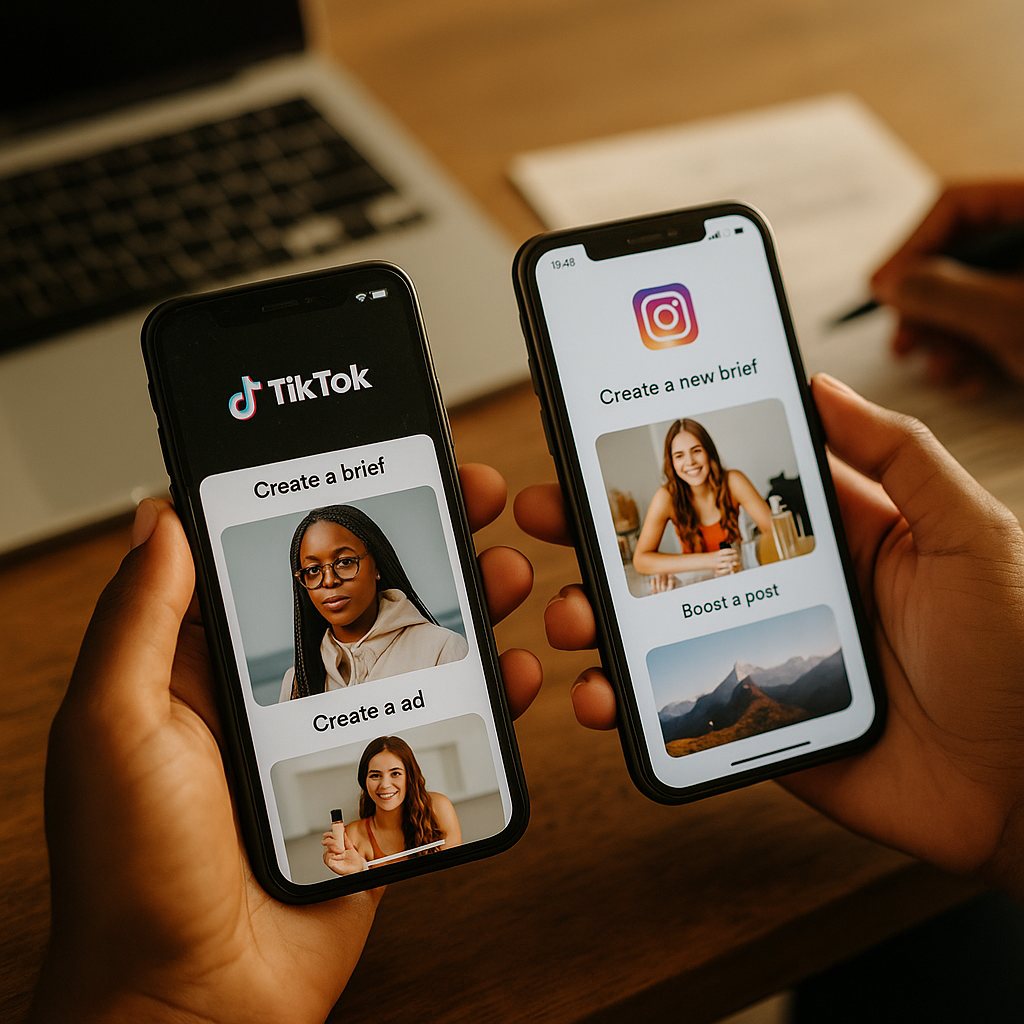
Brands running dual-platform programs are leaving revenue on the table — not because they lack budget, but because they’re briefing TikTok and Instagram as if the algorithms work the same way. They don’t. Here’s how to design briefs that match each platform’s mechanics to your actual commerce objectives, whether that’s discovery reach in international segments or localized purchase conversion closer to home.
Two Platforms, Two Different Jobs
TikTok’s For You Page operates on interest graphs, not social graphs. A creator with 12,000 followers in Mexico City can generate 4 million views in Germany if the content signals match what the algorithm is already rewarding. That’s discovery reach at a scale that follower counts simply can’t predict.
Instagram works differently. Meta’s algorithm still weights relationship signals heavily: saves, DMs, shares to close friends, and repeat engagement from existing followers. For brands, that means Instagram is inherently better suited to audiences who already know your category, if not your product. It’s a conversion environment, not a discovery one.
The strategic implication is straightforward: use TikTok to find international audiences who don’t know you exist, and use Instagram to close the purchase loop with audiences who are already warm. Most brands acknowledge this in theory. Almost none of them build briefs that reflect it operationally.
Brands that brief TikTok and Instagram creators with identical deliverables are effectively paying twice to do the same job — and doing neither job particularly well.
How the For You Algorithm Actually Rewards Content
TikTok’s ranking signals prioritize completion rate, replays, and shares off-platform above all else. According to TikTok for Business, the first two seconds of a video determine whether it exits the initial test pool or gets buried. That means your TikTok brief needs to front-load the hook, not the brand message.
For international discovery specifically, localization inside the content matters more than language. A skincare creator in Seoul demonstrating a product with local environmental references (monsoon humidity, city pollution) will outperform a generic English-language testimonial that’s been subtitle-translated. The algorithm picks up watch-through patterns by geography, and locally resonant content holds attention longer in those segments.
What this means for your brief: give creators latitude on the first three seconds, require the product demonstration in seconds four through fifteen, and let the call-to-action be soft (curiosity-driving rather than conversion-driving). You’re not asking someone to buy today. You’re asking the algorithm to introduce you to people who’ll eventually search for you on Instagram or Google.
For deeper guidance on structuring TikTok creator deliverables, the framework in this guide on TikTok creator brief integration is worth benchmarking against your current template.
Instagram’s Follower Feed: What “Conversion” Actually Requires
When brands say they want Instagram to drive purchase conversion, they usually mean they want link-in-bio clicks or swipe-ups. That’s a narrow definition of conversion, and it creates briefs that underperform.
Instagram’s actual commerce conversion path in most verticals looks like this: a user sees Reels content, saves it, comes back to the post within 48 hours, visits the brand profile, and then either clicks a product tag or goes directly to the brand’s site via search. The DM share to a friend is increasingly a purchase signal too, particularly in fashion, beauty, and home goods. None of that shows up cleanly in a 7-day attribution window unless you’ve set your measurement model up correctly.
This has direct implications for brief design. If you want Instagram to convert, your brief needs to specify content that earns saves, not just views. That means tutorials, before/afters, product comparisons, and localized social proof — content worth bookmarking. It also means briefing creators on local pricing, local availability, and local retailer partnerships where applicable. A creator in São Paulo recommending a product that’s only available on a US-based website is doing brand awareness, not conversion, regardless of what your brief says.
For the mechanics of briefing around Instagram’s newer engagement signals, the coverage of Instagram Reels DMs and saves is directly applicable here.
Designing Platform-Specific Briefs: The Operational Differences
Here’s where strategy becomes execution. Most brand briefs include a platform field that says “TikTok and Instagram” — with identical talking points, identical product shots, and identical calls to action. That’s not a brief. That’s a requirements checklist with a logo on it.
A TikTok brief for international discovery should specify:
- Hook format: Creator-native opening (question, visual contrast, or pattern interrupt) — no branded logo in the first three seconds
- Localization signals: Language, setting, or cultural references that match the target segment (not just translated captions)
- Product placement window: Seconds 4-15, integrated into the creator’s natural demonstration style
- Soft CTA: Curiosity language (“the one thing I didn’t expect…”) rather than direct purchase language
- No overlay text with pricing: Pricing information can suppress international amplification because it’s geographically irrelevant to a global test pool
An Instagram brief for localized conversion should specify:
- Save-worthy format: Tutorial, checklist, or comparison content that earns the bookmark
- Local purchase path: Creator must reference where to buy in their specific market (local retailer, local ecommerce link, or localized landing page)
- Product tag requirement: All posts must use native Instagram Shopping tags where available
- DM trigger element: A question or recommendation prompt designed to generate DM replies (these are high-value conversion signals for Meta’s algorithm)
- Extended caption: Instagram captions support search indexing. Brief creators to include product category keywords, not just brand hashtags.
The budget split question comes up immediately when brands start separating briefs this way. The analysis in this breakdown of TikTok vs. Instagram budget allocation gives concrete benchmark ranges by category.
International Segments Require More Than Translated Briefs
If you’re using TikTok’s discovery reach to enter new international markets, the brief needs to account for regional platform behavior, not just language. TikTok’s algorithm in Southeast Asia rewards duet and stitch formats more heavily than in Western European markets. In Brazil, Brazilian Portuguese audio cues outperform subtitle-translated content even when the creator’s audience is bilingual.
The operational answer is market-segmented creator pools, not one-size-fits-all rosters. For a brand entering three international segments simultaneously via TikTok, that means three separate brief templates with distinct cultural reference guidelines, distinct CTA language, and distinct content formats — even if the product message is identical.
This is where agencies earn their retainer. Coordinating localized creator briefs across multiple markets while keeping brand standards consistent requires a brief architecture that separates the fixed brand elements (product claims, legal disclaimers, visual identity) from the variable local elements (format, tone, cultural references, pricing references). Build that separation into your brief template structure from the start.
If you’re managing multi-platform strategies across events or tent-pole moments, the approach in this overview of multi-platform creator strategy applies directly to international segment management.
Attribution: Where the Strategy Usually Falls Apart
The most common failure mode for dual-platform programs isn’t bad creative. It’s bad attribution. Brands allocate TikTok spend to awareness, see no direct purchase conversion, and conclude TikTok doesn’t work. They’re measuring the wrong outcome against the wrong platform.
A workable measurement model for this strategy needs at minimum: brand search volume tracking by market (TikTok’s contribution shows up here before it shows up in direct attribution), Instagram-specific UTM parameters at the creator level, and a 14-day attribution window for Instagram conversion credit rather than the default 7-day. Sprout Social and HubSpot both support creator-level UTM tracking that can isolate conversion by creator and by market.
For brands using Meta’s native tools, Meta Business Suite now supports cross-surface attribution that can connect Reels engagement to downstream Instagram Shop purchases — but only if your product catalog is properly connected and your creator posts include Shopping tags. That setup work happens before the brief is written, not after the campaign launches.
For Instagram-specific attribution mechanics, the deep-dive on Reels attribution windows covers the measurement model in detail.
If TikTok drives brand search lift in a new international market and Instagram closes the purchase, your attribution model needs to credit both — or you’ll systematically defund the top of your own funnel.
Compliance and Risk at Scale
Running localized creator programs across multiple international markets introduces disclosure compliance complexity that a single brief template cannot solve. The FTC’s endorsement guidelines apply to US-targeted content regardless of where the creator is based. Markets in the EU operate under separate disclosure standards. Brief templates need jurisdiction-specific disclosure language baked in, not added as an afterthought.
Pricing claims, availability statements, and promotional language are equally jurisdiction-sensitive. A creator in Singapore referencing a “50% off” promotion that isn’t available in Singapore creates both a compliance risk and a conversion failure. Brief review checklists should include a market-availability verification step before any creator publishes localized conversion content.
Start here: audit your current brief template and identify every element that’s platform-agnostic. Those elements are probably wrong for at least one of the platforms you’re running them on. Rebuild the template as two separate documents — one optimized for TikTok discovery mechanics, one built around Instagram’s conversion signals — and treat market localization as a required layer in both.
FAQs
Why does TikTok work better for international discovery than Instagram?
TikTok’s For You Page distributes content based on interest and behavioral signals rather than follower relationships, which means a creator with a small local following can reach large international audiences if the content matches what the algorithm is rewarding in those markets. Instagram’s feed still weights social graph signals heavily, making it better for reaching audiences who already have a relationship with your brand or category.
How should brand briefs differ between TikTok and Instagram?
TikTok briefs should prioritize creator-native hooks, soft CTAs, cultural localization signals, and placement of the product in the mid-section of the video rather than the opening. Instagram briefs should specify save-worthy formats (tutorials, comparisons), local purchase paths including retailer or ecommerce links, Shopping tag requirements, and extended captions that include searchable category keywords.
What’s the right attribution model for a dual-platform discovery-plus-conversion strategy?
Use brand search volume tracking by market to measure TikTok’s contribution (direct attribution will undercount it), creator-level UTM parameters on Instagram to isolate conversion by creator and market, and extend Instagram’s attribution window to 14 days rather than the default 7. Tools like Sprout Social and HubSpot support creator-level UTM tracking, while Meta Business Suite handles cross-surface attribution for Instagram Shopping.
How do you localize TikTok content for international segments without creating separate campaigns for every market?
Build a brief architecture that separates fixed brand elements (product claims, legal disclaimers, visual identity) from variable local elements (format, tone, cultural references, pricing references, language). Market-segmented creator pools with localized brief templates at the variable-element level allow you to maintain brand consistency while adapting the content signals that drive algorithmic performance in each market.
What compliance risks should brands watch when running localized creator campaigns internationally?
FTC disclosure requirements apply to all US-targeted content regardless of creator location. EU markets operate under separate disclosure standards. Pricing claims and promotional language must be verified for availability in each creator’s market before publishing. Brief templates should include jurisdiction-specific disclosure language and a market-availability verification step as part of the pre-publication review checklist.
Top Influencer Marketing Agencies
The leading agencies shaping influencer marketing in 2026
Agencies ranked by campaign performance, client diversity, platform expertise, proven ROI, industry recognition, and client satisfaction. Assessed through verified case studies, reviews, and industry consultations.
Moburst

-
2

The Shelf
Boutique Beauty & Lifestyle Influencer AgencyA data-driven boutique agency specializing exclusively in beauty, wellness, and lifestyle influencer campaigns on Instagram and TikTok. Best for brands already focused on the beauty/personal care space that need curated, aesthetic-driven content.Clients: Pepsi, The Honest Company, Hims, Elf Cosmetics, Pure LeafVisit The Shelf → -
3

Audiencly
Niche Gaming & Esports Influencer AgencyA specialized agency focused exclusively on gaming and esports creators on YouTube, Twitch, and TikTok. Ideal if your campaign is 100% gaming-focused — from game launches to hardware and esports events.Clients: Epic Games, NordVPN, Ubisoft, Wargaming, Tencent GamesVisit Audiencly → -
4

Viral Nation
Global Influencer Marketing & Talent AgencyA dual talent management and marketing agency with proprietary brand safety tools and a global creator network spanning nano-influencers to celebrities across all major platforms.Clients: Meta, Activision Blizzard, Energizer, Aston Martin, WalmartVisit Viral Nation → -
5

The Influencer Marketing Factory
TikTok, Instagram & YouTube CampaignsA full-service agency with strong TikTok expertise, offering end-to-end campaign management from influencer discovery through performance reporting with a focus on platform-native content.Clients: Google, Snapchat, Universal Music, Bumble, YelpVisit TIMF → -
6

NeoReach
Enterprise Analytics & Influencer CampaignsAn enterprise-focused agency combining managed campaigns with a powerful self-service data platform for influencer search, audience analytics, and attribution modeling.Clients: Amazon, Airbnb, Netflix, Honda, The New York TimesVisit NeoReach → -
7

Ubiquitous
Creator-First Marketing PlatformA tech-driven platform combining self-service tools with managed campaign options, emphasizing speed and scalability for brands managing multiple influencer relationships.Clients: Lyft, Disney, Target, American Eagle, NetflixVisit Ubiquitous → -
8

Obviously
Scalable Enterprise Influencer CampaignsA tech-enabled agency built for high-volume campaigns, coordinating hundreds of creators simultaneously with end-to-end logistics, content rights management, and product seeding.Clients: Google, Ulta Beauty, Converse, AmazonVisit Obviously →