


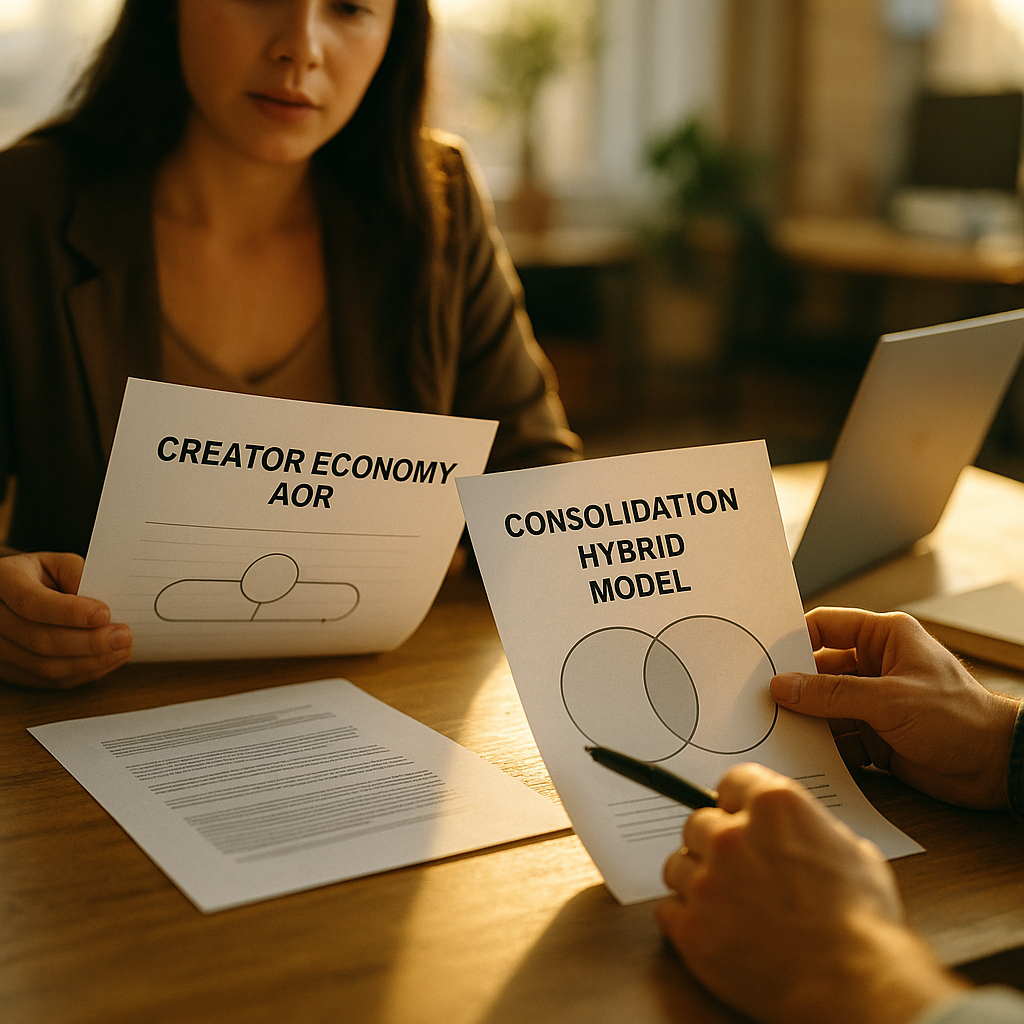
Roughly 61% of enterprise brands now manage creator programs across three or more agencies simultaneously. So the question isn’t whether consolidation is happening in the creator economy AOR space — it’s whether consolidating your program under a single specialist actually makes your operation better, or just simpler on paper.
The Case for Consolidation Is Real — and Often Overstated
The appeal is obvious. One contract, one point of contact, unified reporting, consistent brand voice across platforms. For a CMO managing a $40M creator budget across TikTok, YouTube, Instagram, and emerging platforms like Substack and LinkedIn, the operational drag of managing four specialist agencies is genuinely painful. Duplicated briefing cycles, misaligned attribution models, competing roster recommendations — the friction adds up fast.
Brands like Unilever and P&G have been vocal about their push toward fewer, deeper agency relationships, a trend that accelerated as procurement teams started scrutinizing holding company fees with more rigor. The argument from specialist AOR advocates is compelling: if one agency understands your brand equity, manages your creator roster, controls compliance review, and owns your measurement framework, you eliminate the coordination tax entirely.
But here’s the part that gets glossed over in every agency pitch deck: platform expertise is genuinely specialized, and it degrades quickly when it’s spread thin.
What Platform Expertise Actually Means in Practice
TikTok’s creator monetization tools, algorithmic discovery mechanics, and Shop integration requirements are fundamentally different from YouTube’s long-form sponsorship norms, mid-roll ad structures, and video podcast CPM benchmarks. A team that’s deeply embedded in TikTok’s creator ecosystem — attending ByteDance briefings, testing new ad products, maintaining relationships with top LIVE creators — is operating with information and muscle memory that a generalist team simply won’t have.
This isn’t abstract. When TikTok Shop’s embedded commerce features expanded in early 2026, brands with specialist TikTok agency relationships got early access to beta formats. Brands running consolidated AOR arrangements often found out the same way everyone else did: from a press release. The operational cost of that lag is real.
The same logic applies to B2B creator programs on LinkedIn and YouTube, where the playbook for thought leadership content, newsletter sponsorships, and pipeline attribution is evolving faster than any single generalist team can track across all verticals simultaneously.
Platform expertise isn’t a commodity skill — it’s a perishable one. An agency that splits its attention across five platforms in service of a consolidated AOR relationship will be an expert in none of them within 18 months.
Where the Single-AOR Model Genuinely Wins
There are real scenarios where consolidation delivers measurable efficiency gains, and it’s worth being precise about them.
Brand safety and compliance oversight is the clearest win. Running disclosure reviews, FTC compliance checks, and contract terms through a single agency eliminates the version-control nightmare that comes from having three agencies each running their own legal review. Given that FTC enforcement on influencer disclosures has tightened significantly, a single compliance owner with a unified workflow is operationally superior.
Roster deduplication is another genuine benefit. When you’re running a multi-agency structure, you will pay two agencies to manage the same creator. It happens constantly. A single AOR with a unified creator database eliminates that waste and gives you better leverage in creator negotiations because your total spend is visible in one place.
Measurement and attribution get cleaner. Unified reporting frameworks, consistent tagging taxonomies, and a single source of truth for creator performance data are meaningful operational advantages. If your current multi-agency setup produces four different definitions of “engagement rate,” consolidation will fix that.
The question is whether those gains offset the platform depth you sacrifice. For some brands, they do. For many, they don’t.
The Hybrid Structure Most Sophisticated Brands Are Actually Using
The smartest brands aren’t choosing between full consolidation and fragmented multi-agency chaos. They’re building a layered structure: one lead agency that owns strategy, measurement, compliance, and budget allocation, with platform specialist partners contracted beneath that lead agency’s umbrella.
Think of it like a general contractor model. The AOR holds the client relationship and owns program architecture. Platform specialists execute with depth. The AOR is accountable for integration, not for pretending it has equal depth on every platform.
This model requires an AOR with genuine orchestration capability and intellectual honesty about its own limits — two things worth stress-testing in any agency review. Ask directly: which platforms do you not have deep relationships with, and how do you handle those gaps? If the answer is a deflection, keep looking.
For brands evaluating influencer stack consolidation more broadly, the same principle applies: the goal is coherence, not compression.
Evaluating an AOR Candidate: The Questions That Actually Matter
Before signing a consolidation engagement, run through this evaluation framework:
- Creator roster depth by platform: How many active creator relationships does the agency maintain on each platform where you operate? Not total database size — active, recently activated relationships.
- Platform access: Do they have alpha/beta access to new ad formats on TikTok, YouTube, and Meta? Can they name specific platform contacts?
- Measurement independence: Do they use proprietary attribution, and if so, who audits it? Agencies that control both execution and measurement have a structural conflict of interest.
- Compliance infrastructure: Do they have dedicated legal and compliance staff, or is compliance a task assigned to account managers?
- Sub-contractor transparency: If they use platform specialists as sub-contractors, will they disclose those relationships and those partners’ fees?
If you’re running a sophisticated creator program, also assess whether the AOR candidate has genuine capability in niche creator activation, where the ROI advantage over macro-influencer spend is well-documented but requires different sourcing and briefing workflows than most generalist agencies have built.
The Budget Math You Need to Run
Consolidation should produce a cost model you can actually model. Before you sign, build a comparison across three scenarios: your current fragmented spend (including the coordination overhead), a full single-AOR model, and the hybrid structure described above.
Coordination overhead is frequently underestimated. HubSpot’s research consistently shows that marketing teams undercount internal hours spent on agency management. For a team running three or more agency relationships, internal management time can consume 15-20% of the total program budget when you cost it honestly. That’s real money on the efficiency side of the ledger.
On the other side, platform expertise gaps in a consolidated model carry a cost too, though it’s harder to quantify until you miss a product launch window or get beat to a creator partnership by a competitor with a more agile specialist setup. Building a budget strategy that accounts for both sides of this equation is the only intellectually honest way to evaluate the decision.
The consolidation decision isn’t a vendor preference. It’s a structural choice about where your brand builds capability and where it buys it. Get that architecture wrong and no amount of operational tidiness will fix your results.
One more variable worth pricing in: the AI tool stack your agency operates. Consolidated AOR arrangements with outdated creator discovery or attribution tooling will underperform a well-equipped multi-agency structure on every measurable outcome. Ask for a full tech stack disclosure, and compare it against industry benchmarks for creator management platforms.
The creator economy, now valued north of $480 billion according to Statista’s market data, is too large and too specialized for any single agency to own credibly without a transparent sub-specialist architecture underneath. The brands that win in this environment are the ones that design their agency structure around performance requirements, not administrative convenience.
Before your next agency review, map your platform-by-platform performance gaps first. Then design the structure to close them, whether that points to consolidation, a hybrid model, or a more intentional version of what you already have.
Frequently Asked Questions
What is a creator economy AOR, and how does it differ from a traditional AOR relationship?
A creator economy AOR (agency of record) is a specialist or lead agency that manages a brand’s end-to-end influencer and creator program — including strategy, creator sourcing, compliance, measurement, and often paid amplification. Unlike a traditional AOR that might oversee all paid media or creative, a creator AOR is focused specifically on the creator and influencer channel. The key distinction is that creator programs require active platform relationships, creator network depth, and compliance expertise that general-purpose AOR structures typically lack.
What are the main risks of consolidating creator programs under a single specialist AOR?
The primary risk is loss of platform depth. Agencies that manage creator programs across multiple platforms simultaneously often develop uneven expertise, becoming strong on one or two platforms while underperforming on others. Additional risks include measurement conflicts of interest (when the agency controls both execution and reporting), reduced negotiating leverage with creators if the agency prioritizes its own roster relationships, and slower access to new platform features if the agency lacks direct platform partnerships.
How should brands structure contracts with a creator economy AOR to protect against performance gaps?
Contracts should include platform-specific performance benchmarks, not just aggregate KPIs. Require disclosure of all sub-contractor and specialist partner relationships, including their fees. Include measurement audit rights so a third party can verify attribution claims. Build in platform-specific review cycles — quarterly at minimum — so underperforming channel strategies can be addressed before they drag overall program results. Also require tech stack disclosure to ensure the agency is using current creator discovery and analytics tools.
Is a hybrid AOR model more expensive than full consolidation?
It can appear more expensive on a fee-line basis because you’re paying a lead AOR plus platform specialist fees. In practice, the hybrid model typically produces better ROI than either full consolidation (which sacrifices platform depth) or fragmented multi-agency structures (which carry high coordination costs). The key is ensuring the AOR’s orchestration fee is genuinely offset by reduced internal management time and that platform specialist fees are disclosed transparently rather than marked up inside the AOR’s overall billing.
How do you evaluate whether an agency has genuine platform expertise versus claimed expertise?
Ask for specific evidence: names of platform contacts at TikTok, Meta, YouTube, or LinkedIn’s creator partnership teams; documentation of beta program participation; case studies that include platform-specific creative performance data (not just engagement averages); and client references who can speak to performance on that specific platform. Agencies with genuine platform depth will answer these questions specifically. Agencies with claimed depth will answer generally. That distinction is usually apparent within the first 20 minutes of a detailed agency review conversation.
Top Influencer Marketing Agencies
The leading agencies shaping influencer marketing in 2026
Agencies ranked by campaign performance, client diversity, platform expertise, proven ROI, industry recognition, and client satisfaction. Assessed through verified case studies, reviews, and industry consultations.
Moburst

-
2

The Shelf
Boutique Beauty & Lifestyle Influencer AgencyA data-driven boutique agency specializing exclusively in beauty, wellness, and lifestyle influencer campaigns on Instagram and TikTok. Best for brands already focused on the beauty/personal care space that need curated, aesthetic-driven content.Clients: Pepsi, The Honest Company, Hims, Elf Cosmetics, Pure LeafVisit The Shelf → -
3

Audiencly
Niche Gaming & Esports Influencer AgencyA specialized agency focused exclusively on gaming and esports creators on YouTube, Twitch, and TikTok. Ideal if your campaign is 100% gaming-focused — from game launches to hardware and esports events.Clients: Epic Games, NordVPN, Ubisoft, Wargaming, Tencent GamesVisit Audiencly → -
4

Viral Nation
Global Influencer Marketing & Talent AgencyA dual talent management and marketing agency with proprietary brand safety tools and a global creator network spanning nano-influencers to celebrities across all major platforms.Clients: Meta, Activision Blizzard, Energizer, Aston Martin, WalmartVisit Viral Nation → -
5

The Influencer Marketing Factory
TikTok, Instagram & YouTube CampaignsA full-service agency with strong TikTok expertise, offering end-to-end campaign management from influencer discovery through performance reporting with a focus on platform-native content.Clients: Google, Snapchat, Universal Music, Bumble, YelpVisit TIMF → -
6

NeoReach
Enterprise Analytics & Influencer CampaignsAn enterprise-focused agency combining managed campaigns with a powerful self-service data platform for influencer search, audience analytics, and attribution modeling.Clients: Amazon, Airbnb, Netflix, Honda, The New York TimesVisit NeoReach → -
7

Ubiquitous
Creator-First Marketing PlatformA tech-driven platform combining self-service tools with managed campaign options, emphasizing speed and scalability for brands managing multiple influencer relationships.Clients: Lyft, Disney, Target, American Eagle, NetflixVisit Ubiquitous → -
8

Obviously
Scalable Enterprise Influencer CampaignsA tech-enabled agency built for high-volume campaigns, coordinating hundreds of creators simultaneously with end-to-end logistics, content rights management, and product seeding.Clients: Google, Ulta Beauty, Converse, AmazonVisit Obviously →