


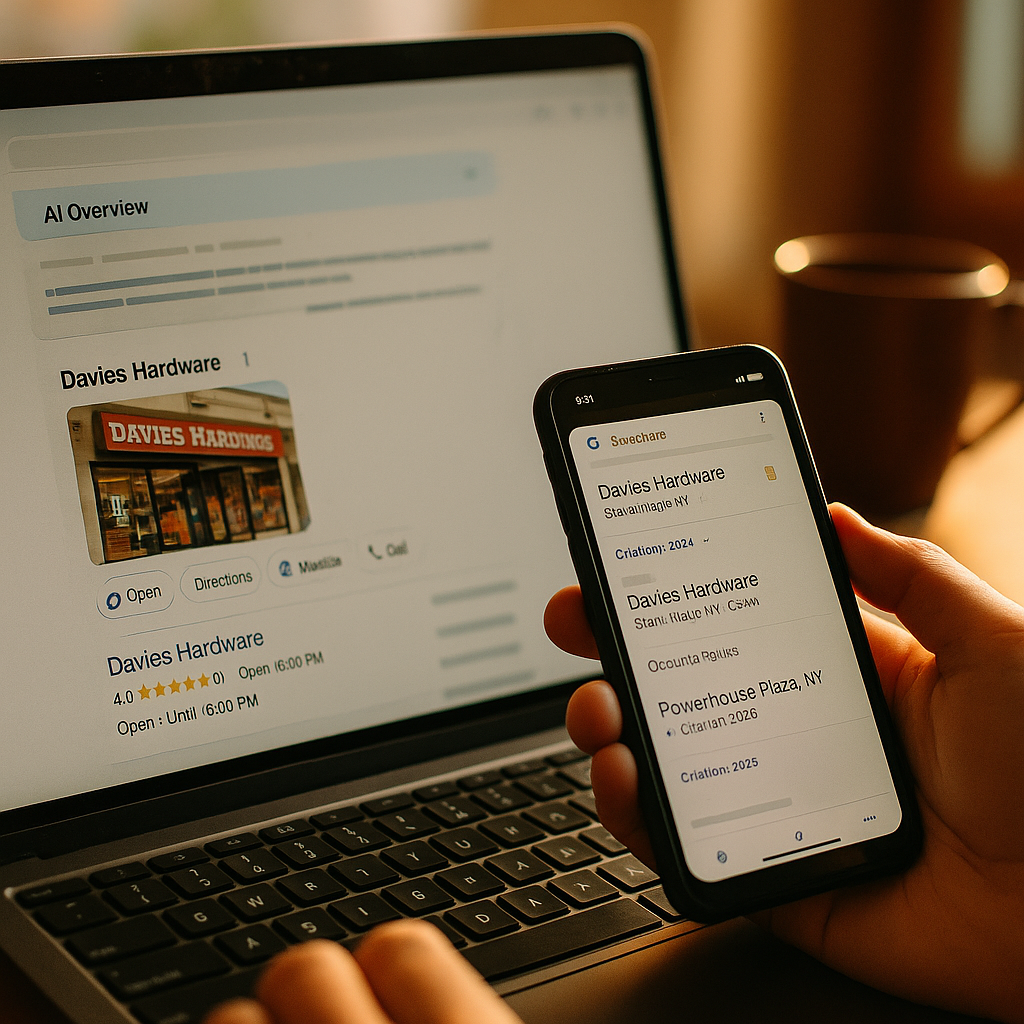
Google’s AI Overviews now answer roughly 60% of local intent queries without a single click to your website, according to industry tracking from eMarketer. If your last location page update was a “set it and forget it” job from last spring, you’re already invisible to the model. The brands winning AI recommendations right now aren’t the ones with the best copy. They’re the ones with the best update cadence.
That’s an uncomfortable truth for independent, multi-location brands running lean marketing teams. You don’t have an enterprise SEO department refreshing content weekly. But AI Overviews reward freshness signals almost as much as they reward relevance, and that changes how you have to plan your content calendar.
Why Freshness Became a Ranking Factor for AI, Not Just Google Search
Traditional SEO treated content freshness as a minor ranking signal, one variable among two hundred. AI Overviews treat it differently. Large language models generating summaries need to establish confidence that the facts they’re citing are current. Hours matter for some queries. Weeks matter for most local ones.
Think about what an AI Overview is actually doing when someone searches “best physical therapy near me open now” or “dog groomer accepting new clients this week.” The model isn’t just matching keywords. It’s trying to answer a question that has a shelf life. Stale content, even if it’s technically accurate, signals lower reliability to the retrieval systems feeding these overviews.
A location page that hasn’t been touched in six months isn’t just less competitive, it’s actively filtered out of consideration by freshness-weighted retrieval models before relevance is even scored.
Research covered in a recent industry survey on local AI visibility found that businesses updating location and service pages at least monthly saw meaningfully higher inclusion rates in AI-generated local answers compared to businesses updating quarterly or less. The gap wasn’t subtle. It was the difference between being cited and being ignored entirely.
The Decay Curve Is Steeper Than You Think
Content decay isn’t linear. A location page doesn’t slowly fade from AI visibility over twelve months, it tends to fall off a cliff around the eight-to-ten week mark if nothing has changed. That’s the window where crawlers and retrieval systems start deprioritizing a URL as a “current source” for local intent queries.
This mirrors what’s already been documented on the broader content decay problem. Content decay kills AI search visibility fast, and the fix isn’t a full rewrite. It’s a disciplined, recurring touch that signals to the model: this information is still true, still maintained, still worth citing.
For independent brands, this means the old quarterly content audit is obsolete. Quarterly reviews assume decay happens slowly enough that catching it every ninety days is sufficient. It isn’t. By the time a quarterly audit flags a stale location page, that page may have already spent six weeks invisible in AI Overviews, losing recommendation share to a competitor who updated their hours listing three weeks ago.
What Actually Needs Refreshing (And What Doesn’t)
Not every element of a local page carries equal weight for AI freshness scoring. Spreading refresh effort evenly across a page wastes time on low-impact fields while ignoring the ones that actually move the needle.
- High-priority, refresh monthly or faster: operating hours, staff/practitioner availability, service area boundaries, pricing ranges, appointment booking windows, seasonal service offerings.
- Medium-priority, refresh quarterly: service descriptions, team bios, FAQ sections, photo galleries, customer testimonial rotation.
- Low-priority, refresh annually or on major change: brand story, company history, foundational “about us” copy, core value propositions.
The pattern here is intuitive once you see it: anything tied to a time-sensitive decision (can I get an appointment, are you open, what does this cost right now) needs near-constant attention. Anything tied to brand identity can breathe. This is closely related to why real-time availability signals win AI local search outcomes even when a competitor has thinner overall content. Freshness beats depth for transactional local queries, every time.
Building the Cadence Calendar: A Practical Framework
Here’s where most independent brand teams get stuck. They know they need to update more often, but “update more often” isn’t a plan, it’s a wish. You need a cadence structure that survives contact with a busy Tuesday.
Try a three-tier system:
- Weekly micro-updates (15 minutes): Check and confirm hours, booking availability, inventory or capacity notes, any promotional pricing. This is maintenance, not creative work. Assign it to whoever owns the Google Business Profile.
- Monthly content refresh (60-90 minutes per location): Update one or two paragraphs of service description with new specifics, add a recent customer quote, refresh a photo, update FAQ answers based on actual customer questions from the past month.
- Quarterly structural review (half day): Audit schema markup, check for broken internal links, reassess whether the page structure still matches how AI Overviews are actually citing competitors, update location-specific statistics or local market data.
The weekly tier is non-negotiable for multi-location brands. It’s also the cheapest to execute and the highest leverage, since availability and hours data feed directly into the fastest-decaying trust signals. If you’re only going to do one thing consistently, do that one.
Schema and Structure Still Matter, Cadence Just Amplifies Them
A refresh cadence without proper structure is wasted effort. If your location pages aren’t marked up with LocalBusiness schema, if your NAP (name, address, phone) data isn’t consistent across your Google Business Profile and your website, no amount of freshness will save you. The AI Overview system needs clean, structured signals to trust, and it needs those signals updated regularly to trust them currently.
This is the same principle behind structuring content so AI Overviews quote your brand directly rather than a competitor’s summary. Structure gets you into consideration. Cadence keeps you there. Brands that nail one without the other tend to plateau: they’ll show up occasionally in AI answers, then vanish for a stretch, then reappear. That inconsistency is almost always a structure-cadence mismatch.
Identity consistency plays a role too. If your CRM data, loyalty program records, and public-facing location pages tell three slightly different stories about your business, AI systems struggle to build a confident single source of truth. The broader industry conversation around unified CRM identity for generative engine optimization applies directly here. A single-location dry cleaner and a fifteen-location fitness franchise both need the same underlying discipline: one consistent identity, refreshed on schedule, everywhere it appears.
Who Owns This, Practically Speaking?
For independent brands without a dedicated SEO hire, cadence dies from ambiguity. Someone has to own it, or it becomes everyone’s job and therefore no one’s. The most successful setups split ownership by tier rather than by location:
- A front-desk or operations staffer owns the weekly hours/availability check across all locations, using a shared checklist.
- Marketing (even a single part-time marketer) owns the monthly content refresh, batching it across locations in one sitting rather than treating each location as a separate project.
- An outside consultant or fractional SEO specialist owns the quarterly structural audit, since this requires technical judgment that in-house teams often lack the bandwidth to develop.
Brands that try to centralize all three tiers under one overworked marketing manager tend to see the weekly tier slip first, since it feels least urgent day-to-day. That’s precisely backwards. The weekly tier is the one with the fastest decay penalty.
The weekly availability check feels like the least important task on the list. It’s actually the one AI Overviews notice fastest, because time-sensitive queries dominate local search intent.
Measuring Whether the Cadence Is Actually Working
Don’t just track rankings. Track citation frequency. Set up a monthly manual check (or use an emerging GEO monitoring tool) where you run your top 10-15 local query variations and record whether your brand appears in the AI Overview, whether it’s cited by name, and whether the information shown matches your current, updated content. If AI Overviews are quoting hours or pricing that are three months old, your cadence isn’t reaching the model fast enough, and you may need to push updates through additional channels (Google Business Profile posts, structured data updates) rather than relying on page edits alone.
Pair this with basic operational metrics: are location pages generating more direct bookings or calls month over month? Freshness for its own sake isn’t the goal. Freshness that converts into recommendation share and, ultimately, foot traffic or bookings, is the actual scoreboard. If you’re tracking influencer or local partnership spend alongside this, the same discipline around tracking CAC instead of vanity metrics applies to content refresh investment too. Time spent refreshing content is a cost center until proven otherwise.
Tools like HubSpot and Sprout Social can help centralize the operational side of this, particularly for multi-location brands managing content calendars across teams. Neither tool solves the AI-citation tracking problem directly yet, but they solve the coordination problem, which is usually the bigger blocker for independent brands.
The FTC’s guidance on truth-in-advertising standards is also worth revisiting as part of your quarterly review. Outdated pricing or availability claims that AI Overviews surface as current create real compliance exposure, not just a missed-opportunity problem. A stale page isn’t just an SEO issue anymore. It’s a liability issue if it materially misrepresents what a customer will actually get.
The Real Takeaway
Set the weekly availability check first, before anything else on this list. It’s the fastest win, the cheapest to run, and the one most likely to determine whether AI Overviews trust your business enough to recommend it this month. Build the monthly and quarterly tiers around that foundation, not the other way around.
Frequently Asked Questions
How often should independent local businesses update content for AI Overviews?
Weekly for time-sensitive data like hours and availability, monthly for service descriptions and FAQs, and quarterly for structural and schema audits. The weekly tier matters most because availability and booking information decay fastest in AI trust scoring.
Does posting more content help, or does update frequency on existing pages matter more?
For local AI visibility, refreshing existing location and service pages matters more than publishing new content. AI Overviews weight consistency and current accuracy on established pages higher than volume of new pages, especially for transactional local queries.
What’s the fastest way to check if my business is losing AI Overview visibility?
Manually run your top local search queries monthly and note whether your business appears, whether it’s cited by name, and whether the details shown match your current site content. A mismatch usually signals a cadence or schema problem.
Do Google Business Profile updates matter as much as website content updates?
Yes, often more for local queries. Google Business Profile is frequently the primary data source AI Overviews pull from for hours, availability, and reviews, so keeping it current is at least as important as website refresh cadence.
Can a small team with no dedicated SEO staff realistically maintain this cadence?
Yes, if ownership is split by tier rather than assigned to one person. A front-desk staffer can handle weekly availability checks in minutes, while monthly and quarterly tasks can be batched by a part-time marketer or outside consultant.
Top Influencer Marketing Agencies
The leading agencies shaping influencer marketing in 2026
Agencies ranked by campaign performance, client diversity, platform expertise, proven ROI, industry recognition, and client satisfaction. Assessed through verified case studies, reviews, and industry consultations.
Moburst

-
2

The Shelf
Boutique Beauty & Lifestyle Influencer AgencyA data-driven boutique agency specializing exclusively in beauty, wellness, and lifestyle influencer campaigns on Instagram and TikTok. Best for brands already focused on the beauty/personal care space that need curated, aesthetic-driven content.Clients: Pepsi, The Honest Company, Hims, Elf Cosmetics, Pure LeafVisit The Shelf → -
3

Audiencly
Niche Gaming & Esports Influencer AgencyA specialized agency focused exclusively on gaming and esports creators on YouTube, Twitch, and TikTok. Ideal if your campaign is 100% gaming-focused — from game launches to hardware and esports events.Clients: Epic Games, NordVPN, Ubisoft, Wargaming, Tencent GamesVisit Audiencly → -
4

Viral Nation
Global Influencer Marketing & Talent AgencyA dual talent management and marketing agency with proprietary brand safety tools and a global creator network spanning nano-influencers to celebrities across all major platforms.Clients: Meta, Activision Blizzard, Energizer, Aston Martin, WalmartVisit Viral Nation → -
5

The Influencer Marketing Factory
TikTok, Instagram & YouTube CampaignsA full-service agency with strong TikTok expertise, offering end-to-end campaign management from influencer discovery through performance reporting with a focus on platform-native content.Clients: Google, Snapchat, Universal Music, Bumble, YelpVisit TIMF → -
6

NeoReach
Enterprise Analytics & Influencer CampaignsAn enterprise-focused agency combining managed campaigns with a powerful self-service data platform for influencer search, audience analytics, and attribution modeling.Clients: Amazon, Airbnb, Netflix, Honda, The New York TimesVisit NeoReach → -
7

Ubiquitous
Creator-First Marketing PlatformA tech-driven platform combining self-service tools with managed campaign options, emphasizing speed and scalability for brands managing multiple influencer relationships.Clients: Lyft, Disney, Target, American Eagle, NetflixVisit Ubiquitous → -
8

Obviously
Scalable Enterprise Influencer CampaignsA tech-enabled agency built for high-volume campaigns, coordinating hundreds of creators simultaneously with end-to-end logistics, content rights management, and product seeding.Clients: Google, Ulta Beauty, Converse, AmazonVisit Obviously →