


The $8,000-a-Month Question Every E-Commerce Brand Is Asking Right Now
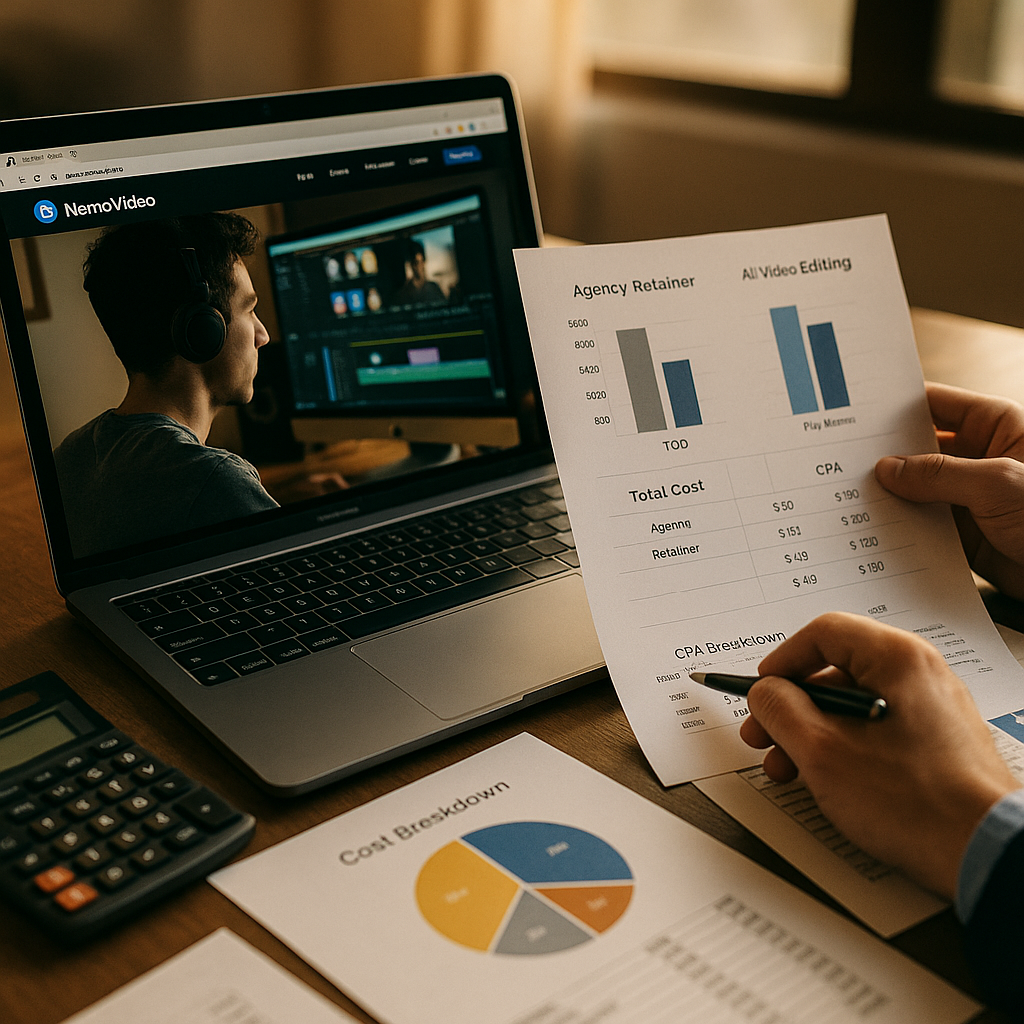
If your video production retainer is consuming 15–20% of your paid media budget before a single ad goes live, you have a cost structure problem. The rise of NemoVideo AI video editing agent tools has forced a genuine reckoning: not “AI versus humans,” but “what does each model actually cost per acquisition?” That’s the only number that matters.
What You’re Actually Buying With an Agency Retainer
A traditional video production retainer for e-commerce typically bundles creative strategy, scripting, shoot coordination, editing, motion graphics, and revision cycles into a monthly fee. Mid-tier agencies charge $6,000–$12,000/month for a dedicated video package. Enterprise retainers with full creative direction routinely exceed $20,000/month.
That sounds like a lot. Sometimes it is the right call. A seasoned creative director brings brand intuition, trend sensitivity, and cross-platform experience that no model has replicated at scale. But be honest about what you’re paying for versus what you’re getting. Most e-commerce brands on a retainer receive four to eight edited ad variants per month. Do the math: at $8,000/month, you’re spending $1,000–$2,000 per creative asset before any media spend touches it.
The hidden costs compound quickly. Rush revision fees. Licensing disputes on stock footage. Onboarding time when a creative lead turns over. These are real line items that rarely appear in the pitch deck.
NemoVideo’s Cost Model: What the Numbers Actually Look Like
NemoVideo operates as an agentic AI video editing system, ingesting raw footage or product assets and generating platform-formatted ad creatives with minimal human intervention. You can review NemoVideo performance benchmarks for context on output quality at scale, but the cost conversation is where the model becomes operationally interesting.
At current pricing tiers, NemoVideo’s subscription plans for production-scale e-commerce brands range from roughly $500–$1,500/month depending on volume and export resolution. Some brands running direct-to-consumer SKUs on TikTok Ads and Meta report generating 40–80 ad variants per month at that price point. That’s a per-asset cost of $18–$37, compared to the $1,000+ figure above.
When you’re running performance creative at volume, the per-asset cost gap between AI production tools and agency retainers can exceed 20x. That delta doesn’t automatically translate to better CPA, but it fundamentally changes how aggressively you can test creative hypotheses.
The honest caveat: those 80 variants are only valuable if you have a testing framework to evaluate them. Volume without attribution discipline is noise. For brands building that infrastructure, see how CRM attribution models can connect creative output to actual revenue events.
CPA Comparison: Actual Data From the Field
CPA is where the theoretical cost advantage either holds or falls apart. Here’s what the available data suggests.
According to research from eMarketer, e-commerce brands that increased creative testing velocity by 3x or more saw average CPA reductions of 18–24% over 90-day periods. That finding is platform-agnostic but directionally consistent with what performance marketers report: more creative iterations mean faster identification of winning hooks, formats, and CTAs. AI video tools enable that iteration volume at a cost most agencies simply cannot match.
But agencies have a counter-argument that holds in specific contexts. For high-AOV categories (luxury goods, premium skincare, B2B software with video components), creative quality and brand coherence correlate strongly with conversion. A $300 CPM campaign for a $1,200 product lives and dies on brand trust signals. Agentic AI tools, including NemoVideo, still produce perceptibly templated output in some format categories. Sophisticated buyers notice.
The middle ground: a hybrid production model. Use AI tooling for performance creative at the top and middle of funnel. Reserve agency-level production for brand campaigns, high-AOV launches, and creator partnership content where the craft premium justifies the cost. You can explore the AI video vs. manual production comparison for a more granular breakdown of where each model wins on CPA by category.
TCO Variables Most Brand Teams Ignore
Total cost of ownership goes beyond the invoice. Here’s what gets missed:
- Ramp time: An agency retainer typically requires 4–6 weeks of onboarding before production velocity reaches baseline. NemoVideo deploys in days. For brands running seasonal campaigns or responding to trend windows, that speed differential is worth real money.
- IP and licensing: Agency-produced content introduces music licensing, talent rights, and usage window variables. AI-generated content has its own IP ambiguity, but the liability structure is different. Consult your legal team, and stay current with FTC guidance on AI-generated advertising disclosure.
- Internal bandwidth: AI tools require an internal operator with enough creative judgment to brief, review, and iterate. If that person doesn’t exist on your team, the output will be mediocre. Agencies bundle that expertise. Neither model is “hands-off.”
- Platform optimization: NemoVideo’s output is designed for Meta and TikTok format specs. If your channel mix includes YouTube long-form, OTT, or CTV, evaluate whether the tool’s output actually covers your distribution needs. For YouTube-specific planning, the YouTube scheduling and brand safety guide is worth bookmarking.
- Contract flexibility: A 12-month agency retainer locks capital. SaaS subscriptions for AI tools are monthly or quarterly. In a volatile media environment, optionality has real value.
How to Structure the Decision for Your Brand
Run a 90-day parallel test if you have the operational capacity. Keep the agency retainer for brand-tier production. Activate NemoVideo (or a comparable AI video agent) for performance creative. Measure CPA by creative source, not just by campaign. This gives you real comparative data instead of theoretical projections.
If your current blended CPA from agency-produced performance creative is above $45 for a sub-$100 AOV product, the math almost always favors shifting volume to AI production. If your AOV is above $200 and brand equity is a meaningful purchase driver, the agency relationship earns its cost more readily.
The question isn’t which model is superior in the abstract. It’s which model produces the lowest CPA for your specific product, funnel, and audience at your current scale.
For brands assessing how AI tools fit into a broader martech stack, the all-in-one AI platform vs. point solutions framework offers a useful consolidation lens. And if you’re tracking NemoVideo’s ROI specifically on TikTok and Meta, there’s direct performance data in the NemoVideo TikTok and Meta ROI breakdown.
One more consideration: platform algorithm dynamics favor fresh creative. Meta’s ad delivery system actively deprioritizes fatigued creatives, and the best antidote is rotation velocity. AI production tools make that velocity structurally achievable in a way monthly agency deliverables cannot.
Start by auditing your current cost-per-asset and measuring it against CPA by creative type. If that data doesn’t exist in your reporting stack, that gap is the first problem to solve.
FAQ
What is NemoVideo and how does it work for e-commerce brands?
NemoVideo is an agentic AI video editing tool that takes raw product footage or asset libraries and generates platform-formatted ad creatives automatically. For e-commerce brands, it significantly reduces the per-asset cost of video production by replacing manual editing workflows with AI-driven processing, enabling higher creative volume at lower cost.
How does the CPA from AI-generated video ads compare to agency-produced ads?
CPA outcomes depend heavily on creative quality, product category, and testing discipline. Brands that use AI tools to increase testing velocity typically see CPA improvements of 18–24% over 90-day periods because they can identify winning creative hooks faster. However, for high-AOV products where brand trust drives conversion, agency-produced creative often maintains a quality advantage that justifies higher production costs.
What is included in the total cost of ownership for an agency video retainer?
Beyond the monthly retainer fee, TCO for agency video includes onboarding time (typically 4–6 weeks), revision and rush fees, music and talent licensing, account management overhead, and the risk of creative turnover. These hidden costs can increase the effective per-asset price significantly above the headline retainer figure.
Is NemoVideo suitable for all video ad formats and platforms?
NemoVideo is optimized primarily for Meta and TikTok short-form ad formats. Brands with a channel mix that includes YouTube long-form, OTT, or CTV should evaluate whether the tool’s output covers those specifications. For multi-platform campaigns, a hybrid model combining AI production for performance formats and agency production for brand-tier placements is often more effective.
When does a traditional agency retainer make more financial sense than an AI video tool?
Agency retainers tend to offer stronger ROI for brands with high AOV products (above $200), campaigns requiring tight brand coherence, launches that demand original cinematography, and creator partnership content where the production craft signals brand quality to a discerning audience. The agency model also suits teams that lack internal creative operators capable of briefing and iterating with AI tools effectively.
Can brands run both NemoVideo and an agency retainer simultaneously?
Yes, and a parallel model is often the most data-driven approach. Running AI-generated performance creative alongside agency-produced brand creative, with CPA tracked by source, generates real comparative data within 90 days. This approach lets brands shift budget allocation based on actual performance rather than assumptions about which model is superior.
Top Influencer Marketing Agencies
The leading agencies shaping influencer marketing in 2026
Agencies ranked by campaign performance, client diversity, platform expertise, proven ROI, industry recognition, and client satisfaction. Assessed through verified case studies, reviews, and industry consultations.
Moburst

-
2

The Shelf
Boutique Beauty & Lifestyle Influencer AgencyA data-driven boutique agency specializing exclusively in beauty, wellness, and lifestyle influencer campaigns on Instagram and TikTok. Best for brands already focused on the beauty/personal care space that need curated, aesthetic-driven content.Clients: Pepsi, The Honest Company, Hims, Elf Cosmetics, Pure LeafVisit The Shelf → -
3

Audiencly
Niche Gaming & Esports Influencer AgencyA specialized agency focused exclusively on gaming and esports creators on YouTube, Twitch, and TikTok. Ideal if your campaign is 100% gaming-focused — from game launches to hardware and esports events.Clients: Epic Games, NordVPN, Ubisoft, Wargaming, Tencent GamesVisit Audiencly → -
4

Viral Nation
Global Influencer Marketing & Talent AgencyA dual talent management and marketing agency with proprietary brand safety tools and a global creator network spanning nano-influencers to celebrities across all major platforms.Clients: Meta, Activision Blizzard, Energizer, Aston Martin, WalmartVisit Viral Nation → -
5

The Influencer Marketing Factory
TikTok, Instagram & YouTube CampaignsA full-service agency with strong TikTok expertise, offering end-to-end campaign management from influencer discovery through performance reporting with a focus on platform-native content.Clients: Google, Snapchat, Universal Music, Bumble, YelpVisit TIMF → -
6

NeoReach
Enterprise Analytics & Influencer CampaignsAn enterprise-focused agency combining managed campaigns with a powerful self-service data platform for influencer search, audience analytics, and attribution modeling.Clients: Amazon, Airbnb, Netflix, Honda, The New York TimesVisit NeoReach → -
7

Ubiquitous
Creator-First Marketing PlatformA tech-driven platform combining self-service tools with managed campaign options, emphasizing speed and scalability for brands managing multiple influencer relationships.Clients: Lyft, Disney, Target, American Eagle, NetflixVisit Ubiquitous → -
8

Obviously
Scalable Enterprise Influencer CampaignsA tech-enabled agency built for high-volume campaigns, coordinating hundreds of creators simultaneously with end-to-end logistics, content rights management, and product seeding.Clients: Google, Ulta Beauty, Converse, AmazonVisit Obviously →