


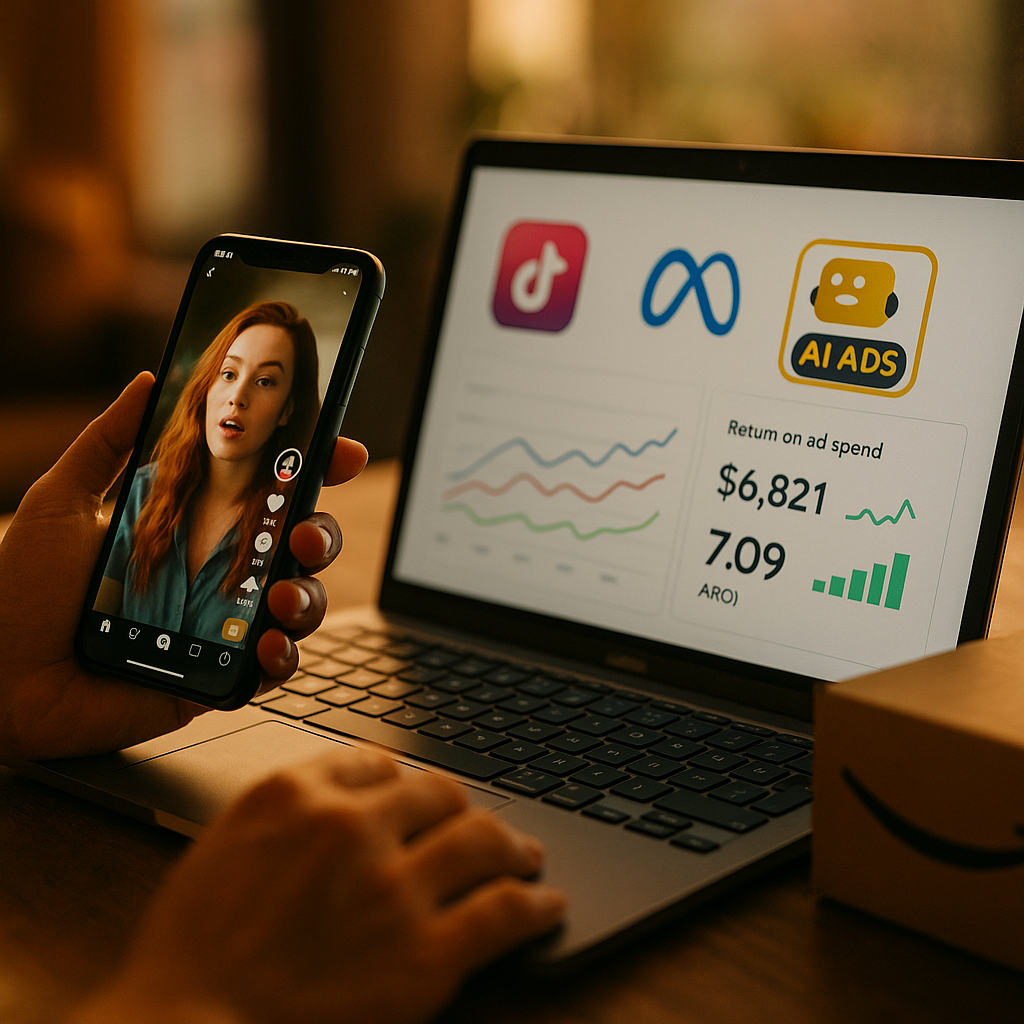
A Single Product Link. Hundreds of Ads. Is That Actually a Good Idea?
NemoVideo and similar AI video production platforms claim they can ingest a product URL and output ready-to-run TikTok and Meta ads in minutes. The pitch is compelling. The risk calculus is more complicated. For e-commerce brands managing large SKU catalogs and aggressive paid social budgets, evaluating automated product-link-to-ad pipelines against manual production is now a tier-one strategic decision, not an experiment to hand off to a junior media buyer.
What NemoVideo Actually Does (and Where the Category Is Heading)
NemoVideo sits inside a growing category of AI video generation platforms that pull structured product data from a URL, extract imagery and copy, and assemble short-form video creatives formatted for TikTok and Meta placements. The workflow collapses what used to take a creative team days into something closer to a batch job.
The platform generates voiceovers, overlays motion graphics, applies platform-native aspect ratios, and can produce multiple variations for A/B testing from a single input. Competitors in the same space include Oxolo, Creatify, and Arcads, each with slightly different positioning around avatar use, script customization, and catalog integration depth.
Where the category is heading is more interesting than where it is today. Expect tighter native integrations with TikTok Ads Manager and Meta’s ad infrastructure, dynamic creative optimization built directly into the generation layer, and real-time performance feedback loops that retrain creative templates. The pipeline from product catalog to live ad unit is getting shorter every quarter.
The Real Cost Comparison: Beyond the Rate Card
The instinct is to compare NemoVideo’s subscription cost against a production studio day rate. That is the wrong comparison.
Manual production for TikTok and Meta typically bundles creative strategy, scripting, talent sourcing, shoot logistics, post-production, and platform formatting. For a mid-market e-commerce brand running 40-plus SKUs with seasonal creative refreshes, that stack can run $15,000 to $60,000 per quarter depending on volume and agency markup. AI pipeline tools collapse several of those cost centers simultaneously.
But the hidden costs on the AI side are real. You need someone who can audit output quality at scale, manage brand safety guardrails, QA voiceover accuracy against product claims, and flag creative that inadvertently violates FTC disclosure requirements when AI-generated talent or synthetic voice is used. That oversight role is not optional. It is a compliance function.
AI video generation reduces production labor costs significantly, but brands that eliminate human creative review entirely expose themselves to brand safety violations and platform policy flags that can suppress ad delivery without warning.
For a sharper view of how AI tools interact with attribution and platform compliance, the multimodal AI creative pipeline framework offers a useful structural model for brand teams thinking through these tradeoffs.
Performance on TikTok vs. Meta: Different Platforms, Different Failure Modes
TikTok and Meta reward creative differently, and this is where automated pipelines can quietly underperform without obvious red flags in the dashboard.
TikTok’s algorithm heavily weights content that feels native to the feed. Organic-style filming, trending audio hooks, creator-led framing. AI-generated video, particularly output that relies on product image compositing and synthetic voiceover, can struggle to pass the “native content” test that TikTok’s delivery system implicitly applies. CPMs may look normal while frequency-adjusted reach quietly deteriorates.
Meta’s environment is more forgiving of polished, produced creative, which means AI-generated output can perform adequately on static-heavy placements in Feed and Marketplace. Where it falls down is Reels, where the same authenticity bias that governs TikTok now applies. Brands running heavy Reels budgets should not assume that an AI pipeline built for Feed will transfer cleanly.
The practical implication: test AI pipeline output against manual production in controlled creative experiments, with spend split by placement type, not just by campaign objective. Attribution models that collapse all conversions into a single CPA view will mask placement-level performance differences that matter enormously for budget allocation decisions. Revisiting your attribution model setup before running this kind of test is worth the time.
Where Automated Pipelines Win Outright
There are specific use cases where NemoVideo-style tools are genuinely superior to manual production, and brands should lean into them deliberately rather than treating AI video as a broad replacement strategy.
- Catalog-wide refresh at launch: When a brand needs to get 50-plus SKUs into paid social rotation quickly, manual production cannot scale. AI pipelines can produce a functional creative foundation across the full catalog in days.
- Rapid promotional response: Flash sales, restocks, and reactive campaign moments require speed that manual production cannot match. AI generation eliminates the 48-72 hour production lag.
- Variation testing at volume: Generating 20 creative variants from a single script to feed an algorithmic creative optimizer is exactly the kind of repetitive, structured task AI pipelines handle well.
- Lower-funnel retargeting: For audiences already familiar with the brand, creative novelty matters less than message relevance. AI-generated product-specific retargeting ads can outperform expensive manual production in this context because the creative job is simpler.
The pattern here is not “AI vs. human.” It is matching production method to creative complexity. When the creative job is simple and the volume requirement is high, AI wins on economics. When the creative job requires cultural nuance, humor, or genuine storytelling, manual or creator-led production wins on performance.
This connects directly to how brands should structure their broader AI platform decisions: point solutions like NemoVideo work well for defined, repeatable tasks, but they need to sit inside a coherent stack strategy, not operate as isolated experiments.
Evaluating Pipeline Vendors: The Questions That Actually Matter
When procurement or marketing ops teams evaluate NemoVideo against alternatives, the standard vendor checklist misses the questions that determine whether the tool will actually improve campaign performance.
Ask these instead:
- How does the platform handle dynamic pricing and inventory signals? If your product feed changes daily and the ad copy does not update accordingly, you have a compliance and customer experience problem, not just a creative one.
- What brand safety controls exist at the output level? Can you restrict color palettes, logo placement, competitive brand adjacency, and voiceover tone before the creative goes to QA review?
- How does the platform integrate with your existing creative testing infrastructure? If NemoVideo output cannot feed directly into your Meta creative A/B testing workflow or TikTok’s Smart+ campaigns, you are adding a manual handoff step that erodes the speed advantage.
- What happens to your creative assets if you cancel? Vendor lock-in risk in AI creative platforms is real. Make sure output files are exportable in standard formats and that your creative library is not held inside a proprietary system.
For teams building longer-term vetting processes, the creator tech stack vetting methodology applies here even though NemoVideo is a production tool rather than a creator platform. The vendor risk assessment framework transfers directly.
The brands extracting real ROI from AI video pipelines are not the ones who replaced their production budget wholesale. They are the ones who identified the specific creative tasks where AI has a structural advantage and redeployed human creative resources toward higher-complexity work.
Industry benchmark data from eMarketer and Sprout Social consistently shows that creative quality remains the single largest driver of paid social performance variance. Automation that reduces creative quality while improving production speed is not a net positive. The evaluation framework has to hold both variables simultaneously.
The Operational Reality for Brand Teams in Practice
The brands that struggle most with AI video pipelines are not those who adopted too slowly. They are the ones who adopted without changing the surrounding workflow. NemoVideo or any comparable platform drops into an existing paid social operation and immediately creates pressure on QA processes, brand guidelines enforcement, and creative performance review cadences.
If your creative review process was built around a weekly production batch from an agency, it will not handle the continuous output that AI pipelines can generate. You need faster QA gates, clearer brand guardrails documented in a format that can inform AI prompt engineering, and a performance review cadence that can detect creative fatigue signals at higher volume.
The TikTok Shop and social commerce AI stack considerations are particularly relevant for e-commerce brands integrating product-link pipelines with shoppable ad formats, where the attribution chain from video creative to purchase is more direct and the consequences of creative errors are more immediately measurable.
Run a 60-day structured pilot before committing budget. Segment by placement, compare CPA and ROAS against manual creative baselines, and measure creative fatigue rates (frequency-adjusted CTR decline) as a leading indicator of output quality. That data will tell you more than any vendor case study.
FAQ
Frequently Asked Questions
What is NemoVideo and how does it work for e-commerce advertising?
NemoVideo is an AI video production platform that ingests a product URL, extracts product data and imagery, and automatically generates short-form video ads formatted for platforms like TikTok and Meta. It is designed to reduce production time and cost for e-commerce brands managing large SKU catalogs or requiring frequent creative refreshes.
How does AI-generated video perform compared to manually produced creative on TikTok?
Performance varies significantly by use case. AI-generated video tends to underperform manual or creator-led production in TikTok’s native feed environment where authenticity signals matter most, but can be competitive or superior in lower-funnel retargeting contexts, rapid promotional campaigns, and high-volume variation testing scenarios where speed and scale outweigh creative nuance.
What are the compliance risks of using AI video generation tools for paid social ads?
Key compliance risks include FTC disclosure requirements around the use of synthetic voices or AI-generated talent, accuracy of product claims in auto-generated copy, and platform policy flags related to misleading creative. Brands should maintain human review processes even when using automated pipelines and ensure AI-generated content meets the same disclosure standards as human-produced creative.
How should e-commerce brands structure a pilot test for NemoVideo or similar tools?
Run a 60-day structured pilot with spend segmented by placement type (Feed, Reels, TikTok In-Feed). Compare AI-generated creative against manual production baselines on CPA, ROAS, and frequency-adjusted CTR. Avoid evaluating performance in aggregate, as placement-level differences can be significant and will directly influence budget allocation decisions.
What is the biggest operational mistake brands make when adopting AI video pipelines?
The most common mistake is adopting an AI video pipeline without updating the surrounding workflow. Existing QA processes, brand guideline enforcement mechanisms, and creative review cadences are typically built for lower-volume manual production. AI pipelines generate creative at a pace that breaks those processes, leading to brand safety issues and inconsistent output quality entering live campaigns.
Top Influencer Marketing Agencies
The leading agencies shaping influencer marketing in 2026
Agencies ranked by campaign performance, client diversity, platform expertise, proven ROI, industry recognition, and client satisfaction. Assessed through verified case studies, reviews, and industry consultations.
Moburst

-
2

The Shelf
Boutique Beauty & Lifestyle Influencer AgencyA data-driven boutique agency specializing exclusively in beauty, wellness, and lifestyle influencer campaigns on Instagram and TikTok. Best for brands already focused on the beauty/personal care space that need curated, aesthetic-driven content.Clients: Pepsi, The Honest Company, Hims, Elf Cosmetics, Pure LeafVisit The Shelf → -
3

Audiencly
Niche Gaming & Esports Influencer AgencyA specialized agency focused exclusively on gaming and esports creators on YouTube, Twitch, and TikTok. Ideal if your campaign is 100% gaming-focused — from game launches to hardware and esports events.Clients: Epic Games, NordVPN, Ubisoft, Wargaming, Tencent GamesVisit Audiencly → -
4

Viral Nation
Global Influencer Marketing & Talent AgencyA dual talent management and marketing agency with proprietary brand safety tools and a global creator network spanning nano-influencers to celebrities across all major platforms.Clients: Meta, Activision Blizzard, Energizer, Aston Martin, WalmartVisit Viral Nation → -
5

The Influencer Marketing Factory
TikTok, Instagram & YouTube CampaignsA full-service agency with strong TikTok expertise, offering end-to-end campaign management from influencer discovery through performance reporting with a focus on platform-native content.Clients: Google, Snapchat, Universal Music, Bumble, YelpVisit TIMF → -
6

NeoReach
Enterprise Analytics & Influencer CampaignsAn enterprise-focused agency combining managed campaigns with a powerful self-service data platform for influencer search, audience analytics, and attribution modeling.Clients: Amazon, Airbnb, Netflix, Honda, The New York TimesVisit NeoReach → -
7

Ubiquitous
Creator-First Marketing PlatformA tech-driven platform combining self-service tools with managed campaign options, emphasizing speed and scalability for brands managing multiple influencer relationships.Clients: Lyft, Disney, Target, American Eagle, NetflixVisit Ubiquitous → -
8

Obviously
Scalable Enterprise Influencer CampaignsA tech-enabled agency built for high-volume campaigns, coordinating hundreds of creators simultaneously with end-to-end logistics, content rights management, and product seeding.Clients: Google, Ulta Beauty, Converse, AmazonVisit Obviously →