


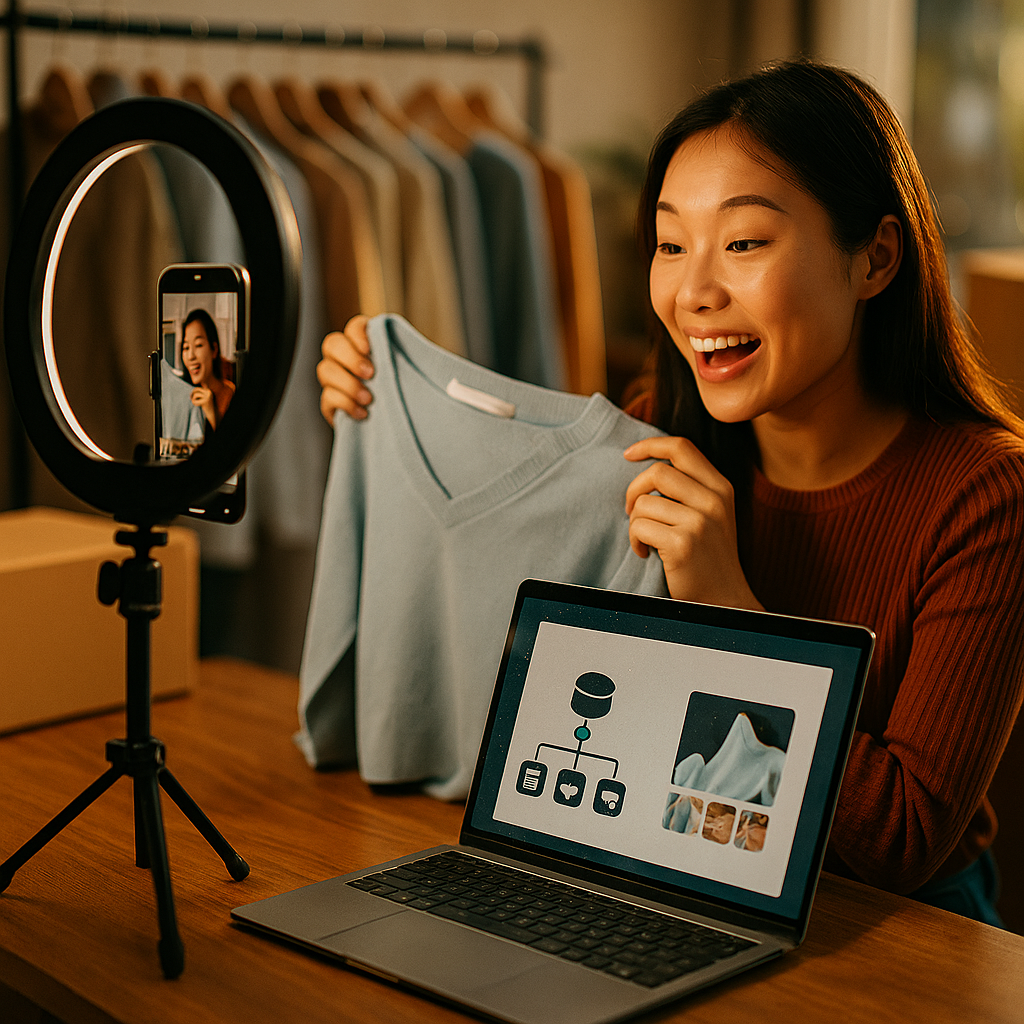
Social commerce is projected to exceed $1 trillion in global GMV by the end of this decade, yet most brands are running three disconnected tools and calling it a strategy. The social commerce AI integration stack is where that gap gets exposed — and where competitive advantage is actually built.
Why Most Brands Are Failing at Social Commerce Architecture
The problem is rarely ambition. Brands have TikTok Shop accounts, they’ve tested livestream formats, and they’ve bolted on an AI recommendation engine from a vendor promising lift. What they don’t have is a coherent architecture that makes these components talk to each other, share signals, and compound results over time.
Consider what happens during a peak livestream event. A creator drives 40,000 concurrent viewers to a TikTok Shop product drop. The recommendation engine, siloed in your e-commerce platform, has no awareness of what’s being shown on stream. The checkout data doesn’t flow back to your CRM in real time. Attribution breaks. You end up with a vanity GMV number and no learnable signal for the next activation.
A social commerce stack is only as strong as its weakest data handoff. If your livestream infrastructure, recommendation layer, and CRM aren’t sharing event-level signals in near real time, you’re not doing social commerce — you’re doing social marketing with a buy button attached.
This is an integration problem masquerading as a platform problem. And it requires a systems-level answer.
The Three-Layer Architecture You Actually Need
Think of social commerce infrastructure in three horizontal layers: the commerce surface layer, the intelligence layer, and the data and attribution layer. Every vendor decision you make should be evaluated against how cleanly it connects to the other two layers — not just what features it offers in isolation.
Layer 1: Commerce Surfaces. This includes TikTok Shop, Instagram Shopping, YouTube’s shoppable formats (see how TikTok Shop compares to YouTube formats), and any owned livestream environments you’re building via tools like Firework, Livescale, or CommentSold. Each surface has its own checkout flow, product catalog feed requirements, and creator compensation mechanics. Your architecture needs to normalize these differences, not paper over them.
Layer 2: Intelligence. This is where AI recommendation engines, dynamic pricing models, and real-time audience segmentation live. Platforms like Nosto, Bloomreach, and Constructor.io operate here. The critical question isn’t which engine produces the best recommendations in a lab environment — it’s which one can ingest live behavioral signals from a streaming session and update recommendations mid-broadcast.
Layer 3: Data and Attribution. The most overlooked layer and the most consequential. If your commerce surfaces and intelligence tools aren’t feeding a unified customer data infrastructure, you’re generating revenue without generating learning. This is where CRM attribution for creator campaigns becomes non-negotiable for CMOs who need to justify the investment to a CFO.
Evaluating TikTok Shop as Infrastructure, Not Just a Channel
TikTok Shop has matured rapidly. It’s no longer accurate to treat it purely as a discovery channel with a checkout add-on. TikTok for Business now offers API-level product catalog syncing, affiliate creator management, and Shop Ads that can be targeted with performance marketing precision. For brands serious about social commerce, this means TikTok Shop needs to be evaluated alongside Shopify and your ERP — not alongside Instagram Stories.
The integration complexity is real. Product catalog sync errors are the most common failure point. Brands that run large SKU catalogs (thousands of products) frequently encounter attribute mapping issues that cause incorrect pricing, missing variants, or broken checkout flows. Solve this before you scale creator volume, not after.
Also worth understanding: TikTok Shop’s affiliate ecosystem creates a data fragmentation problem by design. Each creator who tags your product generates their own transaction trail. Without a systematic approach to creator attribution and audience matching, you’ll never know which creator cohort is driving incremental buyers versus brand loyalists who would have purchased anyway.
What AI-Driven Recommendation Engines Get Wrong in Live Commerce
Most recommendation engines were built for session-based e-commerce: user lands on a page, browses, gets recommendations, converts or doesn’t. Livestream commerce breaks that model entirely.
In a livestream session, intent signals are compressed and volatile. A viewer might spend 45 seconds watching a demo of a product they’ve never seen before and convert on the spot. Standard collaborative filtering, which relies on historical browse and purchase data, has almost nothing to work with in that window. The engines that perform best in live environments are those with real-time event stream processing capabilities, specifically the ability to ingest engagement signals (comments, reactions, shares, time-on-stream) as behavioral inputs alongside transactional history.
When evaluating vendors, ask specifically: does your recommendation API support event-stream integration via Kafka or similar, and what is your latency SLA for real-time personalization? Any answer longer than 250ms is a problem for a high-concurrency livestream environment. For a deeper look at how AI tooling decisions ripple through total cost of ownership, the TCO framework for AI video tools offers a useful evaluative lens that translates to recommendation infrastructure as well.
Livestream Infrastructure: Build, Buy, or Broker?
This is the decision most brands get wrong because they frame it as a content question when it’s an infrastructure question.
Building a proprietary livestream commerce environment (via platforms like cloud-native streaming infrastructure) gives you full data ownership, custom checkout integration, and the ability to run A/B tests on overlay formats, product sequencing, and creator scripts. It’s the right call for brands doing sustained, high-frequency live commerce with a dedicated production team. The tradeoff: audience acquisition is entirely your responsibility.
Brokering distribution through TikTok LIVE or YouTube Live means you’re borrowing a built-in audience. Discovery is easier. But the data you get back is platform-mediated, and your ability to stitch viewer behavior to downstream CRM records is limited by API policies that change without warning. For brands evaluating the right streaming platform for live brand activations, the decision tree almost always comes down to audience ownership versus audience access.
A hybrid model is increasingly common: use native platform streaming for acquisition-stage events, then migrate high-value customers to owned environments for retention-stage live commerce. Each serves a different funnel position and requires a different data integration approach.
Connecting the Stack: Where Integration Actually Breaks
Four failure points appear consistently in enterprise social commerce deployments:
- Catalog synchronization latency: Product data that’s out of sync across commerce surfaces creates oversells, wrong pricing displays, and checkout abandonment. Real-time catalog feeds via middleware (Channable, Feedonomics, or custom ETL pipelines) are table stakes.
- Identity fragmentation: A buyer who watched a TikTok LIVE, clicked through to your Shopify store, and completed checkout on mobile is three different anonymous users in three different systems until you resolve their identity. This is where identity resolution for UGC and audience activation becomes a stack requirement, not a nice-to-have.
- Attribution window misalignment: Social commerce conversions often happen 24-72 hours after a livestream ends, as viewers revisit a product after thinking about it. If your attribution windows are set to last-touch 1-hour, you’re systematically undercounting live commerce ROI.
- Governance gaps around AI outputs: When your recommendation engine surfaces products dynamically during a live session, who is accountable for what appears alongside a creator’s content? Brands that haven’t defined AI content governance policies are one brand-safety incident away from a reputational problem. Review FTC guidelines on AI-driven endorsements and ensure your vendor contracts specify human review protocols.
Identity fragmentation is the silent killer of social commerce ROI measurement. If you can’t connect a TikTok viewer to a Shopify customer to a CRM record, your attribution model is fiction — and your budget decisions are built on it.
Building for Compounding Returns, Not One-Off Events
The brands seeing sustainable social commerce performance aren’t just running better campaigns. They’re building feedback loops. Each livestream event generates audience data. That data refines the recommendation engine. The recommendation engine improves product sequencing for the next event. Better sequencing improves creator briefing. Better briefed creators drive higher conversion rates. The loop compounds.
This only works if your architecture is designed for signal capture from day one. Retroactively trying to connect systems after 12 months of fragmented data collection is expensive, technically messy, and rarely complete. Budget accordingly: eMarketer data consistently shows that brands investing in data infrastructure alongside creative scale significantly outperform those prioritizing creative volume alone.
The question CMOs should be asking their tech stack owners isn’t “which tools do we have?” It’s: “can these tools learn from each other?” If the answer is no, the stack isn’t built for social commerce at scale, regardless of how individually capable each component might be. For teams navigating the broader decision about where AI investment belongs in the budget, the analysis on how CMOs should reallocate AI budgets is directly applicable here.
Also benchmark against what’s happening in more mature social commerce markets. Statista tracks live commerce penetration rates in Southeast Asia and China, where infrastructure maturity is 3-5 years ahead of Western markets. The integration patterns that work there are arriving here faster than most brand teams are planning for.
Before your next platform evaluation meeting, map your current stack against the three-layer framework above, identify the weakest data handoff point, and make fixing that the first priority — everything else is optimization on a broken foundation.
Frequently Asked Questions
What is a social commerce AI integration stack?
A social commerce AI integration stack refers to the connected set of technologies that enable brands to run commerce across social platforms, including TikTok Shop and Instagram Shopping, while using AI-driven recommendation engines and livestream infrastructure to personalize the buying experience and measure results cohesively. The key distinction from a standard martech stack is the requirement for real-time data sharing between all three layers: commerce surfaces, intelligence tools, and attribution infrastructure.
How should brands evaluate AI recommendation engines for live commerce?
Brands should evaluate AI recommendation engines on real-time event stream processing capability, not just historical performance accuracy. In a live commerce environment, the engine must ingest live engagement signals (comments, watch time, reactions) and update recommendations dynamically. Ask vendors for their API latency SLA in high-concurrency scenarios and whether they support streaming data protocols like Kafka. Any latency above 250ms is typically too slow for a high-quality livestream personalization experience.
Should brands build their own livestream commerce infrastructure or use TikTok LIVE?
This decision depends on your stage and objective. TikTok LIVE and similar native platform solutions offer built-in audience discovery and are best for acquisition-stage events. Owned livestream environments built on cloud-native infrastructure give brands full data ownership and deeper CRM integration, making them better suited for retention and high-value customer engagement. Most mature social commerce programs use a hybrid model, routing different funnel stages to different streaming environments.
What are the most common integration failure points in social commerce stacks?
The four most common failure points are: catalog synchronization latency causing incorrect pricing or inventory errors; identity fragmentation making it impossible to connect social viewers to CRM records; attribution window misalignment that undercounts conversions happening 24-72 hours post-livestream; and AI governance gaps that expose brands to brand-safety risks when recommendation engines surface content without human review protocols in place.
How does TikTok Shop’s affiliate creator ecosystem affect attribution?
TikTok Shop’s affiliate model means each creator who tags your products generates a separate transaction trail. Without systematic identity resolution and audience matching, brands cannot distinguish whether creator-driven purchases are truly incremental or simply capture existing brand loyalists. This makes it critical to implement a creator attribution framework that assigns credit at the individual creator and cohort level, and connects social transaction data back to CRM records for full customer lifetime value analysis.
Top Influencer Marketing Agencies
The leading agencies shaping influencer marketing in 2026
Agencies ranked by campaign performance, client diversity, platform expertise, proven ROI, industry recognition, and client satisfaction. Assessed through verified case studies, reviews, and industry consultations.
Moburst

-
2

The Shelf
Boutique Beauty & Lifestyle Influencer AgencyA data-driven boutique agency specializing exclusively in beauty, wellness, and lifestyle influencer campaigns on Instagram and TikTok. Best for brands already focused on the beauty/personal care space that need curated, aesthetic-driven content.Clients: Pepsi, The Honest Company, Hims, Elf Cosmetics, Pure LeafVisit The Shelf → -
3

Audiencly
Niche Gaming & Esports Influencer AgencyA specialized agency focused exclusively on gaming and esports creators on YouTube, Twitch, and TikTok. Ideal if your campaign is 100% gaming-focused — from game launches to hardware and esports events.Clients: Epic Games, NordVPN, Ubisoft, Wargaming, Tencent GamesVisit Audiencly → -
4

Viral Nation
Global Influencer Marketing & Talent AgencyA dual talent management and marketing agency with proprietary brand safety tools and a global creator network spanning nano-influencers to celebrities across all major platforms.Clients: Meta, Activision Blizzard, Energizer, Aston Martin, WalmartVisit Viral Nation → -
5

The Influencer Marketing Factory
TikTok, Instagram & YouTube CampaignsA full-service agency with strong TikTok expertise, offering end-to-end campaign management from influencer discovery through performance reporting with a focus on platform-native content.Clients: Google, Snapchat, Universal Music, Bumble, YelpVisit TIMF → -
6

NeoReach
Enterprise Analytics & Influencer CampaignsAn enterprise-focused agency combining managed campaigns with a powerful self-service data platform for influencer search, audience analytics, and attribution modeling.Clients: Amazon, Airbnb, Netflix, Honda, The New York TimesVisit NeoReach → -
7

Ubiquitous
Creator-First Marketing PlatformA tech-driven platform combining self-service tools with managed campaign options, emphasizing speed and scalability for brands managing multiple influencer relationships.Clients: Lyft, Disney, Target, American Eagle, NetflixVisit Ubiquitous → -
8

Obviously
Scalable Enterprise Influencer CampaignsA tech-enabled agency built for high-volume campaigns, coordinating hundreds of creators simultaneously with end-to-end logistics, content rights management, and product seeding.Clients: Google, Ulta Beauty, Converse, AmazonVisit Obviously →