


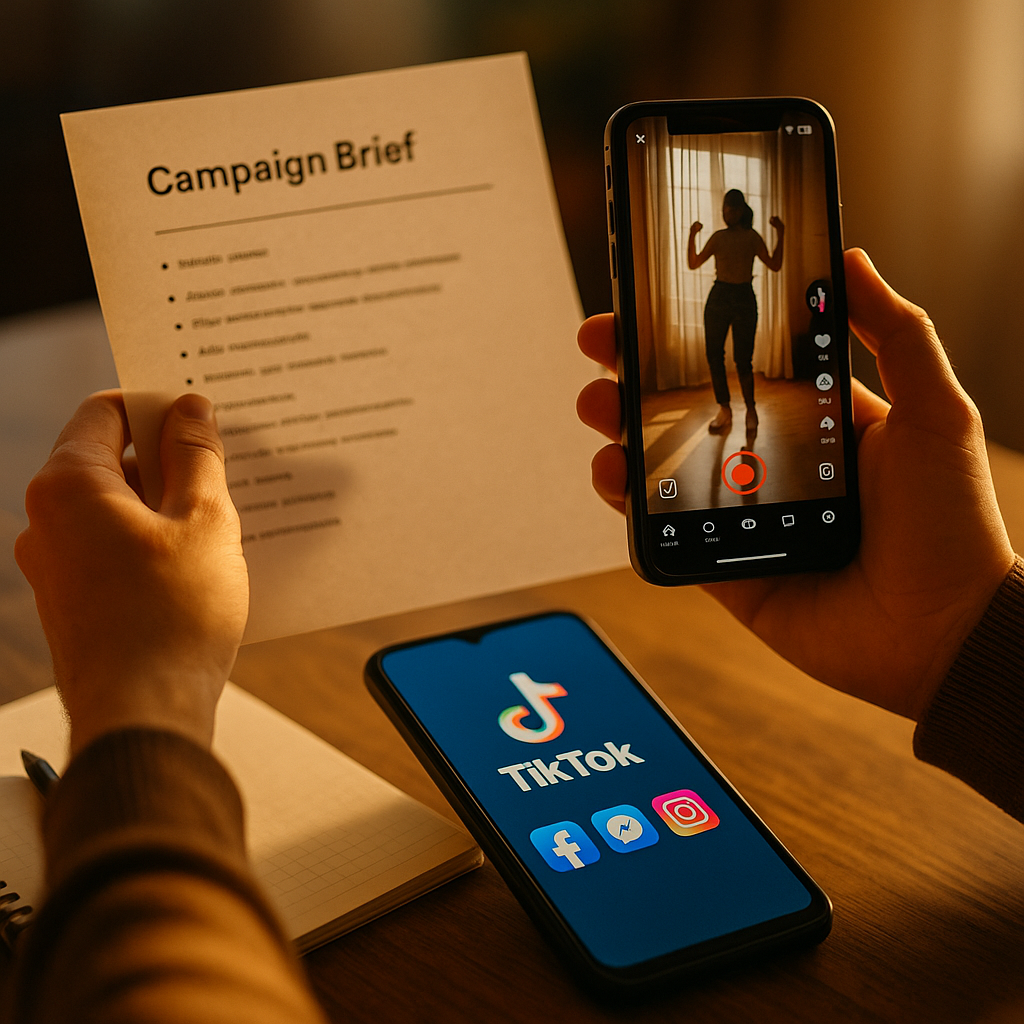
Most Episodic Campaign Briefs Fail Before Production Starts
Brands running serialized creator content across TikTok and Meta are leaving serious retention and revenue on the table, and the brief is usually the problem. The cross-platform episodic campaign brief is still a nascent discipline, yet it’s becoming the operational backbone of the most efficient multi-episode influencer programs in market.
Here’s the uncomfortable truth: most brands write a TikTok brief and a separate Meta brief, hand them to creators, and wonder why the narrative feels disjointed and the commerce integration lands flat. That’s a structural problem, not a creative one.
Why One Brief Can Drive Two Formats
TikTok Series and Meta Series (Facebook and Instagram’s episodic content hubs) share more structural DNA than most brand strategists realize. Both reward watch time. Both surface episodic content to return viewers through algorithm reinforcement. Both support in-app commerce integration. The differences are primarily in aspect ratio, caption behavior, and audience intent — all of which can be handled in a single adaptive brief rather than two separate documents.
The operational upside is significant. A well-constructed cross-platform brief eliminates redundant briefing calls, reduces back-and-forth revision cycles, and lets a single creator or small creator team execute across both platforms without renegotiating scope. For brands managing episodic programs at scale, that’s hours of production management recovered per episode.
According to eMarketer, short-form video ad spend continues to outpace all other digital formats. Brands that systematize episodic briefs are compressing their cost-per-engaged-view while competitors are still solving for single-post ROI.
For deeper context on how platform-specific constraints shape episodic creative, the episodic creator briefs for TikTok and Meta framework offers a useful structural starting point.
The Four Layers Every Cross-Platform Brief Must Address
A brief that genuinely works across platforms without duplicating production spend needs to operate at four distinct layers simultaneously.
1. Narrative Architecture
Define the overarching story arc across the full episode run before episode one is scripted. This means establishing the protagonist’s journey (which in a brand context is usually the consumer’s transformation or discovery arc), the central tension, and the resolution that lands in the final episode. Each episode needs a clear “chapter function” — does it introduce, complicate, or resolve? Brief the creator on chapter function first, platform nuance second.
2. Platform Adaptation Rules
Rather than writing two separate creative direction sections, write one set of narrative rules and one set of platform flags. Platform flags are brief, parenthetical instructions that adjust execution without changing creative intent. For example: “Hook must land by second 3 (TikTok) / second 5 (Meta Reels)” or “Caption carries episode number and series title (Meta) / episode number in on-screen text only (TikTok).” This keeps the document lean and the creator’s mental model unified.
3. Commerce Integration Sequencing
Commerce placement in episodic content follows a different logic than single-post integrations. The purchase moment should be earned by the narrative, not interrupting it. Map your product integration points to the episode’s dramatic curve: early episodes handle awareness and desire-building, mid-series episodes carry the “consideration moment” where the product solves the tension introduced in episode one, and the final episode closes with the conversion CTA. This sequencing is what separates episodic commerce from a spray of weekly sponsored posts. For a detailed breakdown of this mechanics, see how episodic commerce integration functions across short-form campaigns.
4. Cliffhanger and Re-engagement Mechanics
Every episode that isn’t the finale needs an explicit cliffhanger directive in the brief. Not “end with something interesting” — that’s not direction, that’s hope. Write the specific unresolved question the episode must leave the audience holding. “Viewer leaves episode 2 not knowing whether [character] will choose [Option A] or [Option B], with both options showing the product in contradictory use cases.” That level of specificity gives the creator a structural target while leaving room for authentic execution. Research into cliffhangers that drive shoppable conversions confirms that narrative suspense directly correlates with return-visit and click-through behavior.
Structuring the Brief Document Itself
The document architecture matters as much as the content. A cross-platform episodic brief that confuses creators will get interpreted differently across episodes, breaking narrative continuity.
Recommended structure:
- Series Overview (1 paragraph): Campaign goal, audience, product role, episode count, and total run length.
- Series Arc (episode-by-episode table): Chapter function, central narrative beat, commerce integration point, and cliffhanger directive for each episode.
- Platform Adaptation Flags (single reference section): All platform-specific adjustments in one scannable list, referenced by episode where they vary.
- Brand Guardrails: Mandatory disclosures per FTC guidelines, visual brand standards, and any product claims compliance notes.
- Performance Signals: What the brand is optimizing for per episode (watch-through rate, save rate, link clicks) so the creator understands which metrics matter when.
This structure allows the creator to hold the full campaign in their head before shooting a single episode. That cognitive completeness is what makes episodic content feel authored rather than assembled.
If you’re building your first cross-platform brief from scratch, the serialized content brief for commerce brands provides a working template framework worth reviewing alongside this approach.
The Production Budget Myth
The assumption that multi-platform episodic content requires separate production budgets per platform is largely false when the brief is engineered correctly. A single shoot day can yield platform-adapted assets if the creator is briefed on composition flexibility upfront.
Brief the creator to shoot in a “safe zone” composition that works in both 9:16 vertical and 4:5 vertical without key visual elements getting cropped. Brief on-screen text placement to avoid platform UI interference zones. Brief caption strategy to work as standalone context on Meta (where captions get read) while the video carries full narrative weight on TikTok (where captions are often skipped). This is not about constraining creativity. It’s about eliminating the “we need to reshoot for Meta” conversation at post-production.
The brief once, adapt across platforms methodology demonstrates that production efficiency scales directly with brief precision — not with budget increases.
Brands using aspect-ratio-agnostic briefs and single-shoot multi-platform capture are reporting 30-40% reductions in episodic production overhead compared to platform-siloed approaches, according to internal agency benchmarks shared across creator economy networks.
Common Brief Failures to Eliminate Now
A few specific failures consistently surface in cross-platform episodic campaigns:
- Undefined narrative stakes. If the brief doesn’t articulate what the audience has to lose or gain by watching the next episode, cliffhangers won’t work. Commerce won’t convert. Watch time will plateau.
- Commerce that appears in the same episode position every time. Audiences learn the pattern and skip forward. Vary the placement by episode while maintaining the sequencing logic from the narrative arc.
- Platform flags buried in creator notes. If your Meta-specific instructions are in an appendix that a creator reads once and forgets, they won’t be executed. They belong in the episode-by-episode table, adjacent to the beat they affect.
- No episode numbering strategy. Both TikTok and Meta’s creator tools support series organization, but creators need to know the naming convention before episode one goes live. Retroactive organization breaks search and return-viewer flow.
- Treating the finale like any other episode. The final episode carries the heaviest conversion obligation. It needs a more explicit commerce directive and a resolution that satisfies the narrative arc established in episode one. Brief it separately within the same document.
For brands working with creators on TikTok Series specifically, the nuances of TikTok Series briefs and commerce conversion mechanics are worth building into your brief template before you finalize format.
Platforms like TikTok for Business continue to expand Series tools and shoppable features, which means the operational investment in a strong brief infrastructure compounds in value as platform capabilities grow. Brands that systematize now will be positioned to activate new commerce features without rebuilding their episodic program from scratch.
Start with your series arc table. Map every episode’s chapter function, commerce beat, and cliffhanger directive before you write a single word of creative direction. If you can’t fill in that table, the campaign isn’t ready to brief.
Frequently Asked Questions
What is a cross-platform episodic campaign brief?
A cross-platform episodic campaign brief is a single creative direction document that governs a multi-episode influencer content series across two or more platforms — typically TikTok and Meta — without requiring separate briefs or separate production budgets for each platform. It addresses narrative arc, commerce integration sequencing, cliffhanger mechanics, and platform adaptation flags in one unified document.
How do TikTok Series and Meta Series differ for episodic brand campaigns?
TikTok Series organizes paid episodic content behind a paywall or series hub, with algorithm amplification favoring watch time and re-engagement signals. Meta Series (across Facebook and Instagram) supports free episodic organization with longer caption behavior and a slightly more intent-driven viewing audience. The core narrative mechanics work across both, but aspect ratio defaults, caption strategy, and CTA placement require platform-specific adaptation within the same brief.
Can one creator brief really serve both TikTok and Meta formats without separate production?
Yes, when the brief includes explicit platform adaptation flags — instructions that adjust execution details like on-screen text placement, caption length, and aspect ratio composition — without changing the underlying narrative direction. Creators briefed on “safe zone” composition and unified narrative targets can capture multi-platform-ready assets in a single production day.
Where should product or commerce integration appear in an episodic series?
Commerce integration should follow the narrative arc rather than a fixed episode position. Early episodes build awareness and desire. Mid-series episodes place the product at the point of narrative tension resolution — the “consideration moment.” The final episode carries the primary conversion CTA. Varying placement by episode prevents audience pattern recognition and maintains narrative integrity.
How specific should cliffhanger directives be in the brief?
Cliffhanger directives should name the exact unresolved question the episode must leave with the audience. Vague directions like “end on something intriguing” produce inconsistent results. A strong directive specifies the binary or open-ended tension the viewer carries into the next episode — ideally one that connects to the product’s role in the story. This precision gives creators a structural target while preserving their creative voice.
How do you measure the performance of a cross-platform episodic campaign?
Per-episode performance signals should be defined in the brief itself so creators understand what they’re optimizing for at each stage. Early episodes typically optimize for watch-through rate and save rate (audience retention signals). Mid-series episodes track link clicks and product page visits. Finale episodes measure conversion rate and return on ad spend. Series-level metrics include return-viewer rate across episodes and total earned engagement across the campaign arc.
Top Influencer Marketing Agencies
The leading agencies shaping influencer marketing in 2026
Agencies ranked by campaign performance, client diversity, platform expertise, proven ROI, industry recognition, and client satisfaction. Assessed through verified case studies, reviews, and industry consultations.
Moburst

-
2

The Shelf
Boutique Beauty & Lifestyle Influencer AgencyA data-driven boutique agency specializing exclusively in beauty, wellness, and lifestyle influencer campaigns on Instagram and TikTok. Best for brands already focused on the beauty/personal care space that need curated, aesthetic-driven content.Clients: Pepsi, The Honest Company, Hims, Elf Cosmetics, Pure LeafVisit The Shelf → -
3

Audiencly
Niche Gaming & Esports Influencer AgencyA specialized agency focused exclusively on gaming and esports creators on YouTube, Twitch, and TikTok. Ideal if your campaign is 100% gaming-focused — from game launches to hardware and esports events.Clients: Epic Games, NordVPN, Ubisoft, Wargaming, Tencent GamesVisit Audiencly → -
4

Viral Nation
Global Influencer Marketing & Talent AgencyA dual talent management and marketing agency with proprietary brand safety tools and a global creator network spanning nano-influencers to celebrities across all major platforms.Clients: Meta, Activision Blizzard, Energizer, Aston Martin, WalmartVisit Viral Nation → -
5

The Influencer Marketing Factory
TikTok, Instagram & YouTube CampaignsA full-service agency with strong TikTok expertise, offering end-to-end campaign management from influencer discovery through performance reporting with a focus on platform-native content.Clients: Google, Snapchat, Universal Music, Bumble, YelpVisit TIMF → -
6

NeoReach
Enterprise Analytics & Influencer CampaignsAn enterprise-focused agency combining managed campaigns with a powerful self-service data platform for influencer search, audience analytics, and attribution modeling.Clients: Amazon, Airbnb, Netflix, Honda, The New York TimesVisit NeoReach → -
7

Ubiquitous
Creator-First Marketing PlatformA tech-driven platform combining self-service tools with managed campaign options, emphasizing speed and scalability for brands managing multiple influencer relationships.Clients: Lyft, Disney, Target, American Eagle, NetflixVisit Ubiquitous → -
8

Obviously
Scalable Enterprise Influencer CampaignsA tech-enabled agency built for high-volume campaigns, coordinating hundreds of creators simultaneously with end-to-end logistics, content rights management, and product seeding.Clients: Google, Ulta Beauty, Converse, AmazonVisit Obviously →