


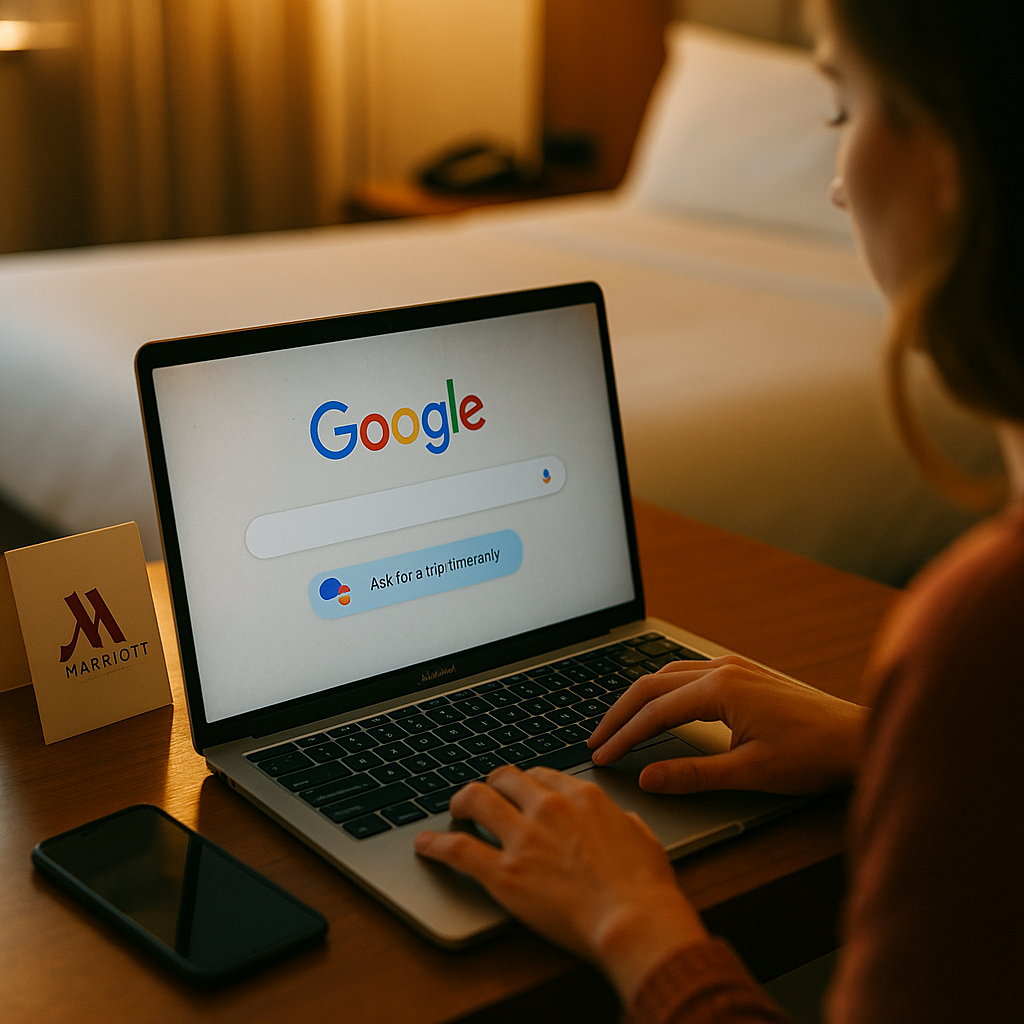
What if your creator content is already losing the sale before a consumer ever clicks? Conversational AI discovery is reshaping the entire purchase funnel, and the Marriott-Google AI search partnership offers brand teams a concrete blueprint for what high-converting creator programs must now do differently.
The Marriott-Google Signal You Should Not Ignore
When Marriott structured its inventory integration with Google’s AI-powered search experience, the outcome wasn’t just better hotel bookings. It was a proof point for a fundamentally different consumer behavior: natural language queries (“best boutique hotel in Nashville for a work trip with a rooftop bar”) producing near-instant, confident recommendations that converted at rates traditional keyword search couldn’t match. According to Statista, conversational AI search adoption among U.S. adults has grown sharply, with AI-assisted queries now representing a material share of commercial intent searches.
The critical insight for brand marketers isn’t “Marriott did a smart tech integration.” It’s that the consumer arrived at the recommendation already pre-qualified. The query itself carried intent, context, and constraint. The AI matched structured, trustworthy content to that query. The result was a shorter path to purchase with less friction at every stage.
Your creator program is sitting on a similar opportunity — and most brands are structured entirely wrong to take advantage of it.
Why Most Creator Funnels Are Built Backwards
The dominant creator program architecture still looks like this: awareness content at the top (wide reach, vague messaging), consideration content in the middle (product features, comparisons), and a conversion push at the bottom (promo code, affiliate link). Linear. Sequential. Slow.
That architecture made sense when consumers moved predictably through stages. It makes less sense when an AI search interface can compress the entire funnel into a single exchange. A shopper asking “which face SPF is best for oily skin under makeup” isn’t starting an awareness journey. They’re at the decision stage, and AI is handing them an answer sourced from content that was structured to be cited.
AI discovery doesn’t route consumers to the top of your funnel. It drops them directly into the moment of decision — and only creator content structured for that moment gets cited.
Most creator briefs don’t account for this. They optimize for engagement metrics, reach, and platform-native virality. None of those signals determine whether a creator’s content gets surfaced when a high-intent AI query is processed. For a deeper look at how to close that gap, the creator content strategy for AI search framework is a practical starting point.
What the Natural Language Query Pattern Actually Demands From Creator Content
Conversational AI systems like Google’s AI Overviews, Perplexity, and ChatGPT’s search mode are trained to surface content that answers specific, context-rich questions. Not brand taglines. Not aesthetic short-form content that performs well in a feed but carries no semantic structure. Answers.
This has direct implications for how creator briefs are written. Instead of briefing a creator to “show how you incorporate [Brand X] into your morning routine,” effective briefs now need to engineer specific question-and-answer moments inside the content. A creator saying “I have combination skin and I’ve tried everything — here’s why this serum finally worked for my T-zone” is producing a content asset that maps to a natural language query. A creator holding a product and smiling is not.
The structural requirements are clear:
- Content must explicitly name the problem or need being solved
- The recommendation must be specific and reasons must be stated
- Comparison framing (“better than X because Y”) performs well in AI citation logic
- Long-form formats (YouTube, long-caption Instagram, blog-style TikTok narration) carry more citable text than visual-only formats
Brands using GEO-ready creator briefs are already ahead of the curve here. The brief architecture shift from “performance brief” to “citation-optimized brief” is operationally small but strategically significant.
Instant Recommendation Logic: Structuring the Middle Funnel for AI Surfaces
The Marriott model works because structured data feeds AI’s ability to make instant, confident recommendations. For creator programs, the equivalent is content architecture. Specifically: does your creator content ecosystem have enough structured, citable assets to support AI-assisted recommendations across the full range of intent queries your category generates?
Most brands have creator content concentrated in a few campaign moments. A product launch burst. A seasonal push. A one-off partnership. What AI search rewards is depth and consistency: a body of creator content that collectively covers the semantic landscape of your category’s high-intent queries.
Think about what Marriott achieved differently. They didn’t run one campaign and hope it got cited. They structured their data to be always-on, always-available, and always-matched to intent. Your creator content program needs the same logic applied to content volume, format diversity, and topic coverage. For context on how search signals interact with creator content performance, auditing creator content for AI citations offers a framework that translates directly into program planning.
Higher Conversion Through Reduced Friction
The conversion lift in the Marriott-Google model wasn’t magic. It was the elimination of the “now what?” moment. A consumer got a recommendation, saw pricing and availability inline, and could book. The path from query to conversion was compressed because the infrastructure behind the recommendation was built to close.
Brand creator programs need to engineer equivalent closing infrastructure. That means:
- Creator content that links directly to shoppable pages, not brand homepages or generic landing pages that require additional navigation
- Product pages that match the language and framing of creator content, so consumers who arrive from an AI-cited creator asset don’t experience a disconnect
- Attribution tracking built for non-linear pathways, because a consumer might discover via an AI citation, leave, and return later through a different channel
That last point is increasingly important. Cookieless creator attribution frameworks are no longer optional infrastructure — they’re the only way to accurately measure what AI discovery is actually contributing to conversion. Without it, brands systematically undercount the value of their creator content in the AI search era.
If your attribution model can’t follow a consumer from an AI-cited creator asset through a multi-session, cross-device purchase path, you’re measuring a fraction of the real impact.
Rebuilding the Discovery-to-Purchase Pathway: Where to Start
Program directors who want to apply the Marriott-Google model to their creator strategy don’t need to rebuild everything. Start with the highest-intent queries in your category. Use tools like Google Search Console or SEMrush to identify the conversational, long-tail queries that signal purchase intent in your category. Then audit existing creator content against those queries: does anything you’ve produced actually answer them in a citable, structured way?
If the answer is mostly no, that’s your brief development priority for the next quarter. Commission creator content specifically engineered to answer those queries, with product recommendations framed in the comparison and specificity logic that AI systems favor. Ensure each asset connects to a frictionless purchase path. Track performance at both the content-citation level and the downstream conversion level.
Brands integrating first-party data into creator briefs are finding they can layer audience-specific intent signals on top of this query architecture, further tightening the match between content and conversion moment. The infrastructure investment is real, but so is the payoff: creator programs that function more like Marriott’s AI integration than a traditional paid media burst.
For a broader picture of how AI shopping surfaces are shifting brand strategy, eMarketer’s commerce research provides useful category-level context, and Think with Google has documented the AI-assisted purchase journey shift in detail.
The next step is concrete: take your three highest-converting creator assets from the last six months, run them through an AI citation audit, and identify the structural gaps between what performed and what would be surfaced by a conversational AI recommendation engine. That gap is your program’s most important optimization target right now.
FAQs
What is conversational AI discovery in the context of creator marketing?
Conversational AI discovery refers to the process by which consumers use natural language queries in AI-powered search tools (such as Google’s AI Overviews, Perplexity, or ChatGPT search) to find product recommendations. For creator marketers, it means that creator-produced content can be surfaced as the source of AI-generated answers, placing that content directly in front of high-intent consumers at the moment of decision.
How does the Marriott-Google AI search model apply to brand creator programs?
Marriott structured its content and inventory data to be easily matched to natural language travel queries, resulting in faster, higher-converting recommendations. Brand creator programs can apply the same logic: instead of producing content optimized only for social feed performance, brands should brief creators to produce structured, question-answering content that AI systems can cite when consumers query their category.
What types of creator content are most likely to be cited in AI search results?
Content that is specific, comparison-driven, and answers a clearly stated problem tends to perform well in AI citation logic. Long-form formats (YouTube video narration, detailed Instagram captions, written reviews) carry more citable text than visual-only short-form content. Briefs that include explicit problem statements, named reasons for a recommendation, and comparison framing produce creator assets that align with how AI search evaluates content quality.
How should brands measure the conversion impact of AI-cited creator content?
Because AI discovery often initiates a multi-session, cross-device purchase journey, traditional last-click attribution significantly undercounts impact. Brands should invest in identity resolution and multi-touch attribution frameworks that can track a consumer from an AI-cited creator asset through subsequent sessions to eventual purchase. First-party data infrastructure is foundational to this measurement approach.
Do smaller creator programs need to overhaul their entire strategy to benefit from AI discovery?
No. The most practical starting point is to identify the top high-intent conversational queries in your category, audit existing creator content for citation-readiness, and commission a focused set of new content assets engineered specifically to answer those queries. Even a small inventory of well-structured creator content can outperform a larger volume of feed-optimized content in AI search surfaces.
Top Influencer Marketing Agencies
The leading agencies shaping influencer marketing in 2026
Agencies ranked by campaign performance, client diversity, platform expertise, proven ROI, industry recognition, and client satisfaction. Assessed through verified case studies, reviews, and industry consultations.
Moburst

-
2

The Shelf
Boutique Beauty & Lifestyle Influencer AgencyA data-driven boutique agency specializing exclusively in beauty, wellness, and lifestyle influencer campaigns on Instagram and TikTok. Best for brands already focused on the beauty/personal care space that need curated, aesthetic-driven content.Clients: Pepsi, The Honest Company, Hims, Elf Cosmetics, Pure LeafVisit The Shelf → -
3

Audiencly
Niche Gaming & Esports Influencer AgencyA specialized agency focused exclusively on gaming and esports creators on YouTube, Twitch, and TikTok. Ideal if your campaign is 100% gaming-focused — from game launches to hardware and esports events.Clients: Epic Games, NordVPN, Ubisoft, Wargaming, Tencent GamesVisit Audiencly → -
4

Viral Nation
Global Influencer Marketing & Talent AgencyA dual talent management and marketing agency with proprietary brand safety tools and a global creator network spanning nano-influencers to celebrities across all major platforms.Clients: Meta, Activision Blizzard, Energizer, Aston Martin, WalmartVisit Viral Nation → -
5

The Influencer Marketing Factory
TikTok, Instagram & YouTube CampaignsA full-service agency with strong TikTok expertise, offering end-to-end campaign management from influencer discovery through performance reporting with a focus on platform-native content.Clients: Google, Snapchat, Universal Music, Bumble, YelpVisit TIMF → -
6

NeoReach
Enterprise Analytics & Influencer CampaignsAn enterprise-focused agency combining managed campaigns with a powerful self-service data platform for influencer search, audience analytics, and attribution modeling.Clients: Amazon, Airbnb, Netflix, Honda, The New York TimesVisit NeoReach → -
7

Ubiquitous
Creator-First Marketing PlatformA tech-driven platform combining self-service tools with managed campaign options, emphasizing speed and scalability for brands managing multiple influencer relationships.Clients: Lyft, Disney, Target, American Eagle, NetflixVisit Ubiquitous → -
8

Obviously
Scalable Enterprise Influencer CampaignsA tech-enabled agency built for high-volume campaigns, coordinating hundreds of creators simultaneously with end-to-end logistics, content rights management, and product seeding.Clients: Google, Ulta Beauty, Converse, AmazonVisit Obviously →