


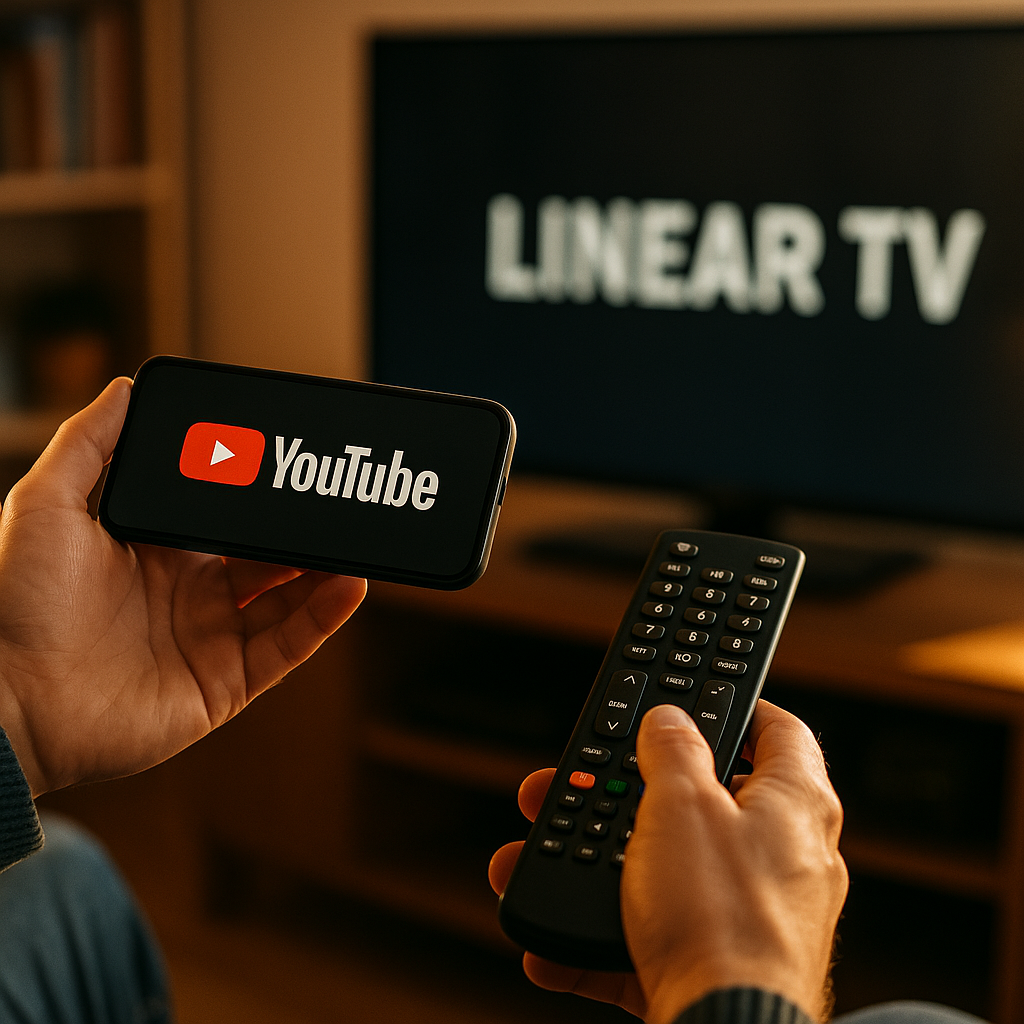
YouTube Is Watching Your TV Budget
YouTube now commands 12 to 13 percent of all U.S. television screen time on a daily basis, according to Nielsen Gauge data. That is not a rounding error. That is a primary channel — and most brands are still buying it like a secondary one.
The internal budget fight has shifted. The question is no longer whether short-form video competes with linear TV. It does. The real question is whether your CMO has the data architecture to win that argument in a room full of CFOs, media planners, and agency partners who built their careers on gross rating points.
This article is a tactical brief for that exact fight.
What the Nielsen Number Actually Means for Upfront Season
Nielsen’s 12 to 13 percent daily viewing share figure for YouTube is significant for one specific reason: it measures time spent on television screens, not mobile. That distinction collapses the last major objection to treating short-form creator inventory as a television-class buy.
For years, the rebuttal from TV-first media planners was that digital video lived on phones, not in living rooms. Nielsen Gauge kills that argument. YouTube is now the single largest streaming platform by share on connected TVs, ahead of Netflix, Hulu, and Disney+. When a creator’s short-form video plays on a 65-inch screen in prime time, it is, functionally, a television placement.
YouTube’s television screen share exceeds every individual streaming competitor. If your upfront plan treats it as a supplementary digital line, you are already misallocating budget relative to where attention actually lives.
The implication for upfront negotiations is direct. Brands that have locked 60 to 70 percent of their video budgets into linear commitments made those decisions using reach and frequency models that predate this shift. Renegotiating or restructuring those commitments requires a data point that finance teams can stress-test. Nielsen Gauge provides exactly that.
Building the Internal Case: The CFO Translation Problem
CMOs lose budget fights not because their data is wrong, but because they present media metrics to people who think in financial terms. Viewing share alone does not move a CFO. What moves a CFO is cost per verified outcome at scale, risk profile, and budget flexibility.
Here is how to reframe the Nielsen data in those terms.
Cost efficiency at equivalent reach: A CPM for a network prime-time placement currently runs between $25 and $40 on guaranteed linear. YouTube’s connected TV CPM, through Google’s reservation buying, runs $15 to $25 for comparable demographic targeting, with the added benefit of audience-level verification rather than panel-based estimation. The gap compounds across a full upfront commitment.
Commitment flexibility: Linear upfront deals lock dollars 9 to 12 months in advance with penalty clauses for cancellations. YouTube and creator inventory, whether bought through Google’s upfront guarantees or directly via creator partnerships, allow quarterly reallocation. For brands operating in volatile categories — CPG, retail, auto — that flexibility is a financial hedge, not just a media preference.
Attribution granularity: Linear TV still relies on modeled attribution. Creator-produced short-form inventory, when bought with proper first-party data integration, supports pixel-level conversion tracking, incrementality testing, and multi-creator attribution models that linear cannot match. A CFO who has sat through one too many post-campaign reports with modeled reach projections will understand the value of measured outcomes.
Why Creator-Produced Inventory Outperforms Studio Production at This Scale
This is the part most brand teams underweight. The shift to short-form is not just a channel decision. It is a production model decision.
Linear TV requires months of creative development, union production, post-production, and clearance. A single 30-second network spot can cost $300,000 to produce before a single dollar of media is spent. Creator-produced short-form content compresses that cycle to days, at a fraction of the cost, and typically outperforms studio-produced creative in engagement benchmarks on the same platforms.
The brands that are getting this right have moved toward creator ecosystems over one-off deals, building repeatable content pipelines rather than episodic campaigns. That structural shift is what allows a brand to redirect a portion of upfront commitments without creating a content gap.
Consider the operational math: a $5 million linear upfront commitment, if partially redirected, could fund a roster of 20 to 30 mid-tier creators producing weekly content across YouTube Shorts, TikTok, and Instagram Reels for a full year, with budget remaining for paid amplification. The reach is comparable. The agility is not.
For media planners already thinking through how to structure that reallocation, the creator amplification budget framework is worth reviewing before your next planning cycle.
The Objections You Will Face — And How to Answer Them
Brand safety is the first objection. It is legitimate, but it is solvable. YouTube’s brand safety controls at the channel and content level have matured significantly. Google’s verified placement tools, combined with creator vetting via platforms like Captiv8, CreatorIQ, or Influential, give procurement teams a compliance layer that did not exist three years ago. The enterprise governance checklist is a useful starting point for structuring that framework internally.
The second objection: upfront commitments carry make-good provisions that protect reach delivery. Fair. But the make-good is only valuable if the underlying reach is reaching the right audience. Nielsen’s own data shows 18-to-49 linear TV ratings have declined every year for a decade. A guaranteed make-good on a shrinking audience is not the protection it once was.
Third objection: agency incentives. Holding companies earn higher fees on linear buys. This is real, and CMOs need to name it directly in internal conversations. The solution is outcome-based agency compensation structures or carving out creator buys to a performance-focused partner without traditional media markup. That is a procurement conversation, not a media one.
The brand safety and measurement objections to creator inventory are largely solved problems. The real barrier to reallocation is institutional inertia and agency incentive misalignment — both of which require executive sponsorship to overcome.
Structuring the Pilot: A 90-Day Proof of Concept
Do not try to restructure the entire upfront at once. Propose a 10 to 15 percent carve-out from the linear commitment as a controlled pilot. Define success metrics in advance: reach delivered, CPM versus linear benchmark, brand search lift, and conversion attribution where applicable. Run it across two quarters with a predetermined review gate.
This framing matters because it removes the all-or-nothing risk perception. You are not asking leadership to abandon TV. You are asking for permission to test a hypothesis with bounded downside.
Pair the pilot with an always-on creator program roadmap so the pilot output feeds a scalable structure rather than a one-time experiment. The goal is to generate internal case study data that makes next year’s budget conversation easier.
The engagement lift KPI framework is particularly useful here because it translates creator performance metrics into language that budget committees recognize as meaningful — share of voice, brand recall, and category share intent.
Externally, platforms like YouTube and TikTok for Business both offer brand lift study infrastructure as part of their managed buys, which gives you third-party measurement without commissioning a separate research project. Nielsen’s own cross-media measurement tools and eMarketer’s video forecasting data can be cited to anchor the business case before a single dollar moves.
The short-form category is also not monolithic. YouTube Shorts, TikTok, and Instagram Reels have distinct audience profiles, CPM floors, and algorithmic discovery behaviors. A thoughtful pilot tests across at least two platforms so the findings are generalizable and not channel-specific.
Run the numbers. Present them in CFO language. Name the structural objections before others raise them. And carve out enough budget to generate statistically meaningful results, not just a directional read.
The data already makes the case for short-form as a television budget competitor. Your job now is to make the internal argument airtight before the next upfront cycle opens.
Frequently Asked Questions
What does YouTube’s 12–13 percent daily viewing share actually mean for media planners?
It means YouTube has crossed the threshold from digital supplement to primary television channel. Nielsen measures this share on actual TV screens, which collapses the traditional distinction between digital and broadcast video. For media planners, it means YouTube inventory should be evaluated against linear CPMs and reach targets, not just social benchmarks.
How should a CMO present this data to a CFO to justify shifting upfront TV budgets?
Translate the viewing share data into financial terms: lower CPMs for equivalent reach, flexible budget reallocation versus locked upfront commitments, and measurable attribution that modeled TV metrics cannot provide. Frame any reallocation as a pilot with bounded downside rather than a wholesale budget overhaul. CFOs respond to risk-managed proposals, not channel ideology.
Is creator-produced short-form content brand-safe enough for large enterprise advertisers?
Yes, for brands that implement proper governance. YouTube’s placement controls, combined with creator vetting platforms such as CreatorIQ, Captiv8, or Influential, give enterprise procurement teams a compliance layer comparable to premium digital publishing environments. The key is building a governance framework before scaling, not after an incident occurs.
What percentage of a linear TV budget should be piloted in creator short-form inventory?
A 10 to 15 percent carve-out is the recommended starting point. It is large enough to generate statistically meaningful data but small enough to manage internal risk perception. Define success metrics, set a review gate at 90 days, and use the pilot results to inform the following year’s upfront negotiation.
How does short-form creator inventory compare to linear TV on attribution?
Short-form creator inventory, when bought with first-party data integration, supports pixel-level conversion tracking and incrementality testing. Linear television still relies primarily on modeled attribution based on panel data. For brands that need to demonstrate return on ad spend to finance teams, creator inventory offers significantly more measurement precision.
Top Influencer Marketing Agencies
The leading agencies shaping influencer marketing in 2026
Agencies ranked by campaign performance, client diversity, platform expertise, proven ROI, industry recognition, and client satisfaction. Assessed through verified case studies, reviews, and industry consultations.
Moburst

-
2

The Shelf
Boutique Beauty & Lifestyle Influencer AgencyA data-driven boutique agency specializing exclusively in beauty, wellness, and lifestyle influencer campaigns on Instagram and TikTok. Best for brands already focused on the beauty/personal care space that need curated, aesthetic-driven content.Clients: Pepsi, The Honest Company, Hims, Elf Cosmetics, Pure LeafVisit The Shelf → -
3

Audiencly
Niche Gaming & Esports Influencer AgencyA specialized agency focused exclusively on gaming and esports creators on YouTube, Twitch, and TikTok. Ideal if your campaign is 100% gaming-focused — from game launches to hardware and esports events.Clients: Epic Games, NordVPN, Ubisoft, Wargaming, Tencent GamesVisit Audiencly → -
4

Viral Nation
Global Influencer Marketing & Talent AgencyA dual talent management and marketing agency with proprietary brand safety tools and a global creator network spanning nano-influencers to celebrities across all major platforms.Clients: Meta, Activision Blizzard, Energizer, Aston Martin, WalmartVisit Viral Nation → -
5

The Influencer Marketing Factory
TikTok, Instagram & YouTube CampaignsA full-service agency with strong TikTok expertise, offering end-to-end campaign management from influencer discovery through performance reporting with a focus on platform-native content.Clients: Google, Snapchat, Universal Music, Bumble, YelpVisit TIMF → -
6

NeoReach
Enterprise Analytics & Influencer CampaignsAn enterprise-focused agency combining managed campaigns with a powerful self-service data platform for influencer search, audience analytics, and attribution modeling.Clients: Amazon, Airbnb, Netflix, Honda, The New York TimesVisit NeoReach → -
7

Ubiquitous
Creator-First Marketing PlatformA tech-driven platform combining self-service tools with managed campaign options, emphasizing speed and scalability for brands managing multiple influencer relationships.Clients: Lyft, Disney, Target, American Eagle, NetflixVisit Ubiquitous → -
8

Obviously
Scalable Enterprise Influencer CampaignsA tech-enabled agency built for high-volume campaigns, coordinating hundreds of creators simultaneously with end-to-end logistics, content rights management, and product seeding.Clients: Google, Ulta Beauty, Converse, AmazonVisit Obviously →