


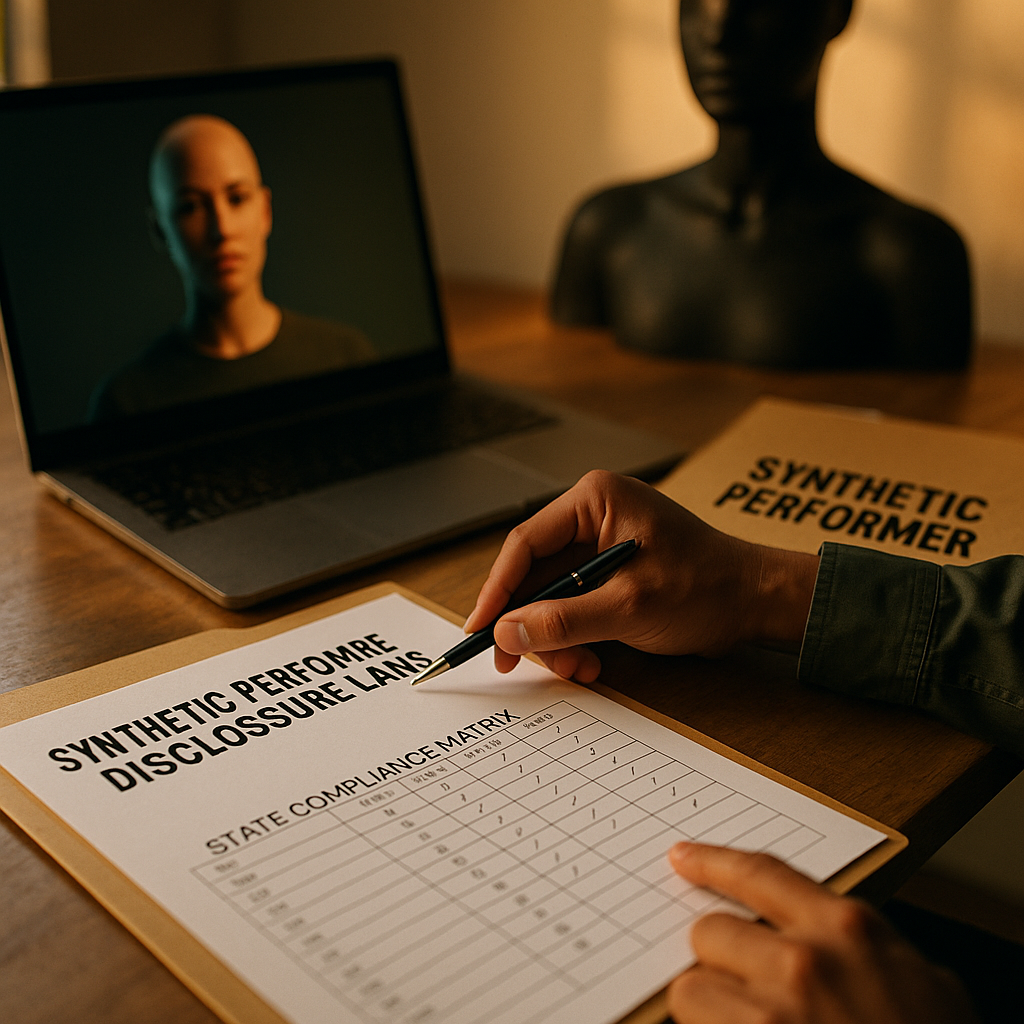
New York started it. California, Illinois, and at least six other states are now drafting or debating their own version. If your brand runs influencer or AI-generated ad content across state lines, synthetic performer disclosure is quietly becoming the compliance headache nobody budgeted for in 2026. One missed label, one wrong state, one lawsuit waiting to happen.
Legal teams love a single federal standard. They’re not getting one. What they’re getting instead is a growing patchwork of state laws targeting AI-generated or “synthetic” performers in advertising, each with its own definitions, thresholds, and penalties. Brands running national campaigns can’t just comply with the strictest state and call it a day, because some state rules conflict rather than stack. This article breaks down what’s actually different, what’s staying the same, and how to build a matrix that keeps your legal team out of the headlines.
Why New York’s Law Became the Template
New York’s synthetic performer disclosure statute, passed to address AI-generated actors, voice clones, and digitally altered spokespeople in advertising, set the baseline most other states are now borrowing from. The law requires clear, conspicuous disclosure whenever a performer in a commercial ad is wholly or substantially AI-generated, or when a real performer’s likeness has been synthetically modified beyond ordinary editing.
The logic tracks with existing FTC guidance on deceptive endorsements, but New York went further by codifying specific disclosure language requirements and creating a private right of action in some circumstances. That last part matters. It means a consumer, not just a regulator, can sue.
New York’s synthetic performer law isn’t just an ad-labeling rule — it’s the first state statute to give consumers standing to sue over undisclosed AI-generated spokespeople, and that private right of action is exactly what other legislatures are copying.
California’s proposed version leans closer to its existing deepfake and likeness-rights statutes, folding synthetic performer disclosure into the state’s broader publicity rights framework. Illinois is drafting language tied to its Biometric Information Privacy Act, which changes the compliance calculus entirely, because BIPA already carries steep statutory damages per violation. Texas and Washington are watching, with early-stage bills that mirror New York’s disclosure language almost verbatim but strip out the private right of action, leaving enforcement to the state AG instead.
That’s the pattern brands need to internalize: same target, different enforcement teeth.
What Counts as a “Synthetic Performer,” Anyway?
This is where most compliance headaches start. Definitions are not harmonized.
- New York: Any performer generated wholly by AI, or a real performer whose voice, face, or movement has been synthetically altered such that a reasonable consumer would be misled about who is actually appearing.
- California (proposed): Broader language covering “digital replicas,” which could sweep in de-aging, voice cloning for dubbing, and AI-assisted body doubles, not just fully synthetic spokespeople.
- Illinois: Ties definitions to biometric identifiers, meaning voice and facial data used to train or generate the synthetic performer may itself trigger separate consent obligations under BIPA, independent of the disclosure requirement.
See the problem? A campaign that clears New York’s bar might still violate Illinois’s biometric consent rules, because Illinois isn’t just asking “did you disclose,” it’s asking “did you have consent to use the underlying data in the first place.” Two different legal questions, two different exposure points, one piece of creative.
Building the Matrix: Five Variables That Actually Matter
Forget trying to memorize every bill. Build a matrix around five variables that determine your actual exposure in each state:
- Trigger definition — does the law cover fully synthetic performers only, or also digitally altered real performers?
- Disclosure format — is there mandated language, placement, or duration (think: on-screen text for a minimum number of seconds), or just a general “clear and conspicuous” standard?
- Enforcement mechanism — state AG only, or private right of action?
- Underlying consent requirements — does the state also require biometric or likeness consent separate from disclosure (Illinois-style), or is disclosure the only obligation?
- Platform scope — does the law apply only to traditional advertising, or does it reach influencer content, UGC-style ads, and social-native formats like TikTok Shop livestreams?
That fifth variable is the one legal teams underestimate. A synthetic performer showing up in a paid TikTok Shop livestream isn’t a theoretical edge case anymore. If your brand is running live-selling compliance checks, synthetic performer disclosure needs to be on that checklist too, not treated as a separate workstream.
Where This Collides With Existing FTC Rules
Here’s the part that trips up marketing teams who think they’ve already solved this at the federal level. The FTC’s endorsement guides already require disclosure when an endorsement isn’t genuine, including AI-generated testimonials. See our prior coverage on FTC rules on AI-assisted creator content for the federal baseline. States aren’t replacing that requirement, they’re layering additional, more specific obligations on top of it.
So you now have two compliance stacks running in parallel: federal deceptive-endorsement rules (apply everywhere, general standard) and state synthetic performer statutes (apply only in that state, specific format requirements). A disclosure that satisfies the FTC might still fail New York’s specific placement rule. That’s not hypothetical, it’s exactly the kind of gap plaintiffs’ attorneys are trained to find.
Brands running AI-generated ad creative at scale, especially through TikTok’s ad platform or programmatic buys touching multiple states, need geofenced compliance logic baked into the creative approval workflow, not a single national disclosure template.
The Audit Trail Question Nobody’s Asking
If a regulator or plaintiff’s attorney challenges your synthetic performer disclosure, can you prove when the disclosure was added, who approved it, and which state-specific rule it was built to satisfy? Most brands can’t. Creative gets approved in Slack threads and shared drives, not systems built for legal defensibility.
This is precisely the gap covered in our piece on audit trails for AI marketing decisions. The same logic applies here: you need a timestamped record showing the disclosure decision, the state-specific rule it maps to, and who signed off, before the ad ever runs. Without that, you’re defending a claim with vibes instead of documentation.
A compliance matrix without an audit trail is just a spreadsheet. Regulators and plaintiffs’ attorneys don’t care what your policy says — they care what you can prove happened before the ad went live.
Pairing the matrix with a proper compliance dashboard turns this from a reactive legal exercise into an operational one. Every piece of synthetic or AI-assisted creator content gets tagged by state exposure, disclosure status, and approval date, automatically, before it ships.
Practical Steps for the Next Two Quarters
You don’t need to solve every state’s law today. You need a process that scales as more states pass their own version.
- Tag creative by distribution state, not just by platform. Geo-targeting data already exists in most ad buys; use it to trigger the right disclosure variant.
- Default to the strictest applicable standard for national or untargeted campaigns, but track this as a business decision, not a legal shortcut, since it may still miss state-specific format rules.
- Separate disclosure compliance from consent compliance. These are two different legal obligations, especially in biometric-privacy states like Illinois. Don’t let one workflow assume it covers the other.
- Build escalation paths for ambiguous cases, similar to the structure outlined in our FTC escalation matrix piece. Synthetic performer questions need the same tiered review before launch.
- Monitor legislative trackers. Industry groups and firms tracking AI and advertising law update these regularly; treat this as a standing agenda item for legal and marketing ops, not an annual review.
Data from eMarketer shows AI-generated and AI-assisted ad content is growing faster than legal and compliance teams can track it, which is exactly why reactive, state-by-state scrambling isn’t sustainable. Build the matrix once, update it quarterly, and treat synthetic performer disclosure as a permanent line item in your creative approval workflow, not a one-off legal review.
Visible FAQ
Frequently Asked Questions
What is a synthetic performer disclosure law?
It’s a state statute requiring advertisers to clearly disclose when a performer in an ad is AI-generated, digitally altered, or otherwise not a genuine, unmodified human appearance. New York’s law is currently the most detailed model, requiring specific disclosure language and placement.
Do these laws apply to influencer content, or just traditional ads?
It depends on the state. Some statutes are broad enough to cover paid influencer content, UGC-style ads, and livestream commerce, especially where a brand directed or paid for the synthetic element. Others are narrower and focus on traditional broadcast or digital advertising. Always check platform scope as a separate matrix variable.
Is FTC compliance enough to cover state synthetic performer laws?
No. FTC endorsement guidelines set a general disclosure standard that applies nationwide, but state laws often add specific format, placement, or consent requirements on top. Meeting the FTC standard doesn’t automatically satisfy New York’s or Illinois’s specific statutory language.
What happens if a brand doesn’t comply?
Consequences vary by state. Some laws only allow state attorney general enforcement, while others, like New York’s, include a private right of action allowing consumers to sue directly. Illinois adds another layer through BIPA’s statutory damages for biometric data misuse.
How often should brands update their compliance matrix?
Quarterly, at minimum. Given how many states currently have bills in committee, a matrix built once and never revisited will be outdated within two or three legislative sessions.
FAQPage Schema
Build the matrix, wire it into your existing creative approval workflow, and revisit it every quarter, because the next state to pass a New York-style law probably isn’t far off.
Top Influencer Marketing Agencies
The leading agencies shaping influencer marketing in 2026
Agencies ranked by campaign performance, client diversity, platform expertise, proven ROI, industry recognition, and client satisfaction. Assessed through verified case studies, reviews, and industry consultations.
Moburst

-
2

The Shelf
Boutique Beauty & Lifestyle Influencer AgencyA data-driven boutique agency specializing exclusively in beauty, wellness, and lifestyle influencer campaigns on Instagram and TikTok. Best for brands already focused on the beauty/personal care space that need curated, aesthetic-driven content.Clients: Pepsi, The Honest Company, Hims, Elf Cosmetics, Pure LeafVisit The Shelf → -
3

Audiencly
Niche Gaming & Esports Influencer AgencyA specialized agency focused exclusively on gaming and esports creators on YouTube, Twitch, and TikTok. Ideal if your campaign is 100% gaming-focused — from game launches to hardware and esports events.Clients: Epic Games, NordVPN, Ubisoft, Wargaming, Tencent GamesVisit Audiencly → -
4

Viral Nation
Global Influencer Marketing & Talent AgencyA dual talent management and marketing agency with proprietary brand safety tools and a global creator network spanning nano-influencers to celebrities across all major platforms.Clients: Meta, Activision Blizzard, Energizer, Aston Martin, WalmartVisit Viral Nation → -
5

The Influencer Marketing Factory
TikTok, Instagram & YouTube CampaignsA full-service agency with strong TikTok expertise, offering end-to-end campaign management from influencer discovery through performance reporting with a focus on platform-native content.Clients: Google, Snapchat, Universal Music, Bumble, YelpVisit TIMF → -
6

NeoReach
Enterprise Analytics & Influencer CampaignsAn enterprise-focused agency combining managed campaigns with a powerful self-service data platform for influencer search, audience analytics, and attribution modeling.Clients: Amazon, Airbnb, Netflix, Honda, The New York TimesVisit NeoReach → -
7

Ubiquitous
Creator-First Marketing PlatformA tech-driven platform combining self-service tools with managed campaign options, emphasizing speed and scalability for brands managing multiple influencer relationships.Clients: Lyft, Disney, Target, American Eagle, NetflixVisit Ubiquitous → -
8

Obviously
Scalable Enterprise Influencer CampaignsA tech-enabled agency built for high-volume campaigns, coordinating hundreds of creators simultaneously with end-to-end logistics, content rights management, and product seeding.Clients: Google, Ulta Beauty, Converse, AmazonVisit Obviously →