


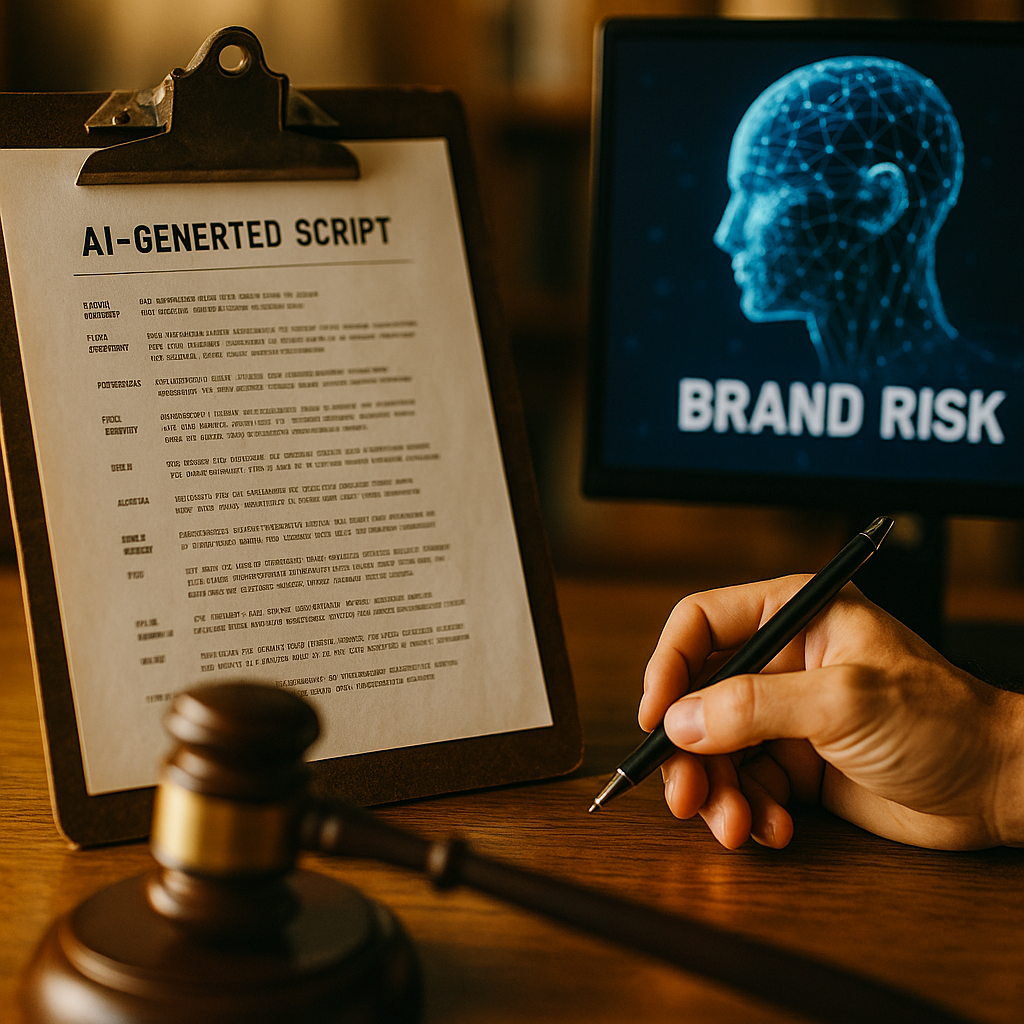
Seventy-two percent of brands now use AI tools somewhere in creator script development. Here’s the uncomfortable part: the FTC’s 2026 stance on AI co-written creator scripts doesn’t care whether a human or a chatbot suggested the claim. If a brand touched the script, the brand owns the endorsement risk.
That single fact is reshaping how legal, marketing, and creator ops teams collaborate. And most companies aren’t ready for it.
The Line Just Moved (Again)
For years, brands treated script involvement as a gray zone. Suggest a few talking points, hand a creator a “brand brief,” maybe run a draft through ChatGPT for tone, and call it creative collaboration rather than a paid endorsement in disguise. The FTC never fully bought that framing, but enforcement was inconsistent enough that brands could plausibly claim distance.
That distance has collapsed. The FTC’s current guidance treats AI-assisted co-writing as a form of “material connection” the moment brand-supplied prompts, product claims, or approved outputs shape what a creator says on camera. It doesn’t matter if a large language model generated the first draft. If your brand’s messaging framework, prompt library, or claims database fed that model, you’re a co-author. And co-authors of endorsement content carry disclosure and substantiation obligations.
The FTC’s core test hasn’t changed in decades: does the brand exercise control over the content, or benefit from a relationship that a reasonable consumer wouldn’t expect? AI just makes that control easier to prove.
Why easier to prove? Because AI tools leave logs. Prompt histories, generation timestamps, edit trails — all of it is discoverable. A brand that once could argue “we never touched the script” now has to explain why its Jasper or Copy.ai workspace shows forty prompts referencing specific product benefits.
What Counts as “Involvement” Now?
This is where marketing teams get tripped up. The FTC isn’t only looking at final scripts. Regulators are examining the entire production chain: briefs, prompt templates, approved claim libraries, and even the AI tools brands mandate creators use.
- Prompt engineering by the brand. If your team writes the prompts a creator feeds into an AI script generator, that’s authorship, not suggestion.
- Approved claims databases. Feeding an AI tool a list of “safe” product claims and letting creators generate scripts from it still counts as brand-directed messaging.
- Mandated AI tools. Requiring creators to use a specific in-house AI assistant for script drafts creates a much stronger material connection than a creator using their own general-purpose tool.
- Post-generation edits. Even light-touch editing, tightening a claim, adding a CTA, tweaking a benefit statement, can push a brand from “reviewer” to “co-writer” in the FTC’s eyes.
Contrast that with a creator who independently uses a generic AI writing assistant, with no brand input on prompts or claims, purely for grammar or pacing. That’s much closer to the old “creative independence” standard the FTC has historically respected. The difference is control, not tooling.
One brand compliance lead I spoke with put it bluntly: “We used to think AI added a layer of separation. It’s the opposite. It added a paper trail.”
Why This Matters for ROI, Not Just Risk
Compliance teams tend to frame this as a legal problem. It’s also a budget problem. FTC penalties for deceptive endorsement practices can run into six figures per violation, and that’s before accounting for platform demonetization, brand safety fallout, or the cost of pulling and re-shooting a campaign mid-flight.
Consider the operational math. A mid-size DTC brand running fifty creator partnerships a quarter, each using some form of AI-assisted scripting, faces exposure across every single one if the disclosure and claims process isn’t standardized. One violation might be a warning letter. Fifty inconsistent processes is a pattern, and patterns are what trigger formal investigations.
Smart brands are treating this as an efficiency play, not just a risk mitigation exercise. Standardizing how AI tools get used in script development, who owns prompts, what claims are pre-cleared, and how disclosures get generated actually speeds up campaign approval. Fewer legal review cycles. Fewer reshoots. Fewer awkward calls with a creator’s manager about why a script got flagged three days before launch.
This is the same logic driving internal approval workflows for AI marketing more broadly. The brands that win aren’t avoiding AI. They’re building governance around it fast enough to keep using it profitably.
Disclosure Language Has to Catch Up
Here’s a wrinkle most brands haven’t addressed: standard #ad disclosures don’t necessarily satisfy the FTC when AI co-authorship is involved. If a script’s specific product claims originated from brand-fed prompts, a generic “sponsored content” tag may not adequately convey the nature of the material connection, particularly if the creator presents claims as personal experience when they were substantially brand-generated.
This echoes concerns raised in earlier coverage on AI-written creator scripts: a disclosure tag addresses the payment relationship, but it doesn’t address the authenticity gap when a creator is reciting brand-engineered claims verbatim. The FTC’s endorsement guides have always emphasized that endorsements must reflect the honest opinions of the endorser. An AI script built entirely from brand prompts strains that requirement, disclosure or not.
Practically, this means brands need two things: clear labeling of the paid relationship, and genuine creative latitude for the creator to modify, question, or reject brand-supplied claims. Scripts that leave zero room for creator voice are the ones drawing scrutiny first.
Building a Defensible Process
So what does a compliant workflow actually look like in practice? A few non-negotiables have emerged from how leading brands and agencies are restructuring their creator ops:
- Log every AI touchpoint. Prompt histories, tool access, and edit trails should be archived the same way brands now archive audit trails for AI marketing decisions. If regulators ask, you need a timestamped record of who prompted what.
- Separate claims libraries from creative direction. Give creators substantiated, pre-cleared claims to choose from, but don’t dictate exact phrasing. Latitude matters legally, not just creatively.
- Run scripts through a compliance dashboard before publish. Automated flagging catches disclosure gaps and claim inconsistencies before a creator hits record. This is the same principle behind creator compliance dashboards built to catch violations before they go live.
- Escalate ambiguous cases fast. Any script where brand involvement is unclear should route to legal within hours, not at the next weekly sync. An FTC compliance escalation matrix keeps this from becoming a bottleneck.
- Train creators on what “material connection” actually means. Most creators aren’t trying to deceive anyone. They just don’t know that heavy brand input on an AI script changes their disclosure obligations.
If your legal team can’t produce a prompt log for a given script within an hour, you don’t have a compliance process. You have a hope.
The Global Wrinkle
Brands running international creator campaigns face a compounding problem. The FTC’s approach doesn’t operate in isolation. The EU’s regulatory posture toward AI-generated content, particularly under frameworks compared in the EU AI Act versus US deepfake law matrix, adds another layer creators and brands must reconcile when a single piece of content runs across markets.
A script that passes FTC muster domestically might still require additional AI-generation disclosures under EU rules, especially if synthetic voice or likeness tools were involved anywhere in production. Brands running multi-market influencer programs need a compliance matrix that accounts for both regimes simultaneously, not sequential region-by-region patchwork fixes.
Industry data reinforces the urgency. eMarketer has tracked accelerating creator economy ad spend for several years running, and Statista figures show AI content tools now touch a majority of influencer campaign production workflows. Scale without governance is exactly the pattern regulators target first.
What Brands Should Do This Quarter
Waiting for a formal FTC rule update is a losing strategy. Enforcement guidance is already shifting through consent decrees and closing letters, which move faster than formal rulemaking. Brands that wait for a black-letter rule will be reacting to an investigation instead of preventing one.
Start with an audit. Pull every AI tool touching creator content, brand-side and creator-side, and map exactly where prompts, claims, and edits originate. If you can’t answer “who wrote this claim” for any given script, that’s your first fix.
The FTC’s 2026 stance on AI co-written creator scripts isn’t really about AI. It’s about control, disguised in a new format. Brands that treat AI involvement with the same rigor they apply to traditional endorsement contracts will be fine. Brands that treat it as a creative shortcut are building their next investigation file one prompt at a time.
FAQs
Frequently Asked Questions
Does using AI to help write a creator script automatically trigger FTC disclosure requirements?
Not automatically. The trigger is brand involvement, not the presence of AI. If a brand supplies prompts, claims, or edits that shape the AI-generated script, that involvement creates a material connection requiring disclosure, regardless of the tool used.
What’s the difference between AI assistance and brand co-authorship?
AI assistance is a creator independently using a general-purpose tool for grammar, structure, or pacing with no brand input on content. Co-authorship happens when the brand supplies prompts, approved claims, or direct edits that shape the substance of what the creator says.
Is a standard #ad hashtag enough disclosure for AI co-written scripts?
Often not. A disclosure tag addresses the payment relationship but doesn’t resolve the authenticity concern when a creator recites brand-engineered claims as personal opinion. The FTC expects endorsements to reflect genuine views, which AI-scripted, brand-directed claims can undermine.
Can brands still mandate specific AI tools for creator scripts without added risk?
They can, but mandating a specific AI tool strengthens the material connection argument. Brands that require in-house AI assistants for script drafts should assume closer FTC scrutiny than brands that leave tool choice entirely to the creator.
What records should brands keep to defend their AI script processes?
Prompt histories, edit logs, claims library versions, and timestamps for every AI-assisted script. If a brand can’t produce this documentation quickly during a review, it has no defensible compliance process.
Top Influencer Marketing Agencies
The leading agencies shaping influencer marketing in 2026
Agencies ranked by campaign performance, client diversity, platform expertise, proven ROI, industry recognition, and client satisfaction. Assessed through verified case studies, reviews, and industry consultations.
Moburst

-
2

The Shelf
Boutique Beauty & Lifestyle Influencer AgencyA data-driven boutique agency specializing exclusively in beauty, wellness, and lifestyle influencer campaigns on Instagram and TikTok. Best for brands already focused on the beauty/personal care space that need curated, aesthetic-driven content.Clients: Pepsi, The Honest Company, Hims, Elf Cosmetics, Pure LeafVisit The Shelf → -
3

Audiencly
Niche Gaming & Esports Influencer AgencyA specialized agency focused exclusively on gaming and esports creators on YouTube, Twitch, and TikTok. Ideal if your campaign is 100% gaming-focused — from game launches to hardware and esports events.Clients: Epic Games, NordVPN, Ubisoft, Wargaming, Tencent GamesVisit Audiencly → -
4

Viral Nation
Global Influencer Marketing & Talent AgencyA dual talent management and marketing agency with proprietary brand safety tools and a global creator network spanning nano-influencers to celebrities across all major platforms.Clients: Meta, Activision Blizzard, Energizer, Aston Martin, WalmartVisit Viral Nation → -
5

The Influencer Marketing Factory
TikTok, Instagram & YouTube CampaignsA full-service agency with strong TikTok expertise, offering end-to-end campaign management from influencer discovery through performance reporting with a focus on platform-native content.Clients: Google, Snapchat, Universal Music, Bumble, YelpVisit TIMF → -
6

NeoReach
Enterprise Analytics & Influencer CampaignsAn enterprise-focused agency combining managed campaigns with a powerful self-service data platform for influencer search, audience analytics, and attribution modeling.Clients: Amazon, Airbnb, Netflix, Honda, The New York TimesVisit NeoReach → -
7

Ubiquitous
Creator-First Marketing PlatformA tech-driven platform combining self-service tools with managed campaign options, emphasizing speed and scalability for brands managing multiple influencer relationships.Clients: Lyft, Disney, Target, American Eagle, NetflixVisit Ubiquitous → -
8

Obviously
Scalable Enterprise Influencer CampaignsA tech-enabled agency built for high-volume campaigns, coordinating hundreds of creators simultaneously with end-to-end logistics, content rights management, and product seeding.Clients: Google, Ulta Beauty, Converse, AmazonVisit Obviously →