


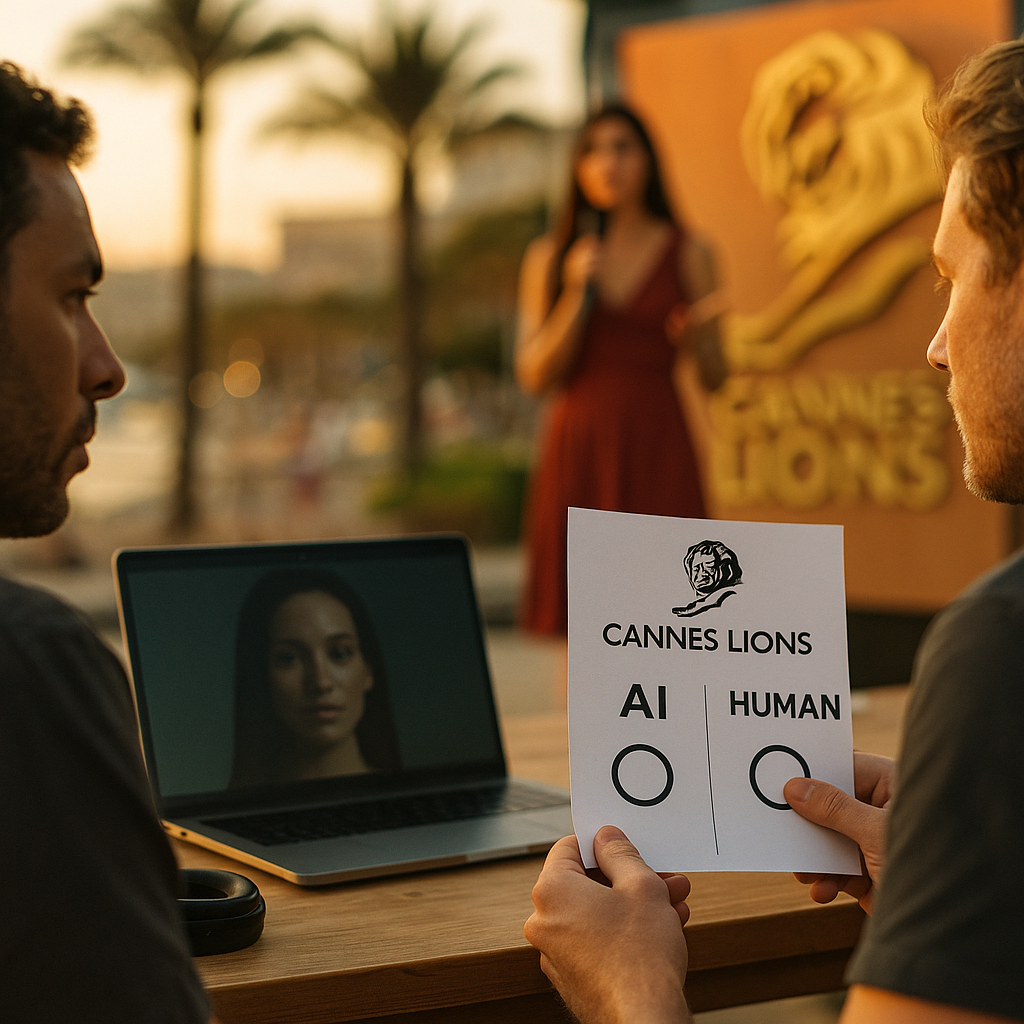
AI can score a creator’s engagement rate in seconds. It cannot tell you whether that creator’s audience will forgive your brand for an awkward partnership. That gap is where Cannes Lions’ Cannes Lions AI creative framework debates are landing hardest — and where smart brands are drawing their operational lines.
The Efficiency Trap That Cannes Keeps Exposing
Every year, the Cannes Lions stage surfaces a version of the same uncomfortable truth: the industry is automating faster than it is thinking. Platforms like AI vs. manual program tradeoffs are well-documented, and the efficiency gains are real. Reduced vetting time. Faster contract generation. Predictive performance modeling. None of that is trivial for a brand running 50 creator activations per quarter.
But efficiency is not strategy. And the campaigns that win Lions — or more importantly, win market share — are consistently the ones where a human made a call that no model would have surfaced.
The question brands should be asking is not “what can AI do?” It’s “what are we outsourcing to AI that we shouldn’t be?”
Where AI Is Genuinely Useful (and Where It Stops)
To be precise about the limits, you need to be honest about the strengths. AI-powered platforms like Grin, Sprinklr, and CreatorIQ have made real progress on:
- Audience authenticity scoring and fraud detection
- Predictive engagement modeling across content formats
- Contract clause generation and compliance flagging
- Real-time sentiment monitoring during live campaigns
- Performance attribution across multi-touch creator journeys
For real-time creator campaign monitoring, AI is close to indispensable at scale. A brand with 200 active creators cannot have a human reading every comment thread. That’s a solved problem.
The unsolved problems are harder. They involve judgment, not data.
AI optimizes for patterns in past behavior. Creator campaigns that break through are almost always doing something that has no pattern — which means the models are structurally blind to the most important creative decisions.
Five Decisions That Require a Human in the Room
1. Reading cultural moment timing. Knowing when to activate a creator around a cultural conversation and when to stay silent is not a classification problem. The difference between a brand that looks plugged-in and one that looks opportunistic is a judgment call about tone, context, and relationship history with an audience. No sentiment model captures that nuance in real time.
2. Evaluating creative risk on brand-stretching briefs. When a brand wants to enter a new category, partner with a controversial creator, or lean into humor that could misfire, AI will flag the risk — and then stop. It cannot evaluate whether the upside justifies the risk in the context of your specific brand equity position. That requires someone who understands the brand’s history, its consumer relationships, and the competitive moment.
3. Assessing creator-brand fit beyond the numbers. Audience demographics match. Engagement rate is strong. The creator’s aesthetic aligns with the brief. And yet, something is wrong. Maybe the creator’s recent podcast comments create a latent liability. Maybe their audience has a specific cultural expectation that makes this partnership feel transactional. Authenticity in creator marketing remains a human read, not an algorithmic score.
4. Managing creator relationships during conflict. When a campaign goes sideways — a creator posts off-brief, a controversy erupts mid-flight, a platform restricts distribution — the response requires human judgment about relationship preservation, public communication, and legal exposure simultaneously. AI tools can surface options. They cannot weigh them against a decade of brand equity.
5. Long-form creative direction. Briefing a creator for a 30-second integration is one thing. Building a multi-episode arc, a co-created content series, or a multi-creator cohort campaign requires narrative judgment, creative chemistry assessment, and editorial instinct that remains stubbornly human. The creative brief itself is an act of strategy, not template completion.
What Cannes Lions Is Actually Surfacing
The Lions jury conversations in recent cycles have gravitated toward a consistent theme: work that wins is almost always work that took a risk a committee — or an algorithm — would have killed. The holding company AI efficiency push is producing leaner operations and thinner creative output at the same time. That is not a coincidence.
According to eMarketer, influencer marketing spend is projected to exceed $9 billion in the US alone this year. At that scale, brands are under real pressure to systematize. The risk is that systematization becomes a substitute for thinking rather than a support for it.
The brands taking home metal at Cannes are not the ones with the best AI stack. They are the ones with the best creative judgment, backed by good tooling. The order matters.
The Compliance Caveat
There is one adjacent area worth flagging: compliance is a domain where AI is becoming genuinely necessary, but where human oversight remains legally required. FTC disclosure requirements and increasingly complex age restriction and contract compliance obligations mean that brands cannot rely on AI alone to manage regulatory risk. The tools are useful for flagging; the accountability sits with humans.
This distinction matters operationally. Brands that treat AI compliance tools as a sign-off mechanism rather than a screening layer are accumulating risk they cannot see until it becomes a problem.
Compliance AI catches what you configured it to catch. It does not know what changed in your category last Tuesday, or what your legal team agreed to in a call they didn’t document.
Building a Human-AI Decision Map for Creator Programs
The practical takeaway from the Cannes Lions framing is not philosophical — it is operational. Brands need an explicit decision map that defines which parts of their creator program are AI-driven, which are AI-assisted, and which are human-only. Most brands have not done this. They have layered tools on top of existing workflows without asking which decisions those tools are actually making.
A working framework looks roughly like this:
- AI-driven: fraud detection, performance reporting, contract drafting, first-pass creator discovery, sentiment monitoring
- AI-assisted: creator shortlisting, brief generation, audience overlap analysis, budget pacing recommendations
- Human-only: creative direction, brand-stretch decisions, relationship management, cultural timing calls, compliance final review
The creator economy power shifts happening right now are partly about this divide. Creators who understand their own strategic value — the human judgment and audience relationships they bring — are negotiating differently than those who see themselves as content producers. Brands that understand the same thing about their own teams will allocate internal resources differently too.
For additional context on how platforms are evolving their own targeting and ROI tooling, Sprout Social and Meta for Business both maintain updated documentation on AI-assisted campaign features that can help teams calibrate what automation is actually doing inside their workflows.
The brands that will win the next cycle of creative awards are already mapping this out. The ones that aren’t are building efficient machines for producing forgettable work. The Cannes Lions framing is a useful forcing function: if a model could have made this decision, why should it win an award? And if it shouldn’t win an award, why is it making the decision?
Start by auditing one active creator campaign and listing every strategic decision made in the last 30 days. For each one, ask who made it and what information they used. That audit will tell you more about your AI exposure than any vendor pitch deck.
Frequently Asked Questions
What specific creator campaign decisions should never be fully automated?
Creative direction, brand-fit assessment beyond demographic data, cultural moment timing, conflict management with creators, and final compliance review should remain human-led. These decisions require contextual judgment, relationship history, and brand equity awareness that current AI models cannot replicate reliably.
Can AI tools help with creator discovery without replacing human judgment?
Yes. AI is effective for first-pass discovery, audience authenticity scoring, and engagement benchmarking. The error is treating that shortlist as a final decision rather than a starting point. Human review of creator content, values, and recent audience behavior remains essential before any partnership commitment.
How does the Cannes Lions framework apply to mid-size brand teams without large AI budgets?
The framework is more about decision governance than tool investment. Even teams using basic platforms benefit from explicitly mapping which decisions are human-owned. The risk of over-automation is as present for a $2M influencer program as a $20M one. Clarity about who owns which call is a policy question, not a budget question.
What is the ROI case for keeping human judgment in the loop on creator campaigns?
The ROI case is risk-adjusted return, not just upside. Campaigns that go wrong due to poor creator-brand fit, cultural missteps, or compliance failures generate costs — in legal exposure, brand equity damage, and remediation spend — that dwarf the efficiency savings from automation. Human judgment is risk mitigation at scale.
How should brands handle the tension between AI efficiency pressures and creative quality?
Brands should separate efficiency goals from creative quality goals in their program design. AI can legitimately reduce operational overhead in areas like reporting, contracting, and discovery. That efficiency should be reinvested in more human creative time, not used to reduce headcount without replacing the judgment those people provided.
Top Influencer Marketing Agencies
The leading agencies shaping influencer marketing in 2026
Agencies ranked by campaign performance, client diversity, platform expertise, proven ROI, industry recognition, and client satisfaction. Assessed through verified case studies, reviews, and industry consultations.
Moburst

-
2

The Shelf
Boutique Beauty & Lifestyle Influencer AgencyA data-driven boutique agency specializing exclusively in beauty, wellness, and lifestyle influencer campaigns on Instagram and TikTok. Best for brands already focused on the beauty/personal care space that need curated, aesthetic-driven content.Clients: Pepsi, The Honest Company, Hims, Elf Cosmetics, Pure LeafVisit The Shelf → -
3

Audiencly
Niche Gaming & Esports Influencer AgencyA specialized agency focused exclusively on gaming and esports creators on YouTube, Twitch, and TikTok. Ideal if your campaign is 100% gaming-focused — from game launches to hardware and esports events.Clients: Epic Games, NordVPN, Ubisoft, Wargaming, Tencent GamesVisit Audiencly → -
4

Viral Nation
Global Influencer Marketing & Talent AgencyA dual talent management and marketing agency with proprietary brand safety tools and a global creator network spanning nano-influencers to celebrities across all major platforms.Clients: Meta, Activision Blizzard, Energizer, Aston Martin, WalmartVisit Viral Nation → -
5

The Influencer Marketing Factory
TikTok, Instagram & YouTube CampaignsA full-service agency with strong TikTok expertise, offering end-to-end campaign management from influencer discovery through performance reporting with a focus on platform-native content.Clients: Google, Snapchat, Universal Music, Bumble, YelpVisit TIMF → -
6

NeoReach
Enterprise Analytics & Influencer CampaignsAn enterprise-focused agency combining managed campaigns with a powerful self-service data platform for influencer search, audience analytics, and attribution modeling.Clients: Amazon, Airbnb, Netflix, Honda, The New York TimesVisit NeoReach → -
7

Ubiquitous
Creator-First Marketing PlatformA tech-driven platform combining self-service tools with managed campaign options, emphasizing speed and scalability for brands managing multiple influencer relationships.Clients: Lyft, Disney, Target, American Eagle, NetflixVisit Ubiquitous → -
8

Obviously
Scalable Enterprise Influencer CampaignsA tech-enabled agency built for high-volume campaigns, coordinating hundreds of creators simultaneously with end-to-end logistics, content rights management, and product seeding.Clients: Google, Ulta Beauty, Converse, AmazonVisit Obviously →