


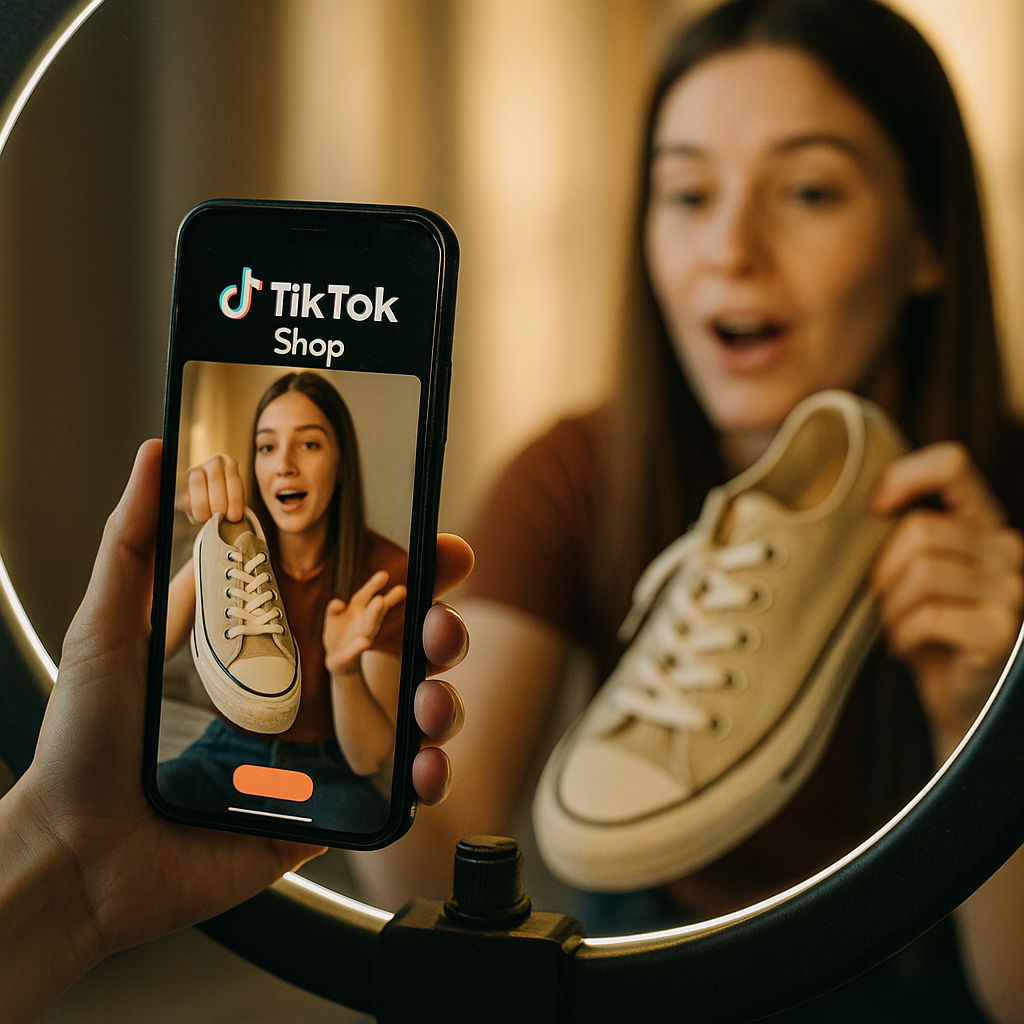
The First Three Seconds Are Already Losing You Sales
Brands running TikTok Shop campaigns without a documented hook framework are leaving conversion rates on the table. Analysis of top-performing sponsored posts on the platform consistently shows that hook architecture, not production quality, separates a 2% conversion rate from a 9% one. Here is what the platform’s highest-converting brand videos are actually doing — and why most briefs still get it wrong.
Hook Architecture: What “Stopping Power” Actually Looks Like
The instinct is to open with a brand logo or a product beauty shot. That is the wrong call, every time. The highest-converting TikTok Shop videos open with tension, not branding. Think about what your target customer is worried about right now — their back pain, their dull skin, their cluttered kitchen — and surface that problem in the first two seconds, visually or verbally.
The three hook formats that consistently outperform on TikTok Shop are:
- The Pattern Interrupt: A visual or audio element that is genuinely unexpected for the category. A skincare brand opening with a close-up of a damaged shirt tag rather than skin. A supplement brand opening mid-workout, gasping. The brain registers novelty before it registers intent to sell.
- The Stakes Statement: A direct verbal claim that creates urgency without clickbait. “I returned $400 worth of products before I found this” beats “Check out my new favorite thing.”
- The Mid-Thought Open: The video starts as if the viewer has already missed part of a conversation. “— and that’s why I never use a regular pillowcase anymore.” Curiosity is the mechanism. Scroll-stopping is the outcome.
According to TikTok for Business research, videos that retain viewers through the three-second mark see a 65% higher chance of completing a watch session. That single metric should be the first line in every commerce-focused creative brief you write.
Hook architecture is not a creative preference — it is a commercial decision. The three-second retention rate is the upstream variable that determines whether your product integration ever gets seen.
For brands building out their broader TikTok brand strategy, the hook is where organic and paid mechanics converge. Spark Ads that amplify creator posts with weak hooks simply accelerate waste.
Product Integration Timing: The 40% Rule
Here is the structural finding that most brand teams resist: the product should not appear before the 40% mark of the video.
This runs against every instinct from traditional advertising, where you lead with the product. But TikTok Shop’s highest-converting posts operate on a different logic. The first 40% of the video is building context, emotional investment, or narrative tension. The product is the resolution, not the opening act.
A 30-second video, by this framework, introduces the product around the 12-second mark. A 45-second video around 18 seconds. The exact timing is less important than the principle: earn the product reveal by making the viewer care first.
What does that first 40% contain? The most effective commerce videos use it for one of three narrative frames:
- The Before State: Showing the problem or frustration in lived, specific detail. Not “I had dry skin” but “I kept waking up with flakes on my pillow.” Specificity builds credibility.
- The Discovery Story: How the creator found the product. A failed search, a recommendation, a skeptical first purchase. This is the narrative framework that makes the product feel earned rather than placed.
- The Results Teaser: A quick flash of the outcome early (the before-and-after, the finished meal, the organized shelf), followed by a return to the story of how they got there. This is the non-linear hook that keeps viewers watching for context they already want.
Brands working on TikTok creator campaign briefs should bake this 40% principle into the brief template itself, not leave it to creator discretion. Give creators the narrative framework; let them supply the authentic voice.
The Disclosure Problem Nobody Wants to Talk About
Disclosure placement on TikTok Shop sponsored content is simultaneously a legal compliance issue and a conversion variable. Most brands treat it as the former and ignore the latter entirely.
The FTC’s endorsement guidelines require that paid partnerships be disclosed clearly and conspicuously, meaning the disclosure must be unavoidable to a typical viewer. On TikTok, this means:
- Using TikTok’s native “Paid Partnership” label (now integrated with TikTok Shop’s branded content toggle) as the baseline requirement, not a replacement for verbal or visual disclosure in high-stakes integrations
- Disclosing before or at the point of product introduction, not after the recommendation has already been delivered
- Avoiding disclosure-in-description-only placements, which the FTC has explicitly flagged as insufficient for short-form video
Now here is the conversion angle that most legal teams do not factor in. Research from Sprout Social and independent creator economy studies consistently shows that audiences are more likely to purchase from creators who disclose clearly and early. Transparency signals that the creator has enough credibility to be paid for an endorsement, which paradoxically increases trust. Burying or delaying a disclosure reads as evasive, and audiences who notice it are less likely to convert.
The optimal disclosure architecture for a TikTok Shop post: platform label activated, verbal acknowledgment within the first 10 seconds (“This is a paid partnership but I genuinely use this”), and the disclosure reinforced (not repeated) near the CTA at the end.
Call-to-Action Placement and the “Soft CTA” Problem
Many TikTok Shop brand videos end with CTAs so soft they register as afterthoughts. “Link in bio” on a platform where TikTok Shop pins the product directly to the video is a missed conversion moment. “Check it out if you’re interested” is not a call to action — it is an exit ramp.
The highest-converting posts use CTAs that:
- Reference the specific friction the product solved (“If you’ve been dealing with the same thing, the link is right there below”)
- Create a reason-to-act-now without manufactured urgency (“The price I got it at is listed — I don’t know how long that holds”)
- Mirror the language of the hook, creating narrative closure that connects the opening problem to the purchase action
This is worth cross-referencing with how Instagram shoppable creator briefs handle CTA architecture — the principles transfer, though TikTok Shop’s in-video product cards make the path to purchase significantly shorter and the CTA even more critical.
What the Brief Actually Needs to Specify
Most TikTok Shop briefs are still written like display ad specs. They define what to say about the product without defining when and how to structure the narrative around it. Based on what the highest-converting posts reveal, a commerce-first brief should include:
- A required hook category (pattern interrupt, stakes statement, or mid-thought open) with 2-3 examples
- A product integration window (the 40% rule as a directional guideline, not a rigid timer)
- Disclosure language and placement requirements that meet FTC standards while supporting narrative flow
- CTA copy options that connect back to the hook’s problem-solution frame
- Video length range: 30-45 seconds continues to outperform both shorter clips (too little narrative) and longer ones (viewer drop-off before the product reveal)
For brands building more sophisticated brief infrastructure, the TikTok AI recommendation layer is now a direct function of creative structure signals — meaning a well-constructed brief does not just improve human conversion rates, it improves algorithmic distribution at the same time.
A TikTok Shop brief that specifies hook category, integration timing, and disclosure placement is not creative overreach. It is the minimum operational standard for a commerce-first short-form campaign in a mature influencer market.
Brands scaling TikTok Shop should also be building content cadence into their strategy. Understanding how to use TikTok Live sales scheduling alongside sponsored video posts creates a full-funnel commerce architecture rather than isolated conversion moments.
If you are running more than five TikTok Shop activations per quarter and you do not have a documented hook framework in your brief template, start there. Build the framework from your top three performing posts and reverse-engineer what they had in common. That is your baseline. Everything else is optimization.
Frequently Asked Questions
What is hook architecture in TikTok Shop videos?
Hook architecture refers to the deliberate structural design of the first two to three seconds of a TikTok video. It includes the specific format (pattern interrupt, stakes statement, or mid-thought open) used to stop the scroll and retain viewers long enough for the product integration to land. It is distinct from production quality and is the single highest-leverage variable in commerce-first short-form content.
When should the product appear in a TikTok Shop sponsored video?
The highest-converting TikTok Shop videos typically introduce the product at around the 40% mark of the video’s total length. For a 30-second video, that means around 12 seconds in. This allows the creator to build narrative tension, problem context, or emotional investment before the product serves as the resolution. Introducing the product earlier tends to reduce viewer retention and overall conversion rates.
Where should the paid partnership disclosure appear in a TikTok Shop video?
Disclosure should appear at three points: the platform’s native Branded Content toggle should be activated (which generates the “Paid Partnership” label), a verbal acknowledgment should come within the first 10 seconds of the video, and the disclosure should be reinforced near the call to action at the end. Disclosure only in the caption or only via the platform label is not sufficient under current FTC guidelines for short-form video content.
How long should TikTok Shop sponsored videos be?
The 30-to-45-second range consistently outperforms both shorter and longer formats for TikTok Shop campaigns. Videos shorter than 30 seconds often lack enough narrative space to build context before the product integration. Videos longer than 60 seconds tend to see significant drop-off before the product reveal and CTA. Within the 30-to-45-second window, the 40% integration rule and a closing CTA can be executed cleanly.
How does disclosure placement affect TikTok Shop conversion rates?
Early and transparent disclosure correlates with higher conversion rates, not lower ones. Audiences who see clear disclosure before or at the point of product introduction are more likely to trust the creator’s recommendation. Delayed or buried disclosure tends to create skepticism when viewers do eventually notice it, reducing both trust and purchase intent. Transparency functions as a credibility signal in commerce-focused short-form content.
Top Influencer Marketing Agencies
The leading agencies shaping influencer marketing in 2026
Agencies ranked by campaign performance, client diversity, platform expertise, proven ROI, industry recognition, and client satisfaction. Assessed through verified case studies, reviews, and industry consultations.
Moburst

-
2

The Shelf
Boutique Beauty & Lifestyle Influencer AgencyA data-driven boutique agency specializing exclusively in beauty, wellness, and lifestyle influencer campaigns on Instagram and TikTok. Best for brands already focused on the beauty/personal care space that need curated, aesthetic-driven content.Clients: Pepsi, The Honest Company, Hims, Elf Cosmetics, Pure LeafVisit The Shelf → -
3

Audiencly
Niche Gaming & Esports Influencer AgencyA specialized agency focused exclusively on gaming and esports creators on YouTube, Twitch, and TikTok. Ideal if your campaign is 100% gaming-focused — from game launches to hardware and esports events.Clients: Epic Games, NordVPN, Ubisoft, Wargaming, Tencent GamesVisit Audiencly → -
4

Viral Nation
Global Influencer Marketing & Talent AgencyA dual talent management and marketing agency with proprietary brand safety tools and a global creator network spanning nano-influencers to celebrities across all major platforms.Clients: Meta, Activision Blizzard, Energizer, Aston Martin, WalmartVisit Viral Nation → -
5

The Influencer Marketing Factory
TikTok, Instagram & YouTube CampaignsA full-service agency with strong TikTok expertise, offering end-to-end campaign management from influencer discovery through performance reporting with a focus on platform-native content.Clients: Google, Snapchat, Universal Music, Bumble, YelpVisit TIMF → -
6

NeoReach
Enterprise Analytics & Influencer CampaignsAn enterprise-focused agency combining managed campaigns with a powerful self-service data platform for influencer search, audience analytics, and attribution modeling.Clients: Amazon, Airbnb, Netflix, Honda, The New York TimesVisit NeoReach → -
7

Ubiquitous
Creator-First Marketing PlatformA tech-driven platform combining self-service tools with managed campaign options, emphasizing speed and scalability for brands managing multiple influencer relationships.Clients: Lyft, Disney, Target, American Eagle, NetflixVisit Ubiquitous → -
8

Obviously
Scalable Enterprise Influencer CampaignsA tech-enabled agency built for high-volume campaigns, coordinating hundreds of creators simultaneously with end-to-end logistics, content rights management, and product seeding.Clients: Google, Ulta Beauty, Converse, AmazonVisit Obviously →