


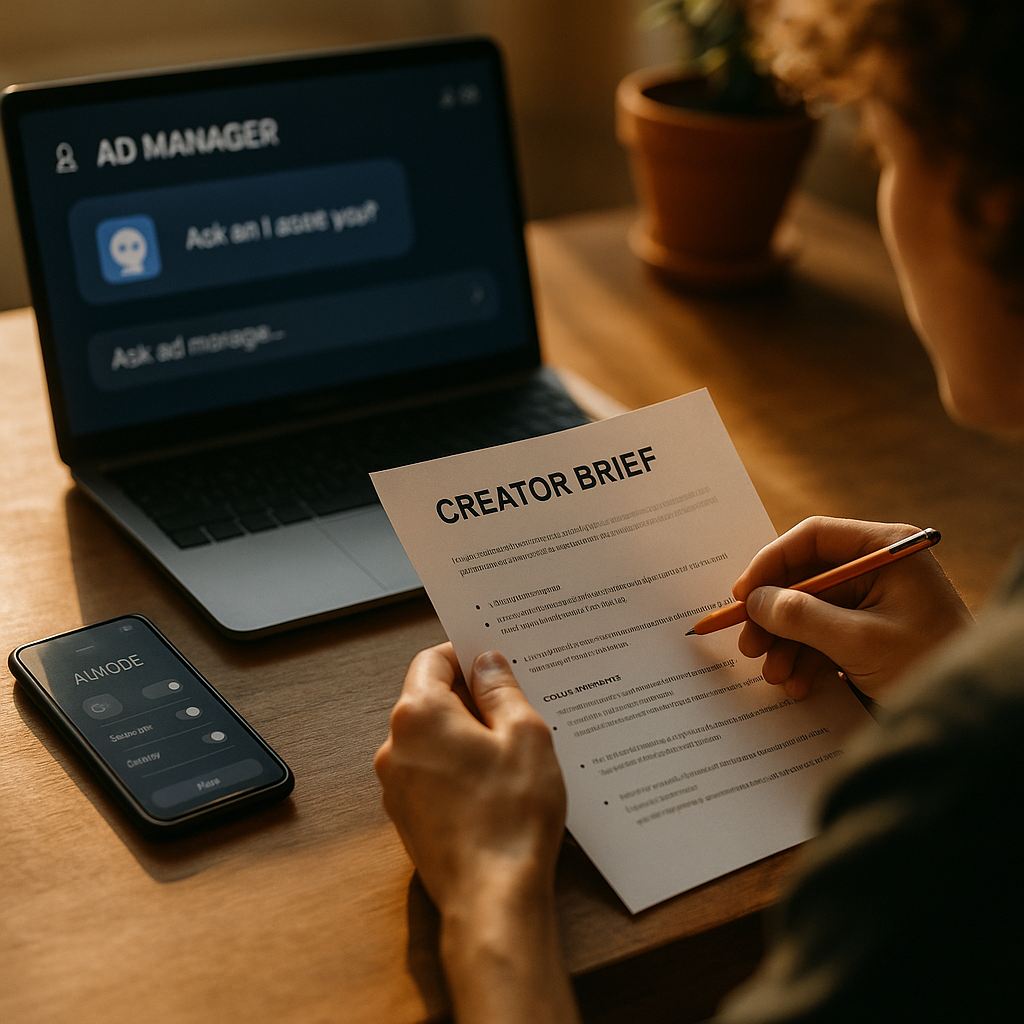
Google’s AI Mode now answers 1 in 4 informational queries without a single click to a website — and creator content is increasingly what it pulls from to construct those answers. If your influencer program is still optimized for search rankings instead of answer-engine visibility, you’re briefing creators for a search landscape that’s already half-gone.
The shift isn’t theoretical. Google’s AI Mode has rolled out broadly across Search, and Ask Ad Manager (Google’s experimental conversational interface for advertisers and publishers) is quietly changing how paid and organic content gets surfaced inside AI-generated summaries. For brands running creator programs, this is a discovery problem, not just a content problem. The old playbook — optimize a blog post, boost a video, hope for a featured snippet — doesn’t map cleanly onto an interface that synthesizes answers from dozens of sources and shows users almost nothing about where the words came from.
What Actually Changed With AI Mode
AI Mode isn’t a bigger snippet box. It’s a fundamentally different retrieval system. Instead of ranking ten blue links, Google’s models decompose a query into sub-questions, pull relevant passages from multiple sources (including video transcripts, forum threads, and creator content), and synthesize a conversational answer. Traditional SEO signals still matter, but they’re necessary, not sufficient.
Here’s the part that should concern brand marketers: creator-generated content is disproportionately well-suited to this format. Product reviews, comparison videos, “here’s what I actually use” posts — these already answer the sub-questions AI Mode is decomposing queries into. A single well-structured TikTok caption or YouTube description can outperform a polished landing page if it directly answers “does this work for oily skin” or “is this compatible with X.”
Google’s own documentation on AI features confirms that structured, direct-answer content performs better in generative results than promotional copy — which means creator authenticity isn’t just a brand-safety nicety anymore, it’s a ranking input.
Ask Ad Manager: The Quiet Second Front
While AI Mode reshapes organic discovery, Ask Ad Manager is doing something adjacent on the paid side. It’s Google’s conversational tool letting advertisers query campaign performance, get optimization suggestions, and — increasingly — understand how their assets are being surfaced across AI-driven placements. Think of it as a control panel for a media environment that no longer behaves like a stack of ranked results.
The practical implication for creator marketing: brands who feed structured, well-tagged creator assets into Google’s ad ecosystem get better visibility signals back through Ask Ad Manager’s reporting. Vague briefs producing vague content give you nothing to optimize. Specific, question-driven creator content gives both the algorithm and your reporting tools something to work with.
Is this a huge shift for most brands right now? Not yet in raw traffic terms. But the trajectory is unambiguous, and eMarketer’s ongoing research on AI search adoption suggests generative interfaces will handle a meaningfully larger share of product-research queries within the next two years. Waiting for the data to be conclusive means starting from behind.
Why Your Current Creator Briefs Won’t Cut It
Most influencer briefs are built around a hook, a CTA, and platform-specific format specs. None of that helps with answer-engine visibility. AI Mode rewards content structured around explicit questions and direct answers — the stuff that used to feel almost too literal for creator content because it read as “salesy” or “listicle-y.”
That’s changing. Creators who structure a video description as “does X work for Y” and then answer it in the first two sentences are getting pulled into AI summaries more often than creators who lead with a vibe-based hook. This isn’t about killing creativity. It’s about front-loading substance so both humans and retrieval models can find the answer fast.
- Brief creators to state the product claim and the caveat within the first 15 seconds of video or the first line of a caption.
- Ask for comparison language (“better than X for Y use case”) rather than generic superlatives.
- Require transcripts or captions on all video content — AI Mode leans heavily on text layers, not just visual recognition.
- Push creators to answer the question a customer would actually type into Search, not the question a brand wants asked.
This is the same discipline shift we’ve written about in the context of completion rate optimization — platforms increasingly reward content that respects the viewer’s actual intent over content optimized purely for algorithmic favor. AI Mode is just the search-side version of that same principle.
Structured Data Is No Longer Optional
If your creator program still treats schema markup as a developer afterthought, that needs to change now. FAQ schema, HowTo schema, and Product schema all feed directly into how AI Mode assembles answers. Creator content hosted on brand-owned pages (think: a landing page that embeds a creator’s video alongside a written breakdown) should carry structured data that mirrors the actual Q&A structure of the content.
This matters more for owned media than for the raw social post itself, since Instagram and TikTok posts aren’t crawlable in the traditional sense. But smart brands are now building “answer hubs” — pages that aggregate creator content around a specific buying question and wrap it in proper schema. It’s a low-cost, high-leverage move that most competitors still aren’t making.
For teams unsure where to start, Google’s own Search Central documentation lays out current structured data guidelines, and it’s worth a quarterly review since AI Mode’s requirements are still evolving.
Platform Spillover: This Isn’t Just a Google Story
The answer-engine shift doesn’t stay contained to Google. TikTok’s own search function increasingly behaves like a mini answer engine, and LinkedIn has leaned hard into AI-assisted discovery for B2B content, something we broke down in LinkedIn’s AI search playbook. The pattern across platforms is consistent: direct-answer, well-structured creator content outperforms polished-but-vague brand content.
Brands running multi-platform creator programs should treat this as one strategic shift, not five separate platform problems. A creator brief written for answer-engine visibility on Google should port reasonably well to TikTok Search and YouTube’s own AI-assisted features with minor format tweaks. Building five completely different content structures per platform is wasted effort in a world where the underlying retrieval logic — decompose the question, find the direct answer, cite the source — is converging.
The brands winning early aren’t the ones with the biggest creator budgets. They’re the ones who rewrote their briefs to answer questions first and sell second.
Measurement Gets Harder Before It Gets Easier
Here’s the uncomfortable part: attribution for AI Mode visibility is genuinely difficult right now. There’s no clean “impressions in AI summary” dashboard for most brands. You’re often inferring visibility from indirect signals — branded search lift, referral traffic anomalies, or direct feedback from Ask Ad Manager’s reporting where available.
That ambiguity shouldn’t be an excuse for inaction. Marketing teams dealt with the same measurement lag when TikTok’s algorithm shifted toward discovery over reach, and the brands that adapted early captured outsized visibility before measurement tools caught up. Track branded search volume, monitor which creator assets get cited or referenced in AI-generated answers when you can find them manually, and treat this quarter as a testing period rather than a fully measured campaign cycle.
Agencies and in-house teams should also loop in compliance early. The FTC’s guidance on endorsements still applies regardless of whether a human or an AI summary is the one surfacing the claim, and FTC endorsement guidelines remain the baseline brands need to satisfy even when content gets remixed into a synthesized answer nobody directly clicked through to read.
A Practical Rollout Sequence
Don’t try to overhaul every creator brief simultaneously. Sequence it:
- Audit your top 10 highest-traffic product or category pages and identify the actual questions customers ask about them.
- Rebrief 3-5 upcoming creator collaborations to lead with direct answers to those questions, not brand messaging.
- Add FAQ or HowTo schema to any owned-media pages hosting or referencing that creator content.
- Monitor branded search and direct traffic for 60-90 days before drawing conclusions.
- Scale the format to your broader creator roster once you see directional lift.
This mirrors the phased approach that worked well when brands adapted to Instagram’s shift toward saves and DMs — small controlled tests before a full rebrief, rather than a company-wide mandate nobody can measure.
The Takeaway
Answer-engine visibility isn’t a future problem — it’s already redistributing where product-research attention lands, and creator content structured around direct answers is winning disproportionately. Rebrief your next five creator collaborations to open with the exact question a customer would type into search, then measure branded search lift over the following quarter before rolling the format out further.
FAQs
What is Google AI Mode and how is it different from traditional search results?
AI Mode is Google’s generative search experience that synthesizes answers from multiple sources into a conversational response, rather than displaying a ranked list of links. It pulls from a wider range of content types, including creator videos and social posts, and prioritizes content that directly answers a query’s underlying sub-questions.
What is Ask Ad Manager and how does it relate to creator marketing?
Ask Ad Manager is Google’s conversational interface for advertisers to query campaign performance and get optimization guidance. For creator marketing, it increasingly reflects how well-structured creator assets are being surfaced across AI-driven ad placements, giving brands a feedback loop that vague, unstructured content doesn’t provide.
How can brands optimize creator briefs for AI Mode visibility?
Brief creators to state a clear claim and answer it within the first few seconds or lines of content, use comparison language rather than generic superlatives, include captions or transcripts on video, and phrase content around the exact question a customer would type into search.
Does structured data still matter if creator content lives on social platforms?
Yes, particularly for owned media. While raw social posts aren’t crawlable the way web pages are, brand-owned “answer hub” pages that embed creator content and wrap it in FAQ or HowTo schema significantly improve the odds of that content feeding into AI-generated answers.
How should brands measure success in an AI Mode search environment?
Direct impression data for AI summaries is still limited, so brands should track branded search volume, monitor referral traffic anomalies, and manually check whether creator assets appear as cited sources in AI-generated answers, treating early efforts as a testing phase rather than a fully measurable campaign.
FAQs
Top Influencer Marketing Agencies
The leading agencies shaping influencer marketing in 2026
Agencies ranked by campaign performance, client diversity, platform expertise, proven ROI, industry recognition, and client satisfaction. Assessed through verified case studies, reviews, and industry consultations.
Moburst

-
2

The Shelf
Boutique Beauty & Lifestyle Influencer AgencyA data-driven boutique agency specializing exclusively in beauty, wellness, and lifestyle influencer campaigns on Instagram and TikTok. Best for brands already focused on the beauty/personal care space that need curated, aesthetic-driven content.Clients: Pepsi, The Honest Company, Hims, Elf Cosmetics, Pure LeafVisit The Shelf → -
3

Audiencly
Niche Gaming & Esports Influencer AgencyA specialized agency focused exclusively on gaming and esports creators on YouTube, Twitch, and TikTok. Ideal if your campaign is 100% gaming-focused — from game launches to hardware and esports events.Clients: Epic Games, NordVPN, Ubisoft, Wargaming, Tencent GamesVisit Audiencly → -
4

Viral Nation
Global Influencer Marketing & Talent AgencyA dual talent management and marketing agency with proprietary brand safety tools and a global creator network spanning nano-influencers to celebrities across all major platforms.Clients: Meta, Activision Blizzard, Energizer, Aston Martin, WalmartVisit Viral Nation → -
5

The Influencer Marketing Factory
TikTok, Instagram & YouTube CampaignsA full-service agency with strong TikTok expertise, offering end-to-end campaign management from influencer discovery through performance reporting with a focus on platform-native content.Clients: Google, Snapchat, Universal Music, Bumble, YelpVisit TIMF → -
6

NeoReach
Enterprise Analytics & Influencer CampaignsAn enterprise-focused agency combining managed campaigns with a powerful self-service data platform for influencer search, audience analytics, and attribution modeling.Clients: Amazon, Airbnb, Netflix, Honda, The New York TimesVisit NeoReach → -
7

Ubiquitous
Creator-First Marketing PlatformA tech-driven platform combining self-service tools with managed campaign options, emphasizing speed and scalability for brands managing multiple influencer relationships.Clients: Lyft, Disney, Target, American Eagle, NetflixVisit Ubiquitous → -
8

Obviously
Scalable Enterprise Influencer CampaignsA tech-enabled agency built for high-volume campaigns, coordinating hundreds of creators simultaneously with end-to-end logistics, content rights management, and product seeding.Clients: Google, Ulta Beauty, Converse, AmazonVisit Obviously →