


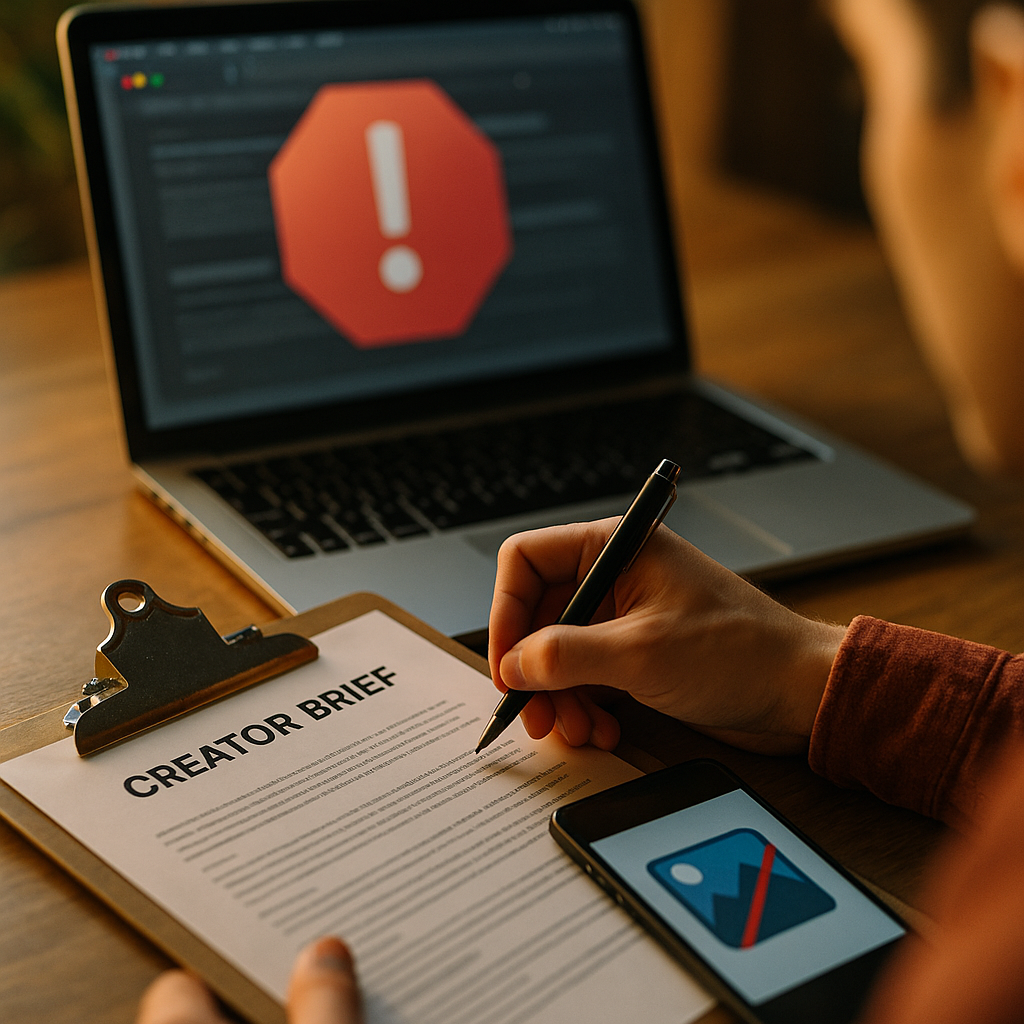
Platforms are actively suppressing AI-generated content. Algorithmic authenticity signals now determine whether a creator post gets distributed or buried, and brands that built their UGC pipelines around AI-assisted production are discovering the hard way that reach is collapsing. The question facing every brand team right now: how do you write a creator brief that produces genuinely human content without sacrificing brand control?
Why AI Detection Is Now a Distribution Problem
TikTok, Meta, and YouTube all have AI content classifiers running at the infrastructure level. These systems don’t just flag synthetic video; they assess behavioral signals: edit rhythm, caption cadence, vocal authenticity, comment-response patterns, and even the metadata fingerprints left by AI generation tools. A creator who runs their footage through an AI editing agent before posting can trigger suppression before a single human sees the content.
According to eMarketer, sponsored creator content now accounts for a significant portion of social commerce-driven purchases, which means a distribution penalty isn’t just an awareness problem. It’s a revenue problem. Brands that once celebrated the efficiency of AI-assisted UGC pipelines are now watching conversion rates from sponsored posts fall as organic reach is throttled.
Platform AI classifiers don’t just penalize synthetic video. They penalize synthetic behavior: the too-perfect edit, the suspiciously structured caption, the comment section that nobody responded to organically. Brands need to brief for human messiness, not polish.
This creates a genuine tension for brand teams. You need content that looks and feels native. You also need it to hit brand safety guidelines, include proper FTC disclosures, and integrate commerce CTAs. Writing a brief that threads all of those requirements without pushing creators toward the kind of over-produced, templated output that triggers AI suppression is harder than it sounds.
What “Platform-Native” Actually Means in a Brief
Platform-native is not an aesthetic choice. It’s a technical requirement.
Each platform’s algorithm rewards content that was created for that platform, not repurposed from another. A creator who films a TikTok natively, using in-app audio, native text overlays, and real-time reactions will outperform a creator who films a polished video and uploads it. Your brief needs to specify production method, not just output format. This is where most brand briefs fail. They describe what the final content should look like without specifying how it should be made.
Practical brief language for platform-native production looks like this: “Film this on your phone, not a mirrorless camera. Use TikTok’s in-app audio selector. Do not export from a desktop editor. Your first cut should be the cut you post.” That’s not a creative restriction. It’s an algorithmic instruction. For a deeper technical breakdown of format-specific production requirements, vertical short-form video guidance covers the spec-level detail that most campaign briefs skip.
Structuring the Brief for Authentic Signal Generation
The brief is where brand control and authentic human output either coexist or collide. Most briefs swing too far in one direction. Either they’re so prescriptive that the creator produces a corporate-scripted video that gets suppressed, or they’re so loose that the creator goes off-brand entirely.
The framework that actually works has four layers:
- Narrative permission: Tell creators what story they’re allowed to tell, not what words to say. Give them a topic latitude — “your honest experience using this for three days” — rather than a script. This is where narrative architect briefs have a structural advantage over traditional brand scripts.
- Non-negotiable elements: List the hard requirements separately, clearly: the disclosure language, the product name mention, the link-in-bio instruction. Isolating these prevents creators from accidentally embedding them in ways that feel scripted.
- Production guardrails: Specify what not to use. No AI voiceover. No AI caption generation. No synthetically generated B-roll. These guardrails protect against accidental AI fingerprinting more than any positive instruction can.
- Commerce integration logic: If you’re running shoppable content, the brief needs to explain exactly where the product tag goes, when the CTA gets verbalized, and how the link-in-bio or in-video commerce overlay should be structured. Leaving this vague produces content that either skips the conversion mechanic or buries it so awkwardly it kills watch time.
For campaigns running commerce-enabled formats on Meta, the shoppable Reels briefing framework provides a format-specific template that handles the commerce overlay without disrupting the native content feel.
Disclosure Without Destroying Authenticity
The FTC’s disclosure requirements haven’t gotten more lenient. If anything, the compliance environment has tightened as platforms build their own disclosure enforcement layers on top of regulatory requirements. But the way most brands write disclosure requirements into briefs is actively counterproductive.
Telling a creator to say “This is a paid partnership with [Brand]” verbatim at the start of a video guarantees two things: the viewer bounces within three seconds, and the algorithmic watch-time signal tanks. The brief needs to give creators compliant disclosure language that fits their voice. “Partnered with [Brand] on this one” or “gifted by [Brand]” said naturally in context, combined with the platform’s paid partnership tag, satisfies FTC requirements without triggering the audience trust collapse that scripted disclosures produce.
Work with legal to pre-approve two or three disclosure phrasings that creators can choose between. Don’t make the disclosure a fill-in-the-blank at the end of a content checklist. Make it a creative decision with guardrails.
Brand Safety in an Unscripted Environment
This is the legitimate fear behind over-prescriptive briefs. If you let creators speak authentically, what stops them from saying something that ends up in a brand safety incident report?
The answer isn’t more script. It’s better creator selection and clearer exclusion language in the brief. Your brief should include an explicit list of off-limit topics, not a vague instruction to “keep content brand-appropriate.” Specificity here protects both parties. “Do not reference competitor products, political affiliations, or personal health claims about this product” is enforceable. “Please be professional” is not.
Pre-approval workflows also matter. Build a content review checkpoint into the campaign timeline before content goes live. Not a 72-hour review cycle that kills posting momentum, but a 24-hour async review via a shared link. Tools like Aspire, Grin, and Creator.co all support pre-approval workflows at the campaign management level. The key is building this into the brief as an expected step, not a surprise request that creates creator friction after content is already filmed.
Brand safety in creator content isn’t a brief problem. It’s a selection and process problem. The brief can only enforce what your vetting and review workflow supports.
The AI Suppression Test Before You Publish
Before any creator content goes live on a paid amplification budget, run a basic authenticity audit. This doesn’t require enterprise tooling. It requires a checklist:
- Was this filmed natively on a mobile device without post-processing through an AI editor?
- Are captions/text overlays applied in-app rather than generated externally?
- Is the audio original (creator’s voice, in-app audio) or AI-generated?
- Does the creator’s engagement on the post reflect normal organic behavior (genuine responses to comments within the first hour)?
- Does the metadata show native platform creation, or an external upload from a desktop suite?
If any of these fail, the content needs to be re-shot, not edited. This is an operational reality that brief design needs to account for: build reshoots into campaign timelines and creator compensation structures. A creator who has to reshoot because AI fingerprinting was detected needs to be compensated for that time. If you don’t plan for it, you’ll either publish suppressed content or blow your timeline.
For teams running high-volume UGC across multiple creators simultaneously, the modular UGC pipeline approach provides a scalable way to manage authenticity checks without creating operational bottlenecks.
Brief Design for Commerce-Integrated Creator Content
Shoppable content adds a layer of brief complexity that authenticity-focused teams often underestimate. The product tag, the verbal CTA, and the link-in-bio instruction all have to land without turning the creator into an infomercial host. The brief solution here is sequencing. Tell creators where in the content arc the commerce element belongs, not just that it should be included.
Research from Sprout Social consistently shows that CTAs embedded at the peak of emotional engagement outperform CTAs dropped at the end of content. The brief should specify that the product mention follows the hook or the problem-statement moment, not that it appears “somewhere in the video.” That level of sequencing instruction gives creators creative latitude on everything else while protecting the conversion mechanic. For campaigns where attribution is part of the success equation, performance-oriented brief structures provide the CPA and attribution goal framing that makes commerce integration trackable.
The brief also needs to specify which commerce format is active on each platform, since TikTok Shop, Meta’s in-app checkout, and YouTube Shopping all have different technical requirements. A creator who tags a product correctly on TikTok may not know that the same product requires a different integration path on Instagram. That’s your team’s responsibility to specify, not theirs to figure out.
Start with your next brief: add a production method section, a platform-specific authenticity checklist, and pre-approved disclosure phrasings. That single structural change will do more for your reach and compliance posture than any tool or platform optimization you’re currently running.
FAQs
How do AI suppression filters on social platforms actually work?
Platform AI classifiers assess multiple signals beyond just video content. They analyze edit patterns, metadata from creation tools, caption structure, audio authenticity, and post-publication engagement behavior. Content that was processed through AI editing tools, generated with AI voiceover, or uploaded from desktop suites rather than created natively can trigger reduced distribution even if the content itself looks human-made.
What’s the minimum disclosure language that satisfies FTC requirements for influencer posts?
The FTC requires that the material connection between a creator and a brand be “clearly and conspicuously” disclosed. This means the disclosure must appear where viewers will actually see it — at the beginning of a caption, verbally at the start of a video, or via a platform’s built-in paid partnership tag. Using only a buried hashtag like #ad at the end of a long caption does not meet the standard. Brands should consult the FTC’s official guidance at ftc.gov for current requirements.
Can brands use AI tools anywhere in the creator content workflow without triggering suppression?
Yes, with careful scoping. AI tools are relatively safe at the planning and briefing stage (generating brief templates, researching hooks, identifying trends) and at the post-publication analytics stage. The risk zone is production: AI video editing, AI voiceover, AI caption generation, and AI thumbnail creation all leave detectable fingerprints that can trigger platform suppression filters. The actual content creation step should remain fully human-authored and natively produced.
How should brands handle brand safety in creator content without over-scripting?
The most effective approach is specific exclusion language combined with a pre-approval workflow. Rather than vague instructions to “stay professional,” briefs should list explicit off-limit topics, terminology, and association categories. A 24-hour async pre-approval review process, built into the campaign timeline and creator agreement, catches issues before publication without requiring creators to produce scripted content. Creator selection quality also reduces brand safety risk more than any brief language can.
What’s the best way to integrate commerce CTAs into creator content without harming watch time?
Position the commerce element at the peak emotional engagement point in the content, not at the end. Brief creators on sequencing: the product mention or tag should follow the hook or problem-statement moment, when viewer attention is highest. Specify which platform’s commerce format is active (TikTok Shop, Meta checkout, YouTube Shopping) because each has different technical tagging requirements. Creators should not be left to figure out the commerce integration mechanics themselves.
Top Influencer Marketing Agencies
The leading agencies shaping influencer marketing in 2026
Agencies ranked by campaign performance, client diversity, platform expertise, proven ROI, industry recognition, and client satisfaction. Assessed through verified case studies, reviews, and industry consultations.
Moburst

-
2

The Shelf
Boutique Beauty & Lifestyle Influencer AgencyA data-driven boutique agency specializing exclusively in beauty, wellness, and lifestyle influencer campaigns on Instagram and TikTok. Best for brands already focused on the beauty/personal care space that need curated, aesthetic-driven content.Clients: Pepsi, The Honest Company, Hims, Elf Cosmetics, Pure LeafVisit The Shelf → -
3

Audiencly
Niche Gaming & Esports Influencer AgencyA specialized agency focused exclusively on gaming and esports creators on YouTube, Twitch, and TikTok. Ideal if your campaign is 100% gaming-focused — from game launches to hardware and esports events.Clients: Epic Games, NordVPN, Ubisoft, Wargaming, Tencent GamesVisit Audiencly → -
4

Viral Nation
Global Influencer Marketing & Talent AgencyA dual talent management and marketing agency with proprietary brand safety tools and a global creator network spanning nano-influencers to celebrities across all major platforms.Clients: Meta, Activision Blizzard, Energizer, Aston Martin, WalmartVisit Viral Nation → -
5

The Influencer Marketing Factory
TikTok, Instagram & YouTube CampaignsA full-service agency with strong TikTok expertise, offering end-to-end campaign management from influencer discovery through performance reporting with a focus on platform-native content.Clients: Google, Snapchat, Universal Music, Bumble, YelpVisit TIMF → -
6

NeoReach
Enterprise Analytics & Influencer CampaignsAn enterprise-focused agency combining managed campaigns with a powerful self-service data platform for influencer search, audience analytics, and attribution modeling.Clients: Amazon, Airbnb, Netflix, Honda, The New York TimesVisit NeoReach → -
7

Ubiquitous
Creator-First Marketing PlatformA tech-driven platform combining self-service tools with managed campaign options, emphasizing speed and scalability for brands managing multiple influencer relationships.Clients: Lyft, Disney, Target, American Eagle, NetflixVisit Ubiquitous → -
8

Obviously
Scalable Enterprise Influencer CampaignsA tech-enabled agency built for high-volume campaigns, coordinating hundreds of creators simultaneously with end-to-end logistics, content rights management, and product seeding.Clients: Google, Ulta Beauty, Converse, AmazonVisit Obviously →